Advertisements
Advertisements
प्रश्न
Compose a poem on a farmer in 4 to 6 lines in continuation of the following.
- He sweats ________________
- He does not fret ________________
- He sows ________________
- To the soil he bows ________________
Advertisements
उत्तर
- He sweats every day from dawn to dusk,
- He does not fret any hurdle or crux,
- He sows the seeds for abundant yield,
- To the soil, he bows for God in the field.
Strives he relentlessly comes what may,
He knows what he sows he shall reap one day.
APPEARS IN
संबंधित प्रश्न
Fill in each blank with the suitable word.
He broke _____________ in the middle of his speech at the function.
Explain and analyse the use of hyperbole in the poem.
But a BIRD that stalks down his narrow cage
Can seldom see through his bars of rage
His wings are clipped and his feet are tied
So he opens his throat to sing.
Read the above lines and answer the question that follow.
What docs the word “clipped” mean in this poem?
But a caged BIRD stands on the grave of dreams
His shadow shouts on a nightmare scream
His wings are clipped and his feet are tied
So he opens his throat to sing.
Read the above lines and answer the question that follow.
What does the line “and his shadow shouts on a nightmare scream” mean?
The air broke into a mist with bells,
The old walls rocked with the crowd and cries.
Had I said, "Good folk, mere noise repels....
But give me your sun from yonder skies!"
They had answered "And afterward, what else?"
Read the above lines and answer the question that follow.
Explain with reference to the context.
Explain ‘may his tribe increase.’
What does the reader learn about the characters of the narrator and the old man, in Ernest Hemingway “Old Man and the Bridge?
Dreams
(A) If Rita had finished her work earlier, she would have gone to the market.
(B) Had…………………………
Write a composition (350 - 400 words) on the following:
Narrate an incident from your own experience when you expected to do very well, but for some reason were unable to do so. Explain what happened and why it happened. What lesson did you learn from it?
Fill in the blank with an appropriate word:
His teacher is very pleased ……… him.
Fill in the blank with an appropriate word:
Ali took ……… his cap and wiped his face.
How did the narrator and Lord Otori overpower the intruder?
Read the extract given below and answer the questions that follow:
NEXT MORNING, I HAD AN IDEA. IT WAS nothing clear cut, merely speculative, But I considered it all the way to school. Then, after assembly, as soon as they were quiet I waded in. This might be a bit rough, I thought, but here goes.
“I am your teacher, and I think it right and proper that I should let you know something of my plans-for this class.”
(i) Who is ‘I’ in the above lines? Where is he? In what mood was he when he entered the class?
(ii) What did the narrator expect from his students at this moment?
(iii) Who entered soon after this? What did she do that made the narrator angry? What challenges did he give her?
(iv) What was the effect of the challenge on her? What plan did the narrator have in mind regarding the conduct of the young ladies? Whose help did he seek for this?
(v) What did the narrator expect from the boy? What was the reaction of the children when they heard the narrator’s expectations?
Give reasons for the following.
The boy king changed his name from Tutankhaten to Tutankhamun.
(i) What do you understand by the terms `outsider art’ and `art brut’ or `raw art’?
(ii) Who was the “untutored genius who created a paradise” and what is the nature of his contribution to art?
What according to the poem is involved in the process of growing up?
Examine the structure of the short story ‘Adventure of the Three Garridebs’ with the help of this framework
- The narrator of the story
- Introduction of the topic of the story
- Introduction of the main characters in the plot
- Development of the plot
- Climax
- Resolution of the mystery.
A short report announcing the death of a person in a newspaper is called an 'obituary'. Where would you find the following
|
a citation |
an epitaph |
a glossary |
|
an abstract |
a postscript |
The use of personal pronoun ‘I’ is evident and prominent in this poem. Give reasons.
Look at these sentences.
|
|
| ‘Would’ tells us what the author used to do, or what used to happen. | ‘Could’ tells us what the author was usually able to do, or grandfather is now not able to do. |
Choose would and could to replace the italicised words in the following sentences.
Choose would and could to replace the italicised words in the following sentences.
Grandfather says, in the old days,
1. elephants were able to fly in the sky, like clouds. They were also able to change their shapes. They used to fly behind clouds and frighten them. People used to look up at the sky in wonder.
2. because there was no electricity, he used to get up with the sun, and he used to go to bed with the sun, like the birds.
3. like the owl, he was able to see quite well in the dark. He was able to tell who was coming by listening to their footsteps.
Read the words/phrases in the box. With your partner find their meaning in the dictionary.
|
Harsh conditions harmless survive intruder threatened predators prey continually |
Fill in the blanks in the following passage with the above words/phrases.
All animals in forests and deserts struggle to ______________________in ______________
___________________ . Though most of the animals are ___________________, some are
dangerous when _____________________. If an ___________________ is noticed, they attack
or bite to save themselves. They struggle __________________ for food and water.
Some animals are called ______________because they __________________ on other animals.
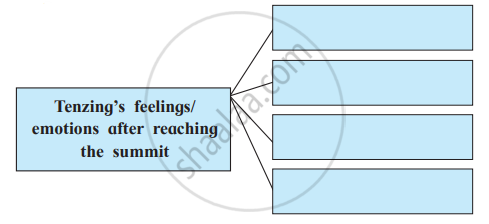
Complete the web highlighting the feelings/emotions of Tenzing after reaching the summit.
Discuss the following with your partner and complete the following sentence.
In a farmers’ market, we find _______________.
Discuss with your partner and choose the correct alternative.
A democratic country is governed by, its - __________________.
Refer to a standard dictionary and find out the meaning of the following word:
Reporter
Different arms and ammunitions are mentioned in the excerpt. Find their names.
Write a summary of the poem using the following points.
- Title
- Introductory paragraph (about the poem, type, Nature, tone)
- Main body (central idea, the gist of the poem)
- Conclusion (opinion, views, appeal)
Given below are the prerequisites for an interview. Fill up the boxes with suitable actions to be undertaken with reference to the given points.

Place the given areas of questioning from the list in the appropriate columns.
- future plans
- inspiration
- overcoming hurdles/ struggle
- coach/ mentor/ guide/ teacher
- message for the youngsters
- family support
- alternate career choice
- first or maiden award/ achievement /success /setbacks
- a turning point in life/ success formula/technique.
| Section of the interview | Aspects to be covered | |
| 1. | Introduction | Welcoming/Greeting, Introduction of the guest/Occasion. |
| 2. | Opening questions | |
| 3. | Main body | |
| 4. | Concluding questions | |
| 5. | Summing up | Concluding the statement, Expressing gratitude. |
You can add your points.
Imagine Taffy comes to you for help to write a letter of apology, in the modern script we use. She wants to express her regret to the stranger-man for her mother’s action. Write that letter of apology (informal) on her behalf.
‘Invictus’ is an example of Traditional Poetry. ‘Please Listen’ is an example of Free Verse.
Write your opinion, in your own words:-
Why did they appreciate and praise the stranger’s story?
What is the meaning of ‘intellectual rubbish’?
Write a paragraph and give an appropriate title to it. Use the following points.
| Birds and Animals | Love and Affection |
| Loyal | Our Best Friends |
| Serve us | Protection and Security |
| Kindness, honesty, compassion | Do not hurt or destroy us |
| Loneliness Avoided | |
Prepare and present a speech on ‘My Favourite Place’.
Use the following points.
- Name of the place
- Its special features
- The reason why you like it
Write a short book review of any one of your favourite books. Your review should include the following things.
- Title of the book
- Name of the author/authors
- Name of the illustrator (artist)
- The central idea of the book (what the book is about)
- The important characters in the book and what they do
- What you like about the book
- Why you want others to read the book/what you learn from the book
Write an autobiography of a hundred-rupee note. (8-10 lines.)
Prepare a ‘tourism leaflet’ on the following.
Your Home Town
‘What Men Can Do, Women can do better’
Divide your class in 2 groups. Let one group offer points ‘For the topic’ and the other, ‘Against the topic.’ Note down the points in your notebooks, expand the points in two separate paragraphs of about 15 to 20 lines each. Suggest suitable titles for each.
Dinesh and Divya have been assigned homework on non-finite. They are not sure when to use a gerund and when to use an infinitive. They decide to meet their teacher and get their doubts cleared. The teacher introduces them to Mr. Gerund and Ms. Infinitive.
Your mom made your favourite dinner. ______
You find it tough to learn a new language ______
How do you cook rice in your house?
Fill in the gaps in this recipe for cooking rice. Use the words in the box
|
boil |
water |
heat |
keep |
rice |
lid |
low |
water |
more |
ready |
What you'll need
- 1 cup uncooked white rice
- 2 cups water
- pinch of salt
How to make it
- ______the rice until the ______runs clear.
- Drain the water and ______ aside.
- In a medium sized pan, bring water to ______.
- Add the salt, stir, and then add the rinsed and drained ______.
- Reduce the heat, cover the rice, and let it simmer on ______ heat for 20 minutes.
- Check after 15 minutes to see if all the ______ has evaporated. If it has, the rice is ______.
- If not, replace the ______ and let the rice simmer for 5 ______
- Remove from ______ and serve
Fill in the form given below.
POST OFFICE SAVING BANK
ACCOUNT OPENING/PURCHASE OF CERTIFICATE APPLICATION FORM FOR INDIVIDUALS

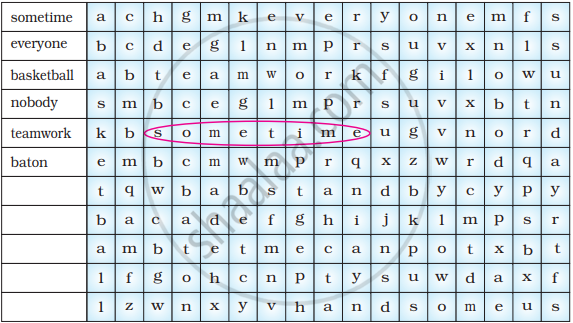
In the puzzle find the words given in the column. Notice that these words are formed by joining two words. One is done for you.
Find some more such words.
Here are some answers about the given picture.
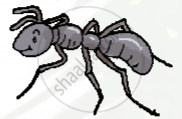
- The colour of the ant is black.
- It lives on land.
- It has two long antennae.
- It crawls on the ground.
- It eats sugar.
Now frame questions for the above answers.
Fill in the blank by choosing the preposition from the option.
The birds were caught ______ the net.
How did the seaside creatures, the crab, the lobster, etc. teach Hari a lesson? Write in a few lines.
Now make sentences using some of the above words.
What used to be there in the place of that shop twenty years ago?
Write conversation on the following situation.
Between two friends on the benefits of early rising
What angered the author?
What changes had the photographer effected on Leacock’s face in the picture?
Reading a map
Nowadays though locations are traced easily using GPS, (Global Positioning System) one should know what to look for in the map to reach the destination. Here are a few general instructions to be followed while reading a map.
- Identify and understand the elements of the map correctly.
- Look out for the title to know what the map shows.
- Study the symbols/colors that are used on the map and find what they stand for.
- Look at the scale of the map. (whether to be scaled or not to be scaled)
- Look for the pointer to know the direction.
Let us together scale the summit. Here is a drawing of the Everest showing the way to the summit, and the position of the camps with their heights. Trace the trekking trail to reach the summit with the given details and write an interesting paragraph in about 100 words.
The Summit of Mount Everest

Write the full form for the following.
weren’t - ______
Write an e-mail to the Principal of a neighbouring school inviting their pupils to attend the classes if they so wish. Give all details of the classes to be held.
What was the blue bead?
What might success mean to the following people? Think about it and write.
A politician
Write a composition (in approximately 400 – 450 words) on the following subject.
You had to go on a train journey with your family. On reaching the railway station, you discovered that your train was delayed by two hours. Describe how you spent those two hours, detailing what you saw, the sounds you heard, and the interactions you had with the people around you. Express your feelings when you saw the train finally approaching the station.
