Advertisements
Advertisements
प्रश्न
Answer the question by looking at the picture.
Example: What is happening in picture 5?

Advertisements
उत्तर
The boats are racing in the river water.
APPEARS IN
संबंधित प्रश्न
Fill in the blank with the suitable word.
He agreed to carry _____________ the manager’s orders.
(A) We did not know that Mr. Francis was retiring and leaving for Ooty.
(B) Little……………………………
The best candidate should be appointed________the post.
Read the following passage carefully and answer the questions that follow:
For some time Mother had greatly envied us our swimming, both in the daytime and at night, but as she pointed out when we suggested she join us, she was far too old for that sort of thing. Eventually, however, under constant pressure from us, Mother paid a visit into town and returned to the villa coyly bearing a mysterious parcel. Opening this she astonished us all by holding up an extraordinary shapeless garment of black cloth, covered from top to bottom with hundreds of frills and pleats and tucks.
‘Well, what do you think of it?’ Mother asked.
We stared at the odd garment and wondered what it was for.
‘What is it?’ asked Larry at length.
‘It’s a bathing-costume, of course,’ said Mother. “What on earth did you think it was?’ ‘It looks to me like a badly-skinned whale,’ said Larry, peering at it closely.
You can’t possibly wear that, Mother,’ said Margo, horrified, Shy, it looks as though it was made in nineteen-twenty.’
‘What are all those frills and things for?’ asked Larry with interest.
‘Decoration, of course,’ said Mother indignantly.
‘What a jolly idea! Don’t forget to shake the fish out of them when you come out of the water.’
‘Well, I like it, anyway,’ Mother said firmly, wrapping the monstrosity up again, ‘and I’m going to wear it.’
‘You’ll have to be careful you don’t get waterlogged, with all that cloth around you,’ said Leslie seriously.
‘Mother, it’s awful; you can’t wear it,’ said Margo. ‘Why on earth didn’t you get something more up to date?’
‘ When you get to my age, dear, you can’t go around in a two-piece bathing suit… you don’t have the figure for it.’
‘I’d love to know what sort of figure that was designed for,’ remarked Larry.
‘You really are hopeless, Mother,’ said Margo despairingly.
‘But I like it… and I’m not asking you to wear it,’ Mother pointed out angrily.
‘That’s right, you do what you want to do,’ agreed Larry; ‘don’t be put off. It’ll probably suit you very well if you can grow another three or four legs to go with it.’
Mother snorted indignantly and swept upstairs to try on her costume. Presently she called to us to come and see the effect, and we all trooped up to the bedroom. Roger the dog, was the first to enter, and on being greeted by this strange apparition clad in its voluminous black costume rippling with frills, he retreated hurriedly through the door, backward, barking ferociously. It was some time before we could persuade him that it really was Mother, and even then he kept giving her vaguely uncertain looks from the corner of his eye. However, in spite of all opposition, Mother stuck to her tent-like bathing- suit, and in the end we gave up.
In order to celebrate her first entry into the sea we decided to have a moonlight picnic down at the bay, and sent an invitation to Theodore, who was the only stranger that Mother would tolerate on such a great occasion. The day for the great immersion arrived, food and wine were prepared, the boat was cleaned out and filled with cushions and everything was ready when Theodore turned up.
One word answers or short phrases will be accepted.
- peering
- ferociously
- immersion
(b) Answer the following questions briefly in your own words.
- Why did mother not join the swimming in the beginning?
- Briefly describe her swimming costume.
- What did Larry think it was?
- Which sentence tells you that Margo thought it was old fashioned?
- What was Leslie’s concern?
- Why did mother think it was suitable?
(c)
(i) In not more than 60 words describe what happened after mother went upstairs to try on her costume.
(ii) Give a title to your summary in 3 (c) (i). Give a reason to justify your choice.
‘Working women make better mothers than women who stay at home’. Express your views either for or against this statement.
Write your views/opinions in brief on the following topic.
We must always cast our votes.
Write your views/opinions in brief on the following topic.
Steps to be taken to eradicate inequality.
You have just returned after your first experience of the kite - festival in Gujarat/Ahmedabad. You were thrilled with the festivities.
Write a short report about the kite - festival for your local newspaper. Give an attractive headline, a dateline, and an account of the kite - festive. Write the report in the third person with more use of Passive voice.
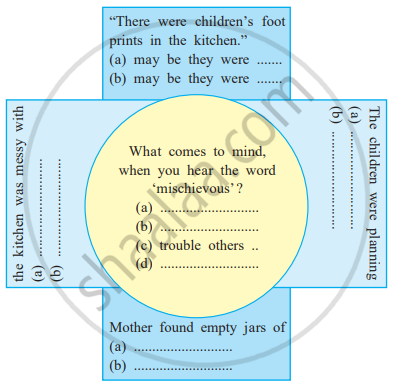
Read the evidence/sentences given below and offer a possible explanation of what happened in this house? Make up some questions to gather more information.
Now collect all your evidences and write a story in your notebook. Give a suitable title.
On seeing these pictures, you would have gone down your memory lane. Write a paragraph in about 50 words describing your favourite sport when you were young.

Imagine yourself as the writer. Narrate the story of your visit to your ancestral house.
How do you cook rice in your house?
Fill in the gaps in this recipe for cooking rice. Use the words in the box
|
boil |
water |
heat |
keep |
rice |
lid |
low |
water |
more |
ready |
What you'll need
- 1 cup uncooked white rice
- 2 cups water
- pinch of salt
How to make it
- ______the rice until the ______runs clear.
- Drain the water and ______ aside.
- In a medium sized pan, bring water to ______.
- Add the salt, stir, and then add the rinsed and drained ______.
- Reduce the heat, cover the rice, and let it simmer on ______ heat for 20 minutes.
- Check after 15 minutes to see if all the ______ has evaporated. If it has, the rice is ______.
- If not, replace the ______ and let the rice simmer for 5 ______
- Remove from ______ and serve
Punctuate the following sentence.
when I went fishing I caught an old shoe a plastic bag and a bad cold.
Imagine you are going on a journey to the centre of the earth. What do you think you will see? What would you feel?
What was the daily routine of the grandmother at home?
Bring out the people’s reaction to the noises from the surgery.
The narrator went to the photographer to ______.
Look at the pictures given below, and write slogans to advertise the products. Suggest your own brand name for each of the products.

As a member of the Student Council of your school, you wish to set up a Food Club to promote healthy eating habits among students. Write a proposal in not more than 150 words, outlining the steps that you will take to make this club a success.
If you want to become a tourist guide at the following places, which languages will you need to learn?
- Ajanta
- Belgavi
- Delhi
- Tarkarli
