Advertisements
Advertisements
प्रश्न
Answer the question by looking at the picture.
Example: What is happening in picture 5?

Advertisements
उत्तर
The boats are racing in the river water.
APPEARS IN
संबंधित प्रश्न
Imagine that you are Santosh Yadav, or Maria Sharapova. You have been invited to speak at an All India Girls’ Athletic Meet, as chief guest. Prepare a short speech to motivate the girls to think and dream big and make an effort to fulfil their dreams, not allowing difficulties or defeat to discourage them. The following words and phrases may help you.
• self confident/confidence/sure of yourself
• self assured/assurance/belief in yourself
• morale/boost morale/raise morale
• giving somebody a boost/fillip/lift
• demoralising/unsure of yourself/insecure/lack confidence
Summers are becoming hotter with each passing year. Write a description of one such very hot day. What did you see and hear as you walked outside ?
How were birds and animals affected ?
Fill in the blank with the suitable word.
She turned _____________ the offer to work at the factory.
What does the reader learn about the characters of the narrator and the old man, in Ernest Hemingway “Old Man and the Bridge?
Write a composition (350 - 400 words) on the following:
Write an original short story that begins with the words : “The day started off well enough, whoever thought it would ……….”
When did he realise that there was something wrong?
In your opinion, does Boori Ma, the main protagonist of the story A Real Durwan, deserve the life that she meets at the end of the story? Give reasons for your answer.
Wilfred Owen paints a horrific picture of a nightmarish memory on the battlefield. How does Duke et Decorum Est become Owen's condemnation and bitter response to war?
Given below is an interesting combination of words. Explain why they have been used together.
eternal brilliance
Use the phrase in a sentence of your own, after finding out its meaning.
streaked over
Use the phrase in a sentence of your own, after finding out its meaning.
lifted off
Complete the following sentences.
The factors that have made 'The Jungle Book' a great movie are - _________________.
- It's a fantasy world of wonder.
- _____________________________
- _____________________________
- _____________________________
Form groups of 5-8. Translate the play into your mother tongue (or Hindi) as a group activity. Enact the translation in the classroom.
Gather information on any one of the following by talking to your elders, family members, and from other sources in your mother tongue and write a short note on it in English.
A special type of embroidery
Read the following Headline and write the dateline, intro and a short continuing paragraph.
| Achievers narrate their success stories at career counselling events. |
Write a short paragraph on 'summer' using the hints given.
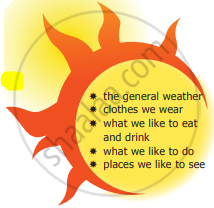
you can begin like this
I live in Chennai. The weather is...
Make opposites with the words –
| dis ______ in______ |
| respect | |
| able | |
| efficient | |
| own | |
| capable | |
| secure |
Was Bob hopeful of his friend’s arrival? How do you know?
Summarising is to briefly sum up the various points given in the notes made from the original passage. It is a retrieval of information from the notes made. Hence, while writing it, one need not go back to the original passage but refer only to the notes made. A first draft will help us to write a fair summary.
Answer the following question as briefly as possible and with close reference to the relevant text.
Discuss how in the poem Dover Beach the poet, Mathew Arnold, reposes faith in love as a beam of hope amidst the surrounding despair.
