Advertisements
Advertisements
प्रश्न
Write points and counter points on the following topic:
You must memorise the rules of grammar
Advertisements
उत्तर
- Points:
- Language forms the foundation of practically everything we do as humans. We can't communicate without language. To understand the linguistic part of human existence, we must first master the rules and laws of grammar, which serves as the fundamental organising principle for language.
- Explicit grammar instruction improves long-term learning and comprehension. Understanding grammar gives foundational knowledge for learning other languages.
- Counter points:
- The difference between a literate and an educated person is that the latter knows how to read and write. Everyone who can read and write understands grammar. It is an essential aspect of learning a language. Taking it as a distinct item to learn can increase student stress levels.
- Language has long served as a medium of communication between humans. Functional grammar is still okay, but memorising rules seems like a waste of time and energy.
- Learning grammar rules has advantages and disadvantages, just like everything else. I believe that basic grammar should be taught up to the primary level before moving on to functional grammar.
APPEARS IN
संबंधित प्रश्न
Which of these words would you use to describe Santosh Yadav? Find reasons in the text to support your choices, and write a couple of paragraphs describing Santosh’s character
| contented | determined | resourceful | polite | adventurous | considerate |
| weak-willed | fearful |
independent |
pessimistic |
patient | persevering |
What are these bangles for? Why has the poet repeated the word happy in the last line here?
What arc the poetic devices used in Maya Angelou’s poem “Caged Bird”?
Show how the story demonstrates that a good deed begets good.
Fill in the blank with an appropriate word:
The dog was hiding __________ the bed, barking at the stranger.
The best candidate should be appointed________the post.
If Mary catches the first bus, she will be on time for school.
(Begin : Unless …………….)
Write a composition (350–400 words) on the following:
You had booked a ticket on an early morning train. However, you woke up late and missed it. You then decided to run to catch a bus to the next station, where you hoped to catch up with the train. Narrate the entire event, including how you felt, the effort you made, and how you finally caught the train. What did you learn from this stressful experience?
Read the extract given below and answer the questions that follow:
Inspector: [Sharply] Are you sure there was nobody in the room already?
De Levis: [Taken aback] I don’t know. I never thought. I didn’t look under the bed if you mean that.
Inspector: [Jotting I Did not look under bed. Did you look under it after the theft?
De Levis: No. I didn’t.
Inspector: Ah! Now, what did you do after you came back from your bath? Just give us that precisely.
(i) What reply did De Levis give to the inspector’s last question in the extract?
(ii) What made De Levis check the contents of his pocketbook? What did he find there?
Whom did he go to upon discovering the theft?
(iii) Who was Robert? Where was Robert’s room? At what time did he take De Levis’ clothes and boots?
(iv) What is the Inspector’s final theory of the theft?
(v) Whom did De Levis accuse of stealing his money? What were his reasons for making this accusation?
Fill in the blank with an appropriate word:
I could not accompany my cousin _________ the trip because I had a fever.
Give reasons for the following.
Tut’s body was buried along with gilded treasures.
In what ways do you think we could help prevent the extinction of languages and dialects?
Below is a topic for essay writing. Follow the steps listed above to write on this topic.
Those who can bear all can dare all
Discuss in groups of four.
Laws are never respected not enforced in India.
Discuss with your partners
The manner you adopt when you talk about a teacher to other teachers.
Make a list of items that are referred to differently in British and American English, for example, 'lift' (BE) 'elevator' (AmE).
Use the phrase in a sentence of your own, after finding out its meaning.
went on
Glance through the text again and explain the qualities of Tenzing Norgay. Pick lines that show his unique qualities. One is done for you.
| Sr No. | Qualities | Lines |
| 1. | Patriotic | I told Colonel Hunt that I was carrying the Indian flag with me and I would like it to be on the top with other flags. |
|
2. |
||
| 3. | ||
| 4. |
Write down the significance of the following in the context of 'On to the Summit': Ice axe.
Refer to a standard dictionary and find out the meaning of the following word:
Reportorial
When a family member is very ill for long, the grandmother of the family urges everyone to send for a person who claims he can cure victims of black magic. Compose a dialogue with her, in which her granddaughter politely convinces her that she should not believe in such things.
Look at the two trees. One is a green flourishing tree and the other, a brown withering tree.

The class will now be divided into two groups. Group A will list down the agents that support a tree’s growth. Group B will list down those that prevent it. Once the groups are ready with their lists, a few representatives from each group will write down the lists on the black board.
Look at the picture given below and frame your own slogan.

Create a poster for the following.
You are Sita/ Sudhan. Design a poster in not more than 50 words to focus on not wasting water. Be creative.
Arrange the picture in order by writing the numbers 1,2,3 and 4 in the given boxes and write this familiar story in about 100 words.
Make use of the words given below.
| thirsty, village, pitcher, disappointment, pebbles, water level |
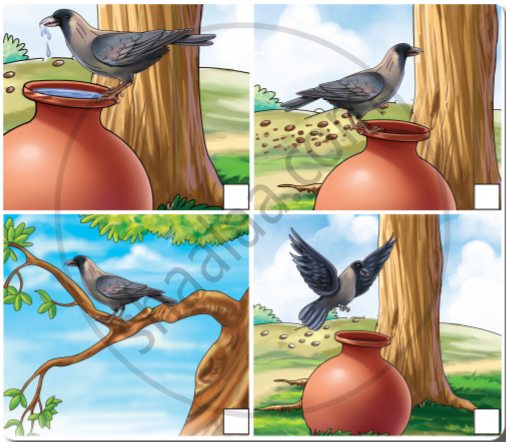
One hot day, a thirsty crow _____________________________________________________________
__________________________________________________________________________________________
Make the children write their own story. The following questions will help them to write. Ask them to gather information from their parents before writing and to give a title.
- When were you born?
- Where were you born?
- What is your father’s name and what is he?
- What is your mother’s name and what is she?
- What is your birth order?
- Do you have any nickname, if yes, reason for that?
- An interesting incident that happened in your life.
Summarizing is to briefly sum up the various points from the notes made from the below passage.
The Sherpas were nomadic people who first migrated from Tibet approximately 600 years ago, through the Nangpa La pass and settled in the Solukhumbu District, Nepal. These nomadic people then gradually moved westward along salt trade routes. During 14th century, Sherpa ancestors migrated from Kham. The group of people from the Kham region, east of Tibet, was called “Shyar Khamba”. The inhabitants of Shyar Khamba, were called Sherpa. Sherpa migrants travelled through Ü and Tsang, before crossing the Himalayas. According to Sherpa oral history, four groups migrated out of Solukhumbu at different times, giving rise to the four fundamental Sherpa clans: Minyagpa, Thimmi, Sertawa and Chawa. These four groups have since split into the more than 20 different clans that exist today.
Sherpas had little contact with the world beyond the mountains and they spoke their own language. AngDawa, a 76-year-old former mountaineer recalled “My first expedition was to Makalu [the world’s fifth highest mountain] with Sir Edmund Hillary’’. We were not allowed to go to the top. We wore leather boots that got really heavy when wet, and we only got a little salary, but we danced the Sherpa dance, and we were able to buy firewood and make campfires, and we spent a lot of the time dancing and singing and drinking. Today Sherpas get good pay and good equipment, but they don’t have good entertainment. My one regret is that I never got to the top of Everest. I got to the South Summit, but I never got a chance to go for the top.
The transformation began when the Sherpa Tenzing Norgay and the New Zealander Edmund Hillary scaled Everest in 1953. Edmund Hillary took efforts to build schools and health clinics to raise the living standards of the Sherpas. Thus life in Khumbu improved due to the efforts taken by Edmund Hillary and hence he was known as ‘Sherpa King’.
Sherpas working on the Everest generally tend to perish one by one, casualties of crevasse falls, avalanches, and altitude sickness. Some have simply disappeared on the mountain, never to be seen again. Apart from the bad seasons in 1922, 1970 and 2014 they do not die en masse. Sherpas carry the heaviest loads and pay the highest prices on the world’s tallest mountain. In some ways, Sherpas have benefited from the commercialization of the Everest more than any group, earning income from thousands of climbers and trekkers drawn to the mountain. While interest in climbing Everest grew gradually over the decades after the first ascent, it wasn’t until the 1990s that the economic motives of commercial guiding on Everest began. This leads to eclipse the amateur impetus of traditional mountaineering. Climbers looked after each other for the love of adventure and “the brotherhood of the rope” now are tending to mountain businesses. Sherpas have taken up jobs as guides to look after clients for a salary. Commercial guiding agencies promised any reasonably fit person a shot at Everest.
Answer the following question as briefly as possible and with close reference to the relevant text.
“Then paint the cut with iodine.” With reference to this line, what is your understanding of Klausner? Do you sympathise with him? Give your reasons.
What’s the difference between ‘hear’ and ‘listen?
With close reference to Act III, describe Alonso's response to the perceived loss of his son, Ferdinand. Write your answer in a short paragraph of about 100-150 words.
