Advertisements
Chapters
1: Reproduction in Organisms
2: Sexual Reproduction in Flowering Plants
3: Human Reproduction
4: Reproductive Health
UNIT 2 : GENETICS AND EVOLUTION
5: Principles of Inheritance and Variation
6: Molecular Basis of Inheritance
7: Origin of Life
8: Evidences and Theories of Biological Evolution
9: Human Evolution
UNIT 3 : BIOLOGY AND HUMAN WELFARE
10: Human Health and Diseases
11: Strategies for Enhancement in Food Production
12: Microbes in Human Welfare
UNIT 4 : BIOTECHNOLOGY AND ITS APPLICATIONS
13: Principles and Processes of Biotechnology
14: Biotechnology and Its Applications
UNIT 5 : ECOLOGY AND ENVIRONMENT
▶ 15: Organisms and Populations
16: Ecosystem
17: Biodiversity and Its Conservation
18: Environmental Issues
![Nootan solutions for बायोलॉजी [अंग्रेजी] कक्षा १२ आईएससी chapter 15 - Organisms and Populations - Shaalaa.com](/images/biology-english-class-12-isc_6:5d0f76efd5b64b75a3ef882e75824c08.png "Nootan solutions for बायोलॉजी [अंग्रेजी] कक्षा १२ आईएससी chapter 15 - Organisms and Populations")
Advertisements
Solutions for Chapter 15: Organisms and Populations
Below listed, you can find solutions for Chapter 15 of CISCE Nootan for बायोलॉजी [अंग्रेजी] कक्षा १२ आईएससी.
Nootan solutions for बायोलॉजी [अंग्रेजी] कक्षा १२ आईएससी 15 Organisms and Populations Test Your Progress [Pages 606 - 613]
OBJECTIVE TYPE QUESTIONS: Choose the correct answer from the alternatives given.
Eichhornia is a ______.
free-floating hydrophyte
submerged floating hydrophyte
amphibious and rooted plant
emergent and rooted plant
Which of the following factors is least likely to affect the type of organism colonizing a pond?
Acidity of water
Age of pond
Amount of rainfall
Amount of sunlight falling on the pond
Identify the odd member in the following:
leafless stem
sunken stomata
thick cuticle
absence of lignified elements
If in a geographic region, rainfall is low, temperatures are high, the soil is loose and sandy, with a low water table, it is not reasonable to expect there ______.
a scrub forest
a xerophytic vegetation
an evergreen tropical forest
a grassland
Which of the following is not a climatic factor?
Water logging
Rainfall
Temperature
None of these
Climate represents ______.
long-term weather
atmospheric conditions
temperature
temperature and rainfall
Soil is ______.
medium of plant growth
biologically inert
powdered rock
habitat of plants
Which of the following results in air pollution?
Mist
Fog
Smog
Dew
Plants adapted to grow in open sun are ______.
heliophytes
sciophytes
lithophytes
halophytes
A population is a group of ______.
species in a community
communities in an ecosystem
individuals in a family
individuals in a species
Which of the following forest plants controls the light conditions at the ground?
Lianas and climbers
Shrubs
Tall trees
Herbs
In a population of predators and prey, it was seen that when the prey population was numerically high, the predator population consumed more and more prey. This is because the predator population ______.
can digest any quantity of food
responds functionally
responds numerically
is a voracious feeder
Amensalism is a type of interspecific relationship in which ______.
one species is harmed, and other is benefited
both are benefited
both are harmed
adverse effect on one, but the other is not affected
In commensalism interspecific relationship ______.
neither species affects the other.
favourable to both species.
favourable to one but no affect on other.
adverse effect on both species.
A biotic community is an assemblage of ______.
food webs
interacting populations
closely related species
family units
An animal that uses camouflage to avoid detection must also have ______.
alarm signals
startle behaviour
a freezing posture
secondary compounds stored in its tissues
A number of populations of different species interacting with one another is called ______.
competition
a community
an ecosystem
predation
Community diversity is made of ______.
composition or a listing of the various species in a community.
a community and all of the abiotic factors associated with it.
the potential number of species that should exist in a community minus the species that have gone locally extinct.
both the number of species and the evenness or relative abundance of individuals of the different species.
Interaction between two species in which one feeds on the other is ______.
competition
a community
an ecosystem
predation
Which of the following is correct in a predator-prey cycle?
A decline in the numbers of predators causes a decline in the number of prey.
A decline in the numbers of prey causes a decline in the number of predators.
An increase in the number of predators triggers an increase in the numbers of prey.
All of the above are correct, causing an up-and-down cycle for each animal.
An intimate relationship between two species in which co-evolution and adaptation occur is ______.
competition
a community
predation
symbiosis
Interaction between two species as both attempt to use the same environmental resources is ______.
competition
an ecosystem
predation
symbiosis
A form of symbiosis in which one participant benefits and the other apparently is not benefited or harmed is ______.
commensalism
parasitism
mutualism
co-evolution
Which of the following statements is not true about parasitism?
The host is generally larger than the parasite.
An efficient parasite usually kills its host.
Smaller parasites often live as endoparasites within the body of the host.
Ectoparasites are attached to the outside of the host’s body by specialized organs.
A form of symbiosis in which both participants benefit is ______.
commensalism
parasitism
mutualism
predation
A probable example of commensalism is ______.
mycorrhizae on the roots of plants
termites with protozoa in their digestive tracts
flowering plants and their pollinators
barnacles on whales
Plant prey defense includes which one of the following?
Sharp spines
Pointed leaves
Tough leathery leaves
All of these
Animal prey defense includes all of the following except:
camouflage
causing harm of fright
mimicry
all of these
Which of the following is a commensalistic relationship?
Plasmodium - humans
Epiphytes - trees
Human colon bacteria - humans
HIV - humans
A two-way flow of benefits in mutualistic interactions between species is an outcome of ______.
two-way exploitation
resource partitioning
close cooperativeness
competitive coexistence
Two species in the same habitat can coexist when they:
differ in their use of resources
share the same resource in different ways
use the same resource at different times
all of the above
Which one of the following levels of ecology most considers the effects of predation and interspecific competition on the distribution and abundance of organisms?
Biotic
Community
Ecosystem
Population
According to the principle of competitive exclusion, ______.
two species cannot coexist in the same habitat
extinction or emigration are the only possible results of competitive interactions
intraspecific competition results in the success of the best-adapted individuals
two species cannot share the same realized niche in a habitat
______ is an interspecific association in which all species involved benefit.
commensalism
mutualism
competition
parasitism
A population is made up of ______.
all individuals of any kind
all groups of organisms in an area at any one time
groups of individuals of different kinds in an area
individuals of the same kind in an area at a given time
Which one of the following is a total parasite?
Nepenthes
Rhizobium
Cuscuta
Lichens
Which one of the following is an example of mutualism?
Lichens
Hypertrophy
Cuscuta
Nepenthes
Orchids, which grow on trees, are the examples of ______.
parasites
epiphytes
saprophytes
mutualism
All organisms living together and interacting with one another in a common environment or natural habitat in a local area are known as a ______.
biome
biosphere
biomass
community
Plants that grow in nitrogen-deficient soils and swampy and boggy places are called ______.
epiphytic
insectivorous
saprophytic
parasitic
Small herbaceous plants that grow on higher plants but do not obtain their nourishment from them are called ______.
insectivorous
epiphytes
saprophytes
mycorrhiza
No predator can become proficient at acquiring prey because ______.
predators are not as intelligent as their prey.
prey populations evolve antipredatory traits.
predators are too large to be fast enough.
prey populations evolve more rapidly than predator populations.
Parasitism is an interaction between two species in which ______.
Both are harmed.
Both are benefited.
One is benefited, and the other is neither benefited nor harmed.
One is benefited, and the other is harmed.
Mutualism is an interaction between two species in which ______.
Both are benefited.
Both are harmed.
One is benefited, and the other is harmed.
One is benefited, and the other is neither benefited nor harmed.
Hyena that lives on left over food of the lion is called a ______.
scavenger
parasite
predator
atnensalism
A stronger species being benefited at the cost of weak species is an example of ______.
predation
commensalism
parasitism
proto-cooperation
A population is a group of ______.
species in a community
communities in an ecosystem
individuals in a family
individuals in a species
Dominance hierarchies are most common when ______.
Resources are uniformly distributed throughout the environment.
Resources are concentrated in one part of the environment.
Parental care is wanting.
Males are larger than females.
Altruistic behaviours between closely related animals are selected for because they ______.
reduce fighting between species
ensure survival of the altruistic individual
force individuals to cooperate with one another and so increase population growth
increase the frequency of the altruistic individual’s genes in the next generation
Intraspecific competition is competition among ______.
populations and their regulatory factors
individuals of a community
individuals of a population
species
Intraspecific competition is strongest when the ______.
reproductive rate is at its maximum
populations overlap in their ranges
species overlap in their distribution
population is at its carrying capacity
Demography is the study of statistics that affects ______.
population growth
geography
family pedigrees
local concentrations of individuals
Members of biologic species are potentially able to ______.
compete
introgress
interbreed
express all the same genes
Which one of the following is not true of singing in male birds?
All songs are learned from their parents.
It is done to claim a territory.
They generally sing at dawn or dusk.
The typical song is characteristic of a species.
Lichens are association of ______.
bacteria and fungus
alga and bacterium
fungus and alga
fungus and virus
Type of interaction where an individual sacrifices its own welfare (life) for the benefit of another animal of its own species is ______.
Altruism
Scavenging
Protocooperation
Commensalism
Amensalism is an association between two species where ______.
one species is harmed and other is benefitted
one species is harmed and other is unaffected
one species is benefitted and other is unaffected
both the species are harmed
Nostoc keeps a symbiotic relation ______.
with the root of Pinus
with coralloid root of Cycas
with the root of rose
all of the above
A population is a group of ______.
species in a community
communities in an ecosystem
individuals in a family
individuals in a species
Exponential growth occurs when there is ______.
no environmental resistance
a fixed carrying capacity
a great environmental resistance
no biotic potential
The carrying capacity of a population is determined by its ______.
limiting resources
natality
mortality
population growth rate
Demography is the study of statistics that affects ______.
population growth
geography
family pedigrees
local concentrations of individuals
When a population is small, there is a greater chance of ______.
mutations occurring
genetic drift
gene flow
natural selection
The rate at which a population grows or declines depends upon the rate of:
births
immigration
deaths
all of these
Which of the following factors does not affect sustainable population size?
Predation
Resources
Competition
All of the above can affect population size
Human population growth curve is a ______.
J-shaped curve
zig-zag curve
parabola curve
S-shaped curve
Consider five human populations that differ demographically only in their age structures. The population that will grow the most in the next 30 years is the one with the greatest fraction of people in which of the following age group?
10-20
20-30
30-40
40-50
Which of the following would necessarily decrease the density of a population in a given habitat?
Natality > mortality
Immigration > emigration
Mortality and emigration
Natality and immigration
Fill in the blanks with appropriate words.
Epiphytes ______ obtain nutrition from the supporting plant.
Nepenthes (pitcher plant) is an example of ______ plants.
The total physical environment of an organism is known as ______.
The alpine plants are ______ gregarious in habit and with beautiful colour flowers.
Edaphic factor is related with conditions of ______.
Presence of high concentration of cell sap, development of water storage tissue, underground perennating organs, lignified and cutinised tissue, well-developed root system, and reduction in leaf size, are characteristic feature of ______.
Root is feebly developed, and stem is soft with a large number of air cavities in ______.
Xerophytes are the plants which normally grow in ______ conditions.
Organisms which have wide tolerance limits for various environmental factors are called as ______ species.
Buoyancy in Eichhornia results from spongy enlargements of the ______.
If the soil particles are loose and could be identified individually, the soil is called as ______.
The place where an organism lives is known as ______.
According to Allen’s Rule, the mammals from colder climates have ______ ears and ______ limbs.
Nepenthes (pitcher plant) is an example of ______ plants.
An association which is not harmful to both the parties is known as ______.
Epiphytes ______ obtain nutrition from the supporting plant.
Chemicals that are released by individuals and serve to influence the behaviour of other members of their own species are called ______.
A limited area that an animal defends is its ______, whereas an area that an animal moves through regularly but does not defend is its ______.
When in some bird species, one member of a flock gives a warning cry upon sighting a predator and thus allows the flock to escape but draws the predator’s attention to itself, the behaviour can be considered to be an example of ______.
The more ______ two organisms are, the more intense the competition between them. Intraspecific competition is ______ intense than interspecific competition.
Evolved features that make organisms better suited to live and reproduce in their environments are called ______.
At carrying capacity, the population growth rate is ______.
The maximum number of individuals that an environment can support is determined by its ______.
State whether the following statement is true or false:
Everything which influences the life activities of an organism constitute its environment.
State whether the following statement is true or false:
The xerophytes are plants which require minimum amount of water supply and therefore to be placed midway between hydrophytes and mesophytes.
State whether the following statement is true or false:
In deserts, the velocity of the wind is high, and yet the leaves do not get torn into bits.
State whether the following statement is true or false:
Two different regions having the same amount of annual rainfall can exhibit different vegetational constituents.
State whether the following statement is true or false:
Plants developing under the influence of drying winds are abnormally short.
State whether the following statement is true or false:
The plants of high mountains show xeromorphic characters.
State whether the following statement is true or false:
Fire is an ecological factor.
State whether the following statement is true or false:
Soils having very fine particles and give smooth feeling is clay.
State whether the following statement is true or false:
The universal feature of xerophytic plants is selective absorption and tolerance of high concentrations of salt.
State whether the following statement is true or false:
The layers of air nearer the earth are richer in CO2 than those above.
State whether the following statement is true or false:
A population consists of the number of individuals in a given area at a particular time.
State whether the following statement is true or false:
An ecological community is an assemblage of interacting populations.
State whether the following statement is true or false:
Species that tolerate narrow range temperature are called stenothermic.
State whether the following statement is true or false:
Species that tolerate a wide range of salinity are called euryhaline.
State whether the following statement is true or false:
A food relation in which an animal feeds on a dead animal or one killed by another animal is known as predation.
State whether the following statement is true or false:
Human intervention in natural community interactions usually makes the community more stable.
State whether the following statement is true or false:
All the physiological requirements and activities of a species in its normal surroundings make up its habitat.
State whether the following statement is true or false:
One of the effects of predation is the stabilization of the predator-prey relationship when there is not too much predatory pressure on the prey population.
State whether the following statement is true or false:
Plants use spines and chemical poisons to prevent predation by animals, especially insects.
State whether the following statement is true or false:
Bacteria living in the human digestive tract and producing vitamins used by the human are best described as parasitic organisms.
State whether the following statement is true or false:
In commensalism, one partner derives benefit from the other and adversely affects the benefactor.
State whether the following statement is true or false:
An epiphyte is a plant that grows on other plants, using them for support but not for nutrition.
State whether the following statement is true or false:
The territory of an animal is larger than its home range.
State whether the following statement is true or false:
The dominant individual in a herd is always a male.
State whether the following statement is true or false:
Pheromones are chemical substances meant for communication and coordination of organs in an individual.
State whether the following statement is true or false:
In commensalism, one partner derives benefit from the other and adversely affects the benefactor.
State whether the following statement is true or false:
A population consists of the number of individuals in a given area at a particular time.
State whether the following statement is true or false:
Demography deals with family pedigrees.
State whether the following statement is true or false:
The population growth rate is inversely related to generation time.
State whether the following statement is true or false:
An ecological community is an assemblage of interacting populations.
VERY SHORT ANSWER TYPE QUESTIONS:
Which one of the following is not a part of the biotic environment?
insects, air, plants, birds
Name a succulent xerophyte.
Name a free-floating hydrophyte.
Name an emergent hydrophyte.
Name a heterophyllous hydrophyte.
State any four alternatives by which organisms can overcome stressful external conditions.
Which one of the two, stenothermals or eurythermals, shows a wide range of distribution on Earth?
How do herbs and shrubs survive under the shadow of big canopied trees in forests?
Give an example where percentage cover is a more meaningful measure of the population size.
Mention any two activities of animals which get cues from diurnal and seasonal variation in light intensity.
In xerophytic plants, the thorns are a modification of which organ?
What are the main functions of air-chambers in hydrophytic plants?
Give the scientific term for a parasite living on other parasite.
Name a species which is both a prey and a predator.
Give two examples of commensal species.
Give two examples of mimicry.
Give one example each of mutualism and proto-cooperation.
Name the two components of lichens.
Which organism was used to control Opuntia in Australia?
Which one of the following is not a part of the biotic environment?
insects, air, plants, birds
What do you understand by the term competition?
What is a ‘biotic community’?
Name an ecto- and an endoparasite.
Name the three types of mimicry.
Give the scientific term for the symbiotic relationship between fungi and the roots of higher plants.
Name a carnivorous (insectivorous) plant.
Name an epiphytic plant.
Scientific term for an animal behaviour which benefits others but is of no advantage to itself.
How does the Monarch butterfly defend itself from predators? Explain.
What is commensalism? Explain it with a suitable example.
State Gause’s competitive exclusion principle.
Name the type of association that the genus Glomus exhibits with higher plants.
Predation is usually referred to as a detrimental association. Mention any two significant roles predation plays in nature.
List two advantages that a mycorrhizal association provides to the plant.
Name the interspecific interaction in which one is detrimental while the other is neutral.
How are closely related species of warblers able to coexist in a competitive environment?
An orchid plant is growing on the branch of a mango tree. What type of interaction do you observe between the orchid and the mango tree?
Write what do phytophagous insects feed on.
Name the two intermediate hosts which the human liver fluke depends on to complete its life cycle so as to facilitate parasitization of its primary host.
What is an amensalism?
Among the crustose, foliose, and fruticose lichens, which one is a pioneer species?
What is symbiosis?
Write the name of a bacterium which is found in root nodules of leguminous plants.
Name the scientist associated with human population growth.
Name the best-known contribution of T. R. Malthus.
Define zero population growth.
Explain the term:
Carrying capacity
What does the following term mean?
Biotic potential
What does the following term mean?
Environmental resistance
Explain the term natality.
Name the type of growth curve that characterises most populations growing in a favourable environment.
The rate at which a population grows or declines depends upon what?
Name the factors which do not affect sustainable population size.
What type of age pyramid reflects an expanding growth status of the human population?
State any four alternatives by which organisms can overcome stressful external conditions.
List the different attributes that a population has, and not an individual organism.
Which one of the two, stenothermals or eurythermals, shows a wide range of distribution on Earth?
In a pond, there were 40 lotus plants. After a year, the number rose to 56. Calculate the birth rate of a lotus plant.
If 8 individuals in a laboratory population of 80 fruit flies died in a week, then what would be the death rate for the population for the said period?
A forest hardly has any carnivores. A census of herbivorous mammals was taken and plotted as a graph, shown below. Identify the curve that will explain the population growth of herbivores. Give a reason to your answer.
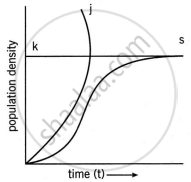
Plot a logistic growth curve.
How do herbs and shrubs survive under the shadow of big canopied trees in forests?
Give an example where percentage cover is a more meaningful measure of the population size.
Mention any two activities of animals which get cues from diurnal and seasonal variation in light intensity.
Give the scientific term for the statistical study of the human population.
What does nature’s carrying capacity for a species indicate?
What parameters are used for tiger census in our country’s national parks and sanctuaries?
Give a scientific term for the study of human population covering all aspects and parameters.
State how the constant internal environment is beneficial to organisms.
What are stenothermal organisms?
SHORT/LONG ANSWER TYPE QUESTIONS:
Name the various environmental factors that affect plant life. Describe how any one of these factors influences plants?
Write a short note on various ecological factors which influence the distribution of plants.
What is an environment?
How do climatic factors affect the vegetation?
Write an essay on ‘light as an ecological factor’.
With the help of suitable examples, show how the environment influences the behaviour of organisms and also how the organisms influence the environment of their surroundings.
What do you mean by edaphic factor?
Discuss those physical, chemical, and biological properties of soil which affect plant growth.
Explain how the structure and composition of the soil surface affect the vegetation of any area.
Lichen is considered a good example of obligate mutualism. Explain.
In theory, populations of organisms can increase exponentially. What does this mean?
In theory, populations of organisms can increase exponentially. Why is it rarely seen in nature?
Describe a biotic community of your nearby place stating the relationships that exist between the common species comprising it.
Write a short note on predation.
Write a short note on mimicry.
Write a short note on mutualism.
Write a short note on antibiosis.
Write a short note on competition.
Describe how human intervention with a community can interfere with normal competition, and give two examples.
Describe how human intervention with a community can interfere with normal predation, and give two examples.
Give an example of parasitism, commensalism, and mutualism, and show that it is not always easy to distinguish between these relationships.
Is competition more acute between the individuals of the same species or those of different species? Explain.
What is symbiosis?
Give a broad outline of various types of positive interactions among organisms.
Population growth is determined by the interaction of biotic potential and environmental resistance. Comment on the statement.
Nootan solutions for बायोलॉजी [अंग्रेजी] कक्षा १२ आईएससी 15 Organisms and Populations BOARD EXAMINATION QUESTIONS [Page 613]
Give an account of the population growth curves.
What is reproductive fitness? Explain it with the help of an example.
Define Allen’s rule.
The following diagram represents the population growth curves of two different species, A and B, living together in an area. Answer the following questions based on it.
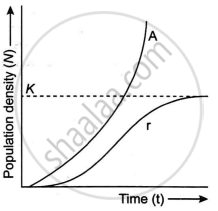
- What type of growth patterns are exhibited by species A and B?
- Give mathematically equations to represent the growth curves of species A and species B separately.
- In the diagram, what does the horizontal line K represent?
Nootan solutions for बायोलॉजी [अंग्रेजी] कक्षा १२ आईएससी 15 Organisms and Populations HIGHER ORDER THINKING SKILLS QUESTIONS (HOTS) [Page 614]
What are the key elements that lead to so much variation in the physical and chemical conditions of different habitats?
What will happen to a well-growing herbaceous plant in the forest if it is transplanted outside the forest in a park?
What would happen to all the energy fixed by autotrophic organisms if the community has no animals to eat the plants?
The weed Calotropis usually grows in abandoned fields.
Study the table given below in regard to population interactions. Identify the interactions (a) to (e).
| Species ‘A’ | Species ‘B’ | Name of Interaction |
| − | 0 | (a) |
| + | − | (b) |
| − | − | (c) |
| + | + | (d) |
| + | 0 | (e) |
Note: (+) plus = beneficial interaction; (−) minus = deterimental interaction; (0) zero = neutral interaction.
Name the interaction in the following:
Cuckoo lays her eggs in the crow’s nest.
Name the interaction in the following:
Orchid grows on a mango tree.
Name the interaction in the following:
Ticks live on the skin of dogs.
Name the interaction in the following:
Sea anemone is often found on the shell of a hermit crab.
Name the interaction in the following:
Cuscuta growing on a shoe flower plant.
Name the interaction in the following:
Mycorrhizae living on the roots of higher plants.
Name the interaction in the following:
Clown fish living among the tentacles of sea anemone.
Name the interaction in the following:
Ascaris worms living in the intestine of human.
Name the interaction in the following:
Sucker fish attached to the shark.
Name the interaction in the following:
Smaller barnacles disappeared when Balanus dominated in the coast of Scotland.
Name the interaction in the following:
Wasp pollinating fig inflorescence.
Name the interaction in the following:
Whale and the barnacles growing on its back.
Name the interaction in the following:
Bumblebee and its favourite orchid, Ophrys.
Egrets are often seen along with grazing cattle. How do you refer to this interaction? Give a reason for this association.
What are the key elements that lead to so much variation in the physical and chemical conditions of different habitats?
Study the population growth curves in the graph given ahead and answer the questions which follow:
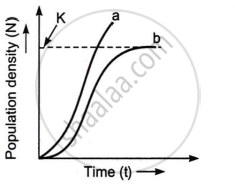
- Identify the growth curves ‘a’ and ‘b’.
- Which one of them is considered a more realistic one, and why?
- If `(dN)/dt = rN ((K - N)/K)` is the equation of the logistic growth curve, what does K stand for?
- What is symbolised by N?
- Mention the conditions responsible for the curves ‘a’ and ‘b’ respectively.
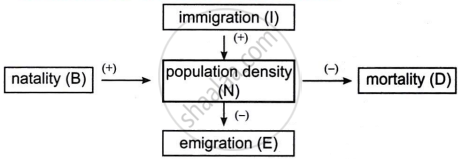
Explain the equation:
Nt + 1 = Nt + [(B + I) − (D + E)]
On the basis of the flow chart given below.
Nootan solutions for बायोलॉजी [अंग्रेजी] कक्षा १२ आईएससी 15 Organisms and Populations NCERT EXERCISES [Pages 615 - 616]
How is diapause different from hibernation?
If a marine fish is placed in a freshwater aquarium, will the fish be able to survive? Why or why not?
Define phenotypic adaptation.
Give one example of phenotype adaptation.
Most living organisms cannot survive at temperatures above 45°C.
How are some microbes able to live in habitats with temperatures exceeding 100°C?
Distinguish between the following:
Hibernation and Aestivation
Distinguish between the following:
Ectotherms and Endotherms
Write a short note on adaptations of desert plants.
Write a short note on adaptations of desert animals.
Write a short note on adaptations of plants to water scarcity.
Write a short note on behavioural adaptations in animals.
Write a short note on the importance of light to plants.
Write a short note on the effect of temperature.
Write a short note on the effect of water scarcity.
Write a short note on adaptations of animals.
List the various abiotic environmental factors.
Give an example of an endothermic animal.
Give an example of an ectothermic animal.
Give an example of an organism of benthic zone.
Name important defence mechanisms in plants against herbivory.
An orchid plant is growing on the branch of a mango tree. How do you describe this interaction between the orchid and the mango tree?
What is the ecological principle behind the biological control method of managing with pest insects?
Define population.
Define community.
Define the following term:
Commensalism
Give one example of commensalism.
Define the following term:
Parasitism
Give one example of parasitism.
Define the following term:
Camouflage
Give one example of camouflage.
Define mutualism.
Give one example of mutualism.
Define the following term:
Interspecific competition
Give one example of interspecific competition.
Select the statement which explains best parasitism.
One organism is benefited.
Both the organisms are benefited.
One organism is benefited, other is not affected.
One organism is benefited, other is affected.
List the attributes that populations but not individuals possess.
If a population growing exponentially double in size in 3 years, what is the intrinsic rate of increase (r) of the population?
With the help of a suitable diagram, describe the logistic population growth curve.
List any three important characteristics of a population and explain.
Nootan solutions for बायोलॉजी [अंग्रेजी] कक्षा १२ आईएससी 15 Organisms and Populations VALUE BASED QUESTIONS [Page 616]
If you had ever been to any high altitude place, you must have experienced what is called ‘altitude sickness’. But gradually you get acclimatised and stop experiencing altitude sickness.
Can you think of any natural habitat on earth that is inhabited just by a single species?
My friend Prakash has a beautiful garden in his house with a lot of ornamental plants, including a section of rose plants and cacti growing in it. On a morning walk, Prakash tried to pluck a rose flower and got hurt by a thorn present on the twig of the plant. He soon started thinking about the beauty of rose flowers, but was not able to understand the presence of thorns over them. He soon approached his father (who is a horticulturist) to resolve his curiosity. Can you feel how his father explained and solved his curiosity?
Is it possible to achieve a ‘zero population growth rate’? If yes, what kind of age pyramid is obtained?
Nootan solutions for बायोलॉजी [अंग्रेजी] कक्षा १२ आईएससी 15 Organisms and Populations DIFFERENTIATE BETWEEN [Page 617]
Differentiate between biotic potential and carrying capacity.
Differentiate between commensalism and amensalism.
Differentiate between commensalism and mutualism.
Differentiate between euryhaline and stenohaline.
Differentiate between intraspecific and interspecific competition.
Differentiate between mutualism and competition.
Differentiate between natality and mortality.
Differentiate between parasitism and predation.
Differentiate between population and community.
Differentiate between predation and cannibalism.
Differentiate between predation and scavenging.
Solutions for 15: Organisms and Populations
Nootan solutions for बायोलॉजी [अंग्रेजी] कक्षा १२ आईएससी chapter 15 - Organisms and Populations
Shaalaa.com has the CISCE Mathematics बायोलॉजी [अंग्रेजी] कक्षा १२ आईएससी CISCE solutions in a manner that help students grasp basic concepts better and faster. The detailed, step-by-step solutions will help you understand the concepts better and clarify any confusion. Nootan solutions for Mathematics बायोलॉजी [अंग्रेजी] कक्षा १२ आईएससी CISCE 15 (Organisms and Populations) include all questions with answers and detailed explanations. This will clear students' doubts about questions and improve their application skills while preparing for board exams.
Further, we at Shaalaa.com provide such solutions so students can prepare for written exams. Nootan textbook solutions can be a core help for self-study and provide excellent self-help guidance for students.
Concepts covered in बायोलॉजी [अंग्रेजी] कक्षा १२ आईएससी chapter 15 Organisms and Populations are Ecology and Biomes, Levels of Ecological Organisation, Organisms and Their Environment, Biomes of India, Major Abiotic Factors, Climatic Factors > Precipitation, Climatic Factors > Wind, Climatic Factors > Temperature, Climatic Factors > Light, Climatic Factors > Atmospheric Humidity, Climatic Factors > Fire, Topographic Factors, Atmospheric Factors, Biotic Factors, Soil Factors (Edaphic Factors), Soil Organisms, Responses of Organisms to Abiotic Factors, Habitat, Niche, Types of Habitats in the Biosphere, Adaptations, Adaptation in Aquatic Plants (Hydrophytes), Adaptation in Grassland Plants (Mesophytes), Adaptation in Desert Plants (Xerophytes), Aquatic Adaptations (Hydrocoles), Desert Adaptations (Xerocoles), Volant Adaptations, Cursorial Adaptations, Fossorial Adaptations, Arboreal (Scansorial) Adaptations, Parasitic Adaptations, Behavioural Adaptations in Animals, Population Interactions, Interaction between Organisms, Intraspecific Relationships, Dominance Hierarchy (Pecking Order), Territoriality, Altruism, Animal Societies, Communication, Interspecific Relationships, Positive Interactions > Commensalism, Positive Interactions > Proto-cooperation, Positive Interactions > Mutualism (Symbiosis), Negative Interactions > Predation, Negative Interactions > Parasitism, Negative Interactions > Competition, Negative Interactions > Amensalism, Concepts and Measures of Population Ecology, Environmental Stochasticity, Population Growth Curve, Population Age Distribution, Sex Ratio, Population Dispersal and Energy Flow (Bioenergetics), Life History Variation, Environmental Resistance, Population Growth, Carrying Capacity and Its Role in Population Sustainability.
Using Nootan बायोलॉजी [अंग्रेजी] कक्षा १२ आईएससी solutions Organisms and Populations exercise by students is an easy way to prepare for the exams, as they involve solutions arranged chapter-wise and also page-wise. The questions involved in Nootan Solutions are essential questions that can be asked in the final exam. Maximum CISCE बायोलॉजी [अंग्रेजी] कक्षा १२ आईएससी students prefer Nootan Textbook Solutions to score more in exams.
Get the free view of Chapter 15, Organisms and Populations बायोलॉजी [अंग्रेजी] कक्षा १२ आईएससी additional questions for Mathematics बायोलॉजी [अंग्रेजी] कक्षा १२ आईएससी CISCE, and you can use Shaalaa.com to keep it handy for your exam preparation.
