Advertisements
Advertisements
प्रश्न
Define population.
Advertisements
उत्तर १
A population is a group of individuals of the same species that are capable of interbreeding and are found in a geographical area. E.g., all the frogs identified as Rana tigrina living in a given pond constitute a population. Similarly, all water hyacinth plants (Eichhornia) growing in that pond form another population. Organisms of the same kind may form several populations inhabiting different geographical areas.
उत्तर २
The population is defined as a group of individuals of a species occupying a definite geographic area at a given time.
APPEARS IN
संबंधित प्रश्न
Define the Stenothermal organisms.
Answer the following question.
Mention the term used to describe a population interaction between an orchid growing on a forest tree.
Give one example of mutualism.
Define Absolute Mortality.
What is Mortality? What are its two types?
Explain any three important characteristics of population.
What is population interaction? Explain the interactions in Mutualism and Competition.
The interaction in nature, where one gets to benefit on the expense of other is _________.
Competition between species leads to ________.
Match the following and choose the correct combination from the options given below.
| Column I | Column II |
| Mutualism | Lion and deer |
| Commensalism | Round worm and man |
| Parasitism | Birds compete with squirrels for nuts |
| Competition | Sea anemone on hermit crab |
| Predation | Barnacles attached to Whales |
Define the following term:
Parasitism
Differentiate between predator and prey.
Identify the interspecific interaction in which species A is harmed and species B is unaffected.
Identify the correct pair that exhibits commensalism.
Brood parasitism is best explained by the example of ____________.
Select the CORRECT match:
| I | II | ||
| i. | Competition | a. | Lichen |
| ii. | Commensalism | b. | Sea anemone and clownfish |
| iii. | Mutualism | c. | Lions and Leopards |
Which of the following is TRUE for amensalism?
In the given picture, identify the type of interspecific interaction.
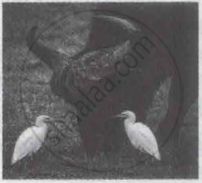
Which of the following is NOT an example of mutualism?
Which one of the following pair does NOT show commensalism?
Which of the following is not an example of commensalism?
Which one of the following is one of the characteristics of a biological community?
An interaction favourable to both population but no obligatory to either is ______.
Give one example for the following:
A parasitic angiosperm
Carnivorous animals-lions and leopards, occupy the same niche but lions predate mostly larger animals and leopards take smaller ones. This mechanism of competition is referred to as ______.
Interaction between clown fish living among the stinging tentacles of sea anemone is an example of ______.
Write a note on parasitism.
What are the special adaptations that endoparasites show?
The diagram given below shows the life cycle of a malarial parasite. Study it carefully and answer the questions that follows:

- Name the hosts in which the asexual phase and sexual phase of the life cycle takes place.
- Identify the infective stage labelled ‘D’.
- Name the structure labelled ‘A’ and ‘E’.
- Give any one symptom of malaria.
Explain one type of mutualism.
Lichen is an example of which type of population interaction?
What is the sign convention for amensalism?
In neutralism, what is the relationship between the two species?
