Advertisements
Advertisements
प्रश्न
Define population.
Advertisements
उत्तर १
A population is a group of individuals of the same species that are capable of interbreeding and are found in a geographical area. E.g., all the frogs identified as Rana tigrina living in a given pond constitute a population. Similarly, all water hyacinth plants (Eichhornia) growing in that pond form another population. Organisms of the same kind may form several populations inhabiting different geographical areas.
उत्तर २
The population is defined as a group of individuals of a species occupying a definite geographic area at a given time.
APPEARS IN
संबंधित प्रश्न
Give the role of VAM related to soil fertility.
Explain mutualism with the help of any two examples.
Why do clown fish and sea anemone pair up? What is this relationship called?
How is mutualism different from commensalism?
Answer the following question.
Mention the term used to describe a population interaction between an orchid growing on a forest tree.
Name and explain the interaction that is seen between clownfish and sea anemones.
Association between sea anemone and Hermit crab in gastropod shell is that of.
Name the type of association:
Clownfish and sea anemone
Name the type of association: Hummingbirds and host flowering plants
Distinguish between the following: Parasitism and Mutualism.
Define community.
The number of deaths under ideal conditions is known as ______.
Define Absolute Mortality.
Define the term population interactions. State its two types.
Identify the interspecific interaction in which species A is harmed and species B is unaffected.
Identify the interspecific interaction depicted in the following figure.
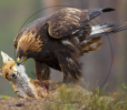
The interspecific interaction between Cuckoo and Crow is ______
Identify the interspecific interaction which one species is benefited and other is neither banned nor benefited.
Parasitism can be conectly represented as ____________.
Which one of the following is an example of predation?
Substantiate by giving two reasons as to why a holistic understanding of the flora and fauna the cropland is required before introducing an appropriate biocontrol method.
Amensalism can be represented as ______
Define stenohaline species.
What is the interaction between two species called?
Define ectoparasite and endoparasite and give suitable examples.
What is brood parasitism? Explain with the help of an example.
Give one example for the following type.
Phytophagous animal
Discuss the various types of positive interactions between species.
Sea Anemone gets attached to the surface of the hermit crab. The kind of population interaction exhibited in this case is ______.
Interspecific interaction could be ______.
Describe mutualism.
Some orchids live on the branches of mango trees. Name the type of interaction that exists between the mango tree and the orchid.
Association between clown fish and sea anemone is ______.
What is the sign convention for the predation interaction?
Cuscuta growing on a host plant is an example of which population interaction?
In commensalism, how is the unaffected species impacted by the interaction?
Tarantulas and cacti sharing a desert habitat is an example of which population interaction?
