Advertisements
Advertisements
प्रश्न
Give one example of parasitism.
Give two examples in the case of parasitism.
Advertisements
उत्तर
Plasmodium, a protozoan parasite, causes malaria in humans by living inside red blood cells and damaging the host.
Notes
Students should refer to the answer according to the question.
APPEARS IN
संबंधित प्रश्न
Give the role of VAM related to soil fertility.
An orchid plant is growing on the branch of a mango tree. How do you describe this interaction between the orchid and the mango tree?
Give one example of interspecific competition.
Define community.
Community is defined as ______.
The number of deaths under ideal conditions is known as ______.
Define Niche.
Explain any three important characteristics of population.
What is population interaction? Explain the interactions in Mutualism and Competition.
Differentiate between predator and prey.
Statement I: If one or two species are lost, it may not affect proper functioning of ecosystem.
Statement II: Loss of key species causes serious threat to functioning of ecosystem. Choose the correct alternative with reference to the above statements
Brood parasitism is best explained by the example of ____________.
The interspecific interaction between Cuckoo and Crow is ______
Type of interspecific interaction wherein one organism is benefited and other is harmed is called ____________.
______ interaction is the biological interaction between organisms of same population.
Lichens showing relationship between alga and fungus is an example of ____________ type of interaction.
Mycorrhizae are the example of ______.
Rafflesia an arnoldii is an example of ______.
Which type of interaction is represented by the given figure?
In a pond, we see plants which are free-floating; rooted–submerged; rooted emergent; rooted with floating leaves; Write the type of plant against the following examples.
| Plant Name | Type | |
| a. | Hydrilla | ______ |
| b. | Typha | ______ |
| c. | Nymphaea | ______ |
| d. | Lemna | ______ |
| e. | Vallisneria | ______ |
Observe the set of 4 figures A, B, C and D and, answer the following questions
- Which one of the figures shows mutualism?
- What kind of association is shown in D?
- Name the organisms and the association in C.
- What role is the insect performing in B?
 Fig. (A) |
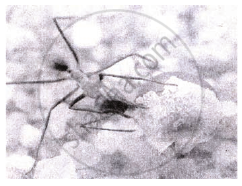 Fig. (B) |
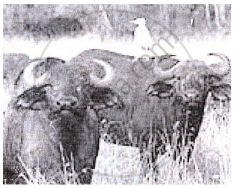 Fig. (C) |
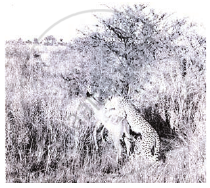 Fig. (D) |
In an aquarium two herbivorous species of fish are living together and feeding on phytoplanktons. As per the Gause’s Principle, one of the species is to be eliminated in due course of time, but both are surviving well in the aquarium. Give possible reasons.
Give one example for the following:
A parasitic angiosperm
Write the observations made at the end of Connell's field, experiment on barnacles on the rocky sea coasts of Scotland.
Interspecific interaction could be ______.
"Abingdon tortoise in Galapagos islands became extinct within a decade on introduction of goats in the island." Explain giving reason.
What are the special adaptations that endoparasites show?
The diagram given below shows the life cycle of a malarial parasite. Study it carefully and answer the questions that follows:

- Name the hosts in which the asexual phase and sexual phase of the life cycle takes place.
- Identify the infective stage labelled ‘D’.
- Name the structure labelled ‘A’ and ‘E’.
- Give any one symptom of malaria.
Describe mutualism.
What happens to an inferior competitor if the superior competitor is removed from the environment?
Parasitism is an interaction between two organisms in which ______.
Which interaction type is characterized by both species being benefited?
When two plant species in the same field compete for sunlight, water, and minerals, which type of population interaction is occurring?
In commensalism, how is the unaffected species impacted by the interaction?
Tall plants blocking sunlight for smaller nearby plants is an example of which population interaction?
Which population interaction type involves both species being negatively affected?
