- A concave mirror has an inward-curved reflecting surface, while a convex mirror has an outward-curved reflecting surface.
- Important parts of a spherical mirror: Pole (P), Centre of Curvature (C), Principal Axis, and Principal Focus (F).
- For spherical mirrors, the relation is R = 2f, where R is the radius of curvature and f is the focal length.
- In concave mirrors, parallel rays converge at the focus; in convex mirrors, they appear to diverge from the focus behind the mirror.
Definitions [32]
Define the principal focus of a concave mirror.
Light rays that are parallel to the principal axis of a concave mirror converge at a specific point on its principal axis after reflecting from the mirror. This point is known as the principal focus of the concave mirror.
Define principal focus of the concave mirror.
Principal focus (F): The point on the principal axis of the spherical mirror where the rays of light parallel to the principal axis meet or appear to meet after reflection from the spherical mirror.
Define linear magnification produced by a mirror.
The ratio of the height of an image (h') to the height of an object (h) is known as linear magnification
That is,
`mh/h`
where, h' = height of image
h = height of object
Define the term principal axis of a lens.
It is the line joining the centers of curvature of the two surfaces of the lens.
The principal axis of a lens is the line joining the centres of curvatures of the two surfaces of the lens.
Define the principal focus of a convex lens.
For a convex lens, the principal focus is a point on the principal axis of a convex lens at which the rays of light originally parallel and close to the principal axis of the lens pass through it after refraction by the lens.
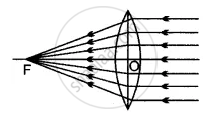
Define the principal axis of a convex lens.
An imaginary line that passes through the optical centre and the centre of curvature of both faces of the lens, and is perpendicular to the faces, is known as the principal axis.
Define the power of a lens.
Power of a lens is defined as the ability of a lens to bend the rays of light. It is given by the reciprocal of focal length in metre.
The power of a lens is a measure of the deviation produced by it in the path of rays refracted through it.
Definition: Unit of Power
The SI unit of power of a lens is the dioptre.
One dioptre is the power of a lens whose focal length is 1 metre.
1D = 1m−1
Definition: Power of a Lens
The deviation of the incident light rays produced by a lens on refraction through it, is a measure of its power.
or
The power of a lens is defined as the reciprocal of its focal length. It is represented by the letter P.
OR
The power (P) of a thin lens is equal to the reciprocal of its focal length (f) measured in metres.
Define the following term in relation to concave mirror.
Pole
Pole “is the mid-point of the mirror”.
Define the following term in relation to concave mirror.
Center of curvature
The centre of a hollow sphere of which the mirror forms a part is called the centre of curvature.
Define the following term in relation to concave mirror.
Principal axis
An imaginary line passing through the pole and the centre of curvature of a spherical mirror is called principal axis.
Define the following term in relation to concave mirror.
Principal focus
It is a point on the principal axis, where a beam of light, parallel to the principal axis, after reflection actually meet.
Define the following term in relation to concave mirror.
Radius of curvature
The linear distance between the pole and the center of curvature is called the radius of curvature.
Define the following term in relation to concave mirror.
Focal length
The linear distance between the pole and the principal focus is called focal length.
Define the term Focus of a concave mirror.
The focus of a concave mirror is a point on the principal axis of the mirror, where all the rays travelling parallel to the principal axis and close to it after reflection from the mirror converge to that point.
Define the term Normal.
Normal to the surface of a mirror at any point is the straight line at the right angle to the tangent drawn at that point.
Definition: Spherical Mirrors
Mirrors whose reflecting surfaces are spherical are called spherical mirrors.
OR
A spherical mirror is a part of a hollow sphere, whose one side is silvered and coated with red oxide and the other side is the reflecting surface.
OR
A spherical mirror is a piece cut out of a spherical surface, which can be concave or convex.
Definition: Concave Mirror
A spherical mirror, whose reflecting surface is curved inwards, that is, faces towards the centre of the sphere, is called a concave mirror.
OR
A concave mirror is one whose reflecting surface is towards the centre of the sphere of which the mirror is a part.
OR
The reflecting surface is on the inner side of the sphere (converging mirror).
Definition: Convex Mirror
A spherical mirror whose reflecting surface is curved outwards, is called a convex mirror.
OR
A convex mirror is one whose reflecting surface is away from the centre of the sphere of which the mirror is a part.
OR
The reflecting surface is on the outer side of the sphere (diverging mirror).
Definition: Radius of Curvature
The radius of the sphere of which the reflecting surface of a spherical mirror forms a part is called the radius of curvature of the mirror. It is represented by the letter R.
OR
The radius of the sphere of which the mirror forms a part, is called the 'radius of curvature' of the mirror.
Definition: Principal Axis
A straight line passing through the pole and the centre of curvature of a spherical mirror. This line is called the principal axis.
OR
The straight line joining the pole and the centre of curvature of the mirror and extended on both sides is called the 'principal axis' of the mirror.
Definition: Pole
The centre of the reflecting surface of a spherical mirror is a point called the pole. The pole is usually represented by the letter P.
OR
The central point of the reflecting surface of the mirror is called the 'pole' of the mirror.
Definition: Centre of Curvature
The reflecting surface of a spherical mirror forms a part of a sphere. This sphere has a centre. This point is called the centre of curvature of the spherical mirror. It is represented by the letter C.
OR
The centre of the sphere of which the mirror forms a part, is called the ‘centre of curvature' of the mirror.
Define focal length.
The distance between the pole and the principal focus is called the focal length (f) of a spherical mirror.
Define the term Pole.
Pole is the centre of the reflecting surface, in this case, a spherical mirror.
Define the term Aperture.
Aperture is the distance between the extreme points on the periphery of the mirror.
Define the term Centre of curvature.
Centre of curvature is the centre of the imaginary sphere to which the mirror belongs.
Define the term Principle focus.
Principal focus of a spherical mirror is a point on the principal axis of the mirror, where all the rays travelling parallel to the principal axis and close to it after reflection from the mirror, converge to or appear to diverge from.
Define the following term:
spherical mirror
“A mirror which is made from a part of a hollow sphere is called Spherical Mirror.
Define the following term:
convex mirror
“A mirror made by silvering the inner surface such that reflection takes place from the bulging surface” is called Convex Mirror.
The Centre of curvature is towards the silvered surface.
Define the following term:
concave mirror
“A mirror made by silvering the outer or the bulging surface such that the reflection takes place from the concave surface.” Centre of curvature is towards the reflecting surface.
Formulae [4]
Write down a formula for the magnification produced by a concave mirror.
In terms of height of object and height of image.
m = `h_i/h_o`
Write down a formula for the magnification produced by a concave mirror.
In terms of object distance and image distance.
Magnification (m) = `-v/u`
Formula: Power of a Lens
Power of lens (in D) = \[\frac{1}{\text{focal length (in metre)}}\]
or
P = \[\frac {1}{f}\]
or
P = \[\frac {1}{f (m)}\]
Power of a Lens in a Medium:
P = (n2 - n1)\[\left(\frac{1}{R_{1}}-\frac{1}{R_{2}}\right)\] = \[\frac {n_1}{f}\]
Write the formula for a lens connecting image distance (v), object distance (u) and the focal length (f). How does the lens formula differ from the mirror formula?
Lens formula is:
`1/v-1/u=1/f`
Now, the mirror formula is given by:
`1/v+1/u=1/f`
In both the formulas,
u = Object distance
v = Image distance
f = Focal length
In the mirror formula, a positive sign is present between the reciprocals of the image distance and object distance.
In lens formula, a negative sign is present between the reciprocals of image distance and object distance.
Key Points
Key Points: Sign Convention
- Pole (mirror) or optical centre (lens) is the origin; principal axis is the X-axis.
- Distances to the right are positive, to the left are negative; heights above the axis are positive, below are negative.
- Concave mirror: and R are negative; Convex mirror: and R are positive.
- Real images: image distance and magnification are negative; Virtual images: both are positive.
- Lenses are always negative; they are positive for real images and negative for virtual images; they are positive for convex lenses and negative for concave lenses.
Key Points: Myopia
- Myopia is a vision defect in which distant objects appear blurry, while near objects are seen clearly.
- This occurs because the image of distant objects forms on the retina.
- The far point is not at infinity but is shifted closer to the eye.
- Causes include increased curvature of the cornea/lens or elongation of the eyeball.
- Corrected using a concave lens of negative power, which diverges light rays to focus the image on the retina.
Key Points: Spherical Mirrors
Important Questions [39]
- In Which Equipment/S Do You Find ___________________ (A) a Concave Mirror. (B) a Convex Lens (C) Reflecting Mirrors?
- State the different positions of the source of light with respect to the concave mirror in Floodlights.
- State the different positions of the source of light with respect to the concave mirror in Projector lamps.
- Which Type of Mirror is Used by a Dentist ?
- A _____________ Mirror is Used by a Dentist.
- Draw a ray diagram for concave mirror when the object is between centre of curvature and focus.
- State the different positions of the source of light with respect to the concave mirror in Torches.
- With the Help of an Appropriate Ray Diagram, State the Sign Conventions for Reflection by a Spherical Mirror.
- The Height of the Image Formed by an Object of Height 10 Cm Placed in Front of a Plane Mirror is __________.
- An Object of 10 cm is Placed in Front of a Plane Mirror. the Height Of Image Will Be
- The Distance Between Principal Focus and Optical Centre of the Lens is
- Complete the following table for convex lens: Sr. No. Position of the object Position of the image Nature of the image 1. Beyond 2F1 ____ 2. _____ At infinity _____ 3. _____
- My Grandfather Uses a Bifocal Lens in His Spectacle. Explain Why.
- Observe the Following Figure and Complete the Table
- Complete the Following Table: Simple Microscope Compound Microscope Telescope Number of Convex Lenses
- If an Object is Placed in Front of a Convex Lens Beyond 2f1, Then What Will Be the Position, Relative Size, and Nature of an Image Which is Formed? Explain with a Ray Diagram.
- Rewrite the Following Statement by Selecting the Correct Option: the Power of a Convex Lens is 2.5 Dioptres. Its Focal Length is ______________.
- An Object is Held 20 Cm Away from a Converging Lens of Focal Length 10 Cm. Find the Position of the Image Formed.
- Give a scientific reason. Simple microscope is used for watch repairs.
- Calculate the Focal Length of a Corrective Lens Having Power +2d.
- Surabhi from Std. X Uses Spectacle. the Powr of the Lenses in Her Spectacle is 0.5 D. Answer the Following Questions from the Given Information
- Calculate the Focal Length of a Corrective Lens Having Power +2.5 D.
- If focal length of a convex lens is 20 cm at what is the power of the lens?
- The power of convex lens of focal length 20 cm is ______.
- Kavita from 10th is Using Spectacles. the Power of the Lenses in Her Spectacles is –2.5 Dioptre. Answer the Following Questions:Which Lenses Are Used in Her Spectacles? and State the Defect of Vision Kavita is Suffering From.
- What is Myopia?
- Observe the figure and answer the following questions: Name the defect of vision represented in the above figure. State the reasons for this defect.
- In a Std. X Class Out of 40 Students 10 Students Use Spectacles, 2 Students Have Positive Power and 8 Students Have Negative Power of Lenses in Their Spectacles.
- Complete the following table by observing the given figures: Figure → Points ↓ (a) Name of the defect (b) Position of the image (c) Lens used to correct the defect ______ ______ ______ ______ ______
- Anuja Cannot See the Blackboard Writing but She Can See Nearby Things. (A) What is the Eye Defect She is Suffering From? (B) State the Possible Reason for Her Defect
- Given Below is a Diagram Showing a Defect of Human Eye. Study It And Answer the Following Questions.
- Rewrite the Following Table So as to Match Second and Third Column with First Column.
- Explain Two Possible Reasons of Myopia. How Can It Be Corrected? Explain with a Suitable Diagram.
- Choose the Correct Alternative and Rewrite the Following:Mirror Used by a Dental Surgeon is .........................
- A Simple Microscope is Used by Watch Repairers. Give Reason.
- Define Focal Length of Spherical Mirror
- Answer the Following Question: Distinguish Between the Convex Mirror and the Concave Mirror.
- State Two Uses of a Concave Mirror.
- Define Radius of Curvature of Spherical Mirror
