Advertisements
Advertisements
प्रश्न
What is Ulysses’ clarion call to his sailors? How does he inspire them?
Advertisements
उत्तर
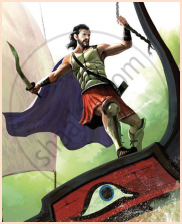
In the third part of the poem, Ulysses makes a clarion call to his hearty compatriots (i.e.) mariners. They have been with him both during ‘thick and thin’ or thunders or sunshine. Similar to Ulysses they possess “free hearts and free foreheads” (i.e.) their hearts and brains are unburdened by domestic cares and responsibilities. They had frolicsome time fighting along with Ulysses against great warriors and Gods in the past. Ulysses does not want to live in the memory of glory. He believes they need not waste away their precious time in nostalgic memories just recounting their escapades to the younger generation. They can really do ‘ something of noble note’ before the end. He is conscious of the impending death in old age. But he tells it is not “too late to seek a newer world”.
The many “voices of the ocean” call out to the mariners to resume the voyage. Ulysses is not content with having earned a name for himself. He has seen many countries and acquired knowledge of various cultures. Those experiences are not to be taken as accomplishments. They are just an ‘arch leading them to an “untravelled world” and constantly sailing to the ever-expanding horizon. He does not want his compatriots to miss even an hour which could provide them novel experiences in their voyage. He persuades his compatriots to gather at the port as the sails are already puffing up welcoming them all. Their life would be one of fulfillment only when they venture out into the unknown on the seas. He uses emotional bait to his mariners. He highlights the probable outcome of their voyage. They might reach the “Happy Isles” (i.e.) great paradise and meet Achilles, their war hero. No matter how much strength they have, they still have some “strength of will” left to strive, to seek, to find, and not to yield.
APPEARS IN
संबंधित प्रश्न
Fill in the following empty boxes.
| Name | Location |
| Fort St. George | Chennai |
| Gingee Fort | ______ |
| Golconda Fort | ______ |
| Red Fort | ______ |
Why were the secret galleries bare?
Read the given line and answer the question that follow in a line or two.
Our gates were strong, our walls were thick,
So smooth and high, no man could win.
- How safe was the castle?
- What was the firm belief of the soldiers?
Name the bird that sings in the poet’s garden.
Describe the reminiscences of the poet, when she sees the casuarina tree.
What is the world compared to?
Describe the second stage of life as depicted by Shakespeare.
When does a man become a judge? How?
Explain the following line briefly with reference to the context.
“Is second childishness and mere oblivion;
Sans teeth, sans eyes, sans taste, sans everything.”
Shakespeare has skilfully brought out the parallels between the life of man and actors on stage. Elaborate this statement with reference to the poem.
Introduction
The poem ‘Ulysses’ is a dramatic monologue that contains 70 lines of blank verse. Ulysses, the King of Ithaca, gathers his men together to prepare for the journey and exhorts them not to waste their time left on earth. Ulysses has grown old, having experienced many adventures at the battle of Troy and in the seas. After returning to Ithaca, he desires to embark upon his next voyage. His inquisitive spirit is always looking forward to more and more of such adventures.
Complete the summary of the poem, choosing words from the list given below. Lines 33 to 42
Ulysses desires to hand over his (1) ______to his son Telemachus, who would fulfil his duties towards his subjects with care and (2) ______. Telemachus possesses patience and has the will to civilise the citizens of Ithaca in a (3) ______way. Ulysses is happy that his son would do his work blamelessly and he would pursue his (4) ______for travel and knowledge.
| prudence, kingdom, quest, tender |
Complete the summary of the poem, choosing words from the list given below. Lines 44 to 70
Ulysses beckons his sailors to (1) ______at the port where the ship is ready to sail. His companions who have faced both (2) ______and sunshine with a smile, are united by their undying spirit of adventure. Though death would end everything, Ulysses urges his companions to join him and sail beyond the sunset and seek a newer (3) ______, regardless of consequences. These brave hearts who had once moved (4) ______ and earth, may have grown old and weak physically but their spirit is young and (5) ______. His call is an inspiration for all those who seek true knowledge and strive to lead (6) ______ lives.
| world, thunder, meaningful, gather, undaunted, heaven |
What does he think of the people of his kingdom?
Read the set of line from the poem and answer the question that follow.
Little remains: but every hour is saved
From that eternal silence, something more,
A bringer of new things; and vile it were
- How is every hour important to Ulysses?
- What does the term ‘Little remains’ convey?
Read the set of line from the poem and answer the question that follow.
Death closes all: but something ere the end,
Some work of noble note, may yet be done,
Not unbecoming men that strove with Gods.
- The above lines convey the undying spirit of Ulysses. Explain.
- Pick out the words in alliteration in the above lines.
Explain with reference to the context the following line.
He works his work, I mine.
How would the poet’s advice help his son who is at the threshold of the manhood?
Why does the poet advise his son to have lazy days?
Here are a few poetic device used in the poem.
Antithesis- It is a literary device that emphasises the idea of contrast.
Read the line given below and answer the question that follow.
Tell him time as a stuff can be wasted.
Tell him to be a fool every so often
- Why does the poet suggest that time can be wasted?
- Identify the figure of speech in the above line.
Read the line given below and answer the question that follow.
Tell him to be a fool ever so often
and to have no shame over having been a fool
yet learning something out of every folly
hoping to repeat none of the cheap follies
- Is it a shame to be a fool at times?
- What does one learn from every folly?
Read the line given below and answer the question that follow.
..........Free imaginations
Bringing changes into a world resenting change.
- How does free imagination help the world?
- Identify the figure of speech.
Explain the following line with reference to the context.
and guide him among sudden betrayals
and tighten him for slack moments.
Explain the following line with reference to the context.
Yet learning something out of every folly
hoping to repeat none of the cheap follies
Explain how the poet guides his son who is at the threshold of manhood, to face the challenges of life.
Describe the posture of Napoleon.
Why did Napoleon’s eyes become soft as a mother eagle’s eyes?
