Advertisements
Advertisements
प्रश्न
Every parent is anxious about the welfare of his/her children. Parents express their anxiety by advising them almost all the time. What kind of advice do you frequently receive from your parents? Fill in the bubbles. Tick the ones you like to follow implicitly and give reasons for the ones you don’t like to follow.
Advertisements
उत्तर
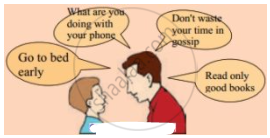
- Wash your fingers before eating.
- Don’t stay awake till late at night.
- Who are you talking to over the phone for a long time?
1. I don’t like to tell my parents what I do with the phone. Why should they interfere with my privacy?
2. I don’t gossip; I just share what I enjoyed. My friends tell me what they like. How can my parents call it ‘gossip’?
Time spent in sharing our dreams is not wasted but invested. The other three agree.
APPEARS IN
संबंधित प्रश्न
Who is the narrator in the poem?
How long had the soldiers been in the castle?
Why were the soldiers in the castle fearless?
Why didn’t the narrator want to tell the tale to anybody?
Identify the figure of speech used in the following line.
Grew thin and treacherous as air.
How does the creeper appear on the tree?
Does nature communicate with human beings?
The casuarina tree will be remembered forever. Why?
Read the line given below and answer the question that follow.
A creeper climbs, in whose embraces bound No other tree could live.
- Which tree is referred to in the above lines?
- How does the tree survive the tight hold of the creeper?
- Why does Toru Dutt use the expression ‘a creeper climbs’?
Explain the following line with reference to the context.
Unto thy honor, Tree, beloved of those
Who now in blessed sleep for aye repose,
Identify the figure of speech used in each of the extract given below and write down the answer in the space given below.
“ What is that dirge-like murmur that I hear Like the sea breaking on a shingle -beach?
Pick out the word in ‘alliteration’ in the following line.
“Jealous in honour, sudden and quick in quarrel.”
Shakespeare has skilfully brought out the parallels between the life of man and actors on stage. Elaborate this statement with reference to the poem.
What does Ulysses yearn for?
Read the set of line from the poem and answer the question that follow.
Little remains: but every hour is saved
From that eternal silence, something more,
A bringer of new things; and vile it were
- How is every hour important to Ulysses?
- What does the term ‘Little remains’ convey?
Read the set of line from the poem and answer the question that follow.
……for my purpose holds
To sail beyond the sunset, and the baths
Of all the western stars, until I die.
- What was Ulysses’ purpose in life?
- How long would his venture last?
Explain with reference to the context the following line.
To follow knowledge like a sinking star,
Beyond the utmost bound of human thought.
What happened to the people who wanted too much money?
How would his being alone help the boy?
Read the line given below and answer the question that follow.
Tell him to be a fool ever so often
and to have no shame over having been a fool
yet learning something out of every folly
hoping to repeat none of the cheap follies
- Is it a shame to be a fool at times?
- What does one learn from every folly?
Explain the following line with reference to the context.
and guide him among sudden betrayals
and tighten him for slack moments.
Explain the following line with reference to the context.
Yet learning something out of every folly
hoping to repeat none of the cheap follies
Explain how the poet guides his son who is at the threshold of manhood, to face the challenges of life.
What did the rider do when he reached Napoleon?
Where did the rider plant the French flag after Ratisbon was captured?
What was Napoleon’s reaction on hearing the news of victory?
How did the young soldier face his end?
Literary Devices
Mark the rhyme scheme of the poem. The rhyme scheme for the first stanza is as follows.
| With neck out-thrust, you fancy how, | a |
| Legs wide, arms locked behind, | b |
| As if to balance the prone brow | a |
| Oppressive with its mind. | b |
Explain the following line with reference to the context.
Then off there flung in smiling joy, And held himself erect
