Advertisements
Advertisements
प्रश्न
List the roles and responsibilities Ulysses assigns to his son Telemachus, while he is away.
Advertisements
उत्तर
The entire poem is a monologue. Yet the second part of the poem is an address to the readers justifying his decision to transfer the rule to his son Telemachus. The cloak of a king seems to be unfit for the temperament of Uly uses. He finds ruling Ithaca a boring thing. He finds Telemachus rooted in the political life of Ithaca. His role is merely to lead a ‘savage race’ to accept standard norms of behavior in society. He believes Telemachus fits well with the role of the ruler of “uninspired and imprudent citizens” and may discharge his duties with honor and grace. When he is away, he wants his son Telemachus to dispense variable justice to the subjects of Ithaca and guide them in the path of virtues and morals.
APPEARS IN
संबंधित प्रश्न
Fill in the following empty boxes.
| Name | Location |
| Fort St. George | Chennai |
| Gingee Fort | ______ |
| Golconda Fort | ______ |
| Red Fort | ______ |
Where were the enemies?
Read the given line and answer the question that follow in a line or two.
Our gates were strong, our walls were thick,
So smooth and high, no man could win.
- How safe was the castle?
- What was the firm belief of the soldiers?
You visit your school after several years. As you cross the banyan tree at the entrance, cheerful memories fi ll your mind. Fill the bubbles with your memories.

Fill in the blanks choosing the words from the box given and complete the summary of the poem.
The casuarina tree is tall and strong, with a creeper winding around it like a (1) ______. The tree stands like a (2) ______with a colourful scarf of flowers. Birds surround the garden and the sweet song of the birds is heard. The poet is delighted to see the casuarina tree through her (3) ______. She sees a grey monkey sitting like a (4) ______on top of the tree, the cows grazing, and the water lilies (5) ______in the pond. The poet feels that the tree is dear to her not for its (6) ______appearance but for the (7) ______memories of her happy childhood that it brings to her. She strongly believes that (8) ______communicates with human beings. The poet could communicate with the tree even when she was in a far-off land as she could hear the tree (9) ______her absence. The poet (10) ______the tree’s memory to her loved ones, who are not alive. She immortalizes the tree through her poem like the poet Wordsworth who (11) ______the yew tree of Borrowdale in verse. She expresses her wish that the tree should be remembered out of love and not just because it cannot be (12) ______.
| python | statue | nature | casement |
| nostalgic | lamenting | impressive | forgotten |
| giant | consecrates | springing | sanctified |
Describe the garden during the night.
How does the poet spend her winter?
Discuss with your partner the different stages in the growth of man from a new born to an adult

What is the world compared to?
Read the poem once again carefully and identify the figure of speech that has been used in each of the following lines from the poem.
“All the world’s a stage,
And all the men and women merely players;
They have their exits and their entrances;
And one man in his time plays many parts,
His acts being seven ages. At first the infant,
Mewling and puking in the nurse’s arms;
Then the whining school-boy, with his satchel
And shining morning face, creeping like snail
Unwillingly to school. And then the lover,
Sighing like furnace, with a woeful ballad
Made to his mistress’ eyebrow. Then a soldier,
Full of strange oaths, and bearded like the pard,
Jealous in honour, sudden and quick in quarrel,
Seeking the bubble reputation
Even in the cannon’s mouth. And then the justice,
In fair round belly with good capon lin’d,
With eyes severe and beard of formal cut,
Full of wise saws and modern instances;
And so he plays his part. The sixth age shifts
Into the lean and slipper’d pantaloon,
With spectacles on nose and pouch on side;
His youthful hose, well sav’d, a world too wide
For his shrunk shank; and his big manly voice,
Turning again toward childish treble, pipes
And whistles in his sound. Last scene of all,
That ends this strange eventful history,
Is second childishness and mere oblivion;
Sans teeth, sans eyes, sans taste, sans everything.”
- “All the world's a stage”
- “And all the men and women merely players”
- “And shining morning face, creeping like snail”
- “Full of strange oaths, and bearded like the pard,”
- “Seeking the bubble reputation”
- “His youthful hose, well sav’d, a world too wide”
- “and his big manly voice, turning again toward childish treble”
Introduction
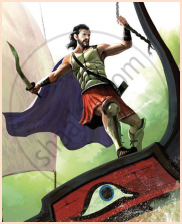
The poem ‘Ulysses’ is a dramatic monologue that contains 70 lines of blank verse. Ulysses, the King of Ithaca, gathers his men together to prepare for the journey and exhorts them not to waste their time left on earth. Ulysses has grown old, having experienced many adventures at the battle of Troy and in the seas. After returning to Ithaca, he desires to embark upon his next voyage. His inquisitive spirit is always looking forward to more and more of such adventures.
Complete the summary of the poem, choosing words from the list given below. Lines 1 to 32
Ulysses is (1) ______to discharge his duties as a (2) ______, as he longs for (3) ______. He is filled with an (4) ______thirst for (5) ______and wishes to live life to the (6) ______. He has travelled far and wide gaining (7) _______ of various places, cultures, men and (8) ______. He recalls with delight his experience at the battle of Troy. Enriched by his (9) ______he longs for more and his quest seems endless. Like metal which would (10) ______if unused, life without adventure is meaningless. According to him living is not merely (11) ______to stay alive. Though old but zestful, Ulysses looks at every hour as a bringer of new things and yearns to follow knowledge even if it is (12)______.
| fullest, unquenchable, unattainable, experience, knowledge, king, matters, rust, adventure, unwilling, travel, breathing |
In what ways were Ulysses and his mariners alike?
What could be the possible outcomes of their travel?
Identify the figure of speech employed in the following line.
To follow knowledge like a sinking star.
Read the set of line from the poem and answer the question that follow.
One equal temper of heroic hearts,
Made weak by time and fate, but strong in will
To strive, to seek, to find, and not to yield.
- Though made weak by time and fate, the hearts are heroic. Explain.
- Pick out the words in alliteration in the above lines.
Explain with reference to the context the following line.
How dull it is to pause, to make an end,
To rust unburnished, not to shine in use!
Explain with reference to the context the following line.
It may be we shall touch the Happy Isles,
And see the great Achilles, whom we knew.
‘A tough will counts.’ Explain.
What has twisted good men into thwarted worms?
Read the line given below and answer the question that follow.
“Life is hard; be steel; be a rock.”
- How should one face life?
- Identify the figure of speech in the above line.
Explain the following line with reference to the context.
and guide him among sudden betrayals
and tighten him for slack moments.
Explain the following line with reference to the context.
Brutes have been gentled where lashes failed.
Explain how the poet guides his son who is at the threshold of manhood, to face the challenges of life.
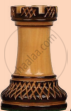
Have you played chess or watched the game carefully?
Now identify the chess pieces and complete the table below. Discuss the role of each piece in the game.
 |
|
 |
|
 |
|
 |
|
 |
|
 |
When did the narrator find that the boy was badly wounded?
How did the young soldier face his end?
Read the line given below and answer the question that follow.
‘You’re wounded!’ ‘Nay’, his soldier’s pride Touched to the quick, he said:
- Why did the boy contradict Napoleon’s words?
- Why was his pride touched?
