Advertisements
Advertisements
प्रश्न
What makes Ulysses seek newer adventures?
Advertisements
उत्तर
In the context of the poem, Ulysses has grown old. He has experienced all daring adventures. He has won the hearts of people during the battle at Troy. Back home, as per the prophecy of Tiresias, he rules Ithaca for a brief time. But he is fed up with the conventional duties of a king. He laments his own uselessness as a ruler of idle people who lead a life like savages, just eating and sleeping. They don’t understand the over vaulting ambition of their adventurous king Ulysses who had moved earth and heavens in the past. He wishes to embark on his next voyage. It might be his last. He is quite sensitive to the moans of the seas tantalizing him and his compatriots to set sail quickly. He wants “to drink life to the lees”. Ulysses doesn’t want to bask in the glory he has earned in the past.
His inquisitive spirit is restless. He has seen much’ and acquired knowledge of various cultures of the world. But he considers all such experiences like an “arch” leading him to the unexplored or “untravelled world”. He wants to sail towards the area ‘beyond sunset’. He must shine in use as a sword but not “rust unburnished”. Yet at home, in the kingdom of Ithaca, he feels bored and yearns to truly engage with what is left of life. He is impatient for “new” experiences lamenting every day and every hour to seek “something more”. His quest for adventure and fulfillment, like the goal of Goethe’s Faust, is defined by the pursuit of new knowledge “beyond the utmost bound of human thought”.
APPEARS IN
संबंधित प्रश्न
Have you ever visited a fort or a castle?
Read the given line and answer the question that follow in a line or two.
Our gates were strong, our walls were thick,
So smooth and high, no man could win.
- How safe was the castle?
- What was the firm belief of the soldiers?
Our gates were strong, our walls were thick,
I will maintain until my death
Underline the alliterated word in the following line.
With our arms and provender, load on load.
What is the creeper compared to?
Describe the garden during the night.
Why is the casuarina tree dear to poet’s heart?
Explain the following line with reference to the context.
Dear is the Casuarina to my soul;
Explain the following line with reference to the context.
It is the tree’s lament, an eerie speech,…
Describe the reminiscences of the poet, when she sees the casuarina tree.
Fill in the blanks using the words given in the box to complete the summary of the poem.
Shakespeare considers the whole world a stage where men and women are only (1) ______. They (2)______the stage when they are born and exit when they die. Every man, during his life time, plays seven roles based on age. In the first act, as an infant, he is wholly (3) ______on the mother or a nurse. Later, emerging as a school child, he slings his bag over his shoulder and creeps most (4)______ to school. His next act is that of a lover, busy (5) ______ballads for his beloved and yearns for her (6) ______. In the fourth stage, he is aggressive and ambitious and seeks (7) ______in all that he does. He (8) ______solemnly to guard his country and becomes a soldier. As he grows older, with (9) ______and wisdom, he becomes a fair judge. During this stage, he is firm and (10) ______. In the sixth act, he is seen with loose pantaloons and spectacles. His manly voice changes into a childish (11) ______. The last scene of all is his second childhood. Slowly, he loses his (12) ______of sight, hearing, smell and taste and exits from the roles of his life.
| attention | treble | reluctantly |
| actors | maturity | reputation |
| serious | faculties | composing |
| enter | promises | dependent |
What is the world compared to?
What is the first stage of a human’s life?
Explain the following line briefly with reference to the context.
“They have their exits and their entrances;
And one man in his time plays many parts,”
Introduction
The poem ‘Ulysses’ is a dramatic monologue that contains 70 lines of blank verse. Ulysses, the King of Ithaca, gathers his men together to prepare for the journey and exhorts them not to waste their time left on earth. Ulysses has grown old, having experienced many adventures at the battle of Troy and in the seas. After returning to Ithaca, he desires to embark upon his next voyage. His inquisitive spirit is always looking forward to more and more of such adventures.
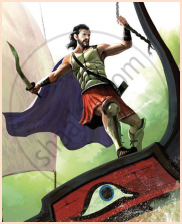
Complete the summary of the poem, choosing words from the list given below. Lines 33 to 42
Ulysses desires to hand over his (1) ______to his son Telemachus, who would fulfil his duties towards his subjects with care and (2) ______. Telemachus possesses patience and has the will to civilise the citizens of Ithaca in a (3) ______way. Ulysses is happy that his son would do his work blamelessly and he would pursue his (4) ______for travel and knowledge.
| prudence, kingdom, quest, tender |
‘Ulysses is not happy to perform his duties as a king.’ Why?
Who does the speaker address in the second part?
What could be the possible outcomes of their travel?
Read the set of line from the poem and answer the question that follow.
Little remains: but every hour is saved
From that eternal silence, something more,
A bringer of new things; and vile it were
- How is every hour important to Ulysses?
- What does the term ‘Little remains’ convey?
Read the set of line from the poem and answer the question that follow.
Death closes all: but something ere the end,
Some work of noble note, may yet be done,
Not unbecoming men that strove with Gods.
- The above lines convey the undying spirit of Ulysses. Explain.
- Pick out the words in alliteration in the above lines.
Explain with reference to the context the following line.
We are not now that strength which in old days Moved earth and heaven;
What happened to the people who wanted too much money?
What are the poet’s thoughts on ‘being different’?
Here are a few poetic device used in the poem.
Transferred Epithet- It is a figure of speech in which an epithet grammatically qualifies a noun other than the person or a thing, it is actually meant to describe.
Read the line given below and answer the question that follow.
Tell him solitude is creative if he is strong and the final decisions are made in silent rooms.
- Can being in solitude help a strong human being? How?
- Identify the figure of speech in the above line.
Where was the narrator when the incident happened?
Why did Napoleon’s eyes become soft as a mother eagle’s eyes?
