Advertisements
Advertisements
प्रश्न
Read the line given below and answer the question that follow.
“Fear, trembling Hope, and Death, the skeleton,
And Time the shadow”, and though weak the verse
That would thy beauty fain, oh, fain rehearse,
May Love defend thee from oblivion’s curse.
- What does the poet mean by the expression ‘May love defend thee from oblivion’s curse?’
- What does the expression ‘fain’ convey?
- What does the poet convey through the expression ‘Fear, trembling Hope’?
Advertisements
उत्तर
- Any living thing will have to meet death. But the poet deeply believes that her love for the tree would ensure its immortality. She will live forever in her verses.
- Fain means eagerly.
- Fear and trembling hope mean the fear of lurking death and trembling hope is that death may not attack in the near future.
APPEARS IN
संबंधित प्रश्न
Why does the narrator say that the enemy was no threat at all?
Why were the secret galleries bare?
Who was the real enemy?
Human greed led to the mighty fall of the citadel. Explain.
Identify the figure of speech used in the following line.
Oh then our maze of tunneled stone
What has Wordsworth sanctified in his poem?
Read the line given below and answer the question that follow.
The giant wears the scarf, and flowers are hung
In crimson clusters all the bough among!
- Who is the giant here?
- Why is the scarf colourful?
Identify the figure of speech used in each of the extract given below and write down the answer in the space given below.
“The water-lilies spring, like snow enmassed.”
Identify the figure of speech used in each of the extract given below and write down the answer in the space given below.
“ What is that dirge-like murmur that I hear Like the sea breaking on a shingle -beach?
How does a man play a lover’s role?
When does a man become a judge? How?
Why is the last stage called second childhood?
Pick out the word in ‘alliteration’ in the following line.
“Jealous in honour, sudden and quick in quarrel.”
Describe the various stages of a man’s life picturised in the poem “All the World’s a stage."
Introduction
The poem ‘Ulysses’ is a dramatic monologue that contains 70 lines of blank verse. Ulysses, the King of Ithaca, gathers his men together to prepare for the journey and exhorts them not to waste their time left on earth. Ulysses has grown old, having experienced many adventures at the battle of Troy and in the seas. After returning to Ithaca, he desires to embark upon his next voyage. His inquisitive spirit is always looking forward to more and more of such adventures.
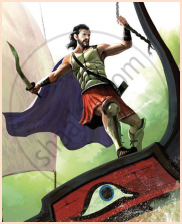
Complete the summary of the poem, choosing words from the list given below. Lines 1 to 32
Ulysses is (1) ______to discharge his duties as a (2) ______, as he longs for (3) ______. He is filled with an (4) ______thirst for (5) ______and wishes to live life to the (6) ______. He has travelled far and wide gaining (7) _______ of various places, cultures, men and (8) ______. He recalls with delight his experience at the battle of Troy. Enriched by his (9) ______he longs for more and his quest seems endless. Like metal which would (10) ______if unused, life without adventure is meaningless. According to him living is not merely (11) ______to stay alive. Though old but zestful, Ulysses looks at every hour as a bringer of new things and yearns to follow knowledge even if it is (12)______.
| fullest, unquenchable, unattainable, experience, knowledge, king, matters, rust, adventure, unwilling, travel, breathing |
Who does the speaker address in the second part?
Identify the figure of speech employed in the following line.
.....the deep Moans round with many voices.
Identify the figure of speech employed in the following line.
To follow knowledge like a sinking star.
Explain with reference to the context the following line.
He works his work, I mine.
Explain with reference to the context the following line.
We are not now that strength which in old days Moved earth and heaven;
What has twisted good men into thwarted worms?
Here are a few poetic device used in the poem.
Antithesis- It is a literary device that emphasises the idea of contrast.
Explain the following line with reference to the context.
Yet learning something out of every folly
hoping to repeat none of the cheap follies
What was Napoleon’s reaction on hearing the news of victory?
Read the line given below and answer the question that follow.
‘You’re wounded!’ ‘Nay’, his soldier’s pride Touched to the quick, he said:
- Why did the boy contradict Napoleon’s words?
- Why was his pride touched?
Read the line given below and answer the question that follow.
A film the mother eagles eye When her bruised eaglet breathes
- Who is compared to the mother eagle in the above lines?
- Explain the comparison.
Explain the following line with reference to the context.
Then off there flung in smiling joy, And held himself erect
Explain the following line with reference to the context.
‘I’m killed, Sire!’ And, his Chief beside, Smiling, the boy fell dead.
