Advertisements
Advertisements
प्रश्न
Who is the narrator in the poem?
Advertisements
उत्तर
A soldier is a narrator in the poem.
APPEARS IN
संबंधित प्रश्न
Why didn’t the narrator want to tell the tale to anybody?
Read the poem again and complete the summary using the words given in box.
Stanzas 1–3
‘The Castle’ by Edwin Muir is a moving poem on the (1)______ of a well guarded (2)______ The soldiers of the castle were totally stress-free and relaxed. They were (3)______ of their castle’s physical strength. Through the turrets they were able to watch the mowers and no enemy was found up to the distance of (4)______ and so they seemed no threat to the castle. They had (5)______ of weapons to protect them and a large quantity of (6)______ in stock to take care of the well-being of the soldiers inside the castle. The soldiers stood one above the other on the towering battlements (7)______ to shoot the enemy at sight. They believed that the castle was absolutely safe because their captain was (8)______ and the soldiers were loyal.
| half-a-mile | watching |
| castle | brave |
| ration | capture |
| plenty | confident |
Stanzas 4–6
Even by a trick no one but the birds could enter. The enemy could not use a (9)______ for their entry inside the castle. But there was a wicket gate guarded by a (10) ______ He (11)______ in the enemies inside the famous citadel that had been known for its secret gallery and intricate path. The strong castle became(12)______ and thin because of the greedy disloyal warder. The (13)______ was captured by the enemies for (14)______ The narrator (15)______ over the (16)______ of the useless warder and also decided not to disclose this (17)______ story to anyone. He was (18)______ and wondered how he would keep this truth to himself. He regretted not finding any (19)______ to fight with the (20)______ called ‘gold’.
| lamented | shameful |
| wicked guard | bait |
| let | gold |
| weapon | citadel |
| weak | disloyalty |
| helpless | enemy |
Bring out the contrasting picture of the castle as depicted in stanzas 3 and 5.
Our only enemy was gold
Identify the figure of speech used in the following line.
Grew thin and treacherous as air.
Identify the figure of speech used in the following line.
How can this shameful tale be told?
Why is the casuarina tree dear to poet’s heart?
To whom does Toru Dutt want to consecrate the tree’s memory?
Explain the following line with reference to the context.
Dear is the Casuarina to my soul;
“And they have their exits and their entrances” - What do the words ‘exits’ and ‘entrances’ mean?
Read the given line and answer the question that follow.
Then the whining school-boy, with his satchel
And shining morning face, creeping like snail
Unwillingly to school.
- Which stage of life is being referred to here by the poet?
- What are the characteristics of this stage?
- How does the boy go to school?
- Which figure of speech has been employed in the second line?
Read the given line and answer the question that follow.
Then a soldier,
full of strange oaths, and bearded like the pard,
Jealous in honour, sudden and quick in quarrel,
Seeking the bubble reputation
Even in the cannon's mouth.
- What is the soldier ready to do?
- Explain ‘bubble reputation’.
- What are the distinguishing features of this stage?
Introduction
The poem ‘Ulysses’ is a dramatic monologue that contains 70 lines of blank verse. Ulysses, the King of Ithaca, gathers his men together to prepare for the journey and exhorts them not to waste their time left on earth. Ulysses has grown old, having experienced many adventures at the battle of Troy and in the seas. After returning to Ithaca, he desires to embark upon his next voyage. His inquisitive spirit is always looking forward to more and more of such adventures.
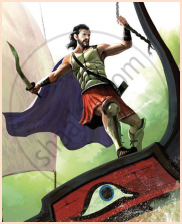
Complete the summary of the poem, choosing words from the list given below. Lines 33 to 42
Ulysses desires to hand over his (1) ______to his son Telemachus, who would fulfil his duties towards his subjects with care and (2) ______. Telemachus possesses patience and has the will to civilise the citizens of Ithaca in a (3) ______way. Ulysses is happy that his son would do his work blamelessly and he would pursue his (4) ______for travel and knowledge.
| prudence, kingdom, quest, tender |
In what ways were Ulysses and his mariners alike?
Identify the figure of speech employed in the following line.
Thro’ scudding drifts the rainy Hyades Vext the dim sea...
Read the set of line from the poem and answer the question that follow.
Little remains: but every hour is saved
From that eternal silence, something more,
A bringer of new things; and vile it were
- How is every hour important to Ulysses?
- What does the term ‘Little remains’ convey?
Read the set of line from the poem and answer the question that follow.
This is my son, mine own Telemachus,
To whom I leave the sceptre and the isle Well-loved of me,
- Who does Ulysses entrust his kingdom to, in his absence?
- Bring out the significance of the ‘sceptre’.
Read the set of line from the poem and answer the question that follow.
Death closes all: but something ere the end,
Some work of noble note, may yet be done,
Not unbecoming men that strove with Gods.
- The above lines convey the undying spirit of Ulysses. Explain.
- Pick out the words in alliteration in the above lines.
Read the set of line from the poem and answer the question that follow.
One equal temper of heroic hearts,
Made weak by time and fate, but strong in will
To strive, to seek, to find, and not to yield.
- Though made weak by time and fate, the hearts are heroic. Explain.
- Pick out the words in alliteration in the above lines.
Explain with reference to the context the following line.
It may be we shall touch the Happy Isles,
And see the great Achilles, whom we knew.
What are the poet’s thoughts on ‘being different’?
Read the line given below and answer the question that follow.
“Life is hard; be steel; be a rock.”
- How should one face life?
- Identify the figure of speech in the above line.
Read the line given below and answer the question that follow.
Tell him solitude is creative if he is strong and the final decisions are made in silent rooms.
- Can being in solitude help a strong human being? How?
- Identify the figure of speech in the above line.
Read the line given below and answer the question that follow.
Tell him time as a stuff can be wasted.
Tell him to be a fool every so often
- Why does the poet suggest that time can be wasted?
- Identify the figure of speech in the above line.
Describe the posture of Napoleon.
Who came galloping on a horse to Napoleon?
What does the phrase ‘full galloping’ suggest?
What did the rider do when he reached Napoleon?
Read the line given below and answer the question that follow.
‘You’re wounded!’ ‘Nay’, his soldier’s pride Touched to the quick, he said:
- Why did the boy contradict Napoleon’s words?
- Why was his pride touched?
