Topics
Physics and Measurement
- What is Physics?
- Scope and Excitement of Physics
- Physics Related to Technology and Society
- Nature of Physical Laws
- Physical Quantities
- Unit and Its Types
- Unit Systems
- The International System of Units (SI)
- Unit Prefixes
- Measurement of Length
- Measurement of Mass
- Accuracy, Precision and Least Count of Measuring Instruments
- Errors in Measurements>Systematic Errors
- Significant Figures
- Dimensions of Physical Quantities
- Dimensional Formulae and Dimensional Equations
- Dimensional Analysis and Its Applications
Kinematics
- Introduction to Kinematics
- Position, Path Length and Displacement
- Position - Time Graph
- Speed and Velocity
- Uniform and Non-uniform Motion
- Average Speed
- Uniformly Accelerated Motion
- Velocity - Time Graphs
- Relations for Uniformly Accelerated Motion (Graphical Treatment)
- Vector Analysis
- Vector
- Vector Operations>Addition and Subtraction of Vectors
- Vector Addition – Analytical Method
- Scalar (Dot) and Vector (Cross) Product of Vectors
- Resolution of Vectors
- Motion in a Plane
- Projectile Motion
- Uniform Circular Motion (UCM)
- Equations of Motion in a Plane with Constant Acceleration
- Relative Velocity in Two Dimensions
Laws of Motion
- Newton’s Laws of Motion
- Aristotle’s Fallacy
- The Law of Inertia
- Newton's First Law of Motion
- Newton’s Second Law of Motion
- Newton's Third Law of Motion
- Conservation of Momentum
- Law of Conservation of Linear Momentum and Its Applications
- Equilibrium of a Particle
- Common Forces in Mechanics
- Types of Friction>Rolling Friction
- Circular Motion and Its Characteristics
- Types of Friction>Kinetic Friction
- Laws of Friction
- Dynamics of Uniform Circular Motion - Centripetal Force
- Solving Problems in Mechanics
- Motion of Connected Bodies, Pulley and Equilibrium of Forces
- Friction
- Banking of Roads
Work, Energy, and Power
- Introduction of Work, Energy and Power
- Notions of Work and Kinetic Energy: the Work-energy Theorem
- Mechanical Energy > Kinetic Energy (K)
- Concept of Work
- Types of Forces>Work Done by a Variable Force
- Mechanical Energy > Potential Energy (U)
- Conservation of Mechanical Energy
- Potential Energy of a Spring
- Forms of Energy > Solar Energy
- Concept of Power
- Collisions
- Concept of Energy
Rotational Motion
- Centre of Mass of Two-particle System
- Centre of Mass of a Rigid Body
- Translational and Rotational Motions
- Moment of a Force
- Torque and Angular Momentum
- Moment of Inertia
- Values of Moments of Inertia for Simple Geometrical Objects (No Derivation)
- Theorems of Perpendicular and Parallel Axes
- Rigid Body Rotation
- Equations of Rotational Motion
- Centre of Gravity
- Principle of Moments
- Angular Displacement
- Velocity and Acceleration in Simple Harmonic Motion
- Couple and Its Torque
- Rolling Motion
- Rotational K.E.
Gravitation
- Concept of Gravitation
- Kepler’s Laws
- Newton's Universal Law of Gravitation
- The Gravitational Constant
- Acceleration Due to Gravity of the Earth
- Acceleration Due to Gravity Below and Above the Earth's Surface
- Variation in the Acceleration>Variation in Gravity with Altitude
- Gravitational Field
- Expression for Gravitational Potential Energy
- Escape Speed
- Earth Satellites
- Binding Energy of an Orbiting Satellite
- Geostationary and Polar Satellites
- Weightlessness
- Escape Velocity
- Orbital Velocity of a Satellite
- Motion of Satellites
Properties of Solids and Liquids
- Introduction of Properties of Solids and Liquids
- Stress and Strain
- Hooke’s Law
- Stress-strain Curve
- Elastic Modulus>Young’s Modulus
- Elastic Modulus>Young’s Modulus
- Elastic Modulus>Shear Modulus (Modulus of Rigidity)
- Elastic Modulus>Bulk Modulus
- Elastic Modulus>Poisson’s Ratio
- Elastic Potential Energy in a Stretched Wire
- Application of Elastic Behaviour of Materials
- Pressure
- Pascal’s Law
- Variation of Pressure with Depth
- Atmospheric Pressure and Gauge Pressure
- Hydraulic Machines
- Streamline and Turbulent Flow
- Bernoulli's Equation
- Applications of Bernoulli’s Equation
- Torricelli's Law
- Viscous Force or Viscosity
- Stoke's Law
- Surface Tension
- Surface Energy
- Surface Tension and Surface Energy
- Angle of Contact
- Drops and Bubbles
- Capillary Rise
- Detergents and Surface Tension
- Temperature and Heat
- Measurement of Temperature
- Absolute Zero and Absolute Temperature
- Thermal Expansion
- Specific Heat Capacity
- Calorimetry
- Latent Heat
- Heat Transfer
- Conduction
- Convection
- Radiation
- Blackbody Radiation
- Qualitative Ideas of Black Body Radiation
- Wien's Displacement Law
- Green House Effect
- Newton’s Law of Cooling
- Reynold's Number
- Work Done in Stretching a Wire
- Terminal Velocity
- Capillarity and Capillary Action
- Fluid Flow
- Thermometer and Its Types
Thermodynamics
- Introduction of Chemical Thermodynamics
- Thermal Equilibrium
- Measurement of Temperature
- Heat, Internal Energy and Work
- First Law of Thermodynamics
- Specific Heat Capacity
- Thermodynamic State Variables and Equation of State
- Thermodynamic Process
- Isothermal Processes
- Adiabatic Processes
- Heat Engine
- Refrigerators and Heat Pumps
- Entropy and Second Law of Thermodynamics
- Reversible and Irreversible Processes
- Carnot Engine
Kinetic Theory of Gases
- Introduction of Kinetic Theory of Gases
- Mean Free Path
- Gases and Its Characteristics
- Kinetic Theory of an Ideal Gas
- Law of Equipartition of Energy
- Specific Heat Capacities - Gases
- Equation of State of a Perfect Gas
- Work Done in Compressing a Gas
- Interpretation of Temperature in Kinetic Theory
- Kinetic Theory of Gases - Concept of Pressure
- Assumptions of Kinetic Theory of Gases
- RMS Speed of Gas Molecules
- Degrees of Freedom
- Avogadro's Number
- Gas Laws
- Mechanical Energy > Kinetic Energy (K)
- Speed of Gas
Oscillations and Waves
- Introduction of Oscillations
- Periodic and Oscillatory Motion
- Simple Harmonic Motion (S.H.M.)
- Simple Harmonic Motion and Uniform Circular Motion
- Velocity and Acceleration in Simple Harmonic Motion
- Force Law for Simple Harmonic Motion
- Energy in Simple Harmonic Motion
- Some Systems Executing Simple Harmonic Motion
- Damped Simple Harmonic Motion
- Forced Oscillations and Resonance
- Displacement as a Function of Time
- Periodic Functions
- Oscillations - Frequency
- Wave Motion
- Transverse Waves
- Displacement Relation for a Progressive Wave
- The Speed of a Travelling Wave
- Principle of Superposition of Waves
- Reflection of Waves
- Introduction of Reflection of Waves
- Standing Waves and Normal Modes
- Beats
- Doppler Effect
- Interference
Electrostatics
- Concept of Electrostatics
- Electrical Conduction in Solids
- Charging by Induction
- Electric Field Due to a System of Charges
- Physical Significance of Electric Field
- Dipole in a Uniform External Field
- Continuous Charge Distribution
- Gauss’s Law
- Uniformly Charged Infinite Plane Sheet and Uniformly Charged Thin Spherical Shell (Field Inside and Outside)
- Electrostatic Potential
- Electric Potential Due to a Point Charge
- Relation Between Electric Field and Electrostatic Potential
- Potential Energy of a System of Charges
- Potential Energy in an External Field
- Potential Energy of a Single Charge
- Potential Energy of a System of Two Charges in an External Field
- Potential Energy of a Dipole in an External Field
- Electrostatics of Conductors
- Capacitors and Capacitance
- The Parallel Plate Capacitor
- Effect of Dielectric on Capacitance
- Work Done in Carrying a Charge
- Grouping of Capacitor
Current Electricity
- Electric Current and Its Related Concepts
- Drift of Electrons and the Origin of Resistivity
- Limitations of Ohm’s Law
- Resistivity of Various Materials
- Temperature Dependence of Resistivity
- Forms of Energy > Electrical Energy
- Electrical Power
- Resistors in Parallel
- Cells, EMF, and Internal Resistance
- V-I Characteristics (Linear and Non-linear)
- Specific Resistance or Electrical Resistivity
- Resistivity of Various Materials
- Cells in Series
- Heating Effect of Electric Current
- Cells, Thermo e.m.f. Electrolysis
Magnetic Effects of Current and Magnetism
- Magnetic force
- Motion in a Magnetic Field
- Motion in Combined Electric and Magnetic Fields
- Velocity Selector
- Cyclotron
- Magnetic Field Due to a Current-carrying Conductor: Biot-savart's Law
- Applications of Biot-Savart's Law > Magnetic Field at the Axis of a Circular Current-carrying Loop
- Ampere’s Circuital Law
- Toroid
- Solenoid
- Force Between Two Parallel Currents (Ampere’s Law)
- Torque on a Current-Loop in a Uniform Magnetic Field
- Moving Coil Galvanometer
- Force on a Current-Carrying Conductor Placed in a Uniform Magnetic Field
- Force on a Moving Charge in Uniform Magnetic and Electric Fields
- Current Loop as a Magnetic Dipole : Magnetic Dipole Moment of Current Loop
- Bar Magnet and Solenoid Analogy
- Magnetism and Gauss’s Law
- The Earth’s Magnetism
- Magnetisation and Magnetic Intensity
- Magnetic Properties of Materials
- Permanent Magnet
- Hysteresis: Retentivity and Coercivity
- Force and Torque on Current Carrying Conductor
- Properties of magnetic lines of force
- Properties of Solids: Magnetic Properties
- Magnetic Equipment
Electromagnetic Induction and Alternating Currents
- Introduction to Electromagnetic Induction
- The Experiments of Faraday and Henry
- Magnetic Flux
- Faraday's Laws of Electromagnetic Induction
- Lenz’s Law and Conservation of Energy
- Motional Electromotive Force (e.m.f.)
- Energy Consideration: a Quantitative Study
- Eddy Currents or Foucault Currents
- Inductance
- Mutual Inductance
- Self Inductance
- Alternating-Current Generator
- AC Voltage Applied to a Resistor
- Representation of AC Current and Voltage by Rotating Vectors - Phasors
- AC Voltage Applied to an Inductor
- AC Voltage Applied to a Capacitor
- AC Voltage Applied to a Series LCR Circuit
- LC Oscillations
- Transformers
- Peak and Rms Value of Alternating Current Or Voltage
- Reactance and Impedance
- Power in AC Circuit
- Motional and Static EMI and Application of EMI
- Voltage and Power
- Introduction to Ac and Aс Circuits
- LCR Circuit
- Quality and Power Factor
Electromagnetic Waves
- Displacement Current
- Introduction to Electromagnetic Waves
- Electromagnetic Spectrum
- Applications of e.m. waves
- Transverse Nature of Electromagnetic Waves (Quantitative Analysis)
- Nature of Electromagnetic Waves
Optics
- Reflection of Light by Spherical Mirrors
- Refraction of Light
- Total Internal Reflection
- Refraction at a Spherical Surface and Lenses
- Refraction at a Spherical Surfaces
- Refraction by a Lens
- Thin Lenses and Their Combination
- Refraction of Light through a Prism
- Some Natural Phenomena Due to Sunlight
- Introduction to Optical Instruments
- Simple Microscope or a Reading Glass
- Compound Microscope
- Telescope
- Huygens Principle
- Reflection and Refraction of Plane Wave at Plane Surface Using Huygens' Principle
- Refraction of a Plane Wave
- Refraction at a Rarer Medium
- Reflection of a Plane Wave by a Plane Surface
- Doppler Effect
- Coherent and Incoherent Addition of Waves
- Interference of Light Waves and Young’s Experiment
- Diffraction of Light
- Fraunhofer's Diffraction Due to a Single-slit
- Electric Polarisation of Dielectrics
- Ray Optics - Mirror Formula
- Dispersion of Light Through a Prism
- Young's Double Slit Experiment and Expression for Fringe Width
- No Interference by Two Independent Light-Sources : Coherent Sources
- Resolving Power of Microscope and Astronomical Telescope
- Width of Central Maximum
- Lens Formula and Magnification
- Magnification
- Brewster's Law
- Polaroids
- Plane Mirror
- Spherical Mirrors
- Reflection of Light
- Power of a Lens
- Resolving Power of Optical Instruments
Dual Nature of Matter and Radiation
- Understanding Dual Nature of Radiation and Matter
- Electron Emission
- The Photoelectric Effect
- Photoelectric Effect - Hertz’s Observations
- Photoelectric Effect - Hallwachs’ and Lenard’s Observations
- Experimental Study of Photoelectric Effect
- Photoelectric Effect and Wave Theory of Light
- Einstein’s Photoelectric Equation: Energy Quantum of Radiation
- Particle Nature of Light: The Photon
- Wave Nature of Matter
- Davisson and Germer Experiment
- Dual Behaviour of Matter: De Broglie's relationship
- Cathode and Positive Rays
- Photoelectric Effect X-rays
Atoms and Nuclei
- Concept of Atoms
- Alpha-particle Scattering and Rutherford’s Nuclear Model of Atom
- Atomic Spectra
- Bohr’s Model for Hydrogen Atom
- Energy Levels
- The Line Spectra of the Hydrogen Atom
- De Broglie’s Explanation of Bohr’s Second Postulate of Quantisation
- Hydrogen Spectrum
- Atomic Masses and Composition of Nucleus
- Size of the Nucleus
- Nuclear Binding Energy
- Mass - Energy
- Atomic Mass, Mass - Energy Relation and Mass Defect
- Nuclear Force
- Radioactivity
- Law of Radioactive Decay
- Alpha Decay
- Beta Decay
- Gamma Decay
- Forms of Energy > Nuclear Energy
- Nuclear Fission
- Nuclear Reactor
- Nuclear Fusion
- Controlled Thermonuclear Fusion
- Structure of the Atom and Nucleus
Electronic Devices
- Concept of Semiconductors
- Classification of Metals, Conductors and Semiconductors
- Intrinsic Semiconductor
- Extrinsic Semiconductor
- Diode or p-n Junction
- Semiconductor Diode
- p-n Junction Diode as a Rectifier
- Special Purpose P-n Junction Diodes
- Voltage Regulator
- Digital Electronics and Logic Gates
- Junction Transistor
- Transistor Action
- Transistor and Characteristics of a Transistor
- Transistor as an Amplifier (Ce-configuration)
- Feedback Amplifier and Transistor Oscillator
Communication Systems
- Communication System
- Propagation of EM Waves
- Need for Modulation and Demodulation
- Modulation and Its Necessity
- Amplitude Modulation (AM)
- Detection of Amplitude Modulated Wave
- Production of Amplitude Modulated Wave
- Frequency Modulation (FM)
- Bandwidth of Signals
- Bandwidth of Transmission Medium
- Basic Terminology Used in Electronic Communication Systems
- Satellite Communication
Defination: Speed
Speed is the distance travelled by an object in a given amount of time without considering the direction.
Formula: Speed = `"Distance traversed" / "Total time."`
Example 1
If a car covers 40 km in one hour, its speed is 40 km/hour.
- Unit: The unit of speed is meters/second (m/s) in the SI system.
- Type: Speed is a scalar quantity. It only tells how fast something is moving, but not in which direction.
2. Velocity
Velocity is the displacement of an object in a specific direction divided by the time taken.
Formula: Velocity = `"Displacement" / "Total time"`
Example 2
If Ranjit’s displacement from home to school is 1000 meters and he takes 25 minutes, his velocity will be:
Velocity = `"1000 meters" / " 25 minutes"` = `"40 meters" / "60 seconds "`
- Unit: The unit of velocity is also meters/second (m/s) in the SI system.
- Type: Velocity is a vector quantity. It tells both how fast something is moving and the direction of movement.
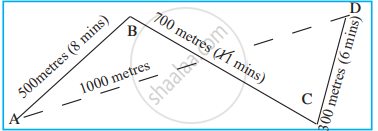
The actual distance traversed by Ranjit from home to school
= AB + BC + CD
= 500 m + 700 m + 300 m = 1500 m.
Total time from home to school = 8 minutes + 11 minutes + 6 minutes = 25 minutes.
Ranjit’s displacement from home to school, AD = 1000 meters. Thus, Ranjit’s velocity when going from home to school.
Velocity= `"Displacement" / "Total time"` = `"1000 metres " / "25 minutes"` = `"40 metres" / "60 seconds "` = 0.66 metres/second
Ranjit’s speed while going to school:
Speed= `"Distance traversed" / "Total time"` = `"1500 metres" / "25 minute"` = `"60 metres" / "60 seconds"` = 1 metre/second
Ranjit did not take the straight route of minimum distance while going to school. Therefore, the magnitudes of his velocity and speed were different. Had Ranjit actually gone by the straight route AD, then the magnitudes of his velocity and speed would have been the same.
Example 3
The straight-line distance between the houses of Sheetal and Sangeeta is 500 m, and that between Sangeeta’s house and school is 1200 m. Also, the straight-line distance between Sheetal’s house and school is 1300 m. Suppose Sheetal takes 5 minutes to reach Sangeeta’s house and then 24 minutes to reach school from there. Then,
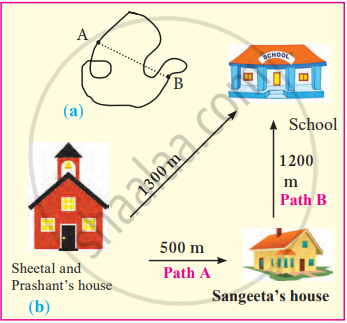
Location of the school and houses
Sheetal’s speed along path A = `"Distance"/"Time"` = `"500 m"/"5 minute"` = 100 m/minute
Sheetal’s speed along path B = `"Distance"/"Time"` = `"1200 m"/"24 minute"` = 50 m/minute
Sheetal’s average speed = `"Total distance"/"Total time"` = `"1700 m"/"29 minute"` = 58.6 m/minute
Sheetal’s velocity = `"Displacement"/"Time"` = `"1300 m"/"29 minute"`
Sheetal’s velocity = 44.83 m/minute
