Topics
Units and Measurements
- Quantitative Science
- System of Units
- Derived Quantities and Units
- Rules and Conventions for Writing SI Units and Their Symbols
- Measurement of Length
- Measurement of Mass
- Measurement of Time
- Dimensions and Dimensional Analysis
- Accuracy, Precision and Uncertainty in Measurement
- Errors in Measurements>Systematic Errors
- Errors in Measurements>Random Errors
- Estimation of Errors
- Combination of Errors
- Significant Figures
- Definitions of SI Units and Constants
Mathematical Methods
- Vector Analysis
- Scalar
- Vector
- Vector Operations>Multiplication of a Vector by a Scalar
- Vector Operations>Addition and Subtraction of Vectors
- Vector Operations>Triangle Law for Vector Addition
- Vector Operations>Law of parallelogram of vectors
- Resolution of Vectors
- Multiplication of Vectors>Scalar Product(Dot Product)
- Multiplication of Vectors>Vector Product (Cross Product)
- Concept of Calculus
- Differential Calculus
- Integral Calculus
Motion in a Plane
- Concept of Motion
- Rectilinear Motion
- Displacement
- Path Length
- Average Velocity
- Average Speed
- Instantaneous Velocity
- Instantaneous Speed
- Acceleration in Linear Motion
- Relative Velocity
- Motion in Two Dimensions - Motion in a Plane
- Average and Instantaneous Velocities
- Acceleration in a Plane
- Equations of Motion in a Plane with Constant Acceleration
- Relative Velocity in Two Dimensions
- Projectile Motion
- Uniform Circular Motion (UCM)
- Key Parameters of Circular Motion
- Centripetal Acceleration
- Conical Pendulum
Laws of Motion
- Fundamental Principles of Motion and Mechanics
- Types of Motion
- Aristotle’s Fallacy
- Newton’s Laws of Motion
- Newton's First Law of Motion
- Newton’s Second Law of Motion
- Newton's Third Law of Motion
- Inertial and Non-inertial Frames of Reference
- Types of Forces>Fundamental Forces in Nature
- Types of Forces>Contact and Non-Contact Forces
- Types of Forces>Real and Pseudo Forces
- Types of Forces>Conservative and Non-Conservative Forces
- Types of Forces>Work Done by a Variable Force
- Work Energy Theorem
- Principle of Conservation of Linear Momentum
- Collisions
- Elastic and Inelastic Collisions
- Perfectly Inelastic Collision
- Coefficient of Restitution e
- Expressions for Final Velocities in Elastic Head-On Collision
- Loss of Kinetic Energy in Perfectly Inelastic Head-On Collision
- Collision in Two Dimensions
- Impulse of a Force
- Necessity of Defining Impulse
- Rotational Analogue of a Force: Moment of a Force Or Torque
- Couple and Its Torque
- Proof of Independence of the Axis of Rotation
- Mechanical Equilibrium
- States of Equilibrium
- Centre of Mass>Mathematical Understanding of Centre of Mass
- Centre of Mass>Velocity of Centre of Mass
- Centre of Mass>Acceleration of Centre of Mass
- Centre of Mass>Characteristics of Centre of Mass
- Centre of Gravity
Gravitation
- Concept of Gravitation
- Kepler’s Laws
- Law of Orbit or Kepler's First Law
- Law of Areas or Kepler's Second Law
- Law of Periods or Kepler's Third Law
- Newton's Universal Law of Gravitation
- Measurement of the Gravitational Constant (G)
- Acceleration Due to Gravity (Earth’s Gravitational Acceleration)
- Variation in the Acceleration>Variation in Gravity with Altitude
- Variation in the Acceleration>Variation in Gravity with Depth
- Variation in the Acceleration>Variation in Gravity with Latitude and Rotation of the Earth
- Variation in the Acceleration>Effect of the Shape of the Earth
- Gravitational Potential Energy
- Expression for Gravitational Potential Energy
- Connection of Potential Energy Formula with mgh
- Potential Difference
- Escape Velocity
- Earth Satellites
- Projection of Satellite
- Weightlessness in a Satellite
- Time Period of Satellite
- Binding Energy of an Orbiting Satellite
Mechanical Properties of Solids
- Understanding Mechanical Properties of Solids
- Elastic Behavior of Solids
- Stress and Strain
- Types of Stress and Corresponding Strain
- Hooke’s Law
- Elastic Modulus>Young’s Modulus
- Elastic Modulus>Bulk Modulus
- Elastic Modulus>Shear Modulus (Modulus of Rigidity)
- Elastic Modulus>Poisson’s Ratio
- Stress-strain Curve
- Strain Energy
- Hardness of Material
- Friction in Solids
- Origin of Friction
- Types of Friction>Static Friction
- Types of Friction>Kinetic Friction
- Types of Friction>Rolling Friction
Thermal Properties of Matter
- Understanding Thermal Properties of Matter
- Temperature and Heat
- Measurement of Temperature
- Absolute Zero and Absolute Temperature
- Ideal Gas Equation
- Thermal Expansion
- Linear Expansion
- Areal Expansion
- Volume Expansion
- Specific Heat Capacity of Solids and Liquids
- Relation Between Coefficient of Expansion
- Specific Heat Capacity of Gas
- Heat Equation
- Thermal Capacity
- Calorimetry
- Change of State
- Analysis of Observation>From Point A to B
- Analysis of Observation>From Point B to D
- Evaporation vs Boiling
- Boiling Point and Pressure
- Sublimation
- Phase Diagram
- Gas and Vapour
- Latent Heat
- Heat Transfer
- Conduction
- Thermal Conductivity
- Coefficient of Thermal Conductivity
- Thermal Resistance
- Applications of Thermal conductivity
- Convection
- Application of Convection
- Free and Forced Convection
- Radiation
- Newton’s Law of Cooling
Sound
- Sound Waves
- Common Properties of All Waves
- Transverse Waves
- Longitudinal Waves
- Mathematical Expression of a Wave
- The Speed of Travelling Waves
- The Speed of Transverse Waves
- The Speed of Longitudinal Waves
- Newton's Formula for Velocity of Sound
- Laplace’s Correction
- Factors Affecting Speed of Sound
- Principle of Superposition of Waves
- Echo
- Reverberation
- Acoustics
- Qualities of Sound
- Doppler Effect
- Source Moving and Listener Stationary
- Listener Approaching a Stationary Source with Velocity
- Both Source and Listener are Moving
- Common Properties between Doppler Effect of Sound and Light
- Major Differences between Doppler Effects of Sound and Light
Optics
- Fundamental Concepts of Light
- Nature of Light
- Ray Optics Or Geometrical Optics
- Cartesian Sign Convention
- Reflection>Reflection from a Plane Surface
- Reflection>Reflection from Curved Mirrors
- Total Internal Reflection
- Refraction of Light
- Applications of Total Internal Reflection
- Refraction at a Spherical Surface and Lenses
- Thin Lenses and Their Combination
- Refraction at a Single Spherical Surface
- Lens Makers' Equation
- Dispersion of Light Through a Prism
- Analysis of Prism
- Thin Prisms
- Some Natural Phenomena Due to Sunlight
- Defects of Lenses
- Introduction to Optical Instruments
- Simple Microscope or a Reading Glass
- Compound Microscope
- Telescope
Electrostatics
- Concept of Electrostatics
- Electric Charges
- Properties of Electric Charge
- Additive Nature of Charge
- Quantization of Charge
- Conservation of Charge
- Force between Charges
- Coulomb’s Law
- Coulomb's Law (Scalar Form): Force Between Two Point-Charges
- Relative Permittivity or Dielectric Constant
- Definition of Unit Charge from the Coulomb’s Law
- Coulomb's Law in Vector Form
- Forces Between Multiple Charges: Superposition Principle
- Electric Field
- Electric Field Intensity Due to a Point-Charge
- Practical Way of Calculating Electric Field
- Electric Lines of Force
- Electric Flux
- Gauss’s Law
- Electric Dipole
- Couple Acting on an Electric Dipole in a Uniform Electric Field
- Electric Intensity at a Point Due to an Electric Dipole
- Continuous Charge Distribution
Electric Current Through Conductors
- Electric Current and Its Related Concepts
- Electric Current
- Flow of Current Through a Conductor
- Drift Speed
- Ohm's Law
- Limitations of Ohm’s Law
- Electrical Power
- Resistors
- Rheostat
- Resistors in Parallel
- Specific Resistance or Electrical Resistivity
- Variation of Resistance with Temperature
- Electromotive Force of a Cell
- Cells in Series
- Cells in Parallel
- Types of Cells
Magnetism
- Concept of Magnetism
- Magnetic Lines of Force
- Bar Magnet and Solenoid Analogy
- Magnetic Field due to a Bar Magnet
- Magnetic Field Due to a Bar Magnet at an Arbitrary Point
- Gauss' Law of Magnetism
- The Earth’s Magnetism
Electromagnetic Waves and Communication System
- Foundations of Electromagnetic Theory
- Nature of Electromagnetic Waves
- Introduction to Electromagnetic Waves
- Characteristics of EM Waves
- Electromagnetic Spectrum
- Radio Waves
- Microwaves
- Infrared waves
- Visible Light
- Ultraviolet rays
- X-rays
- Gamma Rays
- Propagation of EM Waves
- Ground (surface) Wave
- Space wave
- Sky wave propagation
- Communication System
- Elements of a Communication System
- Commonly Used Terms in Electronic Communication System
- Modulation
Semiconductors
- Concept of Semiconductors
- Electrical Conduction in Solids
- Band Theory of Solids
- Intrinsic Semiconductor
- Extrinsic Semiconductor
- n-type Semiconductor
- p-type Semiconductor
- Charge neutrality of extrinsic semiconductors
- Diode or p-n Junction
- Basics of Semiconductor Devices
- Applications of Semiconductors and P-n Junction Diode
- Thermistor
Introduction
A vector can be broken down into simpler parts called components that act in specific directions. Resolution of a vector means splitting one vector into two or more smaller vectors that add up to give the original vector. This technique helps us understand how a force, velocity, or any vector quantity works in different directions. Rectangular components are the most common type, where vectors are split into perpendicular directions (x and y in 2D, or x, y, and z in 3D). Breaking vectors into components makes solving physics problems much easier.
Maharashtra State Board: Class 11
Definition: Resolution of the Vector
A vector \[\vec V\] can be expressed as the sum of two or more vectors along fixed directions. This process is known as vector resolution.
OR
The process of splitting a single vector into two or more vectors in different directions which together produce same effect as produced by the single vector alone is called resolution of vector.
Maharashtra State Board: Class 11
Definition: Rectangular Components
When a vector is resolved into components along mutually perpendicular directions (like x and y axes in 2D, or x, y, and z axes in 3D), these components are called rectangular or Cartesian components.
OR
When a vector is resolved along two mutually perpendicular directions, the components so obtained are called rectangular components of the given vector.
Definition: Component Vectors
The splitting vectors obtained when a single vector is resolved into two or more vectors in different directions are called component vectors.
Definition: Direction Cosines
The values of cosα, cosβ, and cosγ which are the cosines of the angles subtended by the rectangular components with the given vector are called direction cosines of a vector.
Definition: Orthogonal Triad of Base Vectors
The three mutually perpendicular unit vectors \[\hat i\], \[\hat j\], \[\hat k\] used in three-dimensional space to describe the direction of any vector — where \[\hat i\] is along X-axis, \[\hat j\] along Y-axis, and \[\hat k\] along Z-axis — are called an orthogonal triad of base vectors.
Maharashtra State Board: Class 11
Formula: Resolution of a Vector
When a vector \[\vec A\] is resolved into three-dimensional rectangular components, it is given by:
Formula: Magnitude of a 3D Vector
The magnitude of vector \[\vec A\] resolved into three-dimensional components is:
A = \[\sqrt{A_x^2+A_y^2+A_z^2}\]
Formula: Direction Cosines
If α, β, and γ are the angles subtended by the rectangular components with the given vector, then:
cos α = \[\frac {A_x}{A}\], cos β = \[\frac {A_y}{A}\], cos γ = \[\frac {A_z}{A}\]
Formula: Identity of Direction Cosines
The sum of squares of all direction cosines is always equal to 1:
cos2α + cos2β + cos2γ = 1
Characteristics
| Feature | Description |
|---|---|
| Perpendicularity | Components are at right angles (90°) to each other in rectangular systems |
| Independence | Each component acts independently in its direction without affecting others |
| Additivity | The original vector equals the sum of all its components |
| Magnitude Relationship | The magnitude of the original vector can be found using the Pythagorean theorem |
| Direction | The angle of the original vector is found from the ratio of components |
| Unit Vector Notation | Components expressed using standard unit vectors i, j, k |
| Scalar Nature | Component values can be positive, negative, or zero, depending on direction |
Vector Resolution in 2D
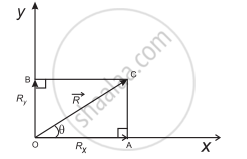
- Identify the vector \[\vec R\] and the angle θ it makes with the x-axis.
- Draw perpendiculars from the tip of the vector to both the x-axis and the y-axis.
- The perpendicular from the vector tip to the x-axis gives the vertical component \[\vec R_y\] at point B.
- The perpendicular from the vector tip to the y-axis gives the horizontal component \[\vec R_x\] at point A.
- Use trigonometry to calculate:
Horizontal component: Rx = R cos θ
Vertical component: Ry = R sin θ - Express the vector in unit vector notation: \[\vec R\] = Rx î + Ry ĵ
- If needed, find the magnitude: R = √(Rx² + Ry²)
- If needed, find the direction: θ = tan⁻¹(Ry/Rx)
2D vs 3D Rectangular Components
| Point of Comparison | 2D Components | 3D Components |
|---|---|---|
| Number of Axes | 2 axes (x and y) | 3 axes (x, y, and z) |
| Vector Form | \[\vec R\] = Rx î + Ry ĵ | \[\vec R\] = Rx î + Ry ĵ + Rz k̂ |
| Magnitude Formula | R = √(Rx² + Ry²) | R = √(Rx² + Ry² + Rz²) |
| Angle/Direction | Single angle θ with the x-axis | Three direction angles (direction cosines) |
| Geometric Shape | Rectangle formed by components | Rectangular parallelepiped (3D box) formed by components |
| Unit Vectors Used | î, ĵ (2 unit vectors) | î, ĵ, k̂ (3 unit vectors) |
| Application | Motion on a flat surface, 2D forces | 3D motion in space, 3D forces in engineering |
Example 1
Find a unit vector in the direction of \[\vec V\] = 3 \[\hat i\] + 4 \[\hat j\].
Solution:
Magnitude |\[\vec V\]| = \[\sqrt{3^{2}+4^{2}}\] = 5.
A unit vector in the same direction is:
Example 2
Given \[\vec a\] =1 \[\hat i\] + 2 \[\hat j\] and \[\vec b\] = 2 \[\hat i\] + 1 \[\hat j\], what are their magnitudes? Are the vectors equal?
Solution:
Both have the same magnitude, but their components differ:
\[a_{x}\neq b_{x},a_{y}\neq b_{y}.\]
Thus \[\vec a\] ≠ \[\vec b\].