Topics
System of Coplanar Forces
- Resultant of concurrent forces
- Resultant of parallel forces
- non-concurrent Non-parallel system of forces
- Moment of force about a point
- Moment of force about Couples
- Varignon’s Theorem
- Force couple system
- Distributed Forces in plane
Center of Gravity and Centroid for Plane Laminas
- Centroid for Plane Laminas
Equilibrium of System of Coplanar Forces
- Condition of equilibrium for concurrent forces
- Condition of equilibrium for parallel forces
- Condition of Equilibrium for non-concurrent nonparallel general forces
- Condition of equilibrium for Couples
Types of Support
- Load Support
- Beams Support
- Determination of reactions at supports for various types of loads on beams
Analysis of Plane Trusses
- Analysis of Plane Trusses by Using Method of Joints
- Analysis of plane trusses By using Method of sections
Forces in Space
Resultant of Noncoplanar force systems
- Resultant of Concurrent Force System
- Parallel Force System
- Non-concurrent Non-parallel Force System
Equilibrium of Noncoplanar force systems
- Equilibrium of Concurrent force system
- Equilibrium of parallel force system
- Equilibrium of non-concurrent non-parallel force system
Friction
- Introduction to Laws of Friction
- Cone of Friction
- Equilibrium of Bodies on Inclined Plane
- Application to Problems Involving Wedges
- Ladders
Principle of Virtual Work
- Applications on Equilibrium Mechanisms
- Applications on pin jointed frames.
Kinematics of Particle
- Rectilinear Motion
- Velocity and Acceleration in Terms of Rectangular Co-ordinate System
- Motion Along Plane Curved Path
- Tangentialand Normal Component of Acceleration
- Motion Curves (a-t, v-t, s-t curves)
- Projectile Motion
Kinematics of Rigid Bodies
- Introduction to General Plane Motion
- Instantaneous Center of Rotation for the Velocity
- Velocity Diagrams for Bodies in Plane Motion.
Kinetics of a Particle
Force and Acceleration
- Introduction to Basic Concepts
- D’Alemberts Principle
- Equations of Dynamic Equilibrium
- Newton’s Second Law of Motion
Work and Energy
- Principle of Work and Energy
- Principle of Conservation of Energy
Impulse and Momentum
- Principle of Linear Impulse and Momentum
- Law of Conservation of Momentum
- Impact and Collision
Introduction
Projectile motion is the movement of an object in flight after being thrown with some initial velocity. Any object in flight after being thrown with some velocity is called a projectile. We see projectile motion every day—when children throw stones at trees to get fruit, when a bowler delivers a ball in cricket, or when a basketball player throws a ball toward the basket. In projectile motion, objects move under the influence of Earth's gravitational field. The motion involves two velocity components: one horizontal and one vertical.
Maharashtra State Board: Class 11
Definition: Projectile
An object in flight after being thrown with some velocity that follows a curved path under the action of gravity is called a projectile.
OR
A body in free fall which is subjected to the force of gravity and air resistance only — which refers to the motion of bodies flung into the air — is called a projectile.
Definition: Projectile Motion
Any object in flight after being thrown with some velocity is called a projectile, and its motion is called projectile motion.
OR
The motion of an object thrown into the air that moves along a curved trajectory under the influence of gravity alone, after the initial throw, is called projectile motion.
Definition: Horizontal Range
The total maximum horizontal distance travelled by a projectile from the point of projection to the point where it hits the ground is called the horizontal range (R).
Definition: Maximum Height
The maximum vertical height reached by the projectile — i.e., the distance travelled along the vertical (y) direction up to the highest point — is called the maximum height (H).
Definition: Time of Flight
The total time for which the projectile remains in the air — from the moment it is projected to the moment it returns to the same level — is called the time of flight (T).
Definition: Time of Ascent
The time taken by the projectile to travel from the point of projection to the maximum height is called the time of ascent (tA).
Definition: Time of Descent
The time taken by the projectile to travel from the maximum height back to the ground is called the time of descent (tD).
Definition: Trajectory
The path followed by a projectile is called its trajectory.
Definition: Projection Angle
The direction of projection with respect to the horizon which determines the shape of trajectory (vertical → vertical, oblique → parabolic, horizontal → half parabolic) is called the projection angle.
Definition: Projection Speed
The magnitude of projection velocity — which, with a fixed projection angle, shows the length of trajectory or range — is called the projection speed.
Definition: Centripetal Acceleration
The acceleration acting on an object undergoing uniform circular motion, which always acts on the object along the radius towards the centre of the circular path, is called centripetal acceleration.
Formula: Projectile Motion
| Quantity | Formula |
|---|---|
| Position after time t | x = (u cos θ)t, y = (u sin θ)t − \[\frac {1}{2}\]gt2 |
| Equation of trajectory | y = x tan θ − \[\frac {g}{2u^2 cos^2 θ}\] ⋅ x2 |
| Maximum height | H = \[\frac {u^2 sin^2 θ}{2g}\] |
| Time of flight | T = \[\frac {2u sin θ}{g}\] |
| Horizontal range | R = \[\frac {u^2 sin 2θ}{g}\] |
| Maximum range | Rmax = \[\frac {u^2}{g}\] at θ = 45° |
| Velocity after time ttt | vx = u cos θ, vy = u sin θ − gt |
| Speed | v = \[\sqrt {v_x^2+v_y^2}\] |
Key Concepts
Velocity Components: The projectile has two components of velocity:
- Horizontal component (along x-axis)
- Vertical component (along y-axis)
Acceleration in Projectile Motion:
- Horizontal acceleration: ax = 0 (no force acts horizontally)
- Vertical acceleration: ay = -g (gravitational acceleration, downward)
Characteristics
- The horizontal component of velocity remains constant throughout the motion.
- The vertical component of velocity changes continuously due to gravity.
- The trajectory is a parabolic path.
- At maximum height, vertical velocity becomes zero (vy = 0).
- The time taken to go up equals the time taken to come down (motion is symmetrical).
- The horizontal and vertical components of velocity are independent of each other.
- Air resistance is neglected in the study of projectile motion.
- The motion is governed solely by gravitational acceleration.
Trajectory Equation
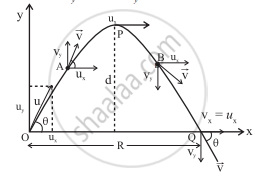
Step 1: Understanding Initial Velocity Components
When a projectile is thrown at an angle θ with the horizontal, the initial velocity u is split into two components:
- Horizontal: ux = u cosθ
- Vertical: uy = u sinθ
Step 2: Horizontal Motion
Since no force acts in the horizontal direction, the horizontal component of velocity (vx) remains constant throughout the motion. This means:
- vx = u cosθ = constant
- Horizontal displacement: sx = u cosθ · t
Step 3: Vertical Motion
The vertical motion is similar to motion under gravity. The vertical velocity decreases as the projectile rises and increases as it falls:
- At any time t: vy = u sinθ - gt
- Vertical displacement: sy = u sinθ · t - ½gt²
Step 4: Motion at Maximum Height
At the maximum height (point P), the vertical velocity becomes zero:
- vy = 0
- Time to reach maximum height: t₀ = (u sinθ)/g
- Maximum height: H = (u sinθ)²/(2g)
Step 5: Complete Flight
Due to symmetry, the total time in the air is:
-
T = 2t₀ = (2u sinθ)/g
The horizontal distance covered (range) is:
-
R = u² sin(2θ)/g
Significance
- Understanding real-world phenomena: Helps explain everyday occurrences like throwing, jumping, and shooting
- Predicting trajectories: Allows us to calculate where and when a projectile will land
- Engineering applications: Used in designing sports equipment, weapons, and flight paths
- Maximum range calculation: Shows that 45° gives the maximum horizontal range
- Independent components: Demonstrates that horizontal and vertical motions are independent
- Parabolic path: Explains why projectiles follow a curved, parabolic trajectory
- Practical applications: Essential for sports, military strategies, and space missions
Example
Problem:
A stone is thrown with initial velocity components of 20 m/s along the vertical and 15 m/s along the horizontal direction. Determine the position and velocity of the stone after 3 s. Find the maximum height and total horizontal distance travelled.
Given:
- Horizontal component: u cosθ = ux = 15 m/s
- Vertical component: u sinθ = uy = 20 m/s
- Time: t = 3 s
- g = 10 m/s²
Solution Steps:
1. Find velocity components at t = 3 s
- vx = u cosθ = 15 m/s (remains constant)
- vy = u sinθ - gt = 20 - 10(3) = 20 - 30 = -10 m/s
The negative sign means the vertical velocity is 10 m/s downward.
2. Find total velocity magnitude
-
v = √(vx² + vy²) = √(15² + 10²) = √(225 + 100) = √325 = 18.03 m/s
3. Find the direction of velocity
- tan α = vy/vx = 10/15 = 2/3
- α = tan⁻¹(2/3) = 33° 41' (below horizontal)
4. Find displacement components
- sx = u cosθ · t = 15 × 3 = 45 m
- sy = u sinθ · t - ½gt² = 20(3) - ½(10)(3)² = 60 - 45 = 15 m
Position after 3 s: The stone is 45 m horizontally and 15 m vertically from the initial position.
5. Calculate maximum height
-
H = (u sinθ)²/(2g) = (20)²/(2 × 10) = 400/20 = 20 m
6. Calculate maximum horizontal distance (range)
-
R = (2 · ux · uy)/g = (2 × 15 × 20)/10 = 600/10 = 60 m
Results:
- Velocity at 3 s: 18.03 m/s at an angle of 33° 41' below horizontal
- Position at 3 s: 45 m horizontal, 15 m vertical
- Maximum height: 20 m
- Horizontal range: 60 m
Real-Life Examples
- Sports: A footballer kicking a goal, a basketball player shooting toward the basket, or a cricket bowler delivering a ball all involve projectile motion.
- Military applications: Bullets and artillery shells follow projectile paths.
Key Points: Projectile Motion
- Horizontal range is maximum at 45° and reduces for any other angle of projection.
- A projectile has two simultaneous independent motions — constant horizontal and gravity-driven vertical.
- The path is a symmetric parabola — equal time up and down, equal speed at the same height.