Advertisements
Advertisements
प्रश्न
A girl riding a bicycle with a speed of 5 m/s towards north direction, observes rain falling vertically down. If she increases her speed to 10 m/s, rain appears to meet her at 45° to the vertical. What is the speed of the rain? In what direction does rain fall as observed by a ground based observer?
Advertisements
उत्तर
Vrg is the velocity of rain that appears to the girl.
We must draw all vectors in the reference frame of the ground-based observer.
Assume north to be `hati` direction and vertically downward to be `(-hatj)`.
Let the rain velocity `v_r = ahati + bhatj`'
Case I: According to the problem, velocity of girl `v_g = ((5m)/s)hati`
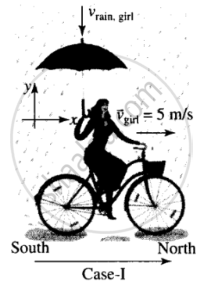
Let `v_(rg)` = velocity of rain w.r.t. girl
= `v_r - v_g`
= `(ahati + bhatj) - 5hati`
= `(a - 5)hati + bhatj`
According to the question, rain appears to fall vertically downward.
Hence, `a - 5 = 0 ⇒ 4a = 5`
Case II: Now velocity of the girl after increasing her speed,
`v_g = ((10m)/s)hati`
∴ `v_(rg) = v_r - v_g`
= `(ahati + bhatj) - 10hati`
= `(a - 10)hati + bhatj`

According to the question, rain appears to fall at 45 to the vertical.
Hence `tan 45^circ = b/(a - 10)` = 1
⇒ `b = a - 10`
= `5 - 10`
= `- 5`
Hence, velocity of rain = `ahati + bhatj`
⇒ `v_r = 5hati - 5hatj`
Speed of rain
= `|v_r| = sqrt((5)^2 + (-5)^2`
= `sqrt(50)`
= `5sqrt(2)` m/s.
