Topics
Basic Concepts in Economics
- Branches of Science
- Natural Science
- Social Science
- Concept of Economics
- Kautilya's Views on Economics
- Types of Economic Systems
- Capitalism
- Socialism
- Mixed Economy
- Introduction to Microeconomics and Macroeconomics
- Microeconomics
- Basic Concepts of Microeconomics > Want
- Basic Concepts of Microeconomics > Goods and Services
- Basic Concepts of Microeconomics > Utility
- Basic Concepts of Microeconomics > Value
- Basic Concepts of Microeconomics > Wealth
- Microeconomics > Personal Income
- Basic Concepts of Microeconomics > Personal Disposable Income
- Microeconomics > Economic Activity
- Types of Income
- Concept of Economic Good
- Macroeconomics
- Cyclical Unemployment
- Difference Between Economic Growth and Economic Development
Money
Partition Values
The Economy of Maharashtra
- Formation and Economic Progress of Maharashtra
- Administrative Divisions of Maharashtra
- Important Features of the Economy of Maharashtra
- Economic Development of Maharashtra
- Agricultural Sector
- Industrial Growth in Maharashtra
- Service Sector
- Core Areas of Service Sector
- Economic Infrastructure of Maharashtra
- Social Infrastructure of Maharashtra
- Measures for Social Infrastructure: Education
- Measures for Social Infrastructure: Health Services
- Co – operative Movement in Maharashtra
- Symbols of Educational Schemes in India
- Tourism in Maharashtra
- Hospitality
- Entertainment Industry
Rural Development in India
Population in India
- Concept of Population in India
- Trends in Population Growth
- Theories of Population Growth
- Population Explosion in India
- Types of Population Based on Resource Availability
- Birth Rate
- Death Rate
- Survival Rate
- Legal Age of Marriage for Males and Females in Different Countries
- The Population as a Human Resource
- Role of Human Resources in Economic Development
Unemployment in India
- Concept of Unemployment
- Important Terms of Employment and Unemployment
- Types of Unemployment
- Rural Unemployment
- Urban Unemployment
- Extent of Unemployment in India
- State-Wise Unemployment Rates in India
- Causes of Unemployment
- General Measures to Reduce Unemployment
- Effects of Unemployment
- Government Measures for Employment Generation
Poverty in India
- Concept of Poverty in India
- Prof. Amartya Sen’s Views on Poverty
- Multi-dimensional Poverty
- Key Concepts of Poverty
- Countries with Highest Extreme Poverty Rates
- Poverty Line
- Informal Sector and Related Activities
- Income Pyramid
- Types of Poverty
- Extent of Poverty in India
- Estimates of Poverty
- Causes of Poverty
- Effects of Poverty
- Sustainable Development Goals
- Understanding Maharashtra’s Tri Colour Family Ration Cards
- Eradication of Poverty
- Poverty Alleviation Programmes and Their Target Sectors
- Tracking Anti-Poverty Efforts
Economic Policy of India since 1991
- Economic Transition of India
- Main Objectives of the Economic Policy of 1991
- Features of the Economic Policy of 1991
- Public Bank Vs Private Banks Vs Foreign Banks
- Components of New Economic Policy
- Liberalisation
- Privatisation
- Globalisation
- Evaluation of the Economic Policy of 1991
- Corporate Social Responsibility
Economic Planning in India
- India’s Planning Commission
- Economic Planning in India
- Overview of the Bombay, People’s, and Gandhian Plans
- Features of Economic Planning
- Five Year Plans (FYP)
- 12th Five Year Plan (2012-2017)
- Levels of National Family Health Survey (NFHS)
- NITI Aayog (National Institution for Transforming India)
- Planning Commission VS NITI Aayog
- Introduction
- Think-Tank Role
- Pillars of NITI Aayog
- Organisational Structure
- Core Functions
- Real-Life Application
- Key Point Summary
Maharashtra State Board: Class 11
Introduction
The Twelfth Five-Year Plan ended on 31 March 2017 and was extended until 4 October 2017 to complete project appraisals. On 1 January 2015, the government replaced the Planning Commission with NITI Aayog, aiming to strengthen federalism by actively involving states in policy design.
Maharashtra State Board: Class 11
Think-Tank Role
A think tank is a panel of experts advising on policy solutions. NITI Aayog:
- Evolves a Shared Vision: Aligns national priorities with state inputs.
- Fosters Cooperative Federalism: Provides continuous policy guidance and support to states.
Maharashtra State Board: Class 11
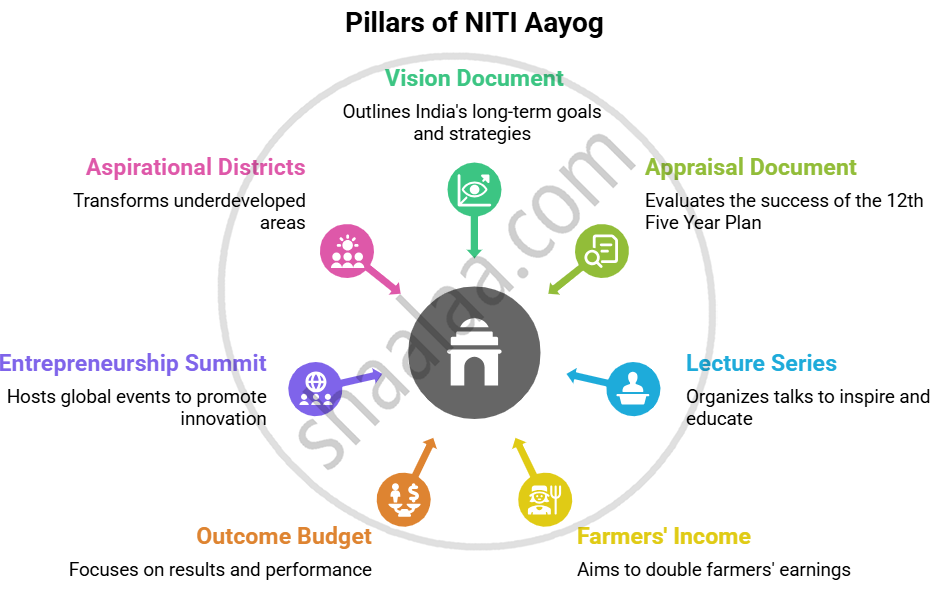
Pillars of NITI Aayog
Maharashtra State Board: Class 11
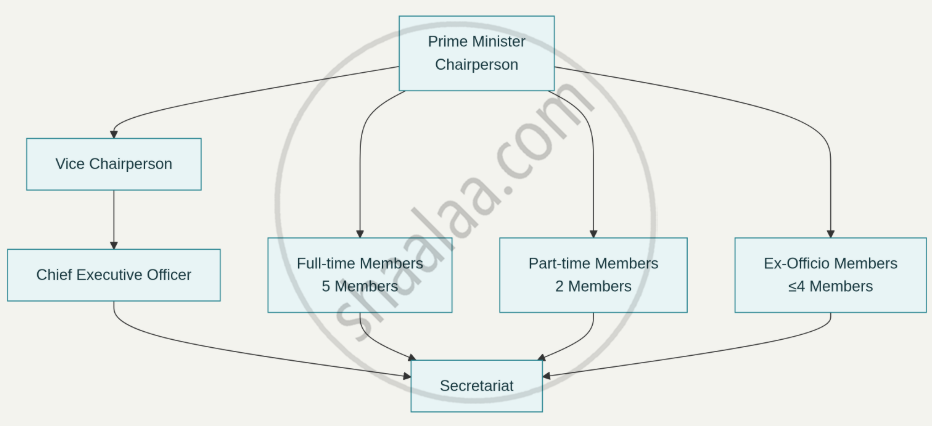
Organizational Structure
Flowchart depicting the hierarchy from the Prime Minister down to the Secretariat.
Maharashtra State Board: Class 11
Core Functions
| Function | Impact Example |
|---|---|
| Shared National Agenda | Joint PM–CM council meetings |
| State Support (“Best Friend”) | Consultancy for state water-management schemes |
| Decentralized Planning | Village-to-national policy feedback loops |
| Knowledge & Innovation Hub | State ranking dashboards |
| Monitoring & Evaluation | Mid-term reviews leading to policy corrections |
| Cooperative & Competitive Federalism | State-wise performance competitions |
Maharashtra State Board: Class 11
Real-Life Application
Cooperative federalism is like a relay race: each state completes its leg (local planning) and then hands the baton to the centre for the final leg (national implementation).
Maharashtra State Board: Class 11
Key Point Summary
- NITI Aayog replaced the Planning Commission to enhance state participation.
- Chaired by the Prime Minister with a Vice-Chair, members, and a CEO.
- Pillars include farmers’ income, entrepreneurship summit, and aspirational districts.
- Functions focus on shared vision, state assistance, and data-driven policy.
Test Yourself
Related QuestionsVIEW ALL [15]
Identify the correct of pairs from the given options:
| 'A' | 'B' | ||
| 1) | Economic Planning | a) | Selection by Prime Minister |
| 2) | Twelfth Five Year Plan | b) | Think Tank group of Indian Government |
| 3) | NITI Aayog | c) | Fast and sustainable growth |
| 4) | NITI Aayog Vice-Chairperson | d) | Time bound programme |
