Topics
Basic Concepts in Economics
- Branches of Science
- Natural Science
- Social Science
- Concept of Economics
- Kautilya's Views on Economics
- Types of Economic Systems
- Capitalism
- Socialism
- Mixed Economy
- Introduction to Microeconomics and Macroeconomics
- Microeconomics
- Basic Concepts of Microeconomics > Want
- Basic Concepts of Microeconomics > Goods and Services
- Basic Concepts of Microeconomics > Utility
- Basic Concepts of Microeconomics > Value
- Basic Concepts of Microeconomics > Wealth
- Microeconomics > Personal Income
- Basic Concepts of Microeconomics > Personal Disposable Income
- Microeconomics > Economic Activity
- Types of Income
- Concept of Economic Good
- Macroeconomics
- Cyclical Unemployment
- Difference Between Economic Growth and Economic Development
Money
Partition Values
The Economy of Maharashtra
- Formation and Economic Progress of Maharashtra
- Administrative Divisions of Maharashtra
- Important Features of the Economy of Maharashtra
- Economic Development of Maharashtra
- Agricultural Sector
- Industrial Growth in Maharashtra
- Service Sector
- Core Areas of Service Sector
- Economic Infrastructure of Maharashtra
- Social Infrastructure of Maharashtra
- Measures for Social Infrastructure: Education
- Measures for Social Infrastructure: Health Services
- Co – operative Movement in Maharashtra
- Symbols of Educational Schemes in India
- Tourism in Maharashtra
- Hospitality
- Entertainment Industry
Rural Development in India
Population in India
- Concept of Population in India
- Trends in Population Growth
- Theories of Population Growth
- Population Explosion in India
- Types of Population Based on Resource Availability
- Birth Rate
- Death Rate
- Survival Rate
- Legal Age of Marriage for Males and Females in Different Countries
- The Population as a Human Resource
- Role of Human Resources in Economic Development
Unemployment in India
- Concept of Unemployment
- Important Terms of Employment and Unemployment
- Types of Unemployment
- Rural Unemployment
- Urban Unemployment
- Extent of Unemployment in India
- State-Wise Unemployment Rates in India
- Causes of Unemployment
- General Measures to Reduce Unemployment
- Effects of Unemployment
- Government Measures for Employment Generation
Poverty in India
- Concept of Poverty in India
- Prof. Amartya Sen’s Views on Poverty
- Multi-dimensional Poverty
- Key Concepts of Poverty
- Countries with Highest Extreme Poverty Rates
- Poverty Line
- Informal Sector and Related Activities
- Income Pyramid
- Types of Poverty
- Extent of Poverty in India
- Estimates of Poverty
- Causes of Poverty
- Effects of Poverty
- Sustainable Development Goals
- Understanding Maharashtra’s Tri Colour Family Ration Cards
- Eradication of Poverty
- Poverty Alleviation Programmes and Their Target Sectors
- Tracking Anti-Poverty Efforts
Economic Policy of India since 1991
- Economic Transition of India
- Main Objectives of the Economic Policy of 1991
- Features of the Economic Policy of 1991
- Public Bank Vs Private Banks Vs Foreign Banks
- Components of New Economic Policy
- Liberalisation
- Privatisation
- Globalisation
- Evaluation of the Economic Policy of 1991
- Corporate Social Responsibility
Economic Planning in India
- India’s Planning Commission
- Economic Planning in India
- Overview of the Bombay, People’s, and Gandhian Plans
- Features of Economic Planning
- Five Year Plans (FYP)
- 12th Five Year Plan (2012-2017)
- Levels of National Family Health Survey (NFHS)
- NITI Aayog (National Institution for Transforming India)
- Planning Commission VS NITI Aayog
- Introduction
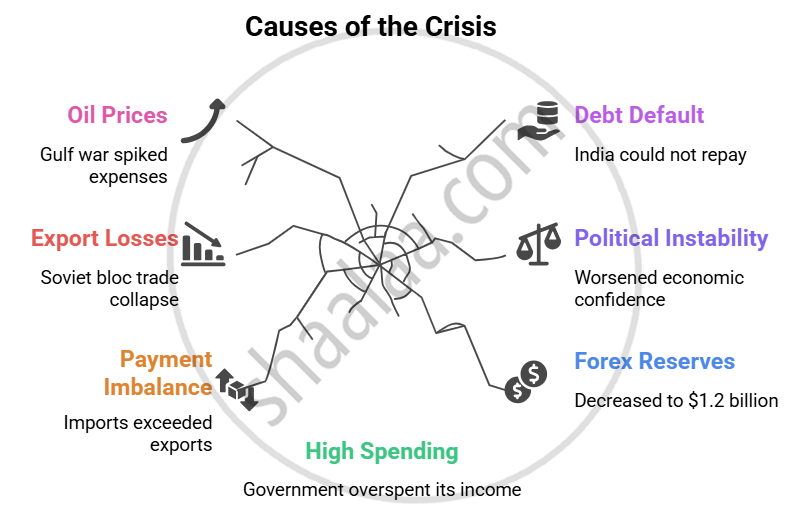
- Causes of the Crisis
- The New Economic Policy (NEP), 1991
- Key NEP Features and Changes
- Impact of NEP
- Real-Life Application
- Key Point Summary
Introduction
In 1991, India faced a major economic crisis: the government barely had enough foreign reserves to pay for two weeks' worth of imports, and inflation soared to nearly 17%. It was a turning point that led to the historic New Economic Policy (NEP).
Causes of the Crisis
The New Economic Policy (NEP), 1991
When the crisis peaked, the new government led by P.V. Narasimha Rao—with Dr Manmohan Singh as Finance Minister—launched the New Economic Policy.
Key NEP Features and Changes
- Removed License Raj: No more government permission required for most new factories or products.
- Devalued Rupee: Made exports cheaper and imports more expensive to boost foreign currency.
- Disinvestment: The Government sold stakes in public sector companies.
- Trade and Tax Reforms: Reduced import duties and made it easier for foreign companies to invest in India.
- Boosted Private Sector: Allowed private firms to do business in many fields previously reserved for government.
Impact of NEP
- GDP Growth: Higher economic growth in the years after NEP.
- Increased Foreign Investment: More money and businesses from abroad came to India.
- Improved Reserves: Foreign currency reserves rose over time.
- Modernisation: India’s economy became more connected and competitive globally.
Real-Life Application
Think of the national budget like a household budget: spending a lot and earning less leads to borrowing from others. If borrowing cannot be repaid, some possessions (like gold or jewellery) might be pledged—just what India did with its gold reserves in 1991.
Key Point Summary
- India’s 1991 crisis was caused by high government spending, too many imports, debts, and political instability.
- NEP launched the “LPG” reforms that opened, modernised, and globalised the Indian economy.
- The NEP’s effects continue to shape India’s growth.
Test Yourself
Related QuestionsVIEW ALL [4]
Read the following passage and answer the questions given below:
|
The Indian ice cream industry is one of the fastest-growing segments of the dairy and food processing sector. India has a low per capita consumption of ice cream of 400 ml whereas in the USA it is 22,000 ml and in China, it is 3000 ml. The per capita consumption of ice cream is low in India because it is a country filled with traditional sweets of more than 100 varieties. In developed countries, people have either pastries or ice-creams for dessert. In the era of Globalisation, the mindset of the people is fast changing. This is because multi-national companies have set up a number of ice-cream parlours, with a lot more varieties and flavours that attract the younger lot. Besides this, there are better delivery systems. The ice cream sector has great potential for growth in the country due to improvements in the cold chain infrastructure, increasing disposable income, and changing the lifestyle of the people. However, it is taxed higher with 18 percent GST while other dairy products in the same basket such as butter and cheese are taxed at 12 per cent. The ice cream industry has generated revenue of more than $1.5 billion in 2016-17. With the employment of 15 lakh people directly or indirectly, it is also considered one of the largest employers of the dairy and food processing industry. |
- Identify the reason for the low per capita consumption of ice cream in India.
- Explain the impact of Globalisation on the Indian ice cream industry.
- Find out the factors that could lead to the growth of the ice cream industry in India.
- Express your views about the implications of higher GST on the ice cream industry in India.
