Topics
Basic Concepts in Economics
- Branches of Science
- Natural Science
- Social Science
- Concept of Economics
- Kautilya's Views on Economics
- Types of Economic Systems
- Capitalism
- Socialism
- Mixed Economy
- Introduction to Microeconomics and Macroeconomics
- Microeconomics
- Basic Concepts of Microeconomics > Want
- Basic Concepts of Microeconomics > Goods and Services
- Basic Concepts of Microeconomics > Utility
- Basic Concepts of Microeconomics > Value
- Basic Concepts of Microeconomics > Wealth
- Microeconomics > Personal Income
- Basic Concepts of Microeconomics > Personal Disposable Income
- Microeconomics > Economic Activity
- Types of Income
- Concept of Economic Good
- Macroeconomics
- Cyclical Unemployment
- Difference Between Economic Growth and Economic Development
Money
Partition Values
The Economy of Maharashtra
- Formation and Economic Progress of Maharashtra
- Administrative Divisions of Maharashtra
- Important Features of the Economy of Maharashtra
- Economic Development of Maharashtra
- Agricultural Sector
- Industrial Growth in Maharashtra
- Service Sector
- Core Areas of Service Sector
- Economic Infrastructure of Maharashtra
- Social Infrastructure of Maharashtra
- Measures for Social Infrastructure: Education
- Measures for Social Infrastructure: Health Services
- Co – operative Movement in Maharashtra
- Symbols of Educational Schemes in India
- Tourism in Maharashtra
- Hospitality
- Entertainment Industry
Rural Development in India
Population in India
- Concept of Population in India
- Trends in Population Growth
- Theories of Population Growth
- Population Explosion in India
- Types of Population Based on Resource Availability
- Birth Rate
- Death Rate
- Survival Rate
- Legal Age of Marriage for Males and Females in Different Countries
- The Population as a Human Resource
- Role of Human Resources in Economic Development
Unemployment in India
- Concept of Unemployment
- Important Terms of Employment and Unemployment
- Types of Unemployment
- Rural Unemployment
- Urban Unemployment
- Extent of Unemployment in India
- State-Wise Unemployment Rates in India
- Causes of Unemployment
- General Measures to Reduce Unemployment
- Effects of Unemployment
- Government Measures for Employment Generation
Poverty in India
- Concept of Poverty in India
- Prof. Amartya Sen’s Views on Poverty
- Multi-dimensional Poverty
- Key Concepts of Poverty
- Countries with Highest Extreme Poverty Rates
- Poverty Line
- Informal Sector and Related Activities
- Income Pyramid
- Types of Poverty
- Extent of Poverty in India
- Estimates of Poverty
- Causes of Poverty
- Effects of Poverty
- Sustainable Development Goals
- Understanding Maharashtra’s Tri Colour Family Ration Cards
- Eradication of Poverty
- Poverty Alleviation Programmes and Their Target Sectors
- Tracking Anti-Poverty Efforts
Economic Policy of India since 1991
- Economic Transition of India
- Main Objectives of the Economic Policy of 1991
- Features of the Economic Policy of 1991
- Public Bank Vs Private Banks Vs Foreign Banks
- Components of New Economic Policy
- Liberalisation
- Privatisation
- Globalisation
- Evaluation of the Economic Policy of 1991
- Corporate Social Responsibility
Economic Planning in India
- India’s Planning Commission
- Economic Planning in India
- Overview of the Bombay, People’s, and Gandhian Plans
- Features of Economic Planning
- Five Year Plans (FYP)
- 12th Five Year Plan (2012-2017)
- Levels of National Family Health Survey (NFHS)
- NITI Aayog (National Institution for Transforming India)
- Planning Commission VS NITI Aayog
- India's Health Mirror
- Evolution of the National Family Health Survey (NFHS)
- NFHS-1 (1992-93): The Foundation
- NFHS-2 (1998-99): Expanding the Lens
- NFHS-3 (2005-06): International Collaboration
- NFHS-4 (2015-16): Comprehensive Coverage
- NFHS-5 (2019-21): The Most Comprehensive Survey
- Key Point Summary
India's Health Mirror
The National Family Health Survey (NFHS) serves as India's comprehensive health report card, conducted by the Ministry of Health and Family Welfare every 3-4 years. Just like how you might track your academic progress through regular tests, the government uses NFHS to monitor the nation's health and social development progress. This survey helps policymakers understand what's working well and what needs improvement in areas like healthcare, nutrition, and family welfare.
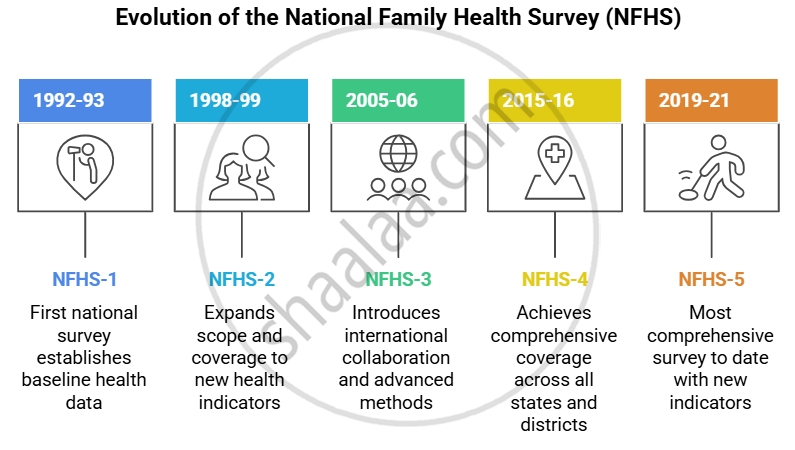
Evolution of the National Family Health Survey (NFHS)
NFHS-1 (1992-93): The Foundation
Primary Focus: Population, health, and nutrition with special emphasis on women and children
The first National Family Health Survey marked India's entry into systematic health data collection. Covering all 26 states of India at that time, this pioneering survey established the baseline for understanding India's demographic and health patterns.
Why It Mattered: Before NFHS-1, India lacked comprehensive, standardised health data. This survey provided the first reliable picture of health conditions across different states, helping identify regional disparities and priority areas for intervention.
Real-World Impact: The survey revealed significant variations in health indicators between states, leading to targeted health programmes for underperforming regions.
NFHS-2 (1998-99): Expanding the Lens
Enhanced Focus: Quality of health services, family planning, domestic violence, reproductive health, and anemia
Building on NFHS-1's foundation, the second round broadened its scope to include critical social issues. The six-year gap between surveys allowed for meaningful trend analysis and policy impact assessment.
Key Innovation: NFHS-2 was among the first large-scale surveys in India to systematically document domestic violence, breaking taboos around discussing this sensitive issue.
Policy Connection: Data from NFHS-2 directly influenced the National Population Policy 2000 and helped design targeted interventions for maternal health improvement.
NFHS-3 (2005-06): International Collaboration
Expanded Coverage: 29 states with significant international funding and technical support
The third round marked a major milestone with international agencies UNICEF, USAID, and DFID (UK) providing financial and technical assistance. This collaboration brought global best practices to India's health data collection system.
Global Standards: International involvement ensured NFHS-3 met international standards for health surveys, making India's data comparable with global health indicators.
Technological Advancement: This round introduced improved sampling techniques and data quality measures, setting higher standards for future surveys.
NFHS-4 (2015-16): Comprehensive Coverage
Massive Scale: 29 states and 6 union territories covering 640 districts
With major financial support from the USA, NFHS-4 achieved unprecedented geographical coverage. The survey's timing coincided with India's major health policy initiatives, providing crucial baseline data for programmes like the National Health Mission.
District-Level Data: For the first time, NFHS provided reliable estimates at the district level, enabling local-level planning and implementation of health programmes.
Digital Revolution: NFHS-4 was the first to use electronic data collection methods, improving data quality and reducing processing time significantly.
NFHS-5 (2019-21): The Most Comprehensive Survey
Record Achievement: All states and union territories with 67 comprehensive indicators
Despite facing delays due to the COVID-19 pandemic, NFHS-5 emerged as the most comprehensive health survey in India's history. The survey captured data from approximately 700,000 households, making it one of the world's largest demographic and health surveys.
Historic Milestone: NFHS-5 documented India's achievement of replacement-level fertility (Total Fertility Rate = 2.0), a demographic transition that took decades to accomplish.
Key Point Summary
Evolution Pattern: NFHS has evolved from a basic health survey (NFHS-1) to a comprehensive social development monitoring system (NFHS-5), reflecting India's growing sophistication in data-driven governance.
Expanding Scope: Each round has broadened its focus – from basic health (NFHS-1) to social issues (NFHS-2) to international standards (NFHS-3) to district-level coverage (NFHS-4) to comprehensive development indicators (NFHS-5).
Real Impact: NFHS data has directly influenced major policy decisions, budget allocations, and programme designs, demonstrating the power of evidence-based governance in a democracy.
Future Significance: As India aims to become a developed nation by 2047, NFHS will continue serving as the primary tool for tracking progress toward health and social development goals.
Global Relevance: NFHS contributes to India's reporting on 30 Sustainable Development Goals, connecting local health improvements to global development objectives.
