Topics
Basic Concepts in Economics
- Branches of Science
- Natural Science
- Social Science
- Concept of Economics
- Kautilya's Views on Economics
- Types of Economic Systems
- Capitalism
- Socialism
- Mixed Economy
- Introduction to Microeconomics and Macroeconomics
- Microeconomics
- Basic Concepts of Microeconomics > Want
- Basic Concepts of Microeconomics > Goods and Services
- Basic Concepts of Microeconomics > Utility
- Basic Concepts of Microeconomics > Value
- Basic Concepts of Microeconomics > Wealth
- Microeconomics > Personal Income
- Basic Concepts of Microeconomics > Personal Disposable Income
- Microeconomics > Economic Activity
- Types of Income
- Concept of Economic Good
- Macroeconomics
- Cyclical Unemployment
- Difference Between Economic Growth and Economic Development
Money
Partition Values
The Economy of Maharashtra
- Formation and Economic Progress of Maharashtra
- Administrative Divisions of Maharashtra
- Important Features of the Economy of Maharashtra
- Economic Development of Maharashtra
- Agricultural Sector
- Industrial Growth in Maharashtra
- Service Sector
- Core Areas of Service Sector
- Economic Infrastructure of Maharashtra
- Social Infrastructure of Maharashtra
- Measures for Social Infrastructure: Education
- Measures for Social Infrastructure: Health Services
- Co – operative Movement in Maharashtra
- Symbols of Educational Schemes in India
- Tourism in Maharashtra
- Hospitality
- Entertainment Industry
Rural Development in India
Population in India
- Concept of Population in India
- Trends in Population Growth
- Theories of Population Growth
- Population Explosion in India
- Types of Population Based on Resource Availability
- Birth Rate
- Death Rate
- Survival Rate
- Legal Age of Marriage for Males and Females in Different Countries
- The Population as a Human Resource
- Role of Human Resources in Economic Development
Unemployment in India
- Concept of Unemployment
- Important Terms of Employment and Unemployment
- Types of Unemployment
- Rural Unemployment
- Urban Unemployment
- Extent of Unemployment in India
- State-Wise Unemployment Rates in India
- Causes of Unemployment
- General Measures to Reduce Unemployment
- Effects of Unemployment
- Government Measures for Employment Generation
Poverty in India
- Concept of Poverty in India
- Prof. Amartya Sen’s Views on Poverty
- Multi-dimensional Poverty
- Key Concepts of Poverty
- Countries with Highest Extreme Poverty Rates
- Poverty Line
- Informal Sector and Related Activities
- Income Pyramid
- Types of Poverty
- Extent of Poverty in India
- Estimates of Poverty
- Causes of Poverty
- Effects of Poverty
- Sustainable Development Goals
- Understanding Maharashtra’s Tri Colour Family Ration Cards
- Eradication of Poverty
- Poverty Alleviation Programmes and Their Target Sectors
- Tracking Anti-Poverty Efforts
Economic Policy of India since 1991
- Economic Transition of India
- Main Objectives of the Economic Policy of 1991
- Features of the Economic Policy of 1991
- Public Bank Vs Private Banks Vs Foreign Banks
- Components of New Economic Policy
- Liberalisation
- Privatisation
- Globalisation
- Evaluation of the Economic Policy of 1991
- Corporate Social Responsibility
Economic Planning in India
- India’s Planning Commission
- Economic Planning in India
- Overview of the Bombay, People’s, and Gandhian Plans
- Features of Economic Planning
- Five Year Plans (FYP)
- 12th Five Year Plan (2012-2017)
- Levels of National Family Health Survey (NFHS)
- NITI Aayog (National Institution for Transforming India)
- Planning Commission VS NITI Aayog
- Introduction
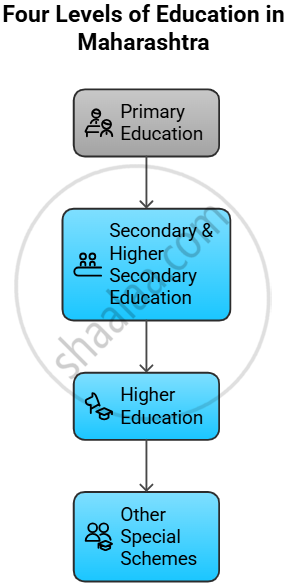
- Four Levels of Education in Maharashtra
- Primary Education
- Secondary and Higher Secondary Education
- Higher Education
- Other Special Schemes
- Real-Life Application
- Key Point Summary
Maharashtra State Board: Class 11
Introduction
Education is a crucial need for every person and plays a key role in a country's growth. India has a large number of young people, making education a top priority, especially in Maharashtra.
Maharashtra State Board: Class 11
Four Levels of Education in Maharashtra
Maharashtra State Board: Class 11
Primary Education
| Aspect | Details |
|---|---|
| Age Group | 6–14 years (Std. I–VIII) |
| Nature | Free and compulsory (Right to Education Act) |
| Implementation | Run under Sarva Shiksha Abhiyan |
| 2016–17 Statistics | 1,04,971 schools, 159.86 lakh students, 5.3 lakh teachers |
| Pupil-Teacher Ratio | 30.1 |
Maharashtra State Board: Class 11
Secondary & Higher Secondary Education
| Aspect | Details |
|---|---|
| Stage | Std IX–XII |
| Support | Rashtriya Madhyamik Shiksha Abhiyan |
| Statistics | 25,737 schools, 66.15 lakh students, 2.13 lakh teachers |
| Pupil-Teacher Ratio | 31.1 |
Maharashtra State Board: Class 11
Higher Education
- Includes universities, technical colleges, and skill centres.
- Total of 53 universities (state, autonomous, private, national institutes)
- Key laws: Maharashtra Public Universities Act, 2016
- RUSA grants support research and innovation.
Maharashtra State Board: Class 11
Other Special Schemes
- Inclusive Education: Focus on children with disabilities
- Girls' Education: Free bus services, bicycles, and no fees till higher secondary
- Adult Literacy: Programs like ‘Each One Teach One’
- Tribal Education: Residential Ashram Schools—free accommodation, food, and books for tribal children.
Maharashtra State Board: Class 11
Real-Life Application
If a girl lives in a village 4 km from her school, she may get a government bicycle and free transport as part of state schemes. Tribal students may stay at Ashram Schools where food and books are provided without charge.
Maharashtra State Board: Class 11
Key Point Summary
- Education in Maharashtra is organised in four stages with focused schemes for each.
- Government spending is high to ensure wide access.
- Special attention is given to girl students, tribal areas, and universal literacy.
