Topics
Introduction to Micro and Macro Economics
- Branches of Economics
- Father of Econometrics: Ragnar Frisch
- Microeconomics
- Macroeconomics
- Macroeconomics Vs Microeconomics
Micro Economics
Introduction to Micro Economics
- Analysis of Market Structure
- Microeconomics
- Micro Economics - Slicing Method
- Use of Marginalism Principle in Micro Economics
- Micro Economics - Price Theory
- Micro Economic - Price Determination
- Micro Economics - Working of a Free Market Economy
- Micro Economics - International Trade and Public Finance
- Welfare Economics
- Micro Economics - Useful to Government
- Assumption of Micro Economic Analysis
Consumers Behavior
Analysis of Demand and Elasticity of Demand
Analysis of Supply
Types of Market and Price Determination Under Perfect Competition
Factors of Production
- Factors of Production - Feature of Capital
- Factors of Production
Macro Economics
Utility Analysis
- Basic Concepts of Microeconomics > Utility
- Commodities and Their Specific Utility for Individuals
- Total Utility and Marginal Utility
- Law of Diminishing Marginal Utility
- Paradox of Value
- Relationship Between Marginal Utility and Price
- Indifference Curve Analysis by Hicks and Allen
Introduction to Macro Economics
- Macroeconomics
- Allocation of Resource and Economic Variable
National Income
Determinants of Aggregates
- Total Demand for Good and Services
- Concept of Aggregate Demand and Aggregate Supply
- Consumption
- Investment Demand
- Government Demand
- Foreign Demand
- Difference Betweeen Export and Import
- Effect of Population of Consumption Expediture
- Types of Investment Expenditure
- Micro Eco-Equilibrium
Money
- Concept of Money
- Functions of Money
- Standard of Deferred Payment
- Standard of Transfer Payment
- Money - Store of Value
- Barter system
- Monetary Payments
- Concept of Good Money
Commercial Bank
Central Bank
- Central Bank
- Central Bank Function - Banker's Bank
- Central Bank as a Controller of Credit
- Monetary Function of Central Bank
- Non Monetary Function of Central Bank
- Methods of Credit Control
- Repo Rate and Reverse Repo Rate
- Central Bank Function - Goverment Bank
Public Economics
- Introduction of Public Economics
- Features of Public Economics
- Government Budget
- Objectives of Government Budget
- Features of Government Budget
- Public Economics - Budget (1 Year)(1 April to 31 March)
- Types of Budget
- Taxable Income
- Budgetary Accounting in India
- Budgetary Accounting - Consolidated , Contingency and Public Fund
- Components (Structure) of the Government Budget
- Factor Influencing Government Budget
Demand Analysis
- Concept of Demand
- Demand Schedule
- Individual Demand Schedule
- Market Demand Schedule
- Demand Curve
- Individual Demand Curve
- Market Demand Curve
- Reasons for the Downward Slope of the Demand Curve
- Types of Demand
- Determinants of Demand
- Law of Demand
- Exceptions to the Law of Demand
- Variations in Demand
- Changes in Demand
Elasticity of Demand
- Concept of Elasticity of Demand
- Types of Elasticity of Demand > Income Elasticity
- Types of Elasticity of Demand > Cross Elasticity
- Types of Elasticity of Demand > Price Elasticity
- Perfectly Elastic Demand
- Perfectly Inelastic Demand
- Unitary Elastic Demand
- Relatively Elastic Demand
- Relatively Inelastic Demand
- Methods of Measuring Price Elasticity of Demand
- Linear Demand Curve
- Non-Linear Demand Curve
- Factors Influencing the Elasticity of Demand
- Importance of Elasticity of Demand
- Determinants of Price Elasticity of Demand
Supply Analysis
- Concept of Supply
- Concept of Total Output
- Concept of Stock
- Distinguish between Stock and Supply
- Supply Schedule
- Individual Supply Schedule
- Market Supply Schedule
- Determinants of Supply
- Law of Supply
- Variations in Supply
- Changes in Supply
- Cost Concepts > Total Costs
- Cost Concepts > Average Cost
- Cost Concepts > Marginal Cost
- Revenue Concepts
- Total Revenue
- Average Revenue
- Marginal Revenue
Forms of Market
- Concept of Market
- Classification of Market > Based on Place
- Classification of Market > Based on Place
- Classification of Market > Based on Time
- Classification of Market > Based on Competition
- Perfect Competition
- Price Determination Under Perfect Competition
- Imperfect Competition
- Monopoly
- Concept of Monopsony
- Oligopoly
- Monopolistic Competition
Index Numbers
- Index Numbers
- Features of Index Numbers
- Types of Index Numbers
- Index Numbers Used by Government of India
- Significance of Index Numbers
- Rebasing of GDP, IIP, and WPI
- Construction of Index Numbers
- Methods of Constructing Index Numbers > Simple Index Number
- Price Index Number
- Quantity Index Number
- Value Index Number
- Methods of Constructing Index Numbers > Weighted Index Number
- Laaspeyre’s Price Index Number
- Paasche’s Price Index Number
- Concepts of Sensex and Nifty
- Crops in India's Agricultural and Industrial Production Index
- Limitations of Index Numbers
National Income
- Concept of National Income
- Features of National Income
- Circular Flow of National Income
- Two Sector Model of Circular Flow of National Income
- Three Sector Model of Circular Flow of National Income
- Four Sector Model of Circular Income
- Different Concepts of National Income
- Concept of Green GNP
- Methods of Measurement of National Income
- Output Method/Product Method
- Income Method
- Expenditure Method
- Concept of Mixed income
- Difficulties in the Measurement of National Income
- Importance of National Income Analysis
Public Finance in India
- Public Finance
- Difference Between Public Finance and Private Finance
- Structure of Public Finance > Public Expenditure
- Important Social Welfare Schemes by the Government
- Structure of Public Finance > Public Revenue
- Public Revenue > Taxes
- Types of Taxes
- Direct Tax
- Indirect Tax
- Public Revenue > Non-tax Revenue
- Structure of Public Finance > Public Debt
- Structure of Public Finance > Fiscal Policy
- Structure of Public Finance > Financial Administration
- GST(Economics)
- Government Budget
- Revenue and Capital Budgets
- Types of Budget
- Importance of Budget
Money Market and Capital Market in India
- Concept of Financial Market
- Money Market
- Structure of Money Market in India > Organized Sector
- Structure of Money Market in India > Organized Sector
- Reserve Bank of India (RBI)
- Commercial Banks
- Co-operative Banks
- Development Financial Institutions (DFIs)
- Discount and Finance House of India (DFHI)
- Structure of Money Market in India > Unorganized Sector
- Money Market
- Role of Money Market in India
- Problems of the Indian Money Market
- Reforms Introduced in the Money Market
- Recent Developments in Banking Sector
- Capital Market
- Structure of Capital Market in India
- Role of Capital Market in India
- Problems of the Capital Market
- Regional Stock Exchanges in India
- Reforms Introduced in the Capital Market
- Economic Policy in an Economy
Foreign Trade of India
- India’s Trade Relations Before 1947
- Internal Trade
- Foreign Trade of India
- Types of Foreign Trade
- Role of Foreign Trade
- India’s Recent Trade Relations with China and Japan
- Composition of India’s Foreign Trade
- India’s Foreign Trade Share in GNI
- Composition of India's Imports
- Composition of India's Exports
- Direction of India’s Foreign Trade
- Trends in India’s Foreign Trade since 2001
- Concept of Balance of Payments
- Balance of Trade
- Member Nations of OPEC and OECD
CISCE: Class 12
Introduction
Macroeconomics studies the economy as a whole, focusing on large aggregates such as national income, total employment, overall investment, savings, and general price levels. The word "macro" comes from Greek, meaning "large". So, macroeconomics deals with large-scale economic factors that affect the whole country or even the world.
CISCE: Class 12
Definition: Macroeconomics
- Kenneth Boulding: "Macro Economics deals not with individual quantities as such but with the aggregates of these quantities, not with the individual incomes but with the national income, not with individual prices but with the general price level, not with individual output but with the national output."
- J.L. Hansen: "Macroeconomics is that branch of economics which considers the relationship between large aggregates such as the volume of employment, total amount of savings, investment, national income, etc."
- Prof Carl Shapiro: "Macroeconomics deals with the functioning of the economy as a whole."
- Gardner Ackley: "Macroeconomics concerns itself with such variables as the aggregate volume of the output of any economy, within the extent to which its resources are employed with the size of the national income, with the general price level."
Basic Concepts in Macroeconomics
National Income
- It’s the total income of a country, reflecting its economic performance.
- Definition: The value of all final goods and services produced in a country during a year.
Saving
- Part of income not spent on current consumption.
- It is set aside for future needs.
Investment
-
The creation of capital assets (e.g., machinery, equipment) using savings.
Trade Cycles
- Economic fluctuations (ups and downs).
- Inflation: Continuous rise in prices.
- Depression: Continuous fall in prices and lower economic activity.
Economic Growth
-
A quantitative increase in a country’s real national income over time.
Economic Development
-
A qualitative improvement in the well-being of people (e.g., better education, health), along with economic growth.
Subject Matter of Macroeconomics
- Focuses on broad areas: national income, theory of employment, inflation, money and banking, international trade, public finance, and economic development.
- Uses models and data to analyse overall trends and suggest government policies.
Scope
1. Theory of Income and Employment
Focus Areas:
- Factors determining national income and employment levels
- Causes of fluctuations in income, output, and employment
- Consumption function and investment function analysis
- Theory of Business Cycles integration
2. Theory of General Price Level and Inflation
Key Elements:
- Determination of the general price level
- Causes of price level fluctuations
- Analysis of inflation and deflation problems
- Price stability mechanisms
3. Theory of Growth and Development
Components:
- Causes of underdevelopment and poverty analysis
- Economic growth theories and models
- Development strategies and policies
- Growth acceleration methods
4. Macro Theory of Distribution
Focus: Analysis of relative shares in total national income:
- Rent (landowners)
- Wages (workers)
- Interest (capital providers)
- Profit (entrepreneurs)
Features: Flowchart
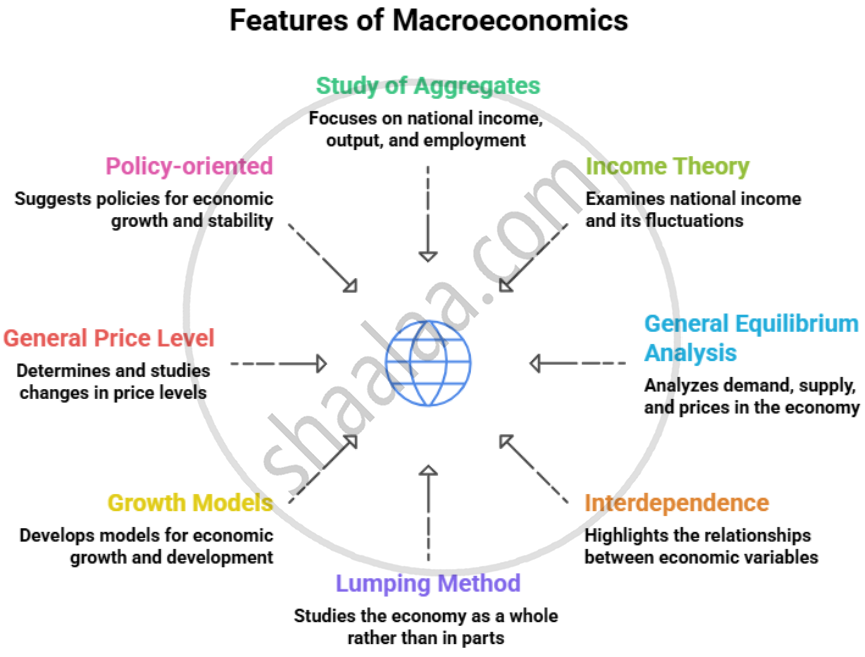
Importance
- Functioning of an Economy – Macroeconomics helps us understand how India's entire economic system works together – like understanding how all parts of a car work together to make it run.
- Economic Fluctuations – It helps analyse why sometimes the economy grows fast (like during the IT boom) and sometimes slows down (like during COVID-19) and suggests ways to control these ups and downs.
- National Income – Macroeconomics teaches us to measure India's total income (GDP), which is essential for making correct economic policies and budget decisions.
- Economic Development – It helps understand and solve problems of developing countries like poverty, unemployment, and inequality by suggesting policy solutions.
- Performance of an Economy – Macroeconomics helps compare India's economic performance over different years to see if we're producing more goods and services than before.
- Study of Macroeconomic Variables – It studies important economic factors like inflation, unemployment, and interest rates that directly affect our daily life and family budget.
- Level of Employment – Macroeconomics helps analyse and improve employment levels across the country through job creation policies and skill development programmes.
Usefulness
| Factor | Simple Explanation | Real-Life Example |
|---|---|---|
| Economy Overview | Tracks total output, income, spending, savings, and jobs. | India's GDP growth from 7% in 2025 shows national health. oswaalbooks |
| Accurate Data | Studies big patterns like overall inflation or employment. | Helps predict recessions using national stats. |
| Economic Planning | Guides government on inflation, trade deficits, population. | RBI uses it to control 2026 price rises. |
| National Income Study | Measures a country's total earnings for welfare/planning. | CBSE exams test India's per capita income trends. |
| Development in Poor Nations | Identifies growth barriers and solutions. | Helps India shift from farm to tech economy. |
| Business Fluctuations | Analyzes booms/busts and stabilization methods. | Post-2024 global slowdown recovery strategies. |
| Problem Solving | Tackles unemployment, poverty, price swings. | Schemes like MGNREGA for job creation. |
| Policy Formulation | Bases decisions on real data/experience. | Trump's 2025 US fiscal policies for growth. |
| Empirical Foundation | Built on tested facts, not theory alone. | Keynesian models proven in 2008 crisis. |
Limitations
| Limitation | Explanation | Example |
|---|---|---|
| Dependence on Individual | Aggregates are made up of individuals; their behavior may not match aggregate trends | Saving is good for individuals but can hurt economy |
| Heterogeneous Measurement | Not all goods/services are comparable | Can't sum apples with buildings |
| Uneven Impact | Policies may affect sectors differently | Inflation may help some, hurt others |
| Statistical Shortcomings | Aggregates vulnerable to errors/overgeneralizations | Individual trends can get “lost” in averages |
| Ignores Individual Behavior | Focus on totals may overlook unique personal circumstances | Doesn't solve specific household issues |
CISCE: Class 12
Real-Life Application
| Importance Area | Real-Life Examples | How It Affects Students/Families |
|---|---|---|
| Functioning of an Economy | Government budget announcements affect tax rates Make in India policy boosts manufacturing sector |
Family tax burden changes More job opportunities in manufacturing Shift to digital payments |
| Economic Fluctuations | COVID-19 recession (2020) - GDP fell 6.6%2008 Global Financial Crisis impact on India |
Job losses during recession, recovery later Parents' business/employment affected Tech jobs became popular career option |
| National Income | India became 5th largest economy globally GDP growth rate 7.2% (among fastest growing) |
Better infrastructure development Higher living standards Increased education and healthcare funding |
| Economic Development | Right to Education: Free education till Class 8 Digital India: Internet access in rural areas |
Employment guarantee for rural families Free healthcare for poor families Online education and job opportunities |
| Performance of Economy | 1991 vs 2024: GDP grew from ₹13 to ₹275 lakh crore Poverty reduced from 45% to 16% - Literacy |
Better economic opportunities than parents' generation More families lifted out of poverty |
| Macroeconomic Variables | Interest rates (6.5%): Home loan EMIs change Unemployment (3.2%): More internship opportunities |
Monthly expenses increase with inflation Family loan EMIs go up/down |
| Employment Creation | Skill India: 40 crore youth training target Startup India: 1.17 lakh startups, 12 lakh jobs Digital India: 40 lakh IT jobs created |
Free skill development courses available More tech career opportunities |
CISCE: Class 12
Key Points: Macroeconomics
Macroeconomics = Understanding the big picture of how India's economy affects your daily life, from job opportunities to price changes to government policies.
