Topics
Introduction to Micro and Macro Economics
- Introduction to Microeconomics and Macroeconomics
- Father of Econometrics: Ragnar Frisch
- Microeconomics
- Macroeconomics
- Macroeconomics Vs Microeconomics
Micro Economics
Introduction to Micro Economics
- Analysis of Market Structure
- Microeconomics
- Micro Economics - Slicing Method
- Use of Marginalism Principle in Micro Economics
- Micro Economics - Price Theory
- Micro Economic - Price Determination
- Micro Economics - Working of a Free Market Economy
- Micro Economics - International Trade and Public Finance
- Welfare Economics
- Micro Economics - Useful to Government
- Assumption of Micro Economic Analysis
Consumers Behavior
Analysis of Demand and Elasticity of Demand
Analysis of Supply
Types of Market and Price Determination Under Perfect Competition
Factors of Production
- Factors of Production - Feature of Capital
- Factors of Production
Macro Economics
Utility Analysis
- Basic Concepts of Microeconomics > Utility
- Commodities and Their Specific Utility for Individuals
- Total Utility and Marginal Utility
- Law of Diminishing Marginal Utility
- Paradox of Value
- Relationship Between Marginal Utility and Price
- Indifference Curve Analysis by Hicks and Allen
Introduction to Macro Economics
- Macroeconomics
- Allocation of Resource and Economic Variable
National Income
Determinants of Aggregates
- Total Demand for Good and Services
- Concept of Aggregate Demand and Aggregate Supply
- Consumption
- Investment Demand
- Government Demand
- Foreign Demand
- Difference Betweeen Export and Import
- Effect of Population of Consumption Expediture
- Types of Investment Expenditure
- Micro Eco-Equilibrium
Money
- Concept of Money
- Functions of Money
- Standard of Deferred Payment
- Standard of Transfer Payment
- Money - Store of Value
- Barter system
- Monetary Payments
- Qualities of Good Money
Commercial Bank
Central Bank
- Central Bank
- Central Bank Function - Banker's Bank
- Central Bank as a Controller of Credit
- Monetary Function of Central Bank
- Non Monetary Function of Central Bank
- Methods of Credit Control by the Central Bank
- Repo Rate and Reverse Repo Rate
- Central Bank Function - Goverment Bank
Public Economics
- Introduction of Public Economics
- Features of Public Economics
- Government Budget
- Objectives of Government Budget
- Features of Government Budget
- Public Economics - Budget (1 Year)(1 April to 31 March)
- Types of Budget
- Taxable Income
- Budgetary Accounting in India
- Budgetary Accounting - Consolidated , Contingency and Public Fund
- Components (Structure) of the Government Budget
- Factor Influencing Government Budget
Demand Analysis
Elasticity of Demand
- Introduction to Elasticity of Demand
- Income Elasticity of Demand
- Cross Elasticity of Demand
- Price Elasticity of Demand
- Perfectly Elastic Demand
- Perfectly Inelastic Demand
- Unitary Elastic Demand
- Relatively Elastic Demand
- Relatively Inelastic Demand
- Methods of Measuring Price Elasticity of Demand
- Linear Demand Curve
- Non-Linear Demand Curve
- Factors Influencing the Elasticity of Demand
- Importance of Elasticity of Demand
- Determinants of Price Elasticity of Demand
Supply Analysis
Forms of Market
- Concept of Market
- Classification of Market > Based on Place
- Classification of Market > Based on Place
- Classification of Market > Based on Time
- Classification of Market > Based on Competition
- Perfect Competition
- Price Determination Under Perfect Competition
- Imperfect Competition
- Monopoly
- Monopsony
- Oligopoly
- Monopolistic Competition
Index Numbers
- Index Numbers
- Features of Index Numbers
- Types of Index Numbers
- Index Numbers Used by Government of India
- Significance of Index Numbers
- Rebasing of GDP, IIP, and WPI
- Construction of Index Numbers
- Methods of Constructing Index Numbers > Simple Index Number
- Price Index Number
- Quantity Index Number
- Value Index Number
- Methods of Constructing Index Numbers > Weighted Index Number
- Laaspeyre’s Price Index Number
- Paasche’s Price Index Number
- Concepts of Sensex and Nifty
- Crops in India's Agricultural and Industrial Production Index
- Limitations of Index Numbers
National Income
- Concept of National Income
- Features of National Income
- Circular Flow of National Income
- Circular Flow of Income in a Two-Sector Economy
- Circular Flow of Income in a Three-Sector Economy
- Four Sector Model of Circular Income
- Different Concepts of National Income
- Concept of Green GNP
- Methods of Measurement of National Income
- Output Method/Product Method
- Income Method
- Expenditure Method
- Concept of Mixed income
- Difficulties in the Measurement of National Income
- Significance or Importance of National Income
Public Finance in India
- Introduction to Public Finance
- Difference Between Public Finance and Private Finance
- Public Expenditure
- Important Social Welfare Schemes by the Government
- Structure of Public Finance > Public Revenue
- Public Revenue > Taxes
- Types of Taxes
- Public Revenue > Non-tax Revenue
- Structure (Types) of Public Debt
- Fiscal Policy
- Structure of Public Finance > Financial Administration
- GST(Economics)
- Government Budget
- Revenue and Capital Budgets
- Types of Budget
- Importance of Budget
Money Market and Capital Market in India
- Concept of Financial Market
- Money Market
- Structure of Money Market in India > Organized Sector
- Structure of Money Market in India > Organized Sector
- Reserve Bank of India (RBI)
- Commercial Banks
- Co-operative Banks
- Development Financial Institutions (DFIs)
- Discount and Finance House of India (DFHI)
- Structure of Money Market in India > Unorganized Sector
- Money Market
- Role of Money Market in India
- Problems of the Indian Money Market
- Reforms Introduced in the Money Market
- Recent Developments in Banking Sector
- Capital Market
- Structure of Capital Market in India
- Role of Capital Market in India
- Problems of the Capital Market
- Regional Stock Exchanges in India
- Reforms Introduced in the Capital Market
- Economic Policy in an Economy
Foreign Trade of India
- India’s Trade Relations Before 1947
- Internal Trade
- Foreign Trade of India
- Types of Foreign Trade
- Role of Foreign Trade
- India’s Recent Trade Relations with China and Japan
- Composition of India’s Foreign Trade
- India’s Foreign Trade Share in GNI
- Composition of India's Imports
- Composition of India's Exports
- Direction of India’s Foreign Trade
- Trends in India’s Foreign Trade since 2001
- Concept of Balance of Payments
- Balance of Trade
- Member Nations of OPEC and OECD
- Meaning of price determination under perfect competition
- Marshall’s scissors analogy
- Example: Demand and supply schedule for apples
- Diagram: equilibrium price with demand and supply
- Total demand and total supply
- Table: equilibrium between demand and supply
- Equilibrium price of firm and industry under perfect competition
- Key Points: Price Determination Under Perfect Competition
CISCE: Class 12
Meaning of price determination under perfect competition
- In perfect competition, the price of a commodity is determined by the interaction of market demand and market supply.
- The price at which quantity demanded is exactly equal to quantity supplied is called the equilibrium price.
- At the equilibrium price, both buyers and sellers are satisfied and there is no tendency for the price to rise or fall.
CISCE: Class 12
Marshall’s scissors analogy
- Alfred Marshall explained price determination with the example of a pair of scissors.
- A cloth can be cut only when both blades of the scissors work together.
- Similarly, price in the market is determined by both demand and supply; it is useless to ask which one is “more important”.
- Sometimes demand may play a bigger role (for example, when tastes or incomes change quickly), and at other times supply may play a bigger role (for example, when the cost of production changes).
- Therefore, both demand and supply together determine the equilibrium price.
CISCE: Class 12
Example: Demand and supply schedule for apples
| Price per kg of apples (₹) | Quantity demanded (kg) | Quantity supplied (kg) | Relationship between DD and SS |
|---|---|---|---|
| 100 | 5000 | 1000 | DD > SS |
| 200 | 4000 | 2000 | DD > SS |
| 300 | 3000 | 3000 | DD = SS |
| 400 | 2000 | 4000 | DD < SS |
| 500 | 1000 | 5000 | DD < SS |
Interpretation
- As price rises from ₹100 to ₹200, quantity demanded falls (from 5000 kg to 4000 kg) and quantity supplied rises (from 1000 kg to 2000 kg).
- At the price of ₹300, quantity demanded and quantity supplied are both 3000 kg, so ₹300 is the equilibrium price and 3000 kg is the equilibrium quantity.
- At prices above ₹300 (₹400, ₹500), supply is greater than demand (excess supply).
- At prices below ₹300 (₹100, ₹200), demand is greater than supply (excess demand).
CISCE: Class 12
Diagram: equilibrium price with demand and supply
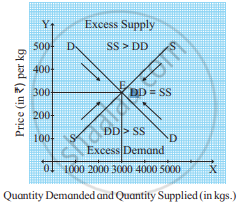
- On the X‑axis: quantity of apples.
- On the Y‑axis: price per kg of apples.
- DD is a downward‑sloping demand curve, showing an inverse relationship between price and quantity demanded.
- SS is an upward‑sloping supply curve, showing a direct relationship between price and quantity supplied.
- The curves intersect at point E.
At E, the equilibrium price = ₹300 and the equilibrium quantity = 3000 kg.
At any price above E, there is excess supply.
At any price below E, there is excess demand. - Market forces push the price towards this intersection point E.
CISCE: Class 12
Total demand and total supply
Total demand (market demand)
- Demand means the quantity of a commodity that consumers are willing and able to buy at different prices during a given period.
- Each unit of a commodity has a “demand price”, the price at which it can be sold to some buyer.
- Other things being equal, when price falls, quantity demanded increases; when price rises, quantity demanded decreases.
- A fall in price:
i. induces existing buyers to buy more,
ii. brings in new buyers, and
iii. may create substitution and income effects.
Total supply (market supply)
- Supply means the quantity of a commodity that producers are willing to offer for sale at different prices during a given period.
- It is not the total stock but only the part that producers are ready to sell at given prices.
- Each unit of a commodity has a “supply price”, the price at which it is offered for sale.
- Other things being equal, when price rises, quantity supplied increases; when price falls, quantity supplied decreases.
CISCE: Class 12
Table: equilibrium between demand and supply
| Price (₹) | Quantity demanded | Quantity supplied | Situation |
|---|---|---|---|
| 5 | 12 | 1 | Excess demand |
| 10 | 10 | 2 | Excess demand |
| 15 | 8 | 4 | Excess demand |
| 20 | 6 | 6 | Equilibrium (D = S) |
| 25 | 4 | 8 | Excess supply |
| 30 | 2 | 10 | Excess supply |
| 35 | 1 | 12 | Excess supply |
Explanation
- At price ₹20, quantity demanded = quantity supplied = 6 units → equilibrium price and equilibrium quantity.
- If the price is above ₹20, say ₹25:
i. Buyers demand only 4 units but sellers supply 8 units (excess supply).
ii. Sellers compete among themselves to sell, so the price falls towards ₹20. - If the price is below ₹20, say ₹15:
i. Buyers demand 8 units but sellers supply only 4 units (excess demand).
ii. Buyers compete among themselves to buy, so the price rises towards ₹20. - Thus, price adjusts until demand equals supply, and equilibrium is reached.
CISCE: Class 12
Equilibrium price of firm and industry under perfect competition
Industry equilibrium
- In perfect competition, the industry (all firms together) determines the market price by the intersection of market demand and market supply.
- In Fig. 2, the industry demand curve DD and supply curve SS intersect at point E, giving equilibrium price OP.
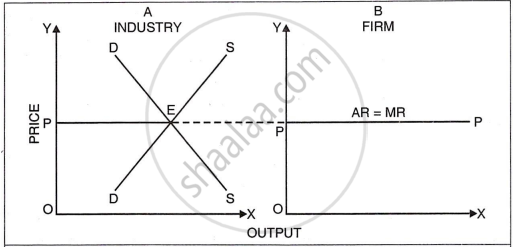
Firm’s price under perfect competition
- Under perfect competition, each individual firm is a price taker, not a price maker.
- In Fig. 2, the firm faces a horizontal demand curve at price OP.
- The firm can sell any quantity of its output at price OP but cannot charge more or less than OP.
- The firm’s demand curve is also its average revenue (AR) and marginal revenue (MR) curve under perfect competition.
Maharashtra State Board: Class 12
CISCE: Class 12
CISCE: Class 12
Key Points: Price Determination Under Perfect Competition
- Price under perfect competition is determined by the interaction of market demand and market supply.
- Equilibrium price is the price at which quantity demanded equals quantity supplied; equilibrium quantity is the corresponding quantity.
- At prices above equilibrium, there is excess supply and price tends to fall.
- At prices below equilibrium, there is excess demand and the price tends to rise.
- Marshall compared demand and supply to the two blades of a pair of scissors; both are essential for price determination.
- In perfect competition, the industry determines the price, and each firm is a price taker and must accept that price.
Test Yourself
Related QuestionsVIEW ALL [3]

Observe the following table and answer the questions:
| Price of a banana (per dozen) in ₹ | Demand (in dozen) | Supply (in dozen) | Relation between DD and SS |
| 10 | 500 | 100 | DD > SS |
| 20 | 400 | _____ | DD > SS |
| 30 | _____ | 300 | DD = SS |
| 40 | 200 | _____ | DD < SS |
| 50 | ______ | 500 | DD < SS |
- Fill in the blanks in the above schedule.
- Derive the equilibrium price from the above schedule with the help of a suitable diagram.
