Topics
Introduction to Micro and Macro Economics
- Introduction to Microeconomics and Macroeconomics
- Father of Econometrics: Ragnar Frisch
- Microeconomics
- Macroeconomics
- Macroeconomics Vs Microeconomics
Micro Economics
Introduction to Micro Economics
- Analysis of Market Structure
- Microeconomics
- Micro Economics - Slicing Method
- Use of Marginalism Principle in Micro Economics
- Micro Economics - Price Theory
- Micro Economic - Price Determination
- Micro Economics - Working of a Free Market Economy
- Micro Economics - International Trade and Public Finance
- Welfare Economics
- Micro Economics - Useful to Government
- Assumption of Micro Economic Analysis
Consumers Behavior
Analysis of Demand and Elasticity of Demand
Analysis of Supply
Types of Market and Price Determination Under Perfect Competition
Factors of Production
- Factors of Production - Feature of Capital
- Factors of Production
Macro Economics
Utility Analysis
- Basic Concepts of Microeconomics > Utility
- Commodities and Their Specific Utility for Individuals
- Total Utility and Marginal Utility
- Law of Diminishing Marginal Utility
- Paradox of Value
- Relationship Between Marginal Utility and Price
- Indifference Curve Analysis by Hicks and Allen
Introduction to Macro Economics
- Macroeconomics
- Allocation of Resource and Economic Variable
National Income
Determinants of Aggregates
- Total Demand for Good and Services
- Concept of Aggregate Demand and Aggregate Supply
- Consumption
- Investment Demand
- Government Demand
- Foreign Demand
- Difference Betweeen Export and Import
- Effect of Population of Consumption Expediture
- Types of Investment Expenditure
- Micro Eco-Equilibrium
Money
- Concept of Money
- Functions of Money
- Standard of Deferred Payment
- Standard of Transfer Payment
- Money - Store of Value
- Barter system
- Monetary Payments
- Qualities of Good Money
Commercial Bank
Central Bank
- Central Bank
- Central Bank Function - Banker's Bank
- Central Bank as a Controller of Credit
- Monetary Function of Central Bank
- Non Monetary Function of Central Bank
- Methods of Credit Control by the Central Bank
- Repo Rate and Reverse Repo Rate
- Central Bank Function - Goverment Bank
Public Economics
- Introduction of Public Economics
- Features of Public Economics
- Government Budget
- Objectives of Government Budget
- Features of Government Budget
- Public Economics - Budget (1 Year)(1 April to 31 March)
- Types of Budget
- Taxable Income
- Budgetary Accounting in India
- Budgetary Accounting - Consolidated , Contingency and Public Fund
- Components (Structure) of the Government Budget
- Factor Influencing Government Budget
Demand Analysis
Elasticity of Demand
- Introduction to Elasticity of Demand
- Income Elasticity of Demand
- Cross Elasticity of Demand
- Price Elasticity of Demand
- Perfectly Elastic Demand
- Perfectly Inelastic Demand
- Unitary Elastic Demand
- Relatively Elastic Demand
- Relatively Inelastic Demand
- Methods of Measuring Price Elasticity of Demand
- Linear Demand Curve
- Non-Linear Demand Curve
- Factors Influencing the Elasticity of Demand
- Importance of Elasticity of Demand
- Determinants of Price Elasticity of Demand
Supply Analysis
Forms of Market
- Concept of Market
- Classification of Market > Based on Place
- Classification of Market > Based on Place
- Classification of Market > Based on Time
- Classification of Market > Based on Competition
- Perfect Competition
- Price Determination Under Perfect Competition
- Imperfect Competition
- Monopoly
- Monopsony
- Oligopoly
- Monopolistic Competition
Index Numbers
- Index Numbers
- Features of Index Numbers
- Types of Index Numbers
- Index Numbers Used by Government of India
- Significance of Index Numbers
- Rebasing of GDP, IIP, and WPI
- Construction of Index Numbers
- Methods of Constructing Index Numbers > Simple Index Number
- Price Index Number
- Quantity Index Number
- Value Index Number
- Methods of Constructing Index Numbers > Weighted Index Number
- Laaspeyre’s Price Index Number
- Paasche’s Price Index Number
- Concepts of Sensex and Nifty
- Crops in India's Agricultural and Industrial Production Index
- Limitations of Index Numbers
National Income
- Concept of National Income
- Features of National Income
- Circular Flow of National Income
- Circular Flow of Income in a Two-Sector Economy
- Circular Flow of Income in a Three-Sector Economy
- Four Sector Model of Circular Income
- Different Concepts of National Income
- Concept of Green GNP
- Methods of Measurement of National Income
- Output Method/Product Method
- Income Method
- Expenditure Method
- Concept of Mixed income
- Difficulties in the Measurement of National Income
- Significance or Importance of National Income
Public Finance in India
- Introduction to Public Finance
- Difference Between Public Finance and Private Finance
- Public Expenditure
- Important Social Welfare Schemes by the Government
- Structure of Public Finance > Public Revenue
- Public Revenue > Taxes
- Types of Taxes
- Public Revenue > Non-tax Revenue
- Structure (Types) of Public Debt
- Fiscal Policy
- Structure of Public Finance > Financial Administration
- GST(Economics)
- Government Budget
- Revenue and Capital Budgets
- Types of Budget
- Importance of Budget
Money Market and Capital Market in India
- Concept of Financial Market
- Money Market
- Structure of Money Market in India > Organized Sector
- Structure of Money Market in India > Organized Sector
- Reserve Bank of India (RBI)
- Commercial Banks
- Co-operative Banks
- Development Financial Institutions (DFIs)
- Discount and Finance House of India (DFHI)
- Structure of Money Market in India > Unorganized Sector
- Money Market
- Role of Money Market in India
- Problems of the Indian Money Market
- Reforms Introduced in the Money Market
- Recent Developments in Banking Sector
- Capital Market
- Structure of Capital Market in India
- Role of Capital Market in India
- Problems of the Capital Market
- Regional Stock Exchanges in India
- Reforms Introduced in the Capital Market
- Economic Policy in an Economy
Foreign Trade of India
- India’s Trade Relations Before 1947
- Internal Trade
- Foreign Trade of India
- Types of Foreign Trade
- Role of Foreign Trade
- India’s Recent Trade Relations with China and Japan
- Composition of India’s Foreign Trade
- India’s Foreign Trade Share in GNI
- Composition of India's Imports
- Composition of India's Exports
- Direction of India’s Foreign Trade
- Trends in India’s Foreign Trade since 2001
- Concept of Balance of Payments
- Balance of Trade
- Member Nations of OPEC and OECD
- Introduction
- Definition: Market
- Essential Market Conditions
- Types of definition of market
- Features of a market
- Real-Life Application
- Key Points: Concept of Market
Introduction
In everyday life, the word 'market' usually makes us think of a place like a bazaar, shopping mall, or vegetable market where buying and selling take place.
In economics, the idea of a market is wider: it is not only a place but any arrangement that brings buyers and sellers into contact so that they can exchange goods and services.
CISCE: Class 12
Definition: Market
According to Augustin Cournot, “Economists understand the term 'market', not any particular marketplace in which things are bought and sold, but the whole of any region in which buyers and sellers are in such close contact with one another that the prices of the same goods tend to equality easily and quickly.”
Essential Market Conditions
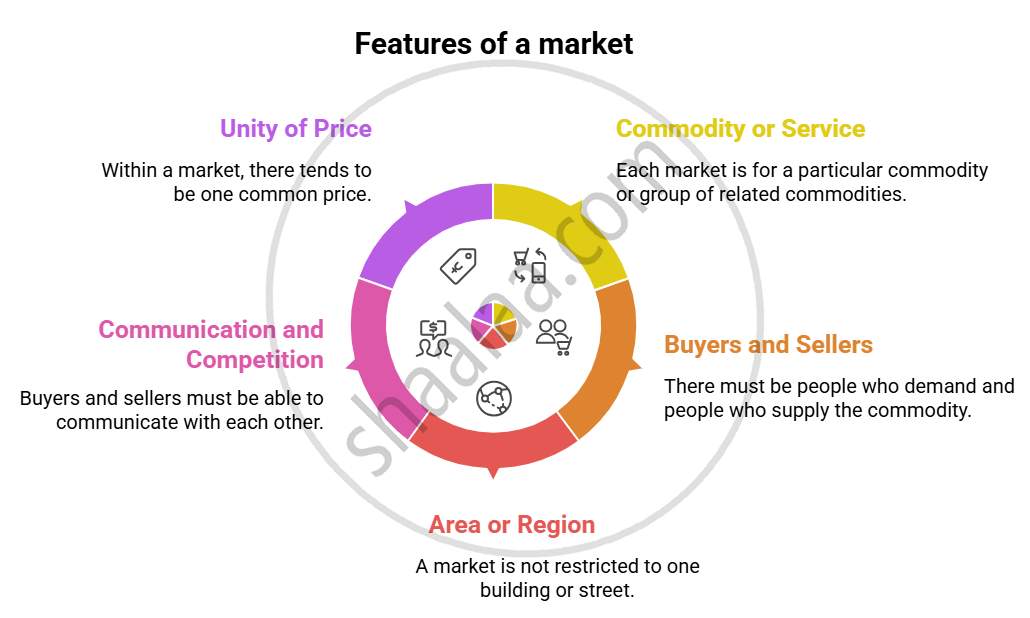
A market will exist at a particular time if the following conditions are present:
- A commodity or service
There must be some good or service to be bought and sold (for example, wheat, mobile phones, taxi rides). - Presence of buyers and sellers
There must be people who are willing to buy and people who are willing to sell that commodity. - Area or region of operation
Buyers and sellers should operate in some area – a village, city, region, country, or even the whole world. - Contact or communication between buyers and sellers
There must be some way for buyers and sellers to communicate with each other (directly or indirectly) so that they know the price and can agree on a deal (e.g., in person, by phone, through an app, etc.). - A price for the product
There should be a price at which the commodity is traded, and this price should tend to be the same for the same commodity at the same time within the market.
When these conditions are fulfilled, a market is said to exist even if there is no single physical marketplace.
Types of definitions of market
Economists often classify definitions of 'market' into two broad types.
A. Geographical definition
This focuses on place or area.
- A market is seen as a place or region where buyers and sellers come together to fix the price and carry out transactions.
- Example: The “Mumbai stock market” refers to the area where the buying and selling of certain financial instruments occur.
B. Functional definition
This focuses on activity or function rather than place.
- A market refers to the group of buyers, sellers, intermediaries and organisations who are in contact with each other and carry out the process of buying and selling.
- In economics, more emphasis is placed on this functional view: how exchange actually happens, not where it happens.
Features of a market
Real-Life Application
- Local vegetable market
Farmers and traders bring vegetables to a nearby yard; customers come and buy. This is a local physical market. - Online book market
A student orders a textbook from an online platform. The seller may be in another city, but because both can see and accept the same price on the platform, this is also a market, even without a common physical place. - World gold market
Gold is traded in many countries, but international communication and financial systems link these trades so that the price of gold is roughly similar across major markets after adjusting for costs. This is a world market.
CISCE: Class 12
Key Points: Concept of Market
- In common language, a market is a place where buying and selling occur.
- In economics, a market is any arrangement that allows buyers and sellers to meet (physically or virtually), decide a price, and exchange a commodity or service.
- A market can be local, national, or international.
- Essential elements of a market: commodity, buyers and sellers, area of operation, communication/contact, and price.
- There are two main ways to define a market: geographical (place‑based) and functional (activity‑based).
- Competition among buyers and sellers tends to produce one prevailing price for the same commodity at the same time within a market.
