Topics
Introduction to Micro and Macro Economics
- Introduction to Microeconomics and Macroeconomics
- Father of Econometrics: Ragnar Frisch
- Microeconomics
- Macroeconomics
- Macroeconomics Vs Microeconomics
Micro Economics
Introduction to Micro Economics
- Analysis of Market Structure
- Microeconomics
- Micro Economics - Slicing Method
- Use of Marginalism Principle in Micro Economics
- Micro Economics - Price Theory
- Micro Economic - Price Determination
- Micro Economics - Working of a Free Market Economy
- Micro Economics - International Trade and Public Finance
- Welfare Economics
- Micro Economics - Useful to Government
- Assumption of Micro Economic Analysis
Consumers Behavior
Analysis of Demand and Elasticity of Demand
Analysis of Supply
Types of Market and Price Determination Under Perfect Competition
Factors of Production
- Factors of Production - Feature of Capital
- Factors of Production
Utility Analysis
- Basic Concepts of Microeconomics > Utility
- Commodities and Their Specific Utility for Individuals
- Total Utility and Marginal Utility
- Law of Diminishing Marginal Utility
- Paradox of Value
- Relationship Between Marginal Utility and Price
- Indifference Curve Analysis by Hicks and Allen
Macro Economics
Introduction to Macro Economics
- Macroeconomics
- Allocation of Resource and Economic Variable
National Income
Determinants of Aggregates
- Total Demand for Good and Services
- Concept of Aggregate Demand and Aggregate Supply
- Consumption
- Investment Demand
- Government Demand
- Foreign Demand
- Difference Betweeen Export and Import
- Effect of Population of Consumption Expediture
- Types of Investment Expenditure
- Micro Eco-Equilibrium
Money
- Concept of Money
- Functions of Money
- Standard of Deferred Payment
- Standard of Transfer Payment
- Money - Store of Value
- Barter system
- Monetary Payments
- Concept of Good Money
Commercial Bank
Central Bank
- Central Bank
- Central Bank Function - Banker's Bank
- Central Bank as a Controller of Credit
- Monetary Function of Central Bank
- Non Monetary Function of Central Bank
- Methods of Credit Control
- Repo Rate and Reverse Repo Rate
- Central Bank Function - Goverment Bank
Public Economics
- Introduction of Public Economics
- Features of Public Economics
- Government Budget
- Objectives of Government Budget
- Features of Government Budget
- Public Economics - Budget (1 Year)(1 April to 31 March)
- Types of Budget
- Taxable Income
- Budgetary Accounting in India
- Budgetary Accounting - Consolidated , Contingency and Public Fund
- Components (Structure) of the Government Budget
- Factor Influencing Government Budget
Demand Analysis
Elasticity of Demand
- Introduction to Elasticity of Demand
- Income Elasticity of Demand
- Cross Elasticity of Demand
- Price Elasticity of Demand
- Perfectly Elastic Demand
- Perfectly Inelastic Demand
- Unitary Elastic Demand
- Relatively Elastic Demand
- Relatively Inelastic Demand
- Methods of Measuring Price Elasticity of Demand
- Linear Demand Curve
- Non-Linear Demand Curve
- Factors Influencing the Elasticity of Demand
- Importance of Elasticity of Demand
- Determinants of Price Elasticity of Demand
Supply Analysis
Forms of Market
- Concept of Market
- Classification of Market > Based on Place
- Classification of Market > Based on Place
- Classification of Market > Based on Time
- Classification of Market > Based on Competition
- Perfect Competition
- Price Determination Under Perfect Competition
- Imperfect Competition
- Monopoly
- Concept of Monopsony
- Oligopoly
- Monopolistic Competition
Index Numbers
- Index Numbers
- Features of Index Numbers
- Types of Index Numbers
- Index Numbers Used by Government of India
- Significance of Index Numbers
- Rebasing of GDP, IIP, and WPI
- Construction of Index Numbers
- Methods of Constructing Index Numbers > Simple Index Number
- Price Index Number
- Quantity Index Number
- Value Index Number
- Methods of Constructing Index Numbers > Weighted Index Number
- Laaspeyre’s Price Index Number
- Paasche’s Price Index Number
- Concepts of Sensex and Nifty
- Crops in India's Agricultural and Industrial Production Index
- Limitations of Index Numbers
National Income
- Concept of National Income
- Features of National Income
- Circular Flow of National Income
- Two Sector Model of Circular Flow of National Income
- Three Sector Model of Circular Flow of National Income
- Four Sector Model of Circular Income
- Different Concepts of National Income
- Concept of Green GNP
- Methods of Measurement of National Income
- Output Method/Product Method
- Income Method
- Expenditure Method
- Concept of Mixed income
- Difficulties in the Measurement of National Income
- Importance of National Income Analysis
Public Finance in India
- Public Finance
- Difference Between Public Finance and Private Finance
- Structure of Public Finance > Public Expenditure
- Important Social Welfare Schemes by the Government
- Structure of Public Finance > Public Revenue
- Public Revenue > Taxes
- Types of Taxes
- Direct Tax
- Indirect Tax
- Public Revenue > Non-tax Revenue
- Structure of Public Finance > Public Debt
- Structure of Public Finance > Fiscal Policy
- Structure of Public Finance > Financial Administration
- GST(Economics)
- Government Budget
- Revenue and Capital Budgets
- Types of Budget
- Importance of Budget
Money Market and Capital Market in India
- Concept of Financial Market
- Money Market
- Structure of Money Market in India > Organized Sector
- Structure of Money Market in India > Organized Sector
- Reserve Bank of India (RBI)
- Commercial Banks
- Co-operative Banks
- Development Financial Institutions (DFIs)
- Discount and Finance House of India (DFHI)
- Structure of Money Market in India > Unorganized Sector
- Money Market
- Role of Money Market in India
- Problems of the Indian Money Market
- Reforms Introduced in the Money Market
- Recent Developments in Banking Sector
- Capital Market
- Structure of Capital Market in India
- Role of Capital Market in India
- Problems of the Capital Market
- Regional Stock Exchanges in India
- Reforms Introduced in the Capital Market
- Economic Policy in an Economy
Foreign Trade of India
- India’s Trade Relations Before 1947
- Internal Trade
- Foreign Trade of India
- Types of Foreign Trade
- Role of Foreign Trade
- India’s Recent Trade Relations with China and Japan
- Composition of India’s Foreign Trade
- India’s Foreign Trade Share in GNI
- Composition of India's Imports
- Composition of India's Exports
- Direction of India’s Foreign Trade
- Trends in India’s Foreign Trade since 2001
- Concept of Balance of Payments
- Balance of Trade
- Member Nations of OPEC and OECD
- Meaning
- Definitions: Monopoly
- Features
- Types
- Price discrimination under monopoly
- Nature of demand and revenue under monopoly
- Costs under monopoly
- Key Points: Monopoly
Meaning
- The term “monopoly” comes from Greek: “mono” = single and “poly” = seller.
- A monopoly is a market situation where there is only one seller or producer of a product, and there is no close substitute for that product.
- Because there is only one seller and no close substitutes, the monopolist controls the entire market supply and can influence the price.
CISCE: Class 12
Definitions: Monopoly
- "A pure monopoly exists when there is only one producer in a market, there are no direct competitors." – Ferguson
- "Monopoly is a market situation in which there is a single seller, there is no close substitute for commodity it produces, there are barriers to entry." – Koutsoyiannis
Features
1] Single seller
- Only one firm sells the product in the market, so the firm and the industry are the same.
- Buyers are many and individually too small to affect the price.
2] No close substitutes
- The monopolist’s product has no close substitute in the market.
- If buyers do not want to pay the price, they may have to go without the product, because no similar alternative is available.
3] Barriers to entry
- New firms cannot easily enter the market because of obstacles such as:
(i) Legal barriers: patents, licences, and copyrights.
(ii) Natural barriers: control over key resources or special location.
(iii) Technological barriers: very high fixed costs, advanced technology. - These barriers protect the monopolist from competition and allow long‑run abnormal profit.
4] Complete control over market supply
- The monopolist decides how much to produce and sell.
- By changing output, the monopolist can influence the market price.
5] Price maker
- A monopolist is a price maker, not a price taker.
- Still, the monopolist cannot fix both price and quantity independently; the chosen price–quantity combination must lie on the market demand curve.
6] Possibility of price discrimination
- A monopolist can sometimes charge different prices to different customers or in different markets for the same product.
- The difference in price is not due to cost but due to differences in demand, place, time, or use (explained later).
7] No distinction between firm and industry
-
Since only one firm produces the whole market output, the monopoly firm itself is called the industry.
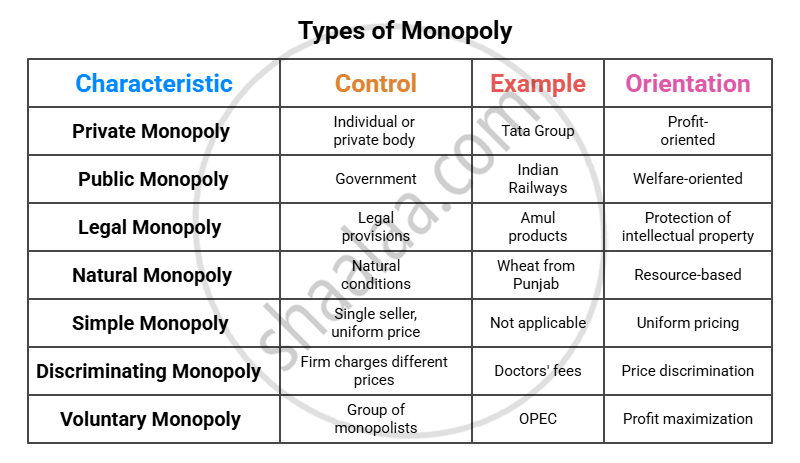
Types
Price discrimination under monopoly
Introduction:
-
It means selling the same product at different prices to different buyers, not because of differences in cost, but due to differences in demand, place, time, use, or buyer category.
| Basis of discrimination | Meaning | Example |
|---|---|---|
| Personal-wise | Different prices for different persons or groups | Doctors charging different fees to different patients |
| Place-wise | Different prices in different regions or cities | Higher house rent in urban area than rural area |
| Time-wise | Different prices at different times | Higher bus/rail fare during peak hours or at night |
| Use-wise | Different prices for different purposes of use | Lower electricity tariff for homes than for factories |
Nature of demand and revenue under monopoly
Key idea: Under monopoly, the firm faces the entire market demand curve.
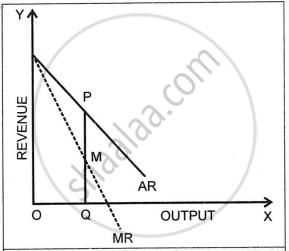
1. Average Revenue (AR) and demand
- AR = price per unit received from selling the product.
- Under monopoly, the AR curve of the firm is the same as the market demand curve.
- AR (demand) curve slopes downward from left to right: to sell more units, the monopolist must reduce the price.
2. Marginal Revenue (MR)
- MR is the extra revenue earned by selling one more unit of output.
- Because the monopolist must lower the price on all units to sell an extra unit, MR falls faster than AR.
- Therefore, the MR curve also slopes downward and lies below the AR curve.
Costs under monopoly
Cost curves:
The shapes of cost curves under monopoly are the same as in perfect competition.
- Fixed Cost (FC) curve is horizontal (parallel to X‑axis).
- Average Fixed Cost (AFC) curve slopes downwards and is a rectangular hyperbola.
- Average Variable Cost (AVC) and Average Cost (AC) curves are U‑shaped.
- Marginal Cost (MC) curve is also U-shaped and cuts both AVC and AC at their lowest points.
Important difference from perfect competition:
- Under perfect competition, the portion of MC above AVC can be treated as the supply curve.
- Under monopoly, the MC curve is not the supply curve because the monopolist does not take price as given.
- The monopolist chooses the output where MC=MR, and then charges the price from the AR (demand) curve at that output.
- Generally, monopoly price is higher than MC; this gap reflects monopoly power and leads to higher profit and possible loss of efficiency.
CISCE: Class 12
Key Points: Monopoly
- Monopoly is a market structure with one seller, no close substitutes, and barriers to entry.
- Main features: single seller, no close substitutes, barriers to entry, price maker, firm = industry, and possible price discrimination.
- Types include private, public, legal, natural, simple, discriminating, and voluntary (cartel) monopolies.
- Under monopoly, AR is the market demand curve; MR lies below AR because price must fall to sell more.
- Equilibrium output is found where MC=MR; price is taken from the AR curve at that output and is usually above MC.
- Cost curves (FC, AFC, AVC, AC, MC) have the usual shapes, but MC is not the supply curve in a monopoly.
- Price discrimination allows a monopolist to charge different prices by person, place, time, or use.
