Advertisements
Online Mock Tests
Chapters
1: GST [Goods and Service Tax]
2: Banking (Recurring Deposit Account)
3: Shares and Dividend
Unit 2. Algebra
4: Linear Inequations (In one variable)
5: Quadratic Equations
6: Solving (simple) Problems (Based on Quadratic Equations)
7: Ratio and Proportion (Including Properties and Uses)
8: Factorization of Polynomials (Remainder and Factor Theorems)
9: Matrices
10: Arithmetic Progression
11: Geometric Progression
Unit 3. Co-ordinate Geometry
12: Reflection
13: Section Formula and Mid-Point Formula
14: Equation of a Line
Unit 4. Geometry
▶ 15: Similarity (With Applications to Maps and Models)
16: Loci (Locus and Its Constructions)
17: Circles
18: Tangents and Intersecting Chords
19: Constructions (Circles)
Unit 5. Mensuration
20: Cylinder, Cone and Sphere
Unit 6. Trigonometry
21: Trigonometrical Identities
22: Height and Distances
Unit 7. Statistics
23: Graphical Representation
24: Measure of Central Tendency (Mean, Median, Quartiles and Mode)
25: Probability

Advertisements
Solutions for Chapter 15: Similarity (With Applications to Maps and Models)
Below listed, you can find solutions for Chapter 15 of CISCE Selina for Concise Mathematics [English] Class 10 ICSE.
Selina solutions for Concise Mathematics [English] Class 10 ICSE 15 Similarity (With Applications to Maps and Models) EXERCISE 15 (A) [Pages 214 - 217]
Multiple Choice Type: Choose the correct answer from the options given below.
In the given diagram OC = 1.5 × OA, then OB is equal to ______.
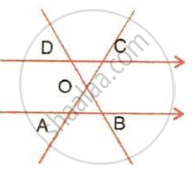
3 × OD
1.5 × OD
`2/3 xx` OD
OD
Are the given triangles similar?
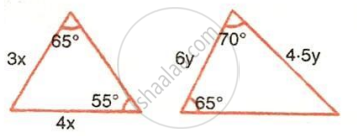
Yes
No
None of these
In the given figure, OA = 5, OB = 6, OC = 3 and OD = 10, then ______.
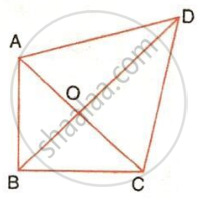
△ AOB ∼ △ AOD
△ AOB ∼ △ BOC
△ BOC ∼ △ COD
△ AOD ∼ △ COB
In the given figure, the value of (x) is ______.
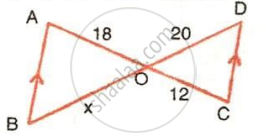
15
30
36
40
In triangle ABC, ∠BAC = 90° and AD is perpendicular to side BC. Triangle ABD is similar to triangle CBA by ______.
SAS
ASA
AAA
RHS
If AE = 10 cm, BD = 8 cm and BC = 10 cm, then AB is equal to ______.
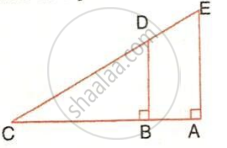
5 cm
25 cm
12.5 cm
2.5 cm
In the given figure:
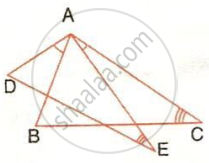
△ ABE ~ △ ADE
△ ADE ~ △ ABC
△ ADE ~ △ BAC
△ ADE ~ △ CAB
The value of (x) is ______.
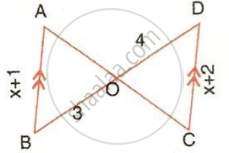
2
3
1
none of these
In the given figure, OD = 2 × OB, OC = 2 × OA and CD = 2 × AB then △ AOB ~ △ COD by ______.
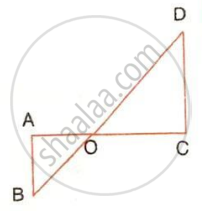
AA
SS
SAS and SSS
SSS
Are the two congruent triangles always similar?
Yes
No
None of these
If \[\frac{AB}{DE} = \frac{BC}{EF} = \frac{AC}{DF}\], then:
△ ABC ∼ △ EDF
△ ABC ∼ △ DEF
△ ABC ∼ △ FDE
none of these
If △ ABC ∼ △ DEF, then ______.
\[\frac{AB}{EF} = \frac{AC}{DF}\]
\[\frac{AB}{DE} = \frac{BC}{DF}\]
\[\frac{AC}{DF} = \frac{AB}{DE}\]
\[\frac{BC}{EF} = \frac{AC}{DE}\]
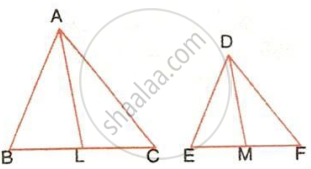
In \[\triangle ABC\] and \[\triangle DEF\], \[\angle A = \angle D\], \[\angle B = \angle E\] and \[\angle C = \angle F.\] Also, \[AL\] and \[DM\] are medians. Prove that \[\frac{BC}{EF} = \frac{AL}{DM}.\]
In triangle ABC, AD is perpendicular to side BC and AD2 = BD × DC. Show that angle BAC = 90°.
In the given figure, \(\triangle \mathrm{ABC}\) and \(\triangle \mathrm{DEF}\) are similar. BM and EN are their medians. Prove that:
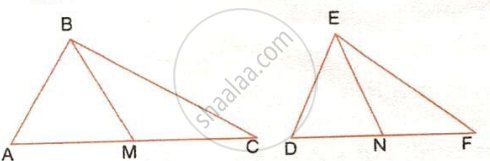
- \[\triangle AMB \sim \triangle DNE\]
- \[\triangle CMB \sim \triangle FNE\]
- \[\frac{BM}{EN} = \frac{AC}{DF}\]
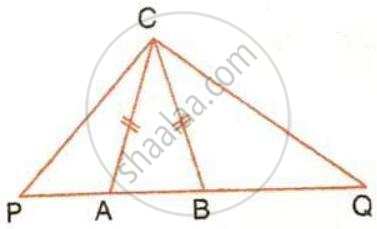
In the given figure, \(\triangle \mathrm{ABC}\) is isosceles and \(A P \times B Q=A C^{2}\), prove that \(\triangle A C P \sim \triangle B C Q\).
In the figure, given below, straight lines AB and CD intersect at P; and AC || BD. Prove that: ΔAPC and ΔBPD are similar.

In the figure, given below, straight lines AB and CD intersect at P; and AC || BD. Prove that: If BD = 2.4 cm, AC = 3.6 cm, PD = 4.0 cm and PB = 3.2 cm; find the lengths of PA and PC.

In the given figure, AB || DC, BO = 6 cm and DQ = 8 cm; find: BP × DO.

Given: ∠GHE = ∠DFE = 90°,
DH = 8, DF = 12,
DG = 3x – 1 and DE = 4x + 2.

Find: the lengths of segments DG and DE.
In ∆PQR, ∠Q = 90° and QM is perpendicular to PR. Prove that:
- PQ2 = PM × PR
- QR2 = PR × MR
- PQ2 + QR2 = PR2
In ∆ABC, ∠B = 90° and BD ⊥ AC.
- If CD = 10 cm and BD = 8 cm; find AD.
- If AC = 18 cm and AD = 6 cm; find BD.
- If AC = 9 cm and AB = 7 cm; find AD.
In the right-angled triangle QPR, PM is an altitude.

Given that QR = 8 cm and MQ = 3.5 cm, calculate the value of PR.
MORE PRACTICES:
In a trapezium ABCD, side AB is parallel to side DC; and the diagonals AC and BD intersect each other at point P. Prove that :
- ΔAPB is similar to ΔCPD.
- PA × PD = PB × PC.
P is a point on side BC of a parallelogram ABCD. If DP produced meets AB produced at point L, prove that: DP : PL = DC : BL.
P is a point on side BC of a parallelogram ABCD. If DP produced meets AB produced at point L, prove that: DL : DP = AL : DC.
In ΔABC, angle ABC is equal to twice the angle ACB, and bisector of angle ABC meets the opposite side at point P. Show that: CB : BA = CP : PA
In ΔABC, angle ABC is equal to twice the angle ACB, and bisector of angle ABC meets the opposite side at point P. Show that: AB × BC = BP × CA
In the given figure, DE || BC, AE = 15 cm, EC = 9 cm, NC = 6 cm and BN = 24 cm.
- Write all possible pairs of similar triangles.
- Find lengths of ME and DM.

In the given figure, AD = AE and AD2 = BD × EC. Prove that: triangles ABD and CAE are similar.

State, true or false:
Two similar polygons are necessarily congruent.
True
False
State, true or false:
Two congruent polygons are necessarily similar.
True
False
State, true or false:
All equiangular triangles are similar.
True
False
State, true or false:
All isosceles triangles are similar.
True
False
State, true or false:
Two isosceles-right triangles are similar.
True
False
State, true or false:
Two isosceles triangles are similar, if an angle of one is congruent to the corresponding angle of the other.
True
False
State, true or false:
The diagonals of a trapezium divide each other into proportional segments.
True
False
D is a point on the side BC of ∆ABC such that ∠ADC = ∠BAC. Prove that` \frac{"CA"}{"CD"}=\frac{"CB"}{"CA"} or "CA"^2 = "CB" × "CD".`
In the given figure, ∆ABC and ∆AMP are right angled at B and M respectively.
Given AC = 10 cm, AP = 15 cm and PM = 12 cm.
- Prove that: ∆ABC ~ ∆AMP
- Find: AB and BC.

In the figure, PQRS is a parallelogram with PQ = 16 cm and QR = 10 cm. L is a point on PR such that RL : LP = 2 : 3. QL produced meets RS at M and PS produced at N.

Find the lengths of PN and RM.
In the given figure, AB || EF || DC; AB = 67.5 cm, DC = 40.5 cm and AE = 52.5 cm.
- Name the three pairs of similar triangles.
- Find the lengths of EC and EF.
In the given figure, P is a point on AB such that AP : PB = 4 : 3. PQ is parallel to AC.

- Calculate the ratio PQ : AC, giving reason for your answer.
- In triangle ARC, ∠ARC = 90° and in triangle PQS, ∠PSQ = 90°. Given QS = 6 cm, calculate the length of AR.
In the figure, given below, the medians BD and CE of a triangle ABC meet at G. Prove that:

- ΔEGD ~ ΔCGB and
- BG = 2GD from (i) above.
Selina solutions for Concise Mathematics [English] Class 10 ICSE 15 Similarity (With Applications to Maps and Models) EXERCISE 15 (B) [Pages 220 - 221]
Multiple Choice Type: Choose the correct answer from the options given below.
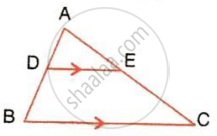
In the given figure, DE is parallel to BC. If AD : BD = 3 : 5 then DE : BC is ______.
3 : 8
3 : 5
5 : 3
8 : 3
If AD = AE and BD = CE then ______.
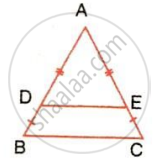
△ ADE ∼ △ ACB
△ ABC ∼ △ ACB
△ ABD ∼ △ ABC
△ ADE ∼ △ ABC
In the given figure, AB = 10 cm, CD = 8 cm = OB, then OD is equal to ______.
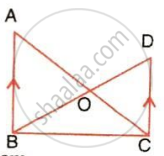
10 cm
3.2 cm
6.4 cm
8 cm
In the given figure, AE : EC = 2 : 3 and BC = 20 cm then DE is equal to ______.
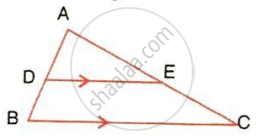
10 cm
12 cm
8 cm
16 cm
Two congruent triangles are ______.
not equal in area
similar
not similar
not similar but congruent
In the following figure, point D divides AB in the ratio 3 : 5. Find :
- `(AE)/(EC)`
- `(AD)/(AB)`
- `(AE)/(AC)`
Also, if: - DE = 2.4 cm, find the length of BC.
- BC = 4.8 cm, find the length of DE.

In the given figure, PQ || AB; CQ = 4.8 cm QB = 3.6 cm and AB = 6.3 cm. Find :
- `(CP)/(PA)`
- PQ
- If AP = x, then the value of AC in terms of x.

A line PQ is drawn parallel to the side BC of ΔABC which cuts side AB at P and side AC at Q. If AB = 9.0 cm, CA = 6.0 cm and AQ = 4.2 cm, find the length of AP.
In ΔABC, D and E are the points on sides AB and AC respectively. Find whether DE || BC, if:
- AB = 9 cm, AD = 4 cm, AE = 6 cm and EC = 7.5 cm.
- AB = 6.3 cm, EC = 11.0 cm, AD = 0.8 cm and AE = 1.6 cm.
In the given figure, ΔABC ~ ΔADE. If AE : EC = 4 : 7 and DE = 6.6 cm, find BC. If ‘x’ be the length of the perpendicular from A to DE, find the length of perpendicular from A to BC in terms of ‘x’.

A line segment DE is drawn parallel to base BC of ΔABC which cuts AB at point D and AC at point E. If AB = 5BD and EC = 3.2 cm, find the length of AE.
In the figure, given below, AB, CD and EF are parallel lines. Given AB = 7.5 cm, DC = y cm, EF = 4.5 cm, BC = x cm and CE = 3 cm, calculate the values of x and y.

In the figure, given below, PQR is a right-angle triangle right angled at Q. XY is parallel to QR, PQ = 6 cm, PY = 4 cm and PX : XQ = 1 : 2. Calculate the lengths of PR and QR.

In the following figure, M is mid-point of BC of a parallelogram ABCD. DM intersects the diagonal AC at P and AB produced at E. Prove that : PE = 2 PD

The given figure shows a parallelogram ABCD. E is a point in AD and CE produced meets BA produced at point F. If AE = 4 cm, AF = 8 cm and AB = 12 cm, find the perimeter of the parallelogram ABCD.

Selina solutions for Concise Mathematics [English] Class 10 ICSE 15 Similarity (With Applications to Maps and Models) EXERCISE 15 (C) [Pages 226 - 227]
Multiple Choice Type: Choose the correct answer from the options given below.
In the given figure, AE = 5 cm and EC = 7 cm, then area of ΔADE: area of ΔABC is ______.
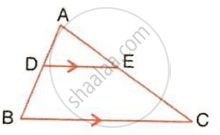
5 : 7
7 : 5
25 : 144
144 : 25
If AD = 5 and BD = 2, then area of ΔADE : area of trapezium DBCE is equal to ______.
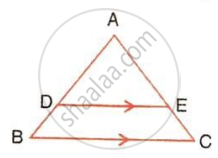
5 : 2
2 : 5
24 : 25
25 : 24
In the given figure, AD : DB = 2 : 5, then area of ∆ODE : area of ∆OCB is ______.
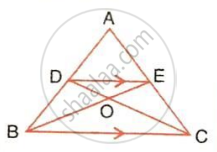
4 : 49
49 : 4
4 : 25
25 : 4
In the given figure, area of △ADE : area of trapezium BCED = 25 : 39, then AD : BD is ______.
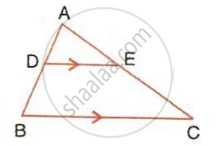
5 : 8
8 : 5
3 : 5
5 : 3
In the given figure, ∠BAC = 90°, AD is perpendicular to BC, BC = 13 cm and AC = 5 cm, then area of △ ADC : area of △ DBA is ______.
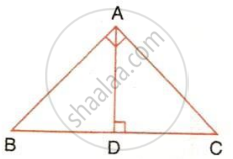
5 : 13
13 : 5
25 : 144
144 : 25
The ratio between the corresponding sides of two similar triangles is 2 is to 5. Find the ratio between the areas of these triangles.
Area of two similar triangles are 98 sq. cm and 128 sq. cm. Find the ratio between the lengths of their corresponding sides.
A line PQ is drawn parallel to the base BC of ∆ABC which meets sides AB and AC at points P and Q respectively. If AP = `1/3` PB; find the value of:
- $\dfrac{\text{Area of } \triangle ABC}{\text{Area of } \triangle APQ}$
- $\dfrac{\text{Area of } \triangle APQ}{\text{Area of trapezium } PBCQ}$
The perimeter of two similar triangles are 30 cm and 24 cm. If one side of the first triangle is 12 cm, determine the corresponding side of the second triangle.
In the given figure, AX : XB = 3 : 5

Find:
- the length of BC, if the length of XY is 18 cm.
- the ratio between the areas of trapezium XBCY and triangle ABC.
ABC is a triangle. PQ is a line segment intersecting AB in P and AC in Q such that PQ || BC and divides triangle ABC into two parts equal in area. Find the value of ratio BP : AB.
In the given triangle PQR, LM is parallel to QR and PM : MR = 3 : 4.

Calculate the value of ratio:
- `(PL)/(PQ)` and then `(LM)/(QR)`
- `"Area of ΔLMN"/"Area of ΔMNR"`
- `"Area of ΔLQM"/"Area of ΔLQN"`
In the figure, given below, ABCD is a parallelogram. P is a point on BC such that BP : PC = 1 : 2. DP produced meets AB produces at Q. Given the area of triangle CPQ = 20 cm2.

Calculate:
- area of triangle CDP,
- area of parallelogram ABCD.
In the given figure, BC is parallel to DE. Area of triangle ABC = 25 cm2, Area of trapezium BCED = 24 cm2 and DE = 14 cm. Calculate the length of BC. Also, find the area of triangle BCD.

In the given figure, ABC is a triangle. DE is parallel to BC and `(AD)/(DB) = 3/2`.
- Determine the ratios `(AD)/(AB)` and `(DE)/(BC)`.
- Prove that ∆DEF is similar to ∆CBF. Hence, find `(EF)/(FB).`
- What is the ratio of the areas of ∆DEF and ∆BFC?
In the given figure, ∠B = ∠E, ∠ACD = ∠BCE, AB = 10.4 cm and DE = 7.8 cm. Find the ratio between areas of the ∆ABC and ∆DEC.

Selina solutions for Concise Mathematics [English] Class 10 ICSE 15 Similarity (With Applications to Maps and Models) EXERCISE 15 (D) [Page 231]
Multiple Choice Type: Choose the correct answer from the options given below.
A model of a vehicle is made to a scale of 1: 25. If length of the vehicle is 1.6 m ; the length of its model is ______.
6.4 cm
0.64 m
40 cm
15.625 m
The length and the breadth of the model of a rectangular object are 12 cm and 7 cm respectively. If the scale factor is 1 : 20, the actual length and breadth of the object are ______.
1 m & 20 m
2.4 m & 1.4 m
12 cm & 140 cm
1.2 m & 0.7 m
The length of a boat is 2.4 m and the length of its model is 16 cm. The scale factor is ______.
15: 1
2 : 3
1 : 15
3 : 2
The floor area of a room is 96 m2 and area of the floor in the model of the room is 96 cm2. The scale factor is ______.
10 : 1
100 : 1
1 : 10
1 : 100
A and B are two similar containers with capacities 216 m3 and 1000 m3 respectively. The scale factor of B with respect to A is ______.
125 : 216
5 : 3
3 : 5
216 : 125
A triangle ABC has been enlarged by scale factor m = 2.5 to the triangle A' B' C'. Calculate : the length of AB, if A' B' = 6 cm.
A triangle ABC has been enlarged by scale factor m = 2.5 to the triangle A' B' C'. Calculate : the length of C' A' if CA = 4 cm.
A triangle LMN has been reduced by scale factor 0.8 to the triangle L' M' N'. Calculate: the length of M' N', if MN = 8 cm.
A triangle LMN has been reduced by scale factor 0.8 to the triangle L' M' N'. Calculate: the length of LM, if L' M' = 5.4 cm.
A model of an aeroplane is made to a scale of 1 : 400. Calculate : the length, in cm, of the model; if the length of the aeroplane is 40 m.
A model of an aeroplane is made to a scale of 1 : 400. Calculate : the length, in m, of the aeroplane, if length of its model is 16 cm.
The dimensions of the model of a multistorey building are 1.2 m × 75 cm × 2 m. If the scale factor is 1 : 30; find the actual dimensions of the building.
On a map drawn to a scale of 1 : 2,50,000; a triangular plot of land has the following measurements : AB = 3 cm, BC = 4 cm and angle ABC = 90°.
Calculate:
- the actual lengths of AB and BC in km.
- the area of the plot in sq. km.
A model of a ship is made to a scale 1 : 300.
- The length of the model of the ship is 2 m. Calculate the length of the ship.
- The area of the deck of the ship is 180,000 m2. Calculate the area of the deck of the model.
- The volume of the model is 6.5 m3. Calculate the volume of the ship.
Selina solutions for Concise Mathematics [English] Class 10 ICSE 15 Similarity (With Applications to Maps and Models) TEST YOURSELF [Pages 232 - 236]
Multiple Choice Type: Choose the correct answer from the options given below.
Triangles ABC and A'B'C' are similar to each other, the corresponding vertices of the two triangles are ______.
A and B'
C and A'
B and B'
C' and A
Triangles ABC and RSP are similar to each other, the corresponding sides of the two triangles are ______.
AB and RS
BC and RP
AC and SP
AB and RP
A : Two similar triangles are congruent.
B : Two congruent triangles are similar, then:
A is true, B is false.
A is false, B is true.
A is false, B is false.
A is true, B is true.
Triangles ABC and PQR are similar to each other, then ______.
\[\frac{\operatorname{Ar} \cdot(\triangle \mathrm{ABC})}{\operatorname{Ar} \cdot(\triangle \mathrm{PQR})}=\frac{\mathrm{BC}^{2}}{\mathrm{PQ}^{2}}\]
\[\frac{\mathrm{AB}^{2}}{\mathrm{PQ}^{2}}=\frac{\mathrm{AC}^{2}}{\mathrm{PR}^{2}}\]
\[\frac{\operatorname{Ar} \cdot(\triangle \mathrm{BAC})}{\operatorname{Ar} \cdot(\triangle \mathrm{QPR})} \neq \frac{\mathrm{AB}^{2}}{\mathrm{QP}^{2}}\]
\[\frac{\mathrm{AC}^{2}}{\mathrm{PR}^{2}}=\frac{\mathrm{BC}^{2}}{\mathrm{PQ}^{2}}\]
In the given figure, EF is parallel to BC. If area of triangle ABC is 576 cm2, the area of triangle AEF is ______.
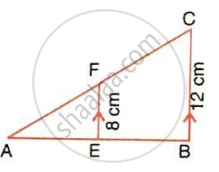
128 cm2
288cm2
256 cm2
768 cm2
In △ABD, C is a point on side BD such that ∠ACD = ∠BAD. Is △BAD similar to triangle ACD? If yes, then which axiom is satisfied:
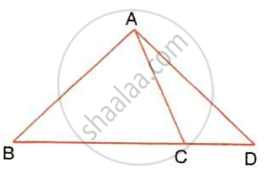
Yes, ASA
Yes, SAS
Yes, AA
No
The model of a ship is made to a scale of 3 : 500. If the length of the model is 1.5 m, the length of ship is ______.
750 m
1000 m
450 m
250 m
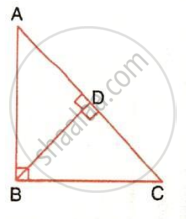
The perpendicular BD drawn from the vertex of a right triangle ABC.
Assertion (A): Triangles ABD and BCD are similar to each other.
Reason (R): Triangles, which are similar to the same triangle, are similar to each other.
A is true, R is false.
A is false, R is true.
Both A and R are true and R is the correct reason for A.
Both A and R are true and R is the incorrect reason for A .
△ABC and △PQR are congruent to each other.
Assertion (A): Triangles ABC and PQR are similar to each other.
Reason (R): Two similar triangles are congruent to each other.
A is true, R is false.
A is false, R is true.
Both A and R are true and R is the correct reason for A.
Both A and R are true and R is the incorrect reason for A .
ΔАВC is reflected in origin to get ΔΑ'Β'C'.
Statement (1): ΔABC is congruent to ΔΑ'Β'C'.
Statement (2): The two triangles are similar to each other.
Both the statements are true.
Both the statements are false.
Statement 1 is true, and statement 2 is false.
Statement 1 is false, and statement 2 is true.
Two similar triangles ABC and DEF such that the area of △ ABC = 64 sq. unit and area of △DEF =121 sq. unit.
Statement (1): \[\frac{\text{Perimeter of } \triangle DEF}{\text{Perimeter of } \triangle ABC} = \frac{8}{11}.\]
Statement (2): The ratio of perimeters of two similar triangles is equal to the ratio of their areas.
Both the statements are true.
Both the statements are false.
Statement 1 is true, and statement 2 is false.
Statement 1 is false, and statement 2 is true.
In triangle △ABC, AD : DB = 2 : 3, DE is parallel to BC.
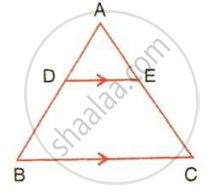
Assertion (A): \[\frac{\mathrm{DE}}{\mathrm{BC}}=\frac{\mathrm{AD}}{\mathrm{BD}}=\frac{2}{3}\].
Reason (R): \[\frac{\mathrm{DE}}{\mathrm{BC}}=\frac{\mathrm{AD}}{\mathrm{AB}}=\frac{2}{5}\]
A is true, R is false.
A is false, R is true.
Both A and R are true and R is the correct reason for A.
Both A and R are true and R is the incorrect reason for A.
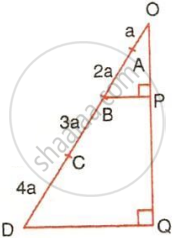
In triangle \(\mathrm{ODQ}, \angle \mathrm{Q}=\angle \mathrm{BPO}=90^{\circ}\)
\(\mathrm{AB}=2 \times \mathrm{OA}, \mathrm{BC}=3 \times \mathrm{OA}\) and \(\mathrm{CD}=4 \times \mathrm{OA}\).
Assertion (A):
\[\frac{\triangle \mathrm{OBP}}{\text { Trapezium BDQP }}=\frac{9}{100-9}\].
Reason (R): \[\triangle \mathrm{OBP} \sim \triangle \mathrm{ODQ}\]
and \[\frac{\triangle \mathrm{OBP}}{\triangle \mathrm{ODQ}}=\frac{(3 a)^{2}}{(10 \mathrm{a})^{2}}\]
A is true, R is false.
A is false, R is true.
Both A and R are true and R is the correct reason for A.
Both A and R are true and R is the incorrect reason for A .
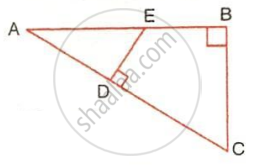
In triangle ABC, ∠B = 90° and in triangle ADE, ∠D = 90°.
Statement (1): \[\frac{AB}{AD} = \frac{AC}{AE}\]
Statement (2): Triangles AED and ACB are similar.
Both the statements are true.
Both the statements are false.
Statement 1 is true, and statement 2 is false.
Statement 1 is false, and statement 2 is true.
Area of triangle ADE = 9 cm2 and area of trapezium DBCE = 16 cm2.
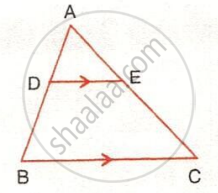
Statement (1): \[\frac{\mathrm{DE}}{\mathrm{BC}}=\frac{3}{4}\]
Statement (2): \[\frac{\triangle \mathrm{ADE}}{\triangle \mathrm{ABC}}=\frac{9}{25} \Rightarrow \frac{\mathrm{DE}}{\mathrm{BC}}=\frac{3}{5}\]
Both the statements are true.
Both the statements are false.
Statement 1 is true, and statement 2 is false.
Statement 1 is false, and statement 2 is true.
In the following figure, XY is parallel to BC, AX = 9 cm, XB = 4.5 cm and BC = 18 cm.

Find :
- `(AY)/(YC)`
- `(YC)/(AC)`
- XY
In the following figure, ABCD to a trapezium with AB || DC. If AB = 9 cm, DC = 18 cm, CF = 13.5 cm, AP = 6 cm and BE = 15 cm.
Calculate:
- EC
- AF
- PE

In the following figure, AB, CD and EF are perpendicular to the straight line BDF.

If AB = x and CD = z unit and EF = y unit, prove that : `1/x + 1/y = 1/z`
Triangle ABC is similar to triangle PQR. If AD and PM are corresponding medians of the two triangles, prove that : `("AB")/("PQ") = ("AD")/("PM")`.
Triangle ABC is similar to triangle PQR. If AD and PM are altitudes of the two triangles, prove that: `(AB)/(PQ) = (AD)/(PM)`.
Triangle ABC is similar to triangle PQR. If bisector of angle BAC meets BC at point D and bisector of angle QPR meets QR at point M, prove that : `(AB)/(PQ) = (AD)/(PM)`.
In the following figure, ∠AXY = ∠AYX. If `(BX)/(AX) = (CY)/(AY)`, show that triangle ABC is isosceles.

In the following figure, DE || AC and DC || AP. Prove that : `(BE)/(EC) = (BC)/(CP)`.

In the figure given below, AB || EF || CD. If AB = 22.5 cm, EP = 7.5 cm, PC = 15 cm and DC = 27 cm.
Calculate :
- EF
- AC

In ΔABC, ∠ABC = ∠DAC, AB = 8 cm, AC = 4 cm and AD = 5 cm.
- Prove that ΔACD is similar to ΔBCA.
- Find BC and CD.
- Find the area of ΔACD : area of ΔABC.

In the following figure, AD and CE are medians of ΔABC. DF is drawn parallel to CE. Prove that :
- EF = FB,
- AG : GD = 2 : 1

The two similar triangles are equal in area. Prove that the triangles are congruent.
The ratio between the altitudes of two similar triangles is 3 : 5; write the ratio between their :
- corresponding medians.
- perimeters.
- areas.
The ratio between the areas of two similar triangles is 16 : 25. State the ratio between their :
- perimeters.
- corresponding altitudes.
- corresponding medians.
On a map, drawn to a scale of 1 : 20000, a rectangular plot of land ABCD has AB = 24 cm and BC = 32 cm. Calculate :
- the diagonal distance of the plot in kilometer.
- the area of the plot in sq. km.
The dimensions of the model of a multistoreyed building are 1 m by 60 cm by 1.20 m. If the scale factor is 1 : 50, find the actual dimensions of the building.
Also, find:
- the floor area of a room of the building, if the floor area of the corresponding room in the model is 50 sq. cm.
- the space (volume) inside a room of the model, if the space inside the corresponding room of the building is 90 m3.
In a triangle PQR, L and M are two points on the base QR, such that ∠LPQ = ∠QRP and ∠RPM = ∠RQP. Prove that:
- ΔPQL ∼ ΔRPM
- QL × RM = PL × PM
- PQ2 = QR × QL

A triangle ABC with AB = 3 cm, BC = 6 cm and AC = 4 cm is enlarged to ΔDEF such that the longest side of ΔDEF = 9 cm. Find the scale factor and hence, the lengths of the other sides of ΔDEF.
Two isosceles triangles have equal vertical angles. Show that the triangles are similar. If the ratio between the areas of these two triangles is 16 : 25, find the ratio between their corresponding altitudes.
In triangle ABC, AP : PB = 2 : 3. PO is parallel to BC and is extended to Q so that CQ is parallel to BA.

Find:
- area ΔAPO : area ΔABC.
- area ΔAPO : area ΔCQO.
In the give figure, ABC is a triangle with ∠EDB = ∠ACB. Prove that ΔABC ∼ ΔEBD. If BE = 6 cm, EC = 4 cm, BD = 5 cm and area of ΔBED = 9 cm2. Calculate the:
- length of AB
- area of ΔABC

In the given figure, ABC is a right angled triangle with ∠BAC = 90°.

- Prove that : ΔADB ∼ ΔCDA.
- If BD = 18 cm and CD = 8 cm, find AD.
- Find the ratio of the area of ΔADB is to area of ΔCDA.
ABC is a right angled triangle with ∠ABC = 90°. D is any point on AB and DE is perpendicular to AC. Prove that :

- ΔADE ∼ ΔACB.
- If AC = 13 cm, BC = 5 cm and AE = 4 cm. Find DE and AD.
- Find, area of ΔADE : area of quadrilateral BCED.
Given : AB || DE and BC || EF. Prove that :
- `(AD)/(DG) = (CF)/(FG)`
- ∆DFG ∼ ∆ACG

PQR is a triangle. S is a point on the side QR of ΔPQR such that ∠PSR = ∠QPR. Given QP = 8 cm, PR = 6 cm and SR = 3 cm.
- Prove ΔPQR ∼ ΔSPR.
- Find the length of QR and PS.
- `"area of ΔPQR"/"area of ΔSPR"`

Case-Study Based Question:
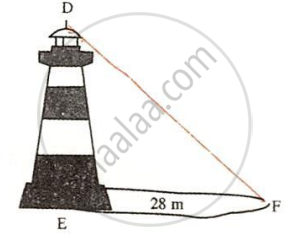
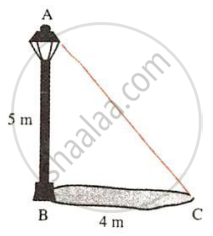
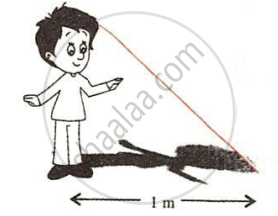
Rohan is trying to find the height of a tower shown below. He is using the properties of similar triangles. He observes a lamp post near it of height 5 m casting a shadow of 4 m on the ground. At the same time, he himself is casting a shadow of 1 m on the ground.
Based on the above information, answer the following questions:
- What is the height of the tower?
- What is Rohan’s height?
- What will be the length of the shadow of the lamp post when the tower casts a shadow of 35 m?
Solutions for 15: Similarity (With Applications to Maps and Models)
Selina solutions for Concise Mathematics [English] Class 10 ICSE chapter 15 - Similarity (With Applications to Maps and Models)
Shaalaa.com has the CISCE Mathematics Concise Mathematics [English] Class 10 ICSE CISCE solutions in a manner that help students grasp basic concepts better and faster. The detailed, step-by-step solutions will help you understand the concepts better and clarify any confusion. Selina solutions for Mathematics Concise Mathematics [English] Class 10 ICSE CISCE 15 (Similarity (With Applications to Maps and Models)) include all questions with answers and detailed explanations. This will clear students' doubts about questions and improve their application skills while preparing for board exams.
Further, we at Shaalaa.com provide such solutions so students can prepare for written exams. Selina textbook solutions can be a core help for self-study and provide excellent self-help guidance for students.
Concepts covered in Concise Mathematics [English] Class 10 ICSE chapter 15 Similarity (With Applications to Maps and Models) are Similarity of Triangles (Corresponding Sides & Angles), Criteria for Similarity of Triangles, Basic Proportionality Theorem, Relation Between the Areas of Two Triangles, Similarity as a Size Transformation, Applications to Maps and Models, Similarity and Congruency of Figures, Similarity of Triangles (Corresponding Sides & Angles), Criteria for Similarity of Triangles, Basic Proportionality Theorem, Relation Between the Areas of Two Triangles, Similarity as a Size Transformation, Applications to Maps and Models, Similarity and Congruency of Figures, Similarity of Triangles (Corresponding Sides & Angles), Criteria for Similarity of Triangles, Basic Proportionality Theorem, Relation Between the Areas of Two Triangles, Similarity as a Size Transformation, Applications to Maps and Models, Similarity and Congruency of Figures.
Using Selina Concise Mathematics [English] Class 10 ICSE solutions Similarity (With Applications to Maps and Models) exercise by students is an easy way to prepare for the exams, as they involve solutions arranged chapter-wise and also page-wise. The questions involved in Selina Solutions are essential questions that can be asked in the final exam. Maximum CISCE Concise Mathematics [English] Class 10 ICSE students prefer Selina Textbook Solutions to score more in exams.
Get the free view of Chapter 15, Similarity (With Applications to Maps and Models) Concise Mathematics [English] Class 10 ICSE additional questions for Mathematics Concise Mathematics [English] Class 10 ICSE CISCE, and you can use Shaalaa.com to keep it handy for your exam preparation.
