Advertisements
Advertisements
Question
In the give figure, ABC is a triangle with ∠EDB = ∠ACB. Prove that ΔABC ∼ ΔEBD. If BE = 6 cm, EC = 4 cm, BD = 5 cm and area of ΔBED = 9 cm2. Calculate the:
- length of AB
- area of ΔABC

Sum
Advertisements
Solution
In ΔABC and ΔEBD
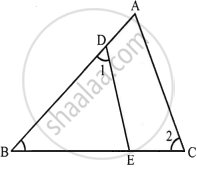
∠1 = ∠2 ...(Given)
∠B = ∠B ...(Common)
`\implies` ΔABC ∼ ΔEBD ...[By AA axiom of similarity]
Now, \[\frac{\text{Area of } \triangle ABC}{\text{Area of } \triangle EBD} = \left(\frac{BC}{BD}\right)^2\] ⇒ \[\frac{\text{Area of } \triangle ABC}{9} = \left(\frac{10}{5}\right)^2\]
⇒ Area of ΔABC = 4 × 9
⇒ Area of ΔABC = 36 cm2
Also, \[\frac{\text{Area of } \triangle ABC}{\text{Area of } \triangle EBD} = \frac{(AB)^2}{(BE)^2}\]
⇒ `36/9 = (AB^2)/36`
⇒ `AB^2 = (36 xx 36)/9`
⇒ AB2 = 144
⇒ AB = 12 cm
shaalaa.com
Is there an error in this question or solution?
