Advertisements
Advertisements
Question
In the given figure, \(\triangle \mathrm{ABC}\) and \(\triangle \mathrm{DEF}\) are similar. BM and EN are their medians. Prove that:
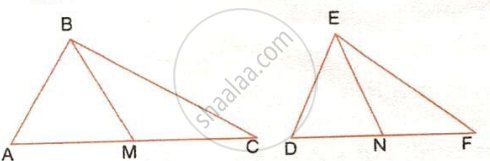
- \[\triangle AMB \sim \triangle DNE\]
- \[\triangle CMB \sim \triangle FNE\]
- \[\frac{BM}{EN} = \frac{AC}{DF}\]
Advertisements
Solution
(i) Given,
Since, \[BM\] and \[EN\] are medians of triangles \[ABC\] and \[DEF\] respectively.
∴ \[AM = \frac{1}{2}\, AC\] and \[DN = \frac{1}{2}\, DF\]
Given,
\[\triangle ABC \sim \triangle DEF\]
∴ \[\angle A = \angle D\] (Corresponding angles of similar triangles are equal)
We know that,
Corresponding sides of similar triangles are proportional.
∴ \[\frac{AB}{DE} = \frac{AC}{DF} \qquad \text{....(1)}\]
⇒ \[\frac{AB}{DE} = \frac{\frac{1}{2}\, AC}{\frac{1}{2}\, DF}\]
⇒ \[\frac{AB}{DE} = \frac{AM}{DN} \qquad \text{....(2)}\]
In \[\triangle AMB\] and \[\triangle DNE\],
⇒ \[\angle A = \angle D\] (Proved above)
⇒ \[\frac{AB}{DE} = \frac{AM}{DN}\] [From equation (2)]
∴ \[\triangle AMB \sim \triangle DNE\] (By SAS postulate)
(ii) Given,
Since, \[BM\] and \[EN\] are medians of triangles \[ABC\] and \[DEF\] respectively.
∴ \[MC = \frac{1}{2}\, AC\] and \[NF = \frac{1}{2}\, DF\]
Given,
\[\triangle ABC \sim \triangle DEF\]
⇒ \[\angle C = \angle F\] (Corresponding angles of similar triangles are equal)
Since, corresponding sides of similar triangles are proportional.
∴ \[\frac{BC}{EF} = \frac{AC}{DF} \qquad \text{....(3)}\]
⇒ \[\frac{BC}{EF} = \frac{\frac{1}{2}\, AC}{\frac{1}{2}\, DF}\]
⇒ \[\frac{BC}{EF} = \frac{MC}{NF} \qquad \text{....(4)}\]
In \[\triangle CMB\] and \[\triangle FNE\],
⇒ \[\angle C = \angle F\] (Proved above)
⇒ \[\frac{BC}{EF} = \frac{MC}{NF}\] [From equation (4)]
∴ \[\triangle CMB \sim \triangle FNE\] (By SAS postulate)
(iii) Given,
\[\triangle ABC \sim \triangle DEF\]
We know that,
Corresponding sides of similar triangles are proportional.
∴ \[\frac{AB}{DE} = \frac{AC}{DF} \qquad \text{.......(5)}\]
\[\triangle AMB \sim \triangle DNE\]
We know that,
Corresponding sides of similar triangles are proportional.
∴ \[\frac{BM}{EN} = \frac{AB}{DE} \qquad \text{......(6)}\]
From equation (5) and (6), we get :
⇒ \[\frac{BM}{EN} = \frac{AC}{DF}\]
Hence, proved that \[\frac{BM}{EN} = \frac{AC}{DF}.\]
