English

In the given figure, โ–ณABC is isosceles and ๐ดโข๐‘ƒ ร—๐ตโข๐‘„ =๐ดโข๐ถ2, prove that โ–ณ๐ดโข๐ถโข๐‘ƒ โˆผโ–ณ๐ตโข๐ถโข๐‘„.

Advertisements
Advertisements

Question

In the given figure, \(\triangle \mathrm{ABC}\) is isosceles and \(A P \times B Q=A C^{2}\), prove that \(\triangle A C P \sim \triangle B C Q\).
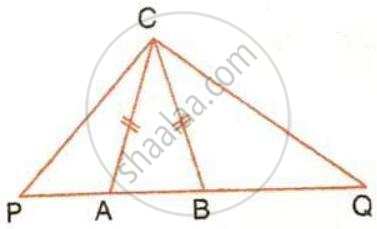
The image displays a triangle PCQ with internal line segments CA and CB extending from vertex C to the base PQ. It features double-tick marks on segments CA and CB to indicate equal lengths.

Sum
Advertisements

Solution

Given,

⇒ AP × BQ = AC2

⇒ AP × BQ = AC × AC

⇒ AP × BQ = AC × BC (From figure, AC = BC)

⇒ `(AP)/(BC) = (AC)/(BQ)`     ....(1)

Since, AC = BC

⇒ ∠CAB = ∠CBA    ....(2) [Angles opposite to equal sides are equal]

⇒ 180° − ∠CAB = 180° − ∠CBA

⇒ ∠CAP = ∠CBQ   ....(3)

In Δ ACP and Δ BCQ,

⇒ ∠CAP = ∠CBQ [From equation (3)]

⇒ `(AP)/(BC) = (AC)/(BQ)`โ€‹ [From equation (1)]

∴ Δ ACP ∼ Δ BCQ (By SAS postulates)

shaalaa.com
  Is there an error in this question or solution?
Chapter 15: Similarity (With Applications to Maps and Models) - EXERCISE 15 (A) [Page 216]

APPEARS IN

Selina Concise Mathematics [English] Class 10 ICSE
Chapter 15 Similarity (With Applications to Maps and Models)
EXERCISE 15 (A) | Q 5. | Page 216
Share
Notifications

Englishเคนเคฟเค‚เคฆเฅ€เคฎเคฐเคพเค เฅ€


      Forgot password?
Use app×