Advertisements
Advertisements
प्रश्न
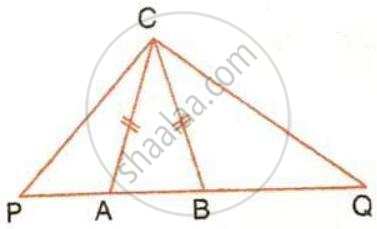
In the given figure, \(\triangle \mathrm{ABC}\) is isosceles and \(A P \times B Q=A C^{2}\), prove that \(\triangle A C P \sim \triangle B C Q\).
योग
Advertisements
उत्तर
Given,
⇒ AP × BQ = AC2
⇒ AP × BQ = AC × AC
⇒ AP × BQ = AC × BC (From figure, AC = BC)
⇒ `(AP)/(BC) = (AC)/(BQ)` ....(1)
Since, AC = BC
⇒ ∠CAB = ∠CBA ....(2) [Angles opposite to equal sides are equal]
⇒ 180° − ∠CAB = 180° − ∠CBA
⇒ ∠CAP = ∠CBQ ....(3)
In Δ ACP and Δ BCQ,
⇒ ∠CAP = ∠CBQ [From equation (3)]
⇒ `(AP)/(BC) = (AC)/(BQ)` [From equation (1)]
∴ Δ ACP ∼ Δ BCQ (By SAS postulates)
shaalaa.com
क्या इस प्रश्न या उत्तर में कोई त्रुटि है?
