Advertisements
Advertisements
Question
In triangle ABC, AP : PB = 2 : 3. PO is parallel to BC and is extended to Q so that CQ is parallel to BA.

Find:
- area ΔAPO : area ΔABC.
- area ΔAPO : area ΔCQO.
Sum
Advertisements
Solution
In ΔABC,
AP : PB = 2 : 3
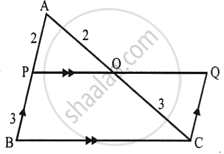
PQ || BC and CQ || BA
∵ PQ || BC
∴ `(AP)/(PB) = (AO)/(OC) = 2/3`
i. In ΔAPQ ∼ ΔABC
∴ `(Area ΔAPO)/(Area ΔABC) = (AP^2)/(AB^2)`
= `(AP^2)/(AP + PB)^2`
= `(2)^2/(2 + 3)^2`
= `4/25`
∴ area ΔAPO : area ΔABC = 4 : 25
ii. In ΔAPO and ΔCQO
∠APO = ∠OQC ...(Alternate angles)
∠AOP = ∠COQ ...(Vertically opposite angles)
∴ ΔAPO ∼ ΔCQO ...(AA axiom)
∴ `(Area ΔAPO)/(Area ΔCQO) = (AP^2)/(CQ^2)`
= `(AP^2)/(PB^2)` {∵ PBCQ is a || gm}
= `(2)^2/(3)^2`
= `4/9`
∴ area ΔAPO : area ΔCQO = 4 : 9
shaalaa.com
Is there an error in this question or solution?
