Advertisements
Online Mock Tests
Chapters
1: Real Numbers
Algebra
2: Polynomials
3: Linear Equations in Two Variables
4: Quadratic Equations
5: Arithmetic Progression
Coordinate Geometry
6: Coordinate Geometry
Geometry
7: Triangles
8: Circles
9: Constructions
Trigonometry
10: Trignometric Ratios
11: T-Ratios of Some Particular Angles
12: Trigonometric Ratios of Some Complemantary Angles
13: Trigonometric identities
14: Heights and Distances
Mensuration
15: Perimeter And Area of Plane Figures
16: Area of Circle, Sector and Segment
17: Volumes and Surface Areas of Solids
Statistics and Probability
18: Mean, Median, Mode of Grouped Data, Cumulative Frequency Graph and Ogive
19: Probability
▶ 20: Additional Questions

Advertisements
Solutions for Chapter 20: Additional Questions
Below listed, you can find solutions for Chapter 20 of CBSE, Karnataka Board R.S. Aggarwal for Mathematics [English] Class 10.
R.S. Aggarwal solutions for Mathematics [English] Class 10 20 Additional Questions Real Numbers [Pages 965 - 969]
Assertion-and-Reason Type Questions Each question consists of two statements, namely, Assertion (A) and Reason (R). For selecting the correct answer, use the following code:
Assertion (A): \(\sqrt{10}\) is an irrational number.
Reason (R): If m is a natural number which is not a perfect square then \(\sqrt{m}\) is irrational.
Both Assertion (A) and Reason (R) are true and Reason (R) is a correct explanation of Assertion (A).
Both Assertion (A) and Reason (R) are true but Reason (R) is not a correct explanation of Assertion (A).
Assertion (A) is true and Reason (R) is false.
Assertion (A) is false and Reason (R) is true.
Assertion (A): \[\frac{19}{500}\] is a terminating decimal.
Reason (R): The rational number \[\frac{p}{q}\] is a terminating decimal, if \[q = (2^{m} \times 5^{n})\] for some whole numbers m and n.
Both Assertion (A) and Reason (R) are true and Reason (R) is a correct explanation of Assertion (A).
Both Assertion (A) and Reason (R) are true but Reason (R) is not a correct explanation of Assertion (A).
Assertion (A) is true and Reason (R) is false.
Assertion (A) is false and Reason (R) is true.
Assertion (A): \[\frac{31}{90}\] is a nonterminating, repeating decimal.
Reason (R): The rational number \[\frac{p}{q}\] is a repeating decimal, if q has at least one factor other than 2 and 5.
Both Assertion (A) and Reason (R) are true and Reason (R) is a correct explanation of Assertion (A).
Both Assertion (A) and Reason (R) are true but Reason (R) is not a correct explanation of Assertion (A).
Assertion (A) is true and Reason (R) is false.
Assertion (A) is false and Reason (R) is true.
Assertion (A): \[\sqrt{7}\] is an irrational number.
Reason (R): If p is prime then \[\sqrt{p}\] is irrational.
Both Assertion (A) and Reason (R) are true and Reason (R) is a correct explanation of Assertion (A).
Both Assertion (A) and Reason (R) are true but Reason (R) is not a correct explanation of Assertion (A).
Assertion (A) is true and Reason (R) is false.
Assertion (A) is false and Reason (R) is true.
Assertion (A): \[\frac{22}{7}\] is a nonterminating, repeating decimal.
Reason (R): The rational number \[\frac{p}{q}\] is a terminating decimal, if \[q = (2^{m} \times 5^{n})\] for some whole numbers m and n.
Both Assertion (A) and Reason (R) are true and Reason (R) is a correct explanation of Assertion (A).
Both Assertion (A) and Reason (R) are true but Reason (R) is not a correct explanation of Assertion (A).
Assertion (A) is true and Reason (R) is false.
Assertion (A) is false and Reason (R) is true.
Assertion (A): \[\frac{1}{\sqrt{3}}\] is a rational number.
Reason (R): If p is prime then \[\frac{1}{\sqrt{p}}\] is irrational.
Both Assertion (A) and Reason (R) are true and Reason (R) is a correct explanation of Assertion (A).
Both Assertion (A) and Reason (R) are true but Reason (R) is not a correct explanation of Assertion (A).
Assertion (A) is true and Reason (R) is false.
Assertion (A) is false and Reason (R) is true.
Assertion (A): π is irrational and \[\frac{22}{7}\] is rational.
Reason (R): \[\pi \neq \frac{22}{7}\]
Both Assertion (A) and Reason (R) are true and Reason (R) is a correct explanation of Assertion (A).
Both Assertion (A) and Reason (R) are true but Reason (R) is not a correct explanation of Assertion (A).
Assertion (A) is true and Reason (R) is false.
Assertion (A) is false and Reason (R) is true.
Assertion (A): \[\sqrt{5}\] is an irrational number.
Reason (R): Let p be a prime number and a be a positive integer. Then, p divides \[a^{2} \Rightarrow\] p divides a.
Both Assertion (A) and Reason (R) are true and Reason (R) is a correct explanation of Assertion (A).
Both Assertion (A) and Reason (R) are true but Reason (R) is not a correct explanation of Assertion (A).
Assertion (A) is true and Reason (R) is false.
Assertion (A) is false and Reason (R) is true.
Assertion (A): \[0.\overline{6}\] is a terminating decimal.
Reason (R): The rational number \[\frac{p}{q}\] is a terminating decimal, if \[q = (2^{m} \times 5^{n})\] for some whole numbers m and n.
Both Assertion (A) and Reason (R) are true and Reason (R) is a correct explanation of Assertion (A).
Both Assertion (A) and Reason (R) are true but Reason (R) is not a correct explanation of Assertion (A).
Assertion (A) is true and Reason (R) is false.
Assertion (A) is false and Reason (R) is true.
Assertion (A): The HCF of two numbers is 25 and their LCM is 60.
Reason (R): The HCF of two given numbers always divides their LCM exactly.
Both Assertion (A) and Reason (R) are true and Reason (R) is a correct explanation of Assertion (A).
Both Assertion (A) and Reason (R) are true but Reason (R) is not a correct explanation of Assertion (A).
Assertion (A) is true and Reason (R) is false.
Assertion (A) is false and Reason (R) is true.
Assertion (A): The HCF of two numbers is 7 and their LCM is 70. If one of the numbers is 14 then the other number is 30.
Reason (R): For any two given positive integers a and b, we have \[\text{HCF},(a, b) \times \text{LCM},(a, b) = (a \times b).\]
Both Assertion (A) and Reason (R) are true and Reason (R) is a correct explanation of Assertion (A).
Both Assertion (A) and Reason (R) are true but Reason (R) is not a correct explanation of Assertion (A).
Assertion (A) is true and Reason (R) is false.
Assertion (A) is false and Reason (R) is true.
Assertion (A): The number \[5^{n}\] cannot end with digit 0, where n is a natural number.
Reason (R): Prime factorisation of 5 has only two prime factors 1 and 5.
Both Assertion (A) and Reason (R) are true and Reason (R) is a correct explanation of Assertion (A).
Both Assertion (A) and Reason (R) are true but Reason (R) is not a correct explanation of Assertion (A).
Assertion (A) is true and Reason (R) is false.
Assertion (A) is false and Reason (R) is true.
Case-Based Questions
| February 14 is celebrated as the International Book Giving Day and many countries in the world celebrate this day. Some people in India also started celebrating this day and donated the following number of books of various subjects to a public library: History = 96, Science = 240, Mathematics = 336. These books have to be arranged in minimum number of stacks such that each stack contains books of only one subject and the number of books on each stack is the same. |
Based on the above information, answer the following questions.
- How many books are arranged in each stack?
- How many stacks are used to arrange all the mathematics books?
- Determine the total number of stacks that will be used for arranging all the books.
- If the thickness of each book of history, science and mathematics is 1.8 cm, 2.2 cm and 2.5 cm respectively then find the height of each stack of history, science and mathematics books
|
In a busy city, three roads run parallel to each other. These roads are intersected by a road, running perpendicular to each one of them. At each intersection, traffic signals have been installed. These signals labelled A, B and C change after every 108 seconds, 72 seconds and 48 seconds respectively.
These signals are switched on simultaneously at 8.00 a.m. |
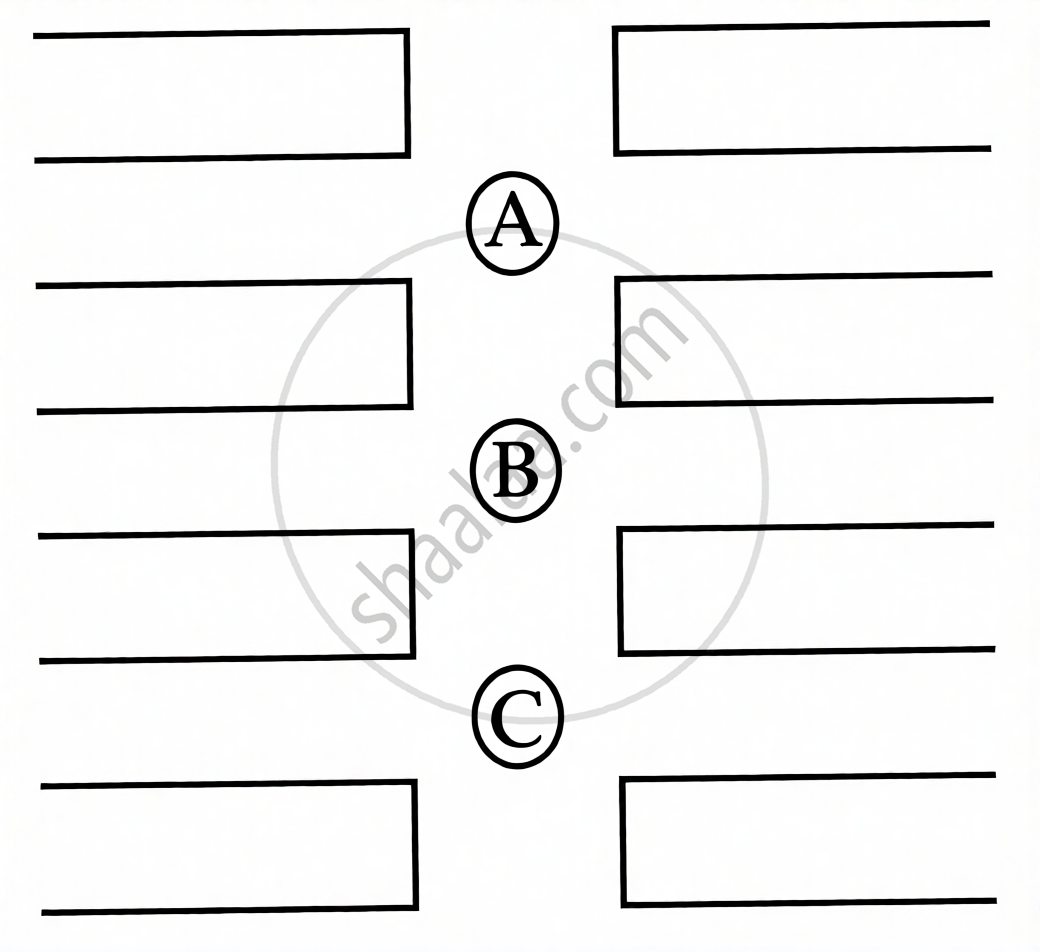
Based on the above information, answer the following questions.
- At what time after 8.00 a.m. will all the signals change simultaneously?
- At what time after 8.00 a.m. will the signals A and B change simultaneously?
- At what time after 8.00 a.m. will the signals B and C change simultaneously?
- At what time after 8.00 a.m. will the signals A and C change simultaneously?
R.S. Aggarwal solutions for Mathematics [English] Class 10 20 Additional Questions Polynomials [Pages 971 - 975]
Assertion-and-Reason Type Questions Each question consists of two statements, namely, Assertion (A) and Reason (R). For selecting the correct answer, use the following code:
Assertion (A): A monic quadratic polynomial having 4 and –2 as its zeros is $$\left(x^{2}-2x-8\right)$$.
Reason (R): The monic quadratic polynomial having $$\alpha$$ and $$\beta$$ as its zeros, is given by $$x^{2}-(\alpha+\beta)x+\alpha\beta$$.
Both Assertion (A) and Reason (R) are true and Reason (R) is a correct explanation of Assertion (A).
Both Assertion (A) and Reason (R) are true but Reason (R) is not a correct explanation of Assertion (A).
Assertion (A) is true and Reason (R) is false.
Assertion (A) is false and Reason (R) is true.
Assertion (A): The quadratic polynomial whose zeros are $$(3+\sqrt{2})$$ and $$(3-\sqrt{2})$$ is given by $$p(x)=(x^{2}-6x+7)$$.
Reason (R): If $$\alpha$$ is a zero of the quadratic polynomial $$p(x)$$ then $$(x-\alpha)$$ is a factor of $$p(x)$$.
Both Assertion (A) and Reason (R) are true and Reason (R) is a correct explanation of Assertion (A).
Both Assertion (A) and Reason (R) are true but Reason (R) is not a correct explanation of Assertion (A).
Assertion (A) is true and Reason (R) is false.
Assertion (A) is false and Reason (R) is true.
Assertion (A): The polynomial $$p(x)=(x^{3}+x)$$ has one real zero.
Reason (R): A polynomial of nth degree has at most n zeros.
Both Assertion (A) and Reason (R) are true and Reason (R) is a correct explanation of Assertion (A).
Both Assertion (A) and Reason (R) are true but Reason (R) is not a correct explanation of Assertion (A).
Assertion (A) is true and Reason (R) is false.
Assertion (A) is false and Reason (R) is true.
Assertion (A): If $$\alpha$$ and $$\beta$$ be the zeros of polynomial $$(x^{2}-6x+k)$$ such that $$(\alpha-\beta)=2$$ then $$k=8$$.
Reason (R): If $$\alpha$$ is a zero of the polynomial $$p(x)$$ then $$p(-\alpha)=0$$.
Both Assertion (A) and Reason (R) are true and Reason (R) is a correct explanation of Assertion (A).
Both Assertion (A) and Reason (R) are true but Reason (R) is not a correct explanation of Assertion (A).
Assertion (A) is true and Reason (R) is false.
Assertion (A) is false and Reason (R) is true.
Assertion (A): If the zeros of the quadratic polynomial $$ax^{2}+bx+c$$ are both negative then a, b, c will have the same sign.
Reason (R): The zeros of a quadratic polynomial are either both positive or both negative.
Both Assertion (A) and Reason (R) are true and Reason (R) is a correct explanation of Assertion (A).
Both Assertion (A) and Reason (R) are true but Reason (R) is not a correct explanation of Assertion (A).
Assertion (A) is true and Reason (R) is false.
Assertion (A) is false and Reason (R) is true.
Assertion (A): If one zero of the polynomial $$p(x)=(k^{2}+4)x^{2}+9x+4k$$ is the reciprocal of the other zero then $$k=2$$.
Reason (R): If $$(x-\alpha)$$ is a factor of the polynomial $$p(x)$$ then $$\alpha$$ is a zero of $$p(x)$$.
Both Assertion (A) and Reason (R) are true and Reason (R) is a correct explanation of Assertion (A).
Both Assertion (A) and Reason (R) are true but Reason (R) is not a correct explanation of Assertion (A).
Assertion (A) is true and Reason (R) is false.
Assertion (A) is false and Reason (R) is true.
Assertion (A): If the sum of the zeros of the quadratic polynomial $$p(x)=kx^{2}+2x+3k$$, is equal to the product of its zeros then $$k=\frac{-2}{3}$$.
Reason (R): If $$\alpha$$ and $$\beta$$ be the zeros of a quadratic polynomial $$p(x)=ax^{2}+bx+c$$ then $$(\alpha+\beta)=\frac{-b}{a}$$ and $$\alpha\beta=\frac{c}{a}$$.
Both Assertion (A) and Reason (R) are true and Reason (R) is a correct explanation of Assertion (A).
Both Assertion (A) and Reason (R) are true but Reason (R) is not a correct explanation of Assertion (A).
Assertion (A) is true and Reason (R) is false.
Assertion (A) is false and Reason (R) is true.
Assertion (A): If on dividing the polynomial $$p(x)=x^{2}-3ax+3a-7$$ by $$(x+1)$$, we get 6 as remainder then $$a=4$$.
Reason (R): When a polynomial $$p(x)$$ is divided by $$(x-\alpha)$$ then the remainder is $$p(\alpha)$$.
Both Assertion (A) and Reason (R) are true and Reason (R) is a correct explanation of Assertion (A).
Both Assertion (A) and Reason (R) are true but Reason (R) is not a correct explanation of Assertion (A).
Assertion (A) is true and Reason (R) is false.
Assertion (A) is false and Reason (R) is true.
Assertion (A): A monic cubic polynomial having 3, 2, –1 as its zeros is $$p(x)=x^{3}+4x^{2}-x+6$$.
Reason (R): The monic cubic polynomial having $$\alpha,\beta,\gamma$$ as its zeros is given by $$x^{3}-(\alpha+\beta+\gamma)x^{2}+(\alpha\beta+\beta\gamma+\gamma\alpha)x-(\alpha\beta\gamma)$$.
Both Assertion (A) and Reason (R) are true and Reason (R) is a correct explanation of Assertion (A).
Both Assertion (A) and Reason (R) are true but Reason (R) is not a correct explanation of Assertion (A).
Assertion (A) is true and Reason (R) is false.
Assertion (A) is false and Reason (R) is true.
Case-Based Questions
|
Rainbow is an arch of colours that is visible in the sky after rain or when water droplets are present in the atmosphere. The colours of the rainbow are generally red, orange, yellow, green, blue, indigo, and violet. Each colour of the rainbow makes a parabola. We know that any quadratic polynomials p(x) = ax2 + bx + c (a ≠ 0) represents a parabola on the graph paper. |
Based on the above information, answer the following questions.
- The graph of a rainbow y = f(x) is shown in the figure given below. Write the number of zeros of the curve.
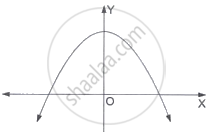
- If the graph of a rainbow does not intersect the x-axis but intersects y-axis at one point, then how many zeros will it have?
- The polynomial x2 – 2x – (7a + 3) represents a rainbow. If –4 is a zero of it, find the value of a.
- If α and β are the zeros of the quadratic polynomialp (x) = x2 – rx – s then find the value of α2 + β2.
|
While playing in a garden, Tanya saw a honeycomb and asked her mother what it was. Her mother replied that it is a honeycomb made by honey bees to store honey. Also, she told her that the shape of the honeycomb formed is a mathematical structure. The mathematical representation of the honeycomb is shown in the graph.
|
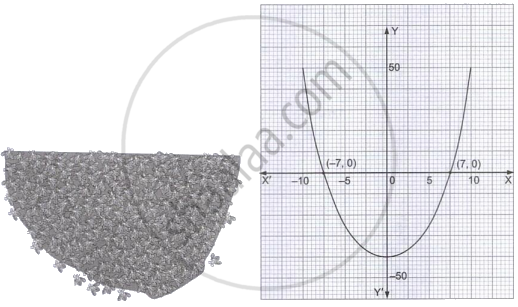
Based on the above information, answer the following questions.
- How many zeros are there for the polynomial represented by the given graph?
- Write the zeros of the polynomial.
- If the zeros of a polynomial x2 + (p + 1)x + q are 2 and –3 then determine the values of p and g.
- If the square of the difference between the zeros of the polynomial x2 + ax + 45 is 144 then find the value of a.
|
In a pool at an aquarium, a dolphin jumps out of the water travelling at 20 cm per second. Its height above water level after t seconds is given by h = 20t – 16t2.
|
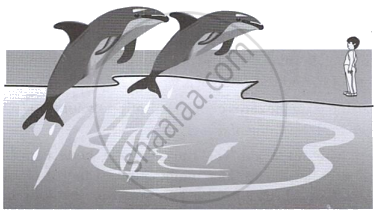
Based on the given information, answer the following questions.
- Find the zeros of the polynomial p(t) = 20t – 16t2.
- Which of the following types of graphs represents p(t)?
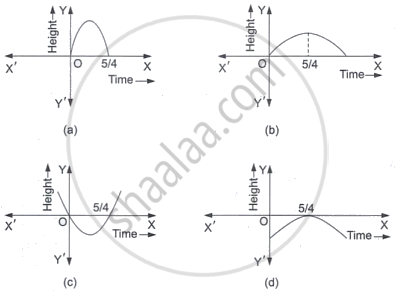
- What would be the value of h at `t = 3/2`? Interpret the result.
- How much distance has the dolphin covered before hitting the water level again?
R.S. Aggarwal solutions for Mathematics [English] Class 10 20 Additional Questions Linear Equations in Two Variables [Pages 978 - 984]
Assertion-and-Reason Type Questions Each question consists of two statements, namely, Assertion (A) and Reason (R). For selecting the correct answer, use the following code:
Assertion (A): The system of equations \[2x+3y-6=0\] and \[4x+6y-12=0\] has infinitely many solutions.
Reason (R): The system of equations \[a_{1}x+b_{1}y+c_{1}=0,\ a_{2}x+b_{2}y+c_{2}=0\] has infinitely many solutions, if \[\frac{a_{1}}{a_{2}}=\frac{b_{1}}{b_{2}}=\frac{c_{1}}{c_{2}}.\]
Both Assertion (A) and Reason (R) are true and Reason (R) is a correct explanation of Assertion (A).
Both Assertion (A) and Reason (R) are true but Reason (R) is not a correct explanation of Assertion (A).
Assertion (A) is true and Reason (R) is false.
Assertion (A) is false and Reason (R) is true.
Assertion (A): The system of equations \[2x-3y-5=0\] and \[4x-6y+3=0\] has no solutions.
Reason (R): The system of equations \[a_{1}x+b_{1}y+c_{1}=0,\ a_{2}x+b_{2}y+c_{2}=0\] has no solutions, if \[\frac{a_{1}}{a_{2}}=\frac{b_{1}}{b_{2}}\ne\frac{c_{1}}{c_{2}}.\]
Both Assertion (A) and Reason (R) are true and Reason (R) is a correct explanation of Assertion (A).
Both Assertion (A) and Reason (R) are true but Reason (R) is not a correct explanation of Assertion (A).
Assertion (A) is true and Reason (R) is false.
Assertion (A) is false and Reason (R) is true.
Assertion (A): The system of equations \[x+2y+2=0\] and \[3x+2y-2=0\] has a unique solution.
Reason (R): The system of equations \[a_{1}x+b_{1}y+c_{1}=0,\ a_{2}x+b_{2}y+c_{2}=0\] has a unique solution, if \[\frac{a_{1}}{a_{2}}=\frac{b_{1}}{b_{2}}\ne\frac{c_{1}}{c_{2}}.\]
Both Assertion (A) and Reason (R) are true and Reason (R) is a correct explanation of Assertion (A).
Both Assertion (A) and Reason (R) are true but Reason (R) is not a correct explanation of Assertion (A).
Assertion (A) is true and Reason (R) is false.
Assertion (A) is false and Reason (R) is true.
Assertion (A): The system of equations \[3x-6y=0\] and \[x-2y-6=0\] has infinitely many solutions.
Reason (R): The system of equations \[a_{1}x+b_{1}y+c_{1}=0,\ a_{2}x+b_{2}y+c_{2}=0\] has infinitely many solutions, if \[\frac{a_{1}}{a_{2}}=\frac{b_{1}}{b_{2}}=\frac{c_{1}}{c_{2}}.\]
Both Assertion (A) and Reason (R) are true and Reason (R) is a correct explanation of Assertion (A).
Both Assertion (A) and Reason (R) are true but Reason (R) is not a correct explanation of Assertion (A).
Assertion (A) is true and Reason (R) is false.
Assertion (A) is false and Reason (R) is true.
Assertion (A): The system of equations \[2x-5y+4=0\], \[2x+y-8=0\] has a unique solution.
Reason (R): The system of equations \[a_{1}x+b_{1}y+c_{1}=0,\ a_{2}x+b_{2}y+c_{2}=0\] is inconsistent, if \[\frac{a_{1}}{a_{2}}=\frac{b_{1}}{b_{2}}\ne\frac{c_{1}}{c_{2}}.\]
Both Assertion (A) and Reason (R) are true and Reason (R) is a correct explanation of Assertion (A).
Both Assertion (A) and Reason (R) are true but Reason (R) is not a correct explanation of Assertion (A).
Assertion (A) is true and Reason (R) is false.
Assertion (A) is false and Reason (R) is true.
Assertion (A): The homogeneous system of equations \[2x+3y=0\], \[4x+6y=0\] has an infinite number of solution.
Reason (R): The homogeneous system of equations \[a_{1}x+b_{1}y=0,\ a_{2}x+b_{2}y=0\] has an infinitely many solutions, if \[\frac{a_{1}}{a_{2}}=\frac{b_{1}}{b_{2}}.\]
Both Assertion (A) and Reason (R) are true and Reason (R) is a correct explanation of Assertion (A).
Both Assertion (A) and Reason (R) are true but Reason (R) is not a correct explanation of Assertion (A).
Assertion (A) is true and Reason (R) is false.
Assertion (A) is false and Reason (R) is true.
Assertion (A): The homogeneous system of equations \[3x-4y=0\], \[2x-3y=0\] has a unique solution x = 0 and y = 0.
Reason (R): The homogeneous system of equations \[a_{1}x+b_{1}y=0,\ a_{2}x+b_{2}y=0\] has a unique solution x = 0 and y = 0 when \[\frac{a_{1}}{a_{2}}\ne\frac{b_{1}}{b_{2}}.\]
Both Assertion (A) and Reason (R) are true and Reason (R) is a correct explanation of Assertion (A).
Both Assertion (A) and Reason (R) are true but Reason (R) is not a correct explanation of Assertion (A).
Assertion (A) is true and Reason (R) is false.
Assertion (A) is false and Reason (R) is true.
Assertion (A): The system of linear equations \[3x+5y-4=0\], \[15x+25y-25=0\] is inconsistent.
Reason (R): The pair of linear equations \[a_{1}x+b_{1}y+c_{1}=0,\ a_{2}x+b_{2}y+c_{2}=0\] is inconsistent, if \[\frac{a_{1}}{a_{2}}=\frac{b_{1}}{b_{2}}\ne\frac{c_{1}}{c_{2}}.\]
Both Assertion (A) and Reason (R) are true and Reason (R) is a correct explanation of Assertion (A).
Both Assertion (A) and Reason (R) are true but Reason (R) is not a correct explanation of Assertion (A).
Assertion (A) is true and Reason (R) is false.
Assertion (A) is false and Reason (R) is true.
Assertion (A): The system of linear equations \[5x-9y+6=0\], \[10x-18y+12=0\] is inconsistent.
Reason (R): The pair of linear equations \[a_{1}x+b_{1}y+c_{1}=0,\ a_{2}x+b_{2}y+c_{2}=0\] is inconsistent, if \[\frac{a_{1}}{a_{2}}=\frac{b_{1}}{b_{2}}\ne\frac{c_{1}}{c_{2}}.\]
Both Assertion (A) and Reason (R) are true and Reason (R) is a correct explanation of Assertion (A).
Both Assertion (A) and Reason (R) are true but Reason (R) is not a correct explanation of Assertion (A).
Assertion (A) is true and Reason (R) is false.
Assertion (A) is false and Reason (R) is true.
Assertion (A): The system of linear equations \[2x-3y+1=0\], \[4x-6y+3=0\] is inconsistent.
Reason (R): The system of linear equations \[a_{1}x+b_{1}y+c_{1}=0,\ a_{2}x+b_{2}y+c_{2}=0\] has a unique solution, if \[\frac{a_{1}}{a_{2}}\ne\frac{b_{1}}{b_{2}}.\]
Both Assertion (A) and Reason (R) are true and Reason (R) is a correct explanation of Assertion (A).
Both Assertion (A) and Reason (R) are true but Reason (R) is not a correct explanation of Assertion (A).
Assertion (A) is true and Reason (R) is false.
Assertion (A) is false and Reason (R) is true.
Assertion (A): The system of linear equations \[x-2y+6=0\], \[2x-4y+9=0\] has a unique solution.
Reason (R): The system of linear equations \[a_{1}x+b_{1}y+c_{1}=0,\ a_{2}x+b_{2}y+c_{2}=0\] has a unique solution, if \[\frac{a_{1}}{a_{2}}\ne\frac{b_{1}}{b_{2}}.\]
Both Assertion (A) and Reason (R) are true and Reason (R) is a correct explanation of Assertion (A).
Both Assertion (A) and Reason (R) are true but Reason (R) is not a correct explanation of Assertion (A).
Assertion (A) is true and Reason (R) is false.
Assertion (A) is false and Reason (R) is true.
Assertion (A): The system of linear equations \[x+y-9=0\], \[x-y+3=0\] has a unique solution.
Reason (R): The system of linear equations \[a_{1}x+b_{1}y+c_{1}=0,\ a_{2}x+b_{2}y+c_{2}=0\] has a unique solution, if \[\frac{a_{1}}{a_{2}}=\frac{b_{1}}{b_{2}}.\]
Both Assertion (A) and Reason (R) are true and Reason (R) is a correct explanation of Assertion (A).
Both Assertion (A) and Reason (R) are true but Reason (R) is not a correct explanation of Assertion (A).
Assertion (A) is true and Reason (R) is false.
Assertion (A) is false and Reason (R) is true.
Case-Based Questions
| Arun, a production manager in Mumbai, hires a taxi everyday to go to his office. The taxi charges in Mumbai consist of a fixed charge together with the charges for the distance covered. His office is at a distance of 10 km from his home. For a distance of 10 km to his office, Arun paid ₹105. While coming back home, he took another route. He covered a distance of 15 km and paid ₹155. |
Based on the above information, answer the following questions.
(i) What are the fixed charges?
(ii) What are the charges per kilometre?
(iii) If fixed charge are ₹20 and charges per kilometre are ₹10 then how much would Arun have to pay for travelling a distance of 10 km?
(iv) Find the total amount paid by Arun for travelling 10 km from home to office and 25 km from office to home. [Fixed charges and charges per kilometre are as in (i) and (ii).]
| Two schools 'X' and 'Y' decided to award prizes to their students for two games—₹p per student for hockey and ₹q per student for cricket. School X decided to award a total of ₹ 9500 for the two games to 5 and 4 students respectively; while school Y decided to award ₹ 7370 for the two games to 4 and 3 students respectively. |
Based on the above information, answer the following questions.
- Represent the above information algebraically (in terms of p and q).
- What is the prize amount for hockey?
- Prize amount for which game is higher and by how much?
- What will be the total prize amount if there are 2 students each from the two games?
| A coaching institute of mathematics conducts classes in two batches I and II and the fees for rich and poor children are different. In batch I, there are 20 poor and 5 rich children, whereas in batch II, there are 5 poor and 25 rich children. The total monthly collection of fees from batch I is ₹ 9000 and from batch II is ₹ 26000. Assume that each poor child pays ₹ x per month and each rich child pay ₹ y per month. |
Based on the above information, answer the following questions.
- Represent the given information in terms of x and y.
- Find the monthly fee paid by a poor child.
- Find the difference in the monthly fee paid by a poor child and a rich child.
- If there are 10 poor and 20 rich children in batch II, then what is the monthly collection of fees from batch II?
R.S. Aggarwal solutions for Mathematics [English] Class 10 20 Additional Questions Quadratic Equations [Pages 985 - 990]
Assertion-and-Reason Type Questions Each question consists of two statements, namely, Assertion (A) and Reason (R). For selecting the correct answer, use the following code:
Assertion (A): The quadratic equation $$x^{2}+3x+4=0$$ has both real roots.
Reason (R): The equation $$ax^{2}+bx+c=0,\ a\neq 0$$ has both real roots, if $$(b^{2}-4ac)\geq 0$$.
Both Assertion (A) and Reason (R) are true and Reason (R) is a correct explanation of Assertion (A).
Both Assertion (A) and Reason (R) are true but Reason (R) is not a correct explanation of Assertion (A).
Assertion (A) is true and Reason (R) is false.
Assertion (A) is false and Reason (R) is true.
Assertion (A): The polynomial $$p(x)=x^{2}+3x+3$$ has two real zeros.
Reason (R): A quadratic polynomial can have at most two real zeros.
Both Assertion (A) and Reason (R) are true and Reason (R) is a correct explanation of Assertion (A).
Both Assertion (A) and Reason (R) are true but Reason (R) is not a correct explanation of Assertion (A).
Assertion (A) is true and Reason (R) is false.
Assertion (A) is false and Reason (R) is true.
Assertion (A): The polynomial $$x^{2}+4x$$ has two real zeros.
Reason (R): The zeros of the polynomial $$x^{2}+ax\ (a\neq 0)$$ are 0 and $$a$$.
Both Assertion (A) and Reason (R) are true and Reason (R) is a correct explanation of Assertion (A).
Both Assertion (A) and Reason (R) are true but Reason (R) is not a correct explanation of Assertion (A).
Assertion (A) is true and Reason (R) is false.
Assertion (A) is false and Reason (R) is true.
Assertion (A): If $$(5 + \sqrt{7})$$ is a root of a quadratic equation with rational coefficients then the other root is $$(5 - \sqrt{7})$$.
Reason (R): The surd roots of a quadratic equation with rational coefficients occur in conjugate pairs.
Both Assertion (A) and Reason (R) are true and Reason (R) is a correct explanation of Assertion (A).
Both Assertion (A) and Reason (R) are true but Reason (R) is not a correct explanation of Assertion (A).
Assertion (A) is true and Reason (R) is false.
Assertion (A) is false and Reason (R) is true.
Assertion (A): If one root of the quadratic equation $$4x^{2}-10x+(k-4)=0$$ is the reciprocal of the other then the value of $$k$$ is 8.
Reason (R): The roots of the quadratic equation $$x^{2}-x+1=0$$ are real.
Both Assertion (A) and Reason (R) are true and Reason (R) is a correct explanation of Assertion (A).
Both Assertion (A) and Reason (R) are true but Reason (R) is not a correct explanation of Assertion (A).
Assertion (A) is true and Reason (R) is false.
Assertion (A) is false and Reason (R) is true.
Assertion (A): If the equation $$x^{2}-kx+1=0$$ has no real roots then $$-2<k<2$$.
Reason (R): The equation $$ax^{2}+bx+c=0$$ has real roots, if $$(b^{2}-4ac)\geq 0$$.
Both Assertion (A) and Reason (R) are true and Reason (R) is a correct explanation of Assertion (A).
Both Assertion (A) and Reason (R) are true but Reason (R) is not a correct explanation of Assertion (A).
Assertion (A) is true and Reason (R) is false.
Assertion (A) is false and Reason (R) is true.
Assertion (A): The quadratic equation $$\sqrt{3}x^{2}+11x+6\sqrt{3}=0$$ has both real roots.
Reason (R): The quadratic equation $$ax^{2}+bx+c=0$$ has both imaginary roots, if $$(b^{2}-4ac)<0$$.
Both Assertion (A) and Reason (R) are true and Reason (R) is a correct explanation of Assertion (A).
Both Assertion (A) and Reason (R) are true but Reason (R) is not a correct explanation of Assertion (A).
Assertion (A) is true and Reason (R) is false.
Assertion (A) is false and Reason (R) is true.
Assertion (A): If –5 is a root of $$2x^{2}+2px-15=0$$ and the equation $$p(x^{2}+x)+k=0$$ has equal roots then $$k=\frac{7}{8}$$.
Reason (R): The equation $$ax^{2}+bx+c=0,\ a\neq 0$$ has equal roots, if $$(b^{2}-4ac)=0$$.
Both Assertion (A) and Reason (R) are true and Reason (R) is a correct explanation of Assertion (A).
Both Assertion (A) and Reason (R) are true but Reason (R) is not a correct explanation of Assertion (A).
Assertion (A) is true and Reason (R) is false.
Assertion (A) is false and Reason (R) is true.
Assertion (A): If the quadratic equation $$px^{2}-4x+4=0$$ has real roots them $$p\leq 1$$.
Reason (R): The quadratic equation $$ax^{2}+bx+c=0$$ has both real roots, if $$(b^{2}-4ac)<0$$.
Both Assertion (A) and Reason (R) are true and Reason (R) is a correct explanation of Assertion (A).
Both Assertion (A) and Reason (R) are true but Reason (R) is not a correct explanation of Assertion (A).
Assertion (A) is true and Reason (R) is false.
Assertion (A) is false and Reason (R) is true.
Assertion (A): The quadratic equation $$x^{2}+5kx+16=0$$ has no real roots, if $$\frac{-8}{5}<k<\frac{8}{5}$$.
Reason (R): The equation $$ax^{2}+bx+c=0,\ a\neq 0$$ has no real root, if $$(b^{2}-4ac)<0$$.
Both Assertion (A) and Reason (R) are true and Reason (R) is a correct explanation of Assertion (A).
Both Assertion (A) and Reason (R) are true but Reason (R) is not a correct explanation of Assertion (A).
Assertion (A) is true and Reason (R) is false.
Assertion (A) is false and Reason (R) is true.
Assertion (A): The quadratic equation $$x^{2}-x-6=0$$ has –2 and 3 as its roots.
Reason (R): If $$ax^{2}+bx+c=0$$ then $$x=\frac{-b\pm\sqrt{b^{2}-4ac}}{2a}.$$
Both Assertion (A) and Reason (R) are true and Reason (R) is a correct explanation of Assertion (A).
Both Assertion (A) and Reason (R) are true but Reason (R) is not a correct explanation of Assertion (A).
Assertion (A) is true and Reason (R) is false.
Assertion (A) is false and Reason (R) is true.
Assertion (A): The quadratic equation $$x^{2}-4x+3=0$$ has both real roots.
Reason (R): The equation $$ax^{2}+bx+c=0,\ a\neq 0$$ has both real roots, if $$(b^{2}-4ac)\geq 0$$.
Both Assertion (A) and Reason (R) are true and Reason (R) is a correct explanation of Assertion (A).
Both Assertion (A) and Reason (R) are true but Reason (R) is not a correct explanation of Assertion (A).
Assertion (A) is true and Reason (R) is false.
Assertion (A) is false and Reason (R) is true.
Assertion (A): The quadratic equation $$3x^{2}-5x+4=0$$ has no real root.
Reason (R): The equation $$ax^{2}+bx+c=0,\ a\neq 0$$ has no real root, if $$(b^{2}-4ac)<0$$.
Both Assertion (A) and Reason (R) are true and Reason (R) is a correct explanation of Assertion (A).
Both Assertion (A) and Reason (R) are true but Reason (R) is not a correct explanation of Assertion (A).
Assertion (A) is true and Reason (R) is false.
Assertion (A) is false and Reason (R) is true.
Case-Based Questions
| In an auditorium, seats are arranged in rows and columns. The number of rows are equal to the number of seats in each row in the beginning. When the number of rows is doubled and the number of seats in each row is reduced by 10, the total number of seats increases by 300. |
Based on the given information, answer the following questions.
- Taking x as the number of rows in the beginning, represent the above situation by a quadratic equation.
- How many rows are there in the original arrangement?
- How many seats are there in the auditorium in the beginning?
- How many seats are there in the auditorium after rearrangement?
|
While designing the school year book, a teacher told the student that the length and width of a particular photo is increased by x units each to double its area. The original photo is 18 cm long and 12 cm wide.
|
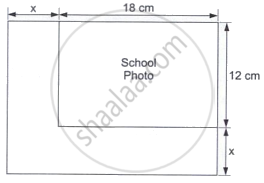
Based on the above information, answer the following questions.
- Write an algebraic equation depicting the above information.
- Write the corresponding quadratic equation in standard form.
- What should be the new dimensions of the enlarged photo?
- Can any rational value of x make the new area equal to 220 cm2?
|
Social work aims at fulfilment of human needs. Social workers aim to open the doors of access and opportunity for those who are in greatest need. Free education is a great social work. By doing so, we can remove illiteracy from our society. Raman, being a social worker, wants to donate his land to the Village Panchayat for opening a school. Raman's land is in the form of a rectangle of dimensions 500 m × 400 m. The Village Panchayat decides to leave area on all four sides of the land for grass and flowers. A path of uniform width x m is kept for grass and flowers on all four sides, with an area of 118400 m2.
|
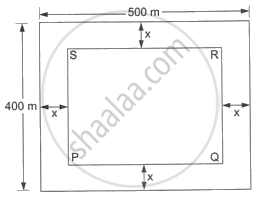
Based on the given information, answer the following questions.
- Write a quadratic equation in x to represent the above information.
- Find the value of x.
- Find the perimeter of rectangle PQRS.
- For what value of x will the area of the path of uniform width be 93600 m2?
R.S. Aggarwal solutions for Mathematics [English] Class 10 20 Additional Questions Arithmetic Progression [Pages 993 - 999]
Assertion-and-Reason Type Questions Each question consists of two statements, namely, Assertion (A) and Reason (R). For selecting the correct answer, use the following code:
Assertion (A): The numbers $$a, b, c$$ are in AP if and only if $$2b = (a + c).$$
Reason (R): The sum of the first $$n$$ odd natural numbers is $$n^{2}.$$
Both Assertion (A) and Reason (R) are true and Reason (R) is a correct explanation of Assertion (A).
Both Assertion (A) and Reason (R) are true but Reason (R) is not a correct explanation of Assertion (A).
Assertion (A) is true and Reason (R) is false.
Assertion (A) is false and Reason (R) is true.
Assertion (A): The sum of first n natural numbers is given by $$S_{n} = \frac{1}{2}n(n + 1).$$
Reason (R): In an AP with first term a and common difference d, the sum of n terms is given by $$S_{n} = \frac{n}{2} \times [2a + (n - 1)d].$$
Both Assertion (A) and Reason (R) are true and Reason (R) is a correct explanation of Assertion (A).
Both Assertion (A) and Reason (R) are true but Reason (R) is not a correct explanation of Assertion (A).
Assertion (A) is true and Reason (R) is false.
Assertion (A) is false and Reason (R) is true.
Assertion (A): The sum of first n even natural numbers is n(n + 1).
Reason (R): The sum of n terms of an AP with first term a and last term $$l$$ is $$S_{n} = \frac{n}{2},(a + l).$$
Both Assertion (A) and Reason (R) are true and Reason (R) is a correct explanation of Assertion (A).
Both Assertion (A) and Reason (R) are true but Reason (R) is not a correct explanation of Assertion (A).
Assertion (A) is true and Reason (R) is false.
Assertion (A) is false and Reason (R) is true.
Assertion (A): The 9th term of the AP 37, 33, 29, 25, ... is –5.
Reason (R): The nth term of the AP with first term a and common difference d is given by $$T_{n} = a + (n - 1)d.$$
Both Assertion (A) and Reason (R) are true and Reason (R) is a correct explanation of Assertion (A).
Both Assertion (A) and Reason (R) are true but Reason (R) is not a correct explanation of Assertion (A).
Assertion (A) is true and Reason (R) is false.
Assertion (A) is false and Reason (R) is true.
Assertion (A): The 10th term from the end of the AP 16, 11, 6, 1, ..., –79 is –34.
Reason (R): The nth term from the end of an AP with last term $$l$$ and common difference d is $${\{l - (n - 1)d}\}.$$
Both Assertion (A) and Reason (R) are true and Reason (R) is a correct explanation of Assertion (A).
Both Assertion (A) and Reason (R) are true but Reason (R) is not a correct explanation of Assertion (A).
Assertion (A) is true and Reason (R) is false.
Assertion (A) is false and Reason (R) is true.
Assertion (A): 47 + 45 + 43 + ... + 11 is an AP having 19 terms.
Reason (R): In an AP with first term a and common difference d, the nth term is given by $$T_{n} = a + (n - 1)d.$$
Both Assertion (A) and Reason (R) are true and Reason (R) is a correct explanation of Assertion (A).
Both Assertion (A) and Reason (R) are true but Reason (R) is not a correct explanation of Assertion (A).
Assertion (A) is true and Reason (R) is false.
Assertion (A) is false and Reason (R) is true.
Assertion (A): In an AP, the first term is 6, the last term is 78 and the sum of the given terms is 630. Then, there are 16 terms in the given AP.
Reason (R): If a is the first term, $$l$$ is the last term and n is the number of terms in an AP then $$S_{n} = \frac{n}{2} (a + l).$$
Both Assertion (A) and Reason (R) are true and Reason (R) is a correct explanation of Assertion (A).
Both Assertion (A) and Reason (R) are true but Reason (R) is not a correct explanation of Assertion (A).
Assertion (A) is true and Reason (R) is false.
Assertion (A) is false and Reason (R) is true.
Assertion (A): The next term of the AP $$\sqrt{3},\ \sqrt{12},\ \sqrt{27},\ \ldots$$ is $$\sqrt{48}.$$
Reason (R): In an AP, we have $$T_{n + 1} = (T_{n} + d).$$
Both Assertion (A) and Reason (R) are true and Reason (R) is a correct explanation of Assertion (A).
Both Assertion (A) and Reason (R) are true but Reason (R) is not a correct explanation of Assertion (A).
Assertion (A) is true and Reason (R) is false.
Assertion (A) is false and Reason (R) is true.
Assertion (A): In an AP, it is given that $$T_{9} = 39$$ and $$T_{15} = 63.$$ Then, its first term is 7 and the common difference is 4.
Reason (R): In an AP with first term a and common difference d, the nth term is given by $$T_{n} = a + (n - 1)d.$$
Both Assertion (A) and Reason (R) are true and Reason (R) is a correct explanation of Assertion (A).
Both Assertion (A) and Reason (R) are true but Reason (R) is not a correct explanation of Assertion (A).
Assertion (A) is true and Reason (R) is false.
Assertion (A) is false and Reason (R) is true.
Assertion (A): The sum of 14 terms of the AP 7 + 10 + 13 + ... is 375.
Reason (R): The sum of n terms of an AP with first term a and common difference d is given by $$S_{n} = \frac{n}{2} \cdot {\{2a + (n - 1)d}\}.$$
Both Assertion (A) and Reason (R) are true and Reason (R) is a correct explanation of Assertion (A).
Both Assertion (A) and Reason (R) are true but Reason (R) is not a correct explanation of Assertion (A).
Assertion (A) is true and Reason (R) is false.
Assertion (A) is false and Reason (R) is true.
Case-Based Questions
|
Sanjana being a plant lover decides to convert her balcony into a beautiful garden full of plants. She bought few plants with pots for her balcony. She placed the pots in such a way that the number of pots in the first row is 2, second row is 5, third row is 8, and so on. |
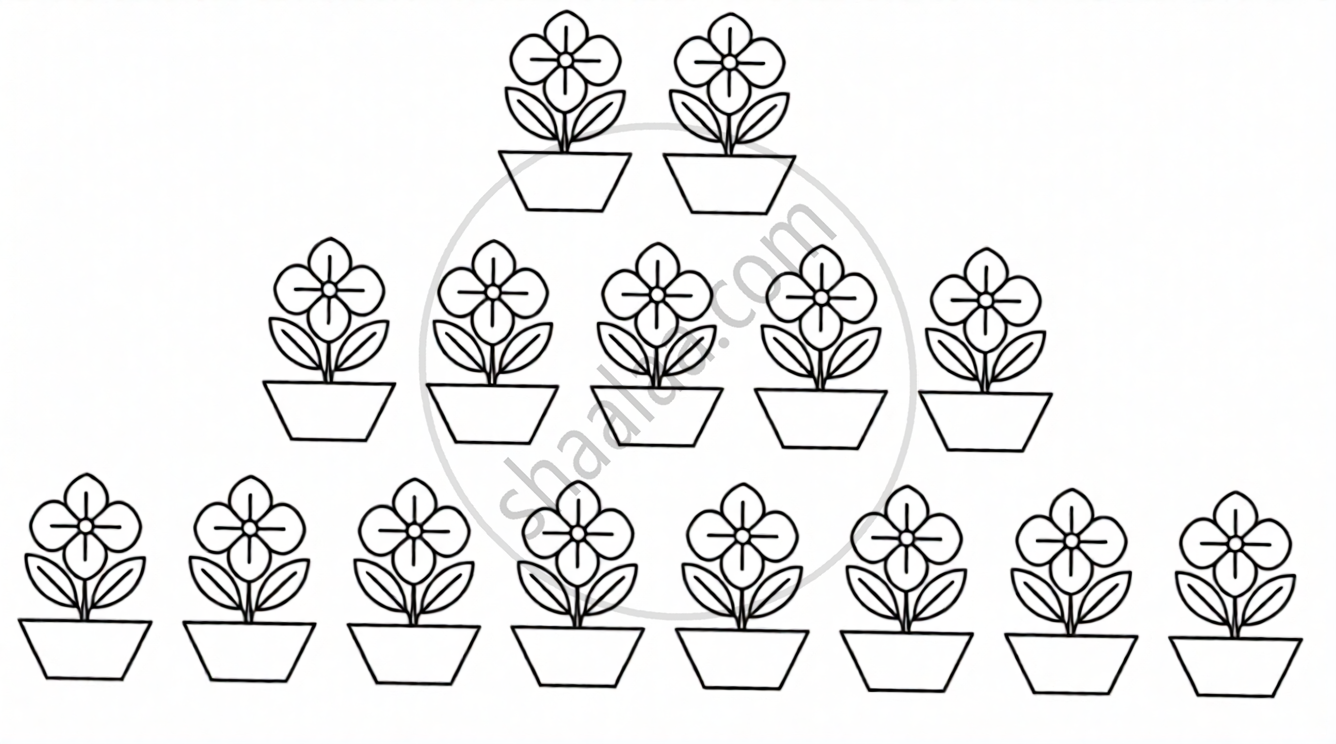
Based on the given information, answer the following questions.
- Find the number of pots placed in the 10th row.
- Find the difference in the number of pots placed in the 5th row and the 2nd row.
- If Sanjana wants to place 100 pots in total then find the total number of rows formed in the arrangement.
- If Sanjana has sufficient space for 12 rows then how many total number of pots are placed by her with the same arrangement?
| India is a competitive manufacturing location due to low manpower costs and strong technical and engineering capabilities, which contribute to higher-quality production runs. The production of TV sets in a factory increases uniformly by a fixed number every year. It produced 16000 sets in the 6th year and 22600 sets in the 9th year. |
Based on the above information, answer the following questions.
- In which year will the factory produce 29200 sets?
- Find the production during the 8th year.
- Find the production during the first 3 years.
- Find the difference in production during the 7th year and the 4th year.
| A school auditorium has to be constructed to accommodate at least 1500 people. The chairs are to be placed in a concentric circular arrangement in such a way that each succeeding circular row has 10 seats more than the previous one. |
Based on the above information, answer the following questions.
- If the first circular row has 30 seats then how many seats will there be in the 10th row?
- For 1500 seats, how many rows must the auditorium have?
- If 1500 seats are to be arranged in the auditorium, how many seats are still left to be put after the 10th row?
- If there were 17 rows in the auditorium, how many seats would be in the middle row?
| Ravindra took a loan of ₹3,45,000 from a bank to buy a car and decided to pay back by ₹2,000 at the end of the first month and then increased the instalment amount by ₹200 each month. |
Based on the given information, answer the following questions.
- Find the amount paid by him in the 10th instalment.
- Find the total amount paid by him in the first 10 instalments.
- In how many instalments would he clear his total loan?
- What amount will he be able to clear in his first 45 instalments?
|
A fashion designer is designing a fabric pattern. In each row, there are some shaded squares and unshaded triangles.
|
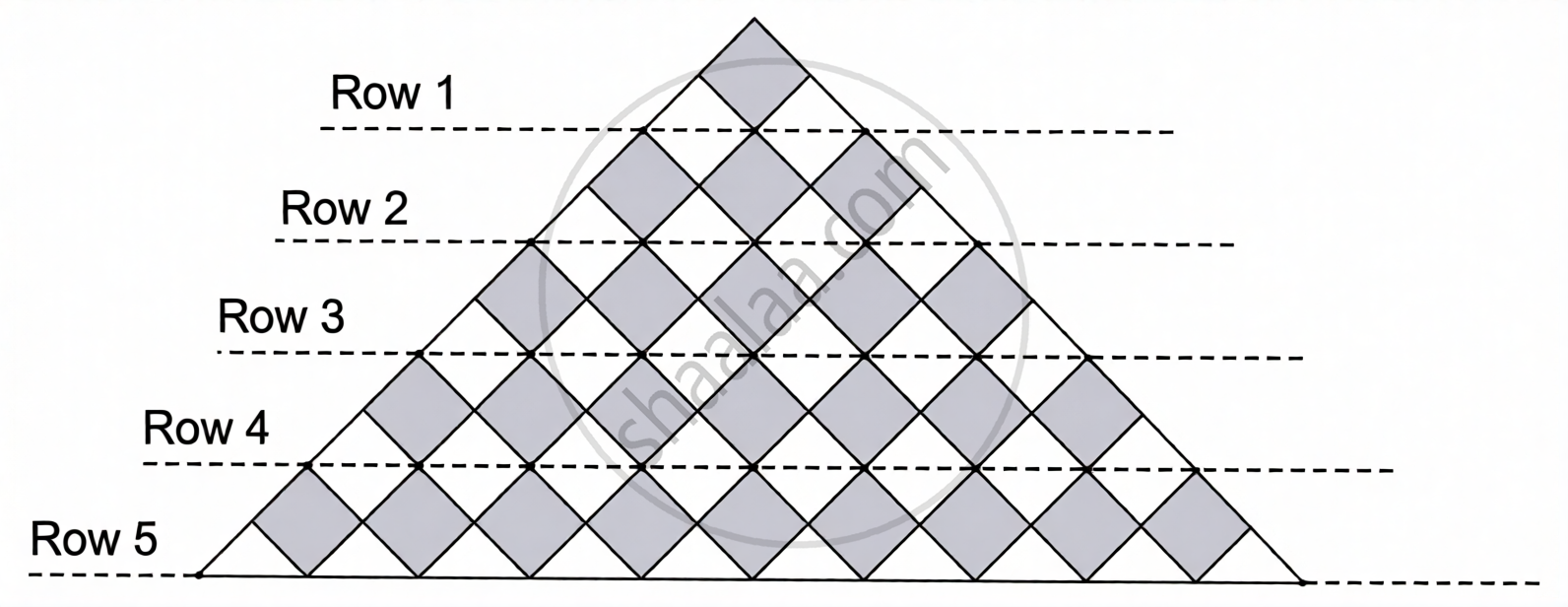
Based on the given figure, answer the following questions.
- Identify the AP for the number of squares in each row.
- Identify the AP for the number of triangles in each row.
- If each shaded square is of side 2 cm then find the shaded area when 15 rows have been designed.
- Write a formula for finding the total number of triangles in n number of rows. Hence, find \(S_{10}\).
|
In mathematics, relations can be expressed in a number of ways. The matchstick patterns are based on linear relations. Different strategies can be used to calculate the number of matchsticks used in different figures. One such pattern is shown below. Observe the given pattern and answer the questions that follow.
|
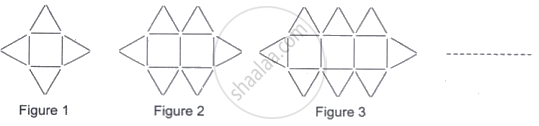
- Write the AP for the number of triangles used in the figures. Also, write the (n)th term of this AP.
- Write the AP for the number of matchsticks used in the figures. Also, write the (n)th term of this AP.
- Find the total number of triangles used in the first 20 figures.
- Which figure has 61 matchsticks?
| Manpreet kaur is the national record holder for women in the shot-put discipline. Her throw of 18.86 m at the Asian Grand Prix in 2017 is the maximum distance for an Indian female athlete. Keeping her as a role model, Sanjitha is determined to earn gold in Olympics one day. Initially, her throw reached 7.56 m only. Being an athlete in school, she regularly practiced both in the mornings and in the evenings and was able to improve the distance by 9 cm every week. During the special camp for 15 days, she started with 40 throws, and every day she kept increasing the number of throws by 12 to achieve this remarkable progress. |
Based on the above information, answer the following questions.
- How many throws did Sanjitha practice on the 11th day of the camp?
- What would be Sanjitha’s throw distance at the end of 6 weeks?
- When will she be able to achieve a throw of 11.16 m?
- How many throws did she make during the entire camp of 15 days?
R.S. Aggarwal solutions for Mathematics [English] Class 10 20 Additional Questions Coordinate Geometry [Pages 1003 - 1010]
Assertion-and-Reason Type Questions Each question consists of two statements, namely, Assertion (A) and Reason (R). For selecting the correct answer, use the following code:
Assertion (A): The point $$P(0, 2)$$ is the point of intersection of the $$y$$-axis with the line $$3x + 2y = 4$$.
Reason (R): The distance of the point $$P(0,2)$$ from the $$x$$-axis is 2 units.
Both Assertion (A) and Reason (R) are true and Reason (R) is a correct explanation of Assertion (A).
Both Assertion (A) and Reason (R) are true but Reason (R) is not a correct explanation of Assertion (A).
Assertion (A) is true and Reason (R) is false.
Assertion (A) is false and Reason (R) is true.
Assertion (A): If the points $$A(4,3)$$ and $$B(x, 5)$$ lie on a circle with centre $$O(2, 3)$$ then the value of $$x$$ is 2.
Reason (R): The centre of a circle is the midpoint of each chord of the circle.
Both Assertion (A) and Reason (R) are true and Reason (R) is a correct explanation of Assertion (A).
Both Assertion (A) and Reason (R) are true but Reason (R) is not a correct explanation of Assertion (A).
Assertion (A) is true and Reason (R) is false.
Assertion (A) is false and Reason (R) is true.
Assertion (A): A point on the $$x$$-axis is of the form $$(x, 0)$$ and a point on the $$y$$-axis is of the form $$(0, y)$$.
Reason (R): The abscissa of a point denotes its distance from $$x$$-axis and the ordinate denotes its distance from $$y$$-axis.
Both Assertion (A) and Reason (R) are true and Reason (R) is a correct explanation of Assertion (A).
Both Assertion (A) and Reason (R) are true but Reason (R) is not a correct explanation of Assertion (A).
Assertion (A) is true and Reason (R) is false.
Assertion (A) is false and Reason (R) is true.
Assertion (A): The points $$A(-1, 1), B(5, 7)$$ and $$C(8, 10)$$ cannot be the vertices of a triangle.
Reason (R): $$\operatorname{area}(\triangle ABC) = 0$$.
Both Assertion (A) and Reason (R) are true and Reason (R) is a correct explanation of Assertion (A).
Both Assertion (A) and Reason (R) are true but Reason (R) is not a correct explanation of Assertion (A).
Assertion (A) is true and Reason (R) is false.
Assertion (A) is false and Reason (R) is true.
Assertion (A): The points $$A(2, -2), B(-3, 8)$$ and $$C(-1, 4)$$ are collinear.
Reason (R): $$BC + AC = AB$$.
Both Assertion (A) and Reason (R) are true and Reason (R) is a correct explanation of Assertion (A).
Both Assertion (A) and Reason (R) are true but Reason (R) is not a correct explanation of Assertion (A).
Assertion (A) is true and Reason (R) is false.
Assertion (A) is false and Reason (R) is true.
Assertion (A): The points $$A(1, 2), B(-2, 3)$$ and $$C(-3, -4)$$ are not collinear.
Reason (R): $$\operatorname{ar}(\triangle ABC) = 11$$ sq units.
Both Assertion (A) and Reason (R) are true and Reason (R) is a correct explanation of Assertion (A).
Both Assertion (A) and Reason (R) are true but Reason (R) is not a correct explanation of Assertion (A).
Assertion (A) is true and Reason (R) is false.
Assertion (A) is false and Reason (R) is true.
Assertion (A): The points $$A(0, 3), B(0, -5)$$ and $$C(2, 3)$$ are noncollinear.
Reason (R): $$A$$ and $$B$$ lie on $$x$$-axis and $$C$$ lies in first quadrant.
Both Assertion (A) and Reason (R) are true and Reason (R) is a correct explanation of Assertion (A).
Both Assertion (A) and Reason (R) are true but Reason (R) is not a correct explanation of Assertion (A).
Assertion (A) is true and Reason (R) is false.
Assertion (A) is false and Reason (R) is true.
Assertion (A): The points $$A(1, -2), B(2, 3), C(-3, 2)$$ and $$D(-4, -3)$$ are the vertices of a parallelogram.
Reason (R): The midpoints of both the diagonals $$AC$$ and $$BD$$ are $$(-1, 0)$$.
Both Assertion (A) and Reason (R) are true and Reason (R) is a correct explanation of Assertion (A).
Both Assertion (A) and Reason (R) are true but Reason (R) is not a correct explanation of Assertion (A).
Assertion (A) is true and Reason (R) is false.
Assertion (A) is false and Reason (R) is true.
Assertion (A): The points $$A(0, -4), B(6, 2), C(3, 5)$$ and $$D(-3, -1)$$ taken in that order are the vertices of a rectangle $$ABCD$$.
Reason (R): The midpoint of both $$AC$$ and $$BD$$ is $$\left(\frac{3}{2}, \frac{1}{2}\right)$$.
Both Assertion (A) and Reason (R) are true and Reason (R) is a correct explanation of Assertion (A).
Both Assertion (A) and Reason (R) are true but Reason (R) is not a correct explanation of Assertion (A).
Assertion (A) is true and Reason (R) is false.
Assertion (A) is false and Reason (R) is true.
Assertion (A): Point $$P(5, -3)$$ is one of the points of trisection of the line segment joining the points $$A(7, -2)$$ and $$B(1, -5)$$.
Reason (R): $$P$$ divides $$AB$$ in the ratio $$2 : 1$$.
Both Assertion (A) and Reason (R) are true and Reason (R) is a correct explanation of Assertion (A).
Both Assertion (A) and Reason (R) are true but Reason (R) is not a correct explanation of Assertion (A).
Assertion (A) is true and Reason (R) is false.
Assertion (A) is false and Reason (R) is true.
Assertion (A): The centroid of $$\triangle ABC$$ having vertices $$A(-1, 0), B(5, -2)$$ and $$C(8, 2)$$ is $$G(4, 0)$$.
Reason (R): The centroid of $$\triangle ABC$$ having vertices $$A(x_{1}, y_{1}), B(x_{2}, y_{2})$$ and $$C(x_{3}, y_{3})$$ is given by $$G = \left(\frac{x_{1} + x_{2} + x_{3}}{3}, \frac{y_{1} + y_{2} + y_{3}}{3}\right).$$
Both Assertion (A) and Reason (R) are true and Reason (R) is a correct explanation of Assertion (A).
Both Assertion (A) and Reason (R) are true but Reason (R) is not a correct explanation of Assertion (A).
Assertion (A) is true and Reason (R) is false.
Assertion (A) is false and Reason (R) is true.
Assertion (A): The point $$P(-2, 4)$$ lies on a circle of radius 6 and centre $$C(3, 5)$$.
Reason (R): $$PC < 6$$.
Both Assertion (A) and Reason (R) are true and Reason (R) is a correct explanation of Assertion (A).
Both Assertion (A) and Reason (R) are true but Reason (R) is not a correct explanation of Assertion (A).
Assertion (A) is true and Reason (R) is false.
Assertion (A) is false and Reason (R) is true.
Assertion (A): The point $$P(-3, 2)$$ lies on the line segment joining the points $$A(-3, 5)$$ and $$B(-3, -5)$$.
Reason (R): The three points $$A, B$$ and $$P$$ lie on the line $$x = -4$$.
Both Assertion (A) and Reason (R) are true and Reason (R) is a correct explanation of Assertion (A).
Both Assertion (A) and Reason (R) are true but Reason (R) is not a correct explanation of Assertion (A).
Assertion (A) is true and Reason (R) is false.
Assertion (A) is false and Reason (R) is true.
Case-Based Questions
|
Jagdish has a field which is in the shape of a right-angled triangle AQC. He wants to leave a space in the form of a square PQRS inside the field for growing wheat and the remaining for growing vegetables (as shown in the figure). In the field, there is a pole marked as O.
|
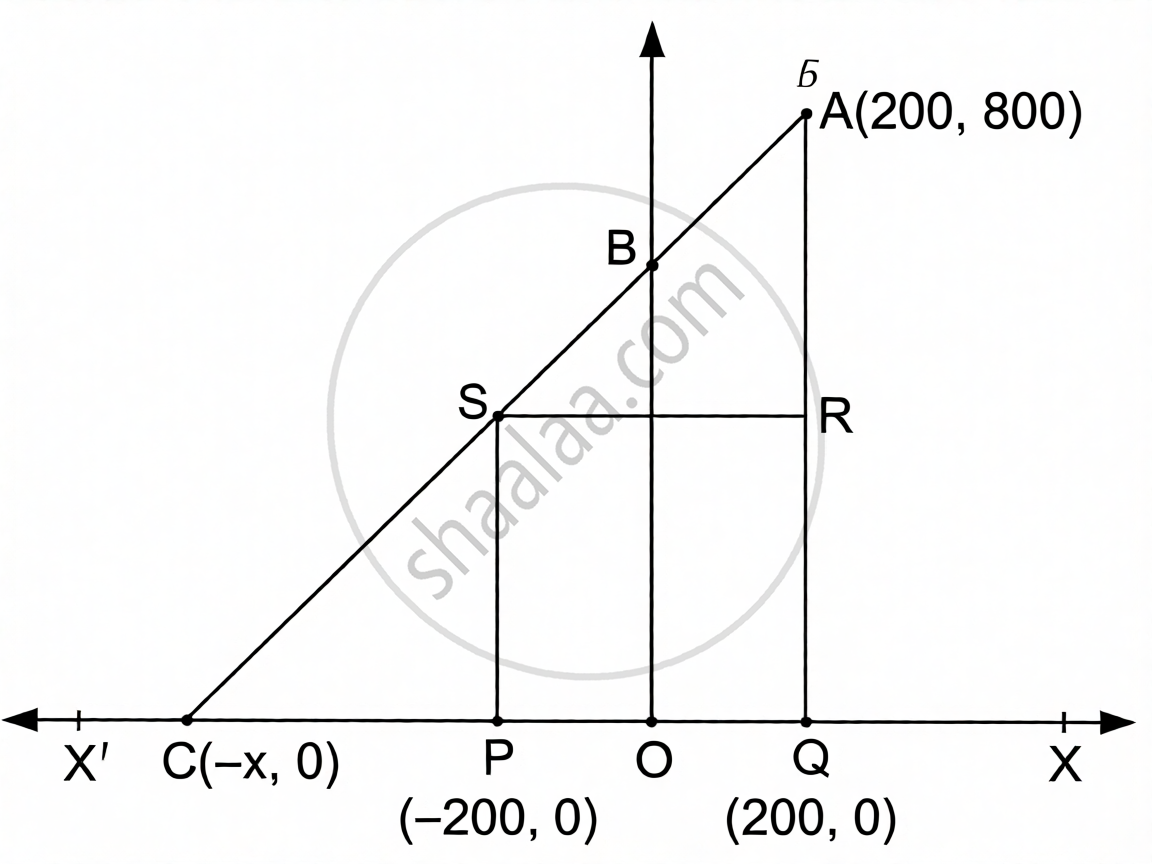
Based on the above information, answer the following questions.
- Taking O as the origin, the coordinates of P are (–200, 0) and that of Q are (200, 0). PQRS being a square, what are the coordinates of R and S?
- What is the area of square PQRS?
- What is the length of diagonal PR in square PQRS?
- If S divides CA in the ratio k : 1, what is the value of k, where point (A) is (200, 800)?
- What are the coordinates of C ?
|
The figure given below shows a school ground OABC such that \(O A=10 \mathrm{~m}\) and \(OC=100 \mathrm{~m}\). On a founders day, some sports activities were performed on this ground.
|
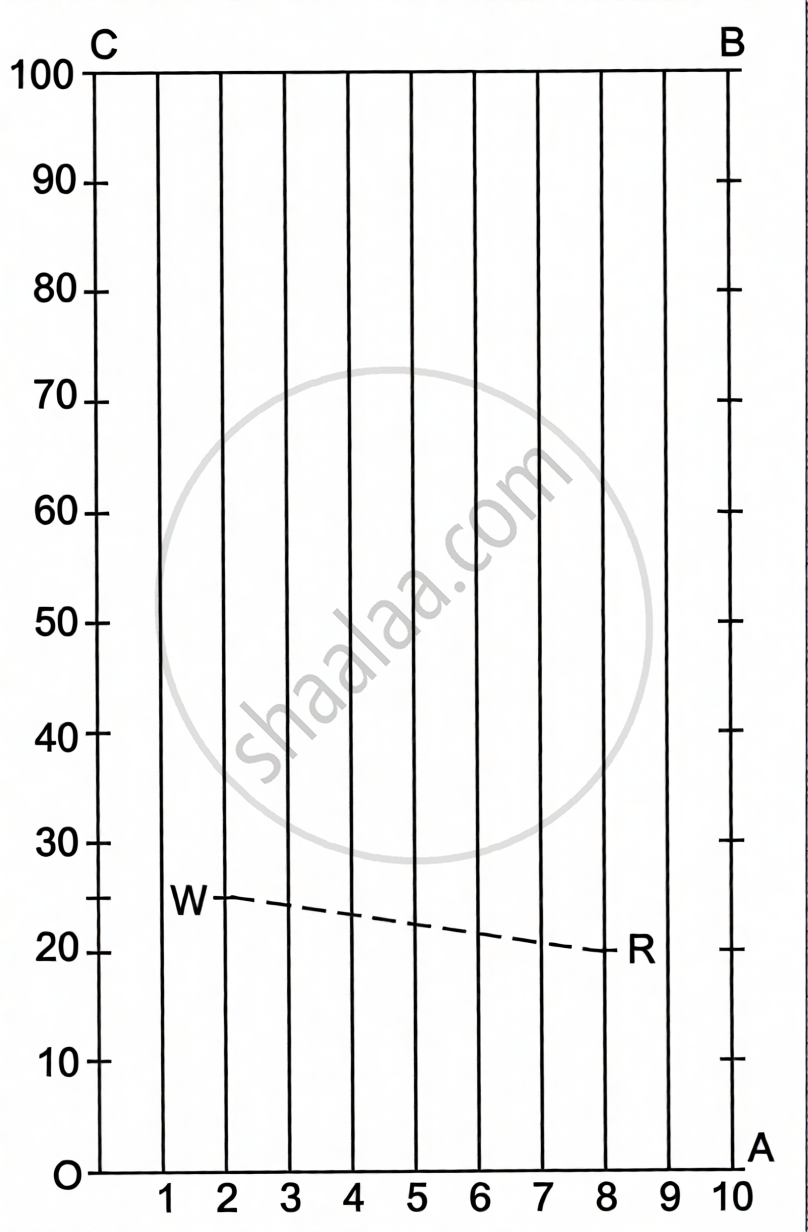
Look at the given figure and answer the following questions.
- What are the coordinates of the point W?
- What are the coordinates of the point R?
- What is the distance between the points W and R?
- What are the coordinates of the point which is exactly halfway between the line segment joining W and R?
- What are the coordinates of the point which is at about one fourth distance in the line segment joining W and R?
|
Use of mobile screen for long hours makes your eyesight weak and gives you headaches. Children who are addicted to playing ‘BGMI’ can get easily stressed out. To raise social awareness about ill effects of playing BGMI, a school decided to start ‘BAN BGMI’ campaign, in which students are asked to prepare campaign board in the shape of a rectangle. One such campaign board made by class X students of the school is shown in the figure given below.
|
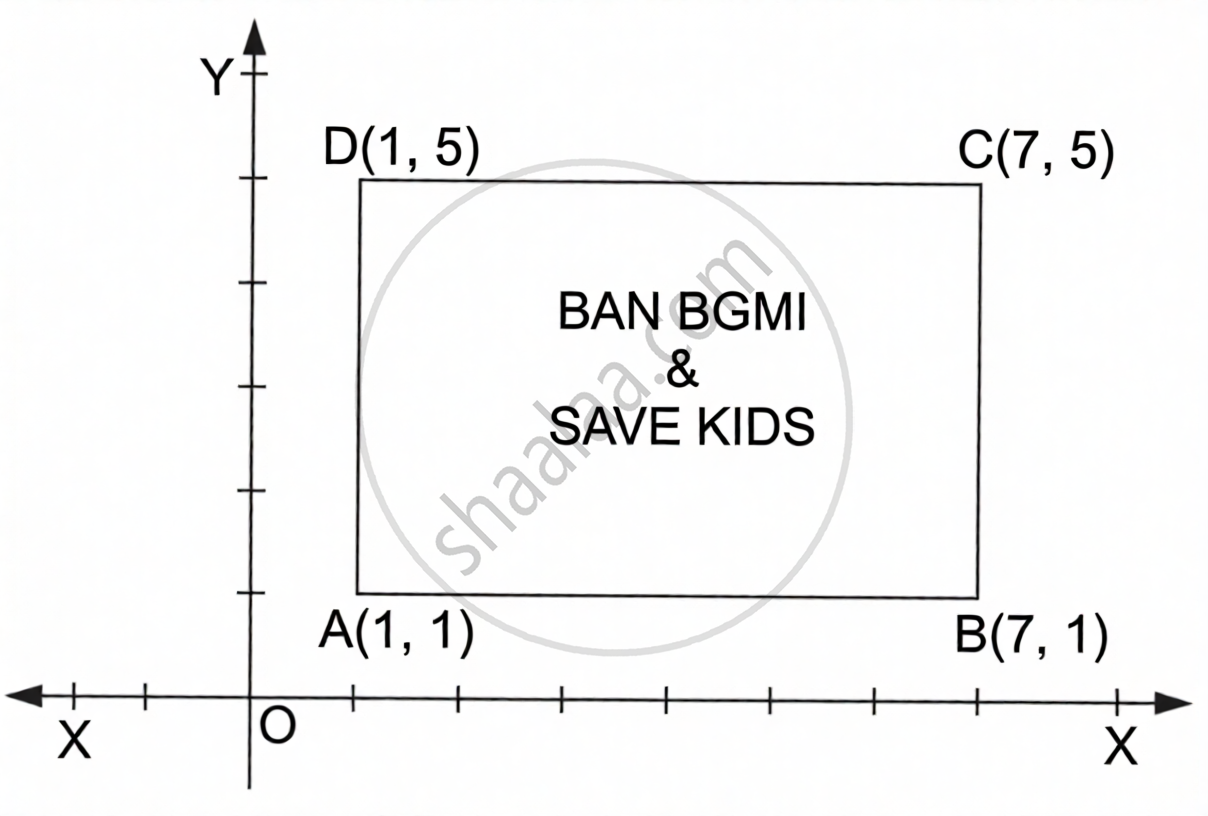
Based on the above information, answer the questions given below.
- What are the coordinates of the point of intersection of diagonals AC and BD?
- What is the length of diagonal AC?
- Find the ratio AB : AD.
- Find the area of the campaign board ABCD.
- What is the perimeter of the campaign board ABCD?
|
Hockey is played on a rectangular field which is 91.40 m long and 55 m broad. The shorter edges of the field are called backlines. Each of the two goals consists of two upright posts placed equidistant from the centre of the backline, joined at the top by a horizontal crossbar. The inner edges of each post must be 3.66 m apart and the lower edge of each crossbar must be 2.14 m above the ground. Each team plays with 11 players on the field during the game, including the goalie. Positions of the players on the left side is shown below.
|
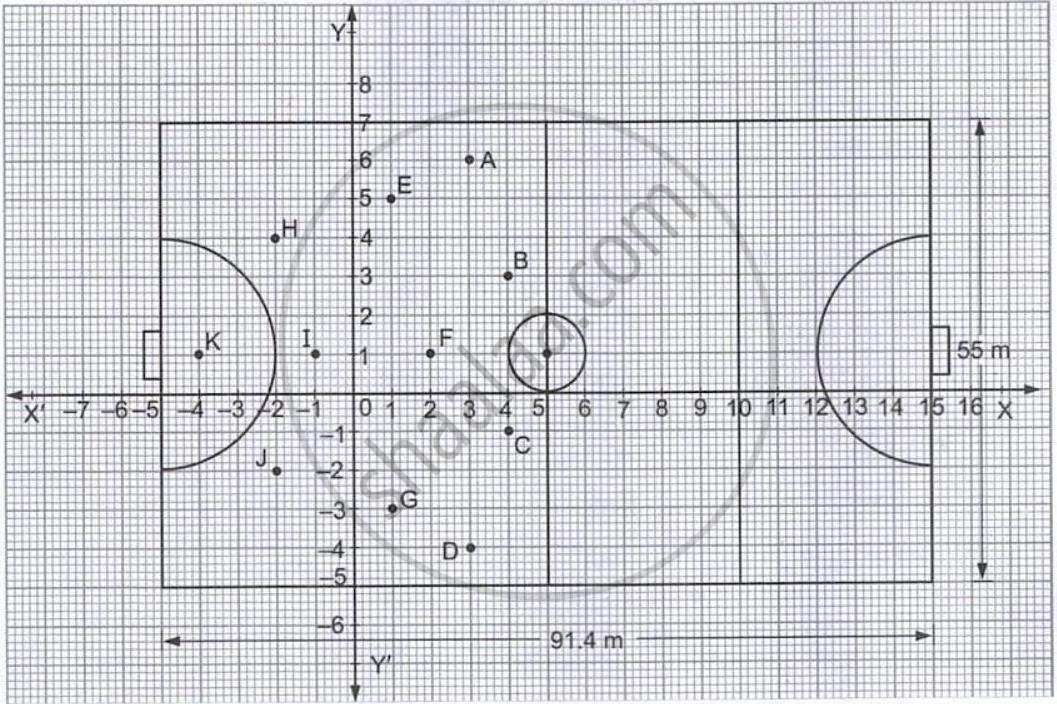
Using the picture of a hockey field given above, answer the questions that follow.
- What are the coordinates of the centroid of \(\triangle HFJ\)?
- What are the coordinates of the point on the x-axis, equidistant from F and I?
- What are the coordinates of the point on the y-axis, equidistant from B and C?
- What are the coordinates of the position of a player Q such that his distance from K is twice his distance from F, where K, Q and F are collinear?
- If a player P needs to be at equal distances from A and G such that A, P and G are in a straight line then what will be the position of P?
R.S. Aggarwal solutions for Mathematics [English] Class 10 20 Additional Questions Triangles [Pages 1014 - 1019]
Assertion-and-Reason Type Questions Each question consists of two statements, namely, Assertion (A) and Reason (R). For selecting the correct answer, use the following code:
Assertion (A): If $$\triangle FED \sim \triangle STU$$ then $$\frac{DE}{ST}=\frac{EF}{TU}$$.
Reason (R): The corresponding sides of similar triangles are proportional.
Both Assertion (A) and Reason (R) are true and Reason (R) is a correct explanation of Assertion (A).
Both Assertion (A) and Reason (R) are true but Reason (R) is not a correct explanation of Assertion (A).
Assertion (A) is true and Reason (R) is false.
Assertion (A) is false and Reason (R) is true.
Assertion (A): Two quadrilaterals are similar, if their corresponding angles are equal.
Reason (R): Two triangles are similar by AAA-criterion if their corresponding angles are equal.
Both Assertion (A) and Reason (R) are true and Reason (R) is a correct explanation of Assertion (A).
Both Assertion (A) and Reason (R) are true but Reason (R) is not a correct explanation of Assertion (A).
Assertion (A) is true and Reason (R) is false.
Assertion (A) is false and Reason (R) is true.
Assertion (A): In the given figure, if $$DE\parallel BC$$ then $$\triangle ADE\sim\triangle ACB$$.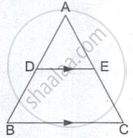
Reason (R): Being corresponding angles, we have $$\angle D=\angle B$$ and $$\angle E=\angle C$$.
Both Assertion (A) and Reason (R) are true and Reason (R) is a correct explanation of Assertion (A).
Both Assertion (A) and Reason (R) are true but Reason (R) is not a correct explanation of Assertion (A).
Assertion (A) is true and Reason (R) is false.
Assertion (A) is false and Reason (R) is true.
Assertion (A): If $$\triangle ABC\sim\triangle DEF$$, $$\angle A=47^{\circ}$$ and $$\angle E=83^{\circ}$$ then $$\angle C=50^{\circ}$$.
Reason (R): Similar triangles are always equiangular.
Both Assertion (A) and Reason (R) are true and Reason (R) is a correct explanation of Assertion (A).
Both Assertion (A) and Reason (R) are true but Reason (R) is not a correct explanation of Assertion (A).
Assertion (A) is true and Reason (R) is false.
Assertion (A) is false and Reason (R) is true.
Assertion (A): The three angles of a triangle are in the ratio 1 : 2 : 3. Then, the triangle is right angled.
Reason (R): The measures of the three angles of the triangle 30°, 60° and 90°.
Both Assertion (A) and Reason (R) are true and Reason (R) is a correct explanation of Assertion (A).
Both Assertion (A) and Reason (R) are true but Reason (R) is not a correct explanation of Assertion (A).
Assertion (A) is true and Reason (R) is false.
Assertion (A) is false and Reason (R) is true.
Assertion (A): In the given figure, if $$\triangle ABC\sim\triangle DEF$$ then $$x = 5$$.
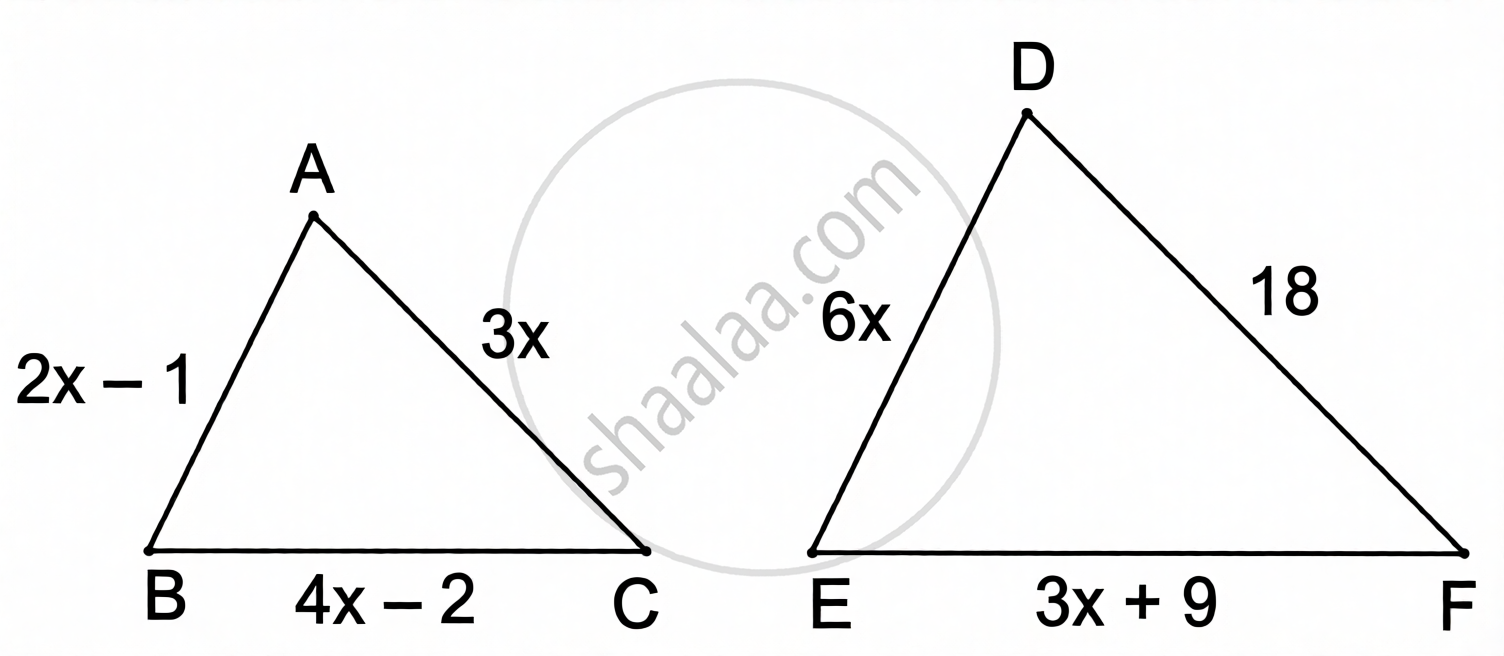
Reason (R): $$\frac{AB}{DE} = \frac{BC}{EF} = \frac{AC}{DF}$$.
Both Assertion (A) and Reason (R) are true and Reason (R) is a correct explanation of Assertion (A).
Both Assertion (A) and Reason (R) are true but Reason (R) is not a correct explanation of Assertion (A).
Assertion (A) is true and Reason (R) is false.
Assertion (A) is false and Reason (R) is true.
Assertion (A): Two sides and the perimeter of one triangle are respectively three times the corresponding sides and the perimeter of the other triangle. Then, the two triangles are similar.
Reason (R): If all the three corresponding sides of two triangles are proportional then the triangles are similar.
Both Assertion (A) and Reason (R) are true and Reason (R) is a correct explanation of Assertion (A).
Both Assertion (A) and Reason (R) are true but Reason (R) is not a correct explanation of Assertion (A).
Assertion (A) is true and Reason (R) is false.
Assertion (A) is false and Reason (R) is true.
Assertion (A): In $$\triangle ABC$$, $$AB=5\ \text{cm}$$, $$BC=12\ \text{cm}$$ and $$AC=13\ \text{cm}$$. Then, $$\angle B=90^{\circ}$$.
Reason (R): $$AB^{2}+AC^{2}=BC^{2}$$.
Both Assertion (A) and Reason (R) are true and Reason (R) is a correct explanation of Assertion (A).
Both Assertion (A) and Reason (R) are true but Reason (R) is not a correct explanation of Assertion (A).
Assertion (A) is true and Reason (R) is false.
Assertion (A) is false and Reason (R) is true.
Assertion (A): In the given figure, if $$\angle AED=\angle ABC$$ then $$\triangle ADE\sim\triangle ACB$$.
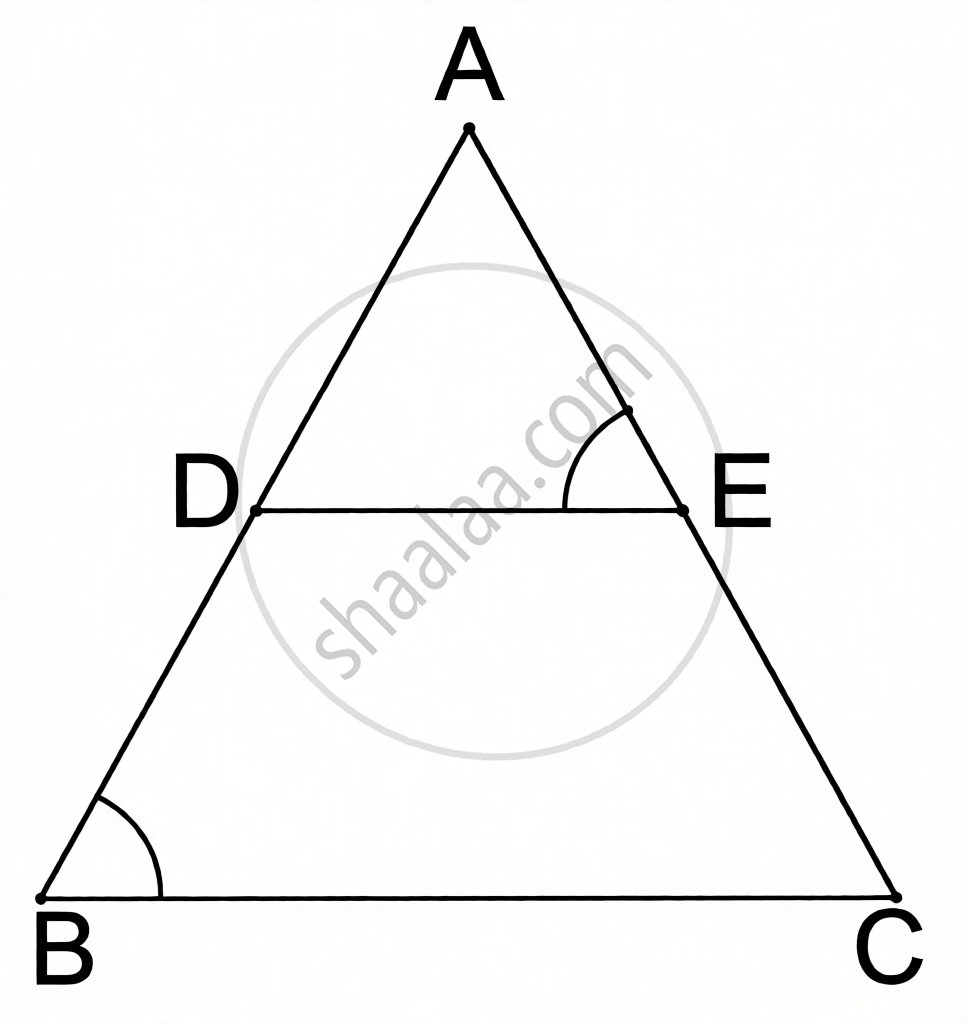
Reason (R): If two corresponding angles of two triangles are equal then the triangles are similar.
Both Assertion (A) and Reason (R) are true and Reason (R) is a correct explanation of Assertion (A).
Both Assertion (A) and Reason (R) are true but Reason (R) is not a correct explanation of Assertion (A).
Assertion (A) is true and Reason (R) is false.
Assertion (A) is false and Reason (R) is true.
Assertion (A): In the given figure, $$MN\parallel BC$$ and $$AM : MB = 1 : 2$$. Then, $$\frac{\operatorname{ar}(\triangle AMN)}{\operatorname{ar}(\triangle ABC)}=\frac{1}{4}$$.
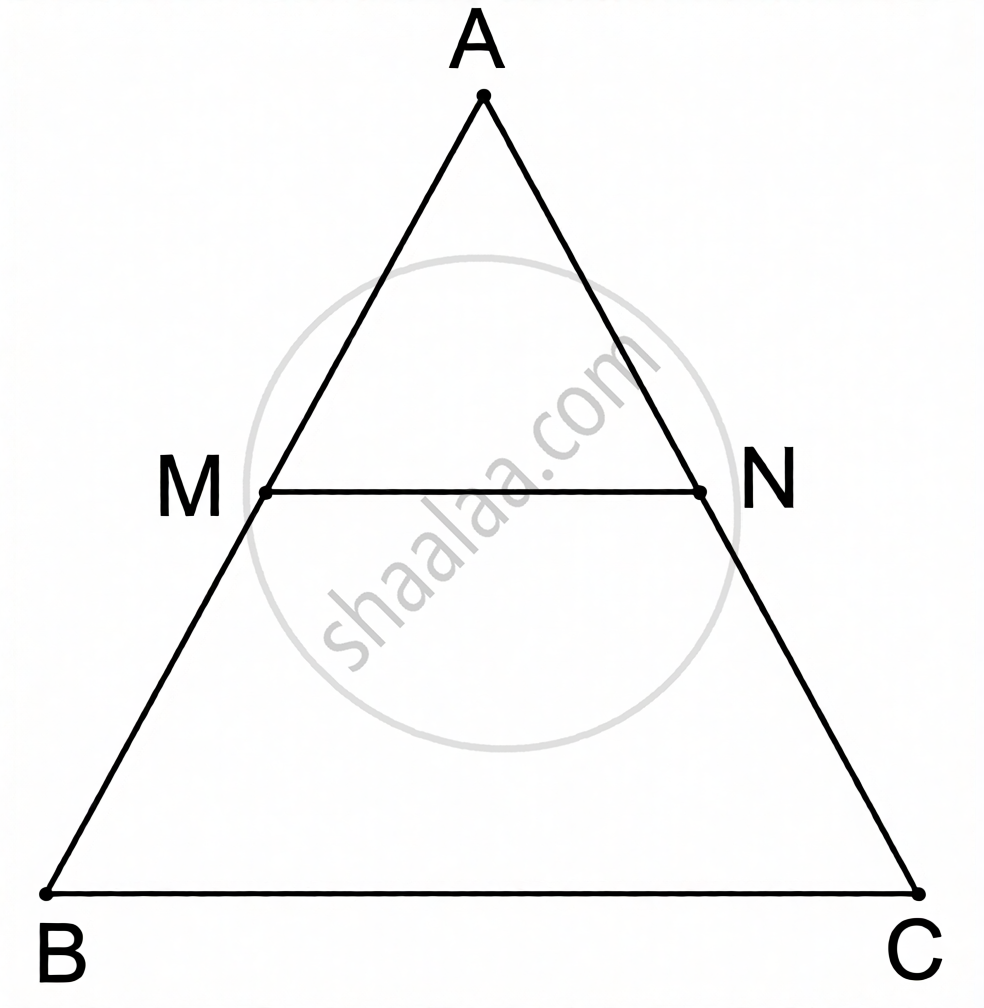
Reason (R): The ratio of the areas of two similar triangles is equal to the ratio of the squares of their corresponding sides.
Both Assertion (A) and Reason (R) are true and Reason (R) is a correct explanation of Assertion (A).
Both Assertion (A) and Reason (R) are true but Reason (R) is not a correct explanation of Assertion (A).
Assertion (A) is true and Reason (R) is false.
Assertion (A) is false and Reason (R) is true.
Assertion (A): Two isosceles triangles with equal vertical angles are similar.
Reason (R): If one angle of a triangle is equal to one angle of the other triangle and the sides including these angles are proportional then the two triangles are similar.
Both Assertion (A) and Reason (R) are true and Reason (R) is a correct explanation of Assertion (A).
Both Assertion (A) and Reason (R) are true but Reason (R) is not a correct explanation of Assertion (A).
Assertion (A) is true and Reason (R) is false.
Assertion (A) is false and Reason (R) is true.
Assertion (A): In $$\triangle ABC$$, $$P$$ and $$Q$$ are points on $$AB$$ and $$AC$$ respectively such that $$AP = 3\ \text{cm}$$, $$PB = 6\ \text{cm}$$, $$AQ = 5\ \text{cm}$$ and $$QC = 10\ \text{cm}$$. Then, $$BC = 3PQ$$.
Reason (R): The corresponding sides of similar triangles $$APQ$$ and $$ABC$$ are proportional.
Both Assertion (A) and Reason (R) are true and Reason (R) is a correct explanation of Assertion (A).
Both Assertion (A) and Reason (R) are true but Reason (R) is not a correct explanation of Assertion (A).
Assertion (A) is true and Reason (R) is false.
Assertion (A) is false and Reason (R) is true.
Assertion (A): In $$\triangle ABC$$ and $$\triangle PQR$$, if $$\frac{AB}{QR} = \frac{BC}{PR} = \frac{CA}{PQ}$$ then $$\triangle ABC\sim\triangle PQR$$.
Reason (R): If the corresponding sides of two triangles are proportional then the triangles are similar.
Both Assertion (A) and Reason (R) are true and Reason (R) is a correct explanation of Assertion (A).
Both Assertion (A) and Reason (R) are true but Reason (R) is not a correct explanation of Assertion (A).
Assertion (A) is true and Reason (R) is false.
Assertion (A) is false and Reason (R) is true.
Assertion (A): If $$\triangle ABC\sim\triangle DEF$$, $$\operatorname{ar}(\triangle ABC) = 81\ \text{cm}^{2}$$, $$\operatorname{ar}(\triangle DEF) = 144\ \text{cm}^{2}$$ and $$EF = 24\ \text{cm}$$ then $$BC = 18\ \text{cm}$$.
Reason (R): $$\frac{\operatorname{ar}(\triangle ABC)}{\operatorname{ar}(\triangle DEF)}=\frac{AB^{2}}{DE^{2}}=\frac{BC^{2}}{EF^{2}}=\frac{AC^{2}}{DF^{2}}$$.
Both Assertion (A) and Reason (R) are true and Reason (R) is a correct explanation of Assertion (A).
Both Assertion (A) and Reason (R) are true but Reason (R) is not a correct explanation of Assertion (A).
Assertion (A) is true and Reason (R) is false.
Assertion (A) is false and Reason (R) is true.
Assertion (A): If $$\triangle ABC\sim\triangle DEF$$ such that $$2AB = 3DE$$ and $$BC = 6\ \text{cm}$$ then $$EF = 4\ \text{cm}$$.
Reason (R): The corresponding sides of similar triangles are proportional.
Both Assertion (A) and Reason (R) are true and Reason (R) is a correct explanation of Assertion (A).
Both Assertion (A) and Reason (R) are true but Reason (R) is not a correct explanation of Assertion (A).
Assertion (A) is true and Reason (R) is false.
Assertion (A) is false and Reason (R) is true.
Case-Based Questions
|
Abhay walks in a straight line away from an electric lamp post of height 8 metres. When he is at a distance of 8 metres from the foot of the pole, his shadow is 2 metres in length.
|
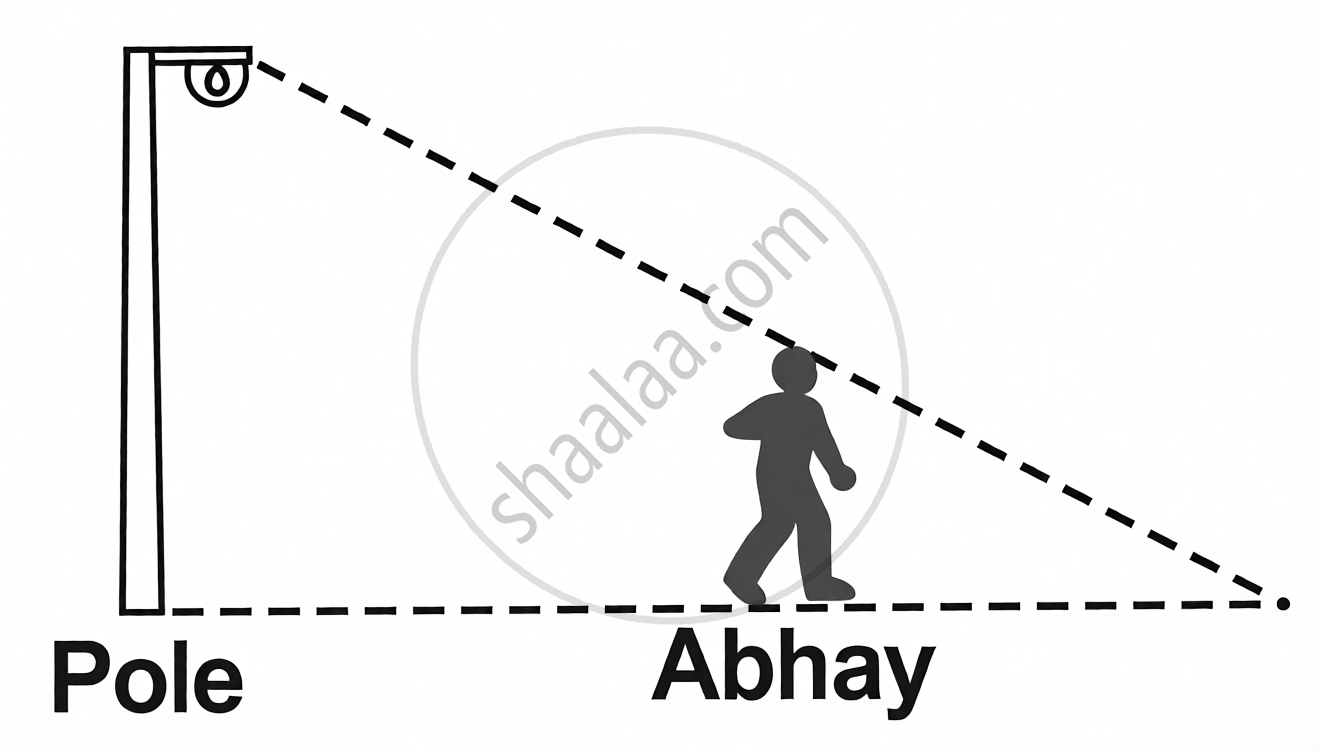
- Find Abhay's height (in cm).
- Find the length of Abhay's shadow (in metres) when he is at a distance of 12 metres from the foot of the pole.
- When Abhay is 12 metres away from the foot of the pole, he meets his friend Sachin who then moves towards the pole at the rate of 5 cm/s. If after 2 minutes the length of Sachin's shadow is 1.2 metres, what is his height?
- Name the similarity criterion used in solving the above problem.
R.S. Aggarwal solutions for Mathematics [English] Class 10 20 Additional Questions Circles [Pages 1020 - 1022]
Assertion-and-Reason Type Questions Each question consists of two statements, namely, Assertion (A) and Reason (R). For selecting the correct answer, use the following code:
Assertion (A): A tangent to a circle is perpendicular to the radius through the point of contact.
Reason (R): The lengths of tangents drawn from an external point to a circle are equal.
Both Assertion (A) and Reason (R) are true and Reason (R) is a correct explanation of Assertion (A).
Both Assertion (A) and Reason (R) are true but Reason (R) is not a correct explanation of Assertion (A).
Assertion (A) is true and Reason (R) is false.
Assertion (A) is false and Reason (R) is true.
Assertion (A): The tangents drawn at the end points of a diameter of a circle are parallel to each other.
Reason (R): A tangent to a circle is perpendicular to the radius through the point of contact.
Both Assertion (A) and Reason (R) are true and Reason (R) is a correct explanation of Assertion (A).
Both Assertion (A) and Reason (R) are true but Reason (R) is not a correct explanation of Assertion (A).
Assertion (A) is true and Reason (R) is false.
Assertion (A) is false and Reason (R) is true.
Assertion (A): If PA and PB are tangents drawn from an external point P to а circle with centre O then the quadrilateral AOBP is cyclic.
Reason (R): The angle between two tangents drawn from an external point to a circle is supplementary to the angle subtended by the line segment joining the points of contact at the centre.
Both Assertion (A) and Reason (R) are true and Reason (R) is a correct explanation of Assertion (A).
Both Assertion (A) and Reason (R) are true but Reason (R) is not a correct explanation of Assertion (A).
Assertion (A) is true and Reason (R) is false.
Assertion (A) is false and Reason (R) is true.
Assertion (A): In the given figure, PQ and PR are tangents to a circle centred at О and S is any point on the circle. If ∠QPR = 55° then ∠QSR = 62.5°.
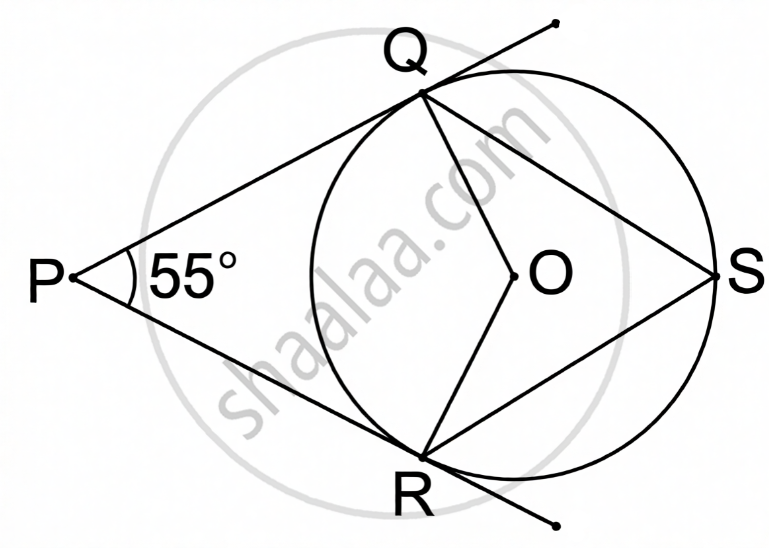
Reason (R): If a chord AB subtends an angle of 60° at the centre of a circle then the angle between the tangents at A and B is also 60°.
Both Assertion (A) and Reason (R) are true and Reason (R) is a correct explanation of Assertion (A).
Both Assertion (A) and Reason (R) are true but Reason (R) is not a correct explanation of Assertion (A).
Assertion (A) is true and Reason (R) is false.
Assertion (A) is false and Reason (R) is true.
Assertion (A): In the given figure, PQ is a tangent to a circle centred at O. If the radius of the circle is 5 cm then the length of the tangent PQ is \[\dfrac{5}{\sqrt{3}}\ \text{cm.}\]
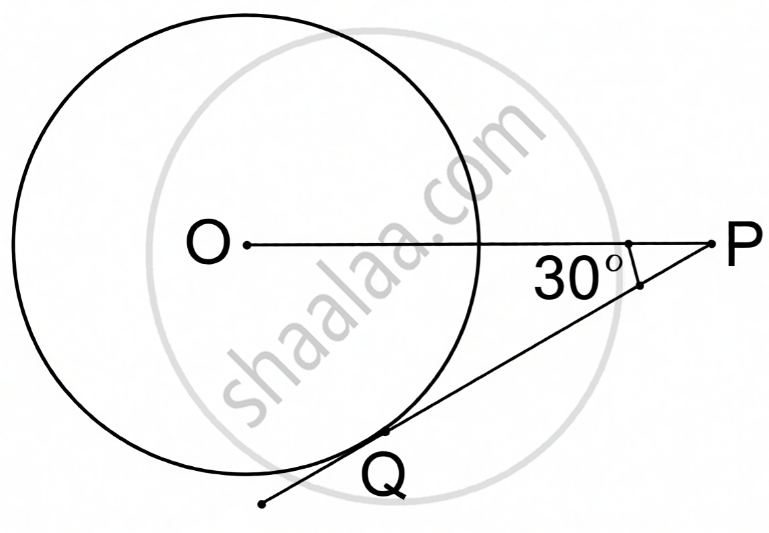
Reason (R): If two tangents are drawn to a circle from an external point then they subtend equal angles at the centre.
Both Assertion (A) and Reason (R) are true and Reason (R) is a correct explanation of Assertion (A).
Both Assertion (A) and Reason (R) are true but Reason (R) is not a correct explanation of Assertion (A).
Assertion (A) is true and Reason (R) is false.
Assertion (A) is false and Reason (R) is true.
Assertion (A): In the given figure, the quadrilateral PQRS circumscribes a circle. Then, PA + CS = PS.
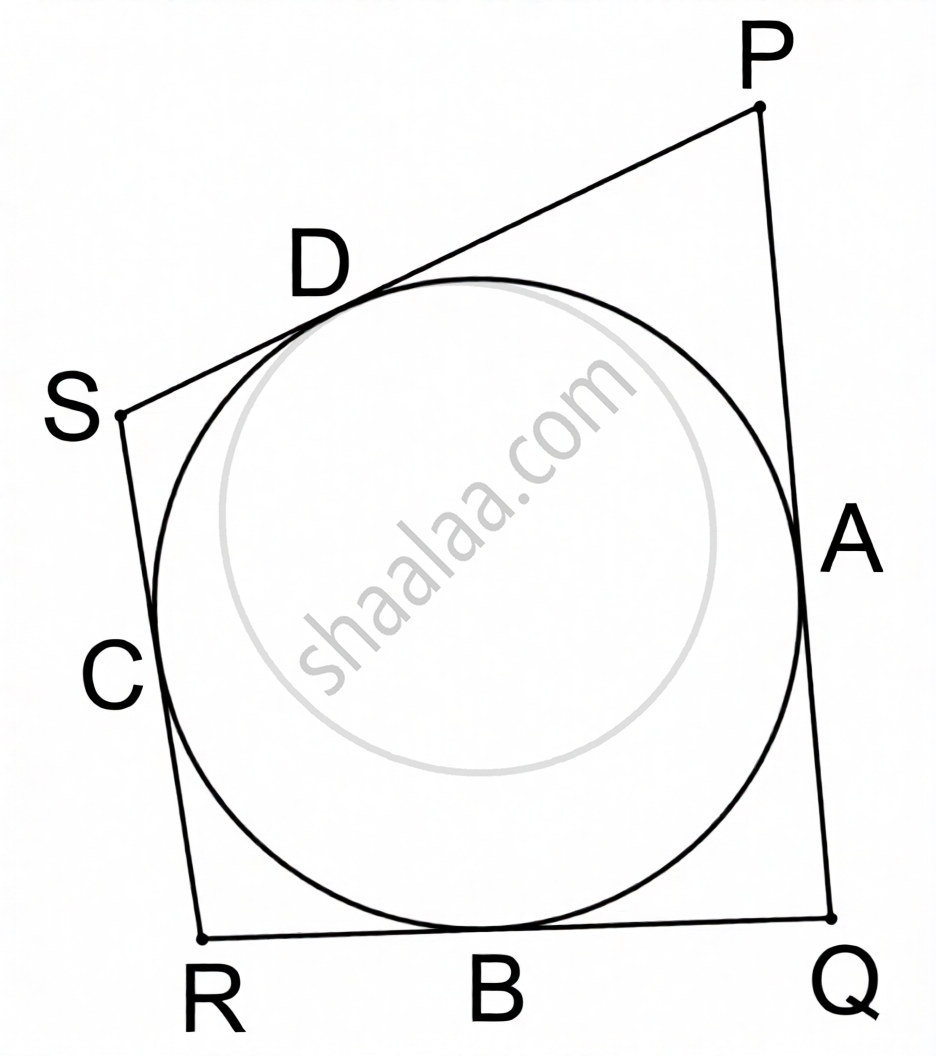
Reason (R): The tangents drawn at the end points of a diameter of a circle are parallel to each other.
Both Assertion (A) and Reason (R) are true and Reason (R) is a correct explanation of Assertion (A).
Both Assertion (A) and Reason (R) are true but Reason (R) is not a correct explanation of Assertion (A).
Assertion (A) is true and Reason (R) is false.
Assertion (A) is false and Reason (R) is true.
Assertion (A): If PA and PB are tangents to the circle centred at O and ∠OPA = 30° then ΔPAB is an equilateral triangle.
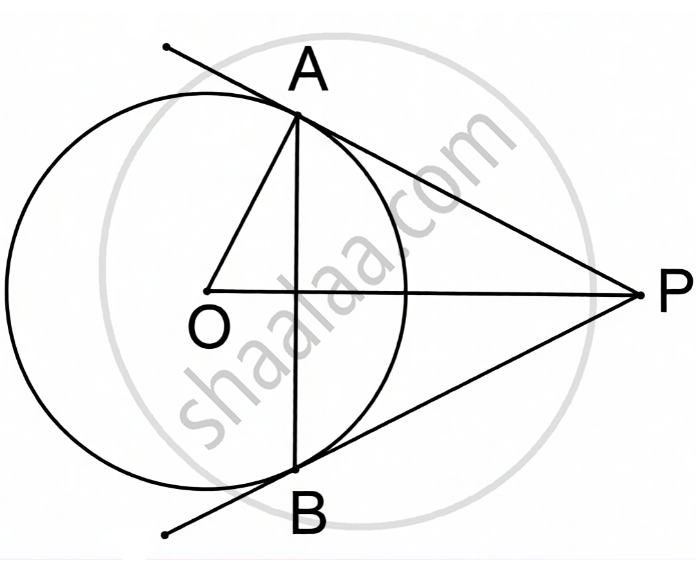
Reason (R): The lengths of tangents drawn from an external point to a circle are equal.
Both Assertion (A) and Reason (R) are true and Reason (R) is a correct explanation of Assertion (A).
Both Assertion (A) and Reason (R) are true but Reason (R) is not a correct explanation of Assertion (A).
Assertion (A) is true and Reason (R) is false.
Assertion (A) is false and Reason (R) is true.
R.S. Aggarwal solutions for Mathematics [English] Class 10 20 Additional Questions Trigonometry [Pages 1023 - 1025]
Assertion-and-Reason Type Questions Each question consists of two statements, namely, Assertion (A) and Reason (R). For selecting the correct answer, use the following code:
Assertion (A): For \(0<\theta \leq 90^{\circ},(\operatorname{cosec} \theta-\cot \theta)\) and \((\operatorname{cosec} \theta+\cot \theta)\) are reciprocal of each other.
Reason (R): \((\operatorname{cosec}^{2} \theta-\cot ^{2} \theta)=1\).
Both Assertion (A) and Reason (R) are true and Reason (R) is a correct explanation of Assertion (A).
Both Assertion (A) and Reason (R) are true but Reason (R) is not a correct explanation of Assertion (А).
Assertion (A) is true and Reason (R) is false.
Assertion (A) is false and Reason (R) is true.
Assertion (A): If \((\tan \theta+\cot \theta)=n\) then \(\tan ^{2} \theta+\cot ^{2} \theta=n^{2}\).
Reason (R): \(\cot \theta=\frac{1}{\tan \theta}\).
Both Assertion (A) and Reason (R) are true and Reason (R) is a correct explanation of Assertion (A).
Both Assertion (A) and Reason (R) are true but Reason (R) is not a correct explanation of Assertion (А).
Assertion (A) is true and Reason (R) is false.
Assertion (A) is false and Reason (R) is true.
Assertion (A): \(\tan 48^{\circ}=\cot 52^{\circ}\).
Reason (R): \(\tan \theta=\cot \left(90^{\circ}-\theta\right)\) for \(0^{\circ}<\theta<90^{\circ}\).
Both Assertion (A) and Reason (R) are true and Reason (R) is a correct explanation of Assertion (A).
Both Assertion (A) and Reason (R) are true but Reason (R) is not a correct explanation of Assertion (А).
Assertion (A) is true and Reason (R) is false.
Assertion (A) is false and Reason (R) is true.
Assertion (A): If \(\cos 2 \theta=\sin \left(\theta-15^{\circ}\right)\) then \(\theta=35^{\circ}\).
Reason (R): \(\cos \theta=\sin \left(90^{\circ}-\theta\right)\), for \(0^{\circ} \leq \theta \leq 90^{\circ}\).
Both Assertion (A) and Reason (R) are true and Reason (R) is a correct explanation of Assertion (A).
Both Assertion (A) and Reason (R) are true but Reason (R) is not a correct explanation of Assertion (А).
Assertion (A) is true and Reason (R) is false.
Assertion (A) is false and Reason (R) is true.
Assertion (A): The value of \((\sin 80^{\circ}-\cos 80^{\circ})\) is positive.
Reason (R): \(45^{\circ}<\theta \leq 90^{\circ} \Rightarrow \sin \theta>\cos \theta\).
Both Assertion (A) and Reason (R) are true and Reason (R) is a correct explanation of Assertion (A).
Both Assertion (A) and Reason (R) are true but Reason (R) is not a correct explanation of Assertion (А).
Assertion (A) is true and Reason (R) is false.
Assertion (A) is false and Reason (R) is true.
Assertion (A): The value of \((\cos ^{2} 24^{\circ}-\sin ^{2} 66^{\circ})\) is positive.
Reason (R): \(0^{\circ} \leq \theta \leq 90^{\circ} \Rightarrow \cos \left(90^{\circ}-\theta\right)=\sin \theta\).
Both Assertion (A) and Reason (R) are true and Reason (R) is a correct explanation of Assertion (A).
Both Assertion (A) and Reason (R) are true but Reason (R) is not a correct explanation of Assertion (А).
Assertion (A) is true and Reason (R) is false.
Assertion (A) is false and Reason (R) is true.
Assertion (A): The value of \((\sin \theta+\cos \theta)\) is always greater than 1.
Reason (R): For \(0^{\circ} \leq \theta \leq 90^{\circ}\), the value of \(\sin \theta\) varies from 0 to 1 and the value of \(\cos \theta\) varies from 1 to 0.
Both Assertion (A) and Reason (R) are true and Reason (R) is a correct explanation of Assertion (A).
Both Assertion (A) and Reason (R) are true but Reason (R) is not a correct explanation of Assertion (А).
Assertion (A) is true and Reason (R) is false.
Assertion (A) is false and Reason (R) is true.
Assertion (A): The value of \(\tan 1^{\circ} \cdot \tan 11^{\circ} \cdot \tan 21^{\circ} \cdot \tan 69^{\circ} \cdot \tan 79^{\circ} \cdot \tan 89^{\circ}\) is 1.
Reason (R): For \(0^{\circ}<\theta<90^{\circ}\), we have \(\tan \left(90^{\circ}-\theta\right)=\cot \theta\).
Both Assertion (A) and Reason (R) are true and Reason (R) is a correct explanation of Assertion (A).
Both Assertion (A) and Reason (R) are true but Reason (R) is not a correct explanation of Assertion (А).
Assertion (A) is true and Reason (R) is false.
Assertion (A) is false and Reason (R) is true.
Assertion (A): If \((\operatorname{cosec} \theta-\cot \theta)=\frac{1}{3}\) then \((\operatorname{cosec} \theta+\cot \theta)=3\).
Reason (R): \(\operatorname{cosec}^{2} \theta-\cot ^{2} \theta=1\) for all values of \(\theta\), where \(0^{\circ} \leq \theta \leq 90^{\circ}\).
Both Assertion (A) and Reason (R) are true and Reason (R) is a correct explanation of Assertion (A).
Both Assertion (A) and Reason (R) are true but Reason (R) is not a correct explanation of Assertion (А).
Assertion (A) is true and Reason (R) is false.
Assertion (A) is false and Reason (R) is true.
Assertion (A): If \(\operatorname{cosec} \theta=\frac{3}{2}\) then \((\operatorname{cosec}^{2} \theta+\cot ^{2} \theta)=\frac{7}{4}\).
Reason (R): \(\cot ^{2} \theta=\left(\operatorname{cosec}^{2} \theta-1\right)\), where \(0^{\circ} \leq \theta \leq 90^{\circ}\).
Both Assertion (A) and Reason (R) are true and Reason (R) is a correct explanation of Assertion (A).
Both Assertion (A) and Reason (R) are true but Reason (R) is not a correct explanation of Assertion (А).
Assertion (A) is true and Reason (R) is false.
Assertion (A) is false and Reason (R) is true.
Assertion (A): The value of \((\cot 10^{\circ} \times \cot 30^{\circ} \times \cot 80^{\circ})\) is \(\frac{\sqrt{3}}{2}\).
Reason (R): \(\cot \left(90^{\circ}-\theta\right)=\tan \theta\).
Both Assertion (A) and Reason (R) are true and Reason (R) is a correct explanation of Assertion (A).
Both Assertion (A) and Reason (R) are true but Reason (R) is not a correct explanation of Assertion (А).
Assertion (A) is true and Reason (R) is false.
Assertion (A) is false and Reason (R) is true.
Assertion (A): If \(\sec 4 \theta=\operatorname{cosec}\left(\theta-10^{\circ}\right)\) and \(4 \theta\) is acute then \(\theta=20^{\circ}\).
Reason (R): \(\sec \phi=\operatorname{cosec}\left(90^{\circ}-\phi\right)\) for all acute angles \(\phi\).
Both Assertion (A) and Reason (R) are true and Reason (R) is a correct explanation of Assertion (A).
Both Assertion (A) and Reason (R) are true but Reason (R) is not a correct explanation of Assertion (А).
Assertion (A) is true and Reason (R) is false.
Assertion (A) is false and Reason (R) is true.
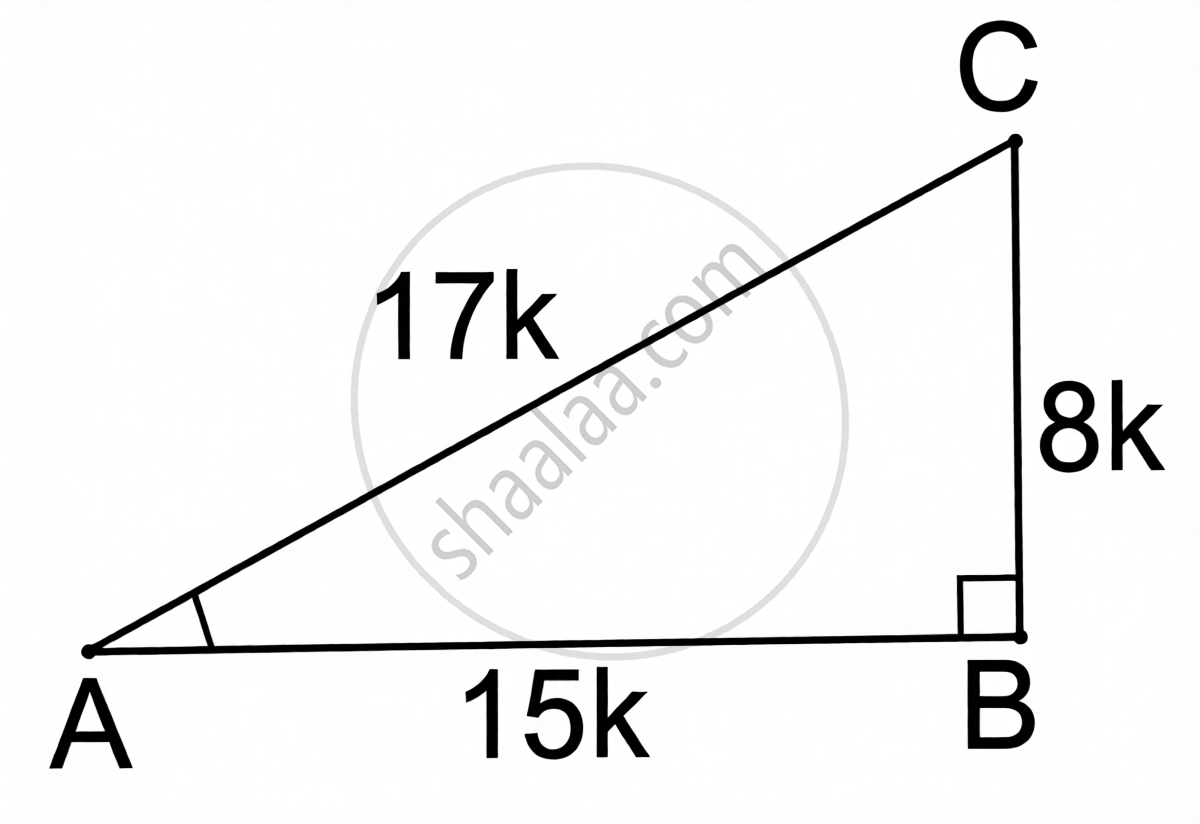
Assertion (A): If \(\sin A=\frac{8}{17}\) then \(\cot A=\frac{15}{8}\).
Reason (R): In a \(\triangle A B C\), right angled at B, we have \(\sin A=\frac{B C}{A C}\) and \(\cot A=\frac{A B}{B C}\).
Both Assertion (A) and Reason (R) are true and Reason (R) is a correct explanation of Assertion (A).
Both Assertion (A) and Reason (R) are true but Reason (R) is not a correct explanation of Assertion (А).
Assertion (A) is true and Reason (R) is false.
Assertion (A) is false and Reason (R) is true.
Assertion (A): If \(\sec \theta=\frac{25}{7}\) then \(\operatorname{cosec} \theta=\frac{25}{24}\).
Reason (R): In a \(\triangle A B C\), right angled at B, we have \(\sec \theta=\frac{A C}{A B}\) and \(\operatorname{cosec} \theta=\frac{A C}{B C}\).
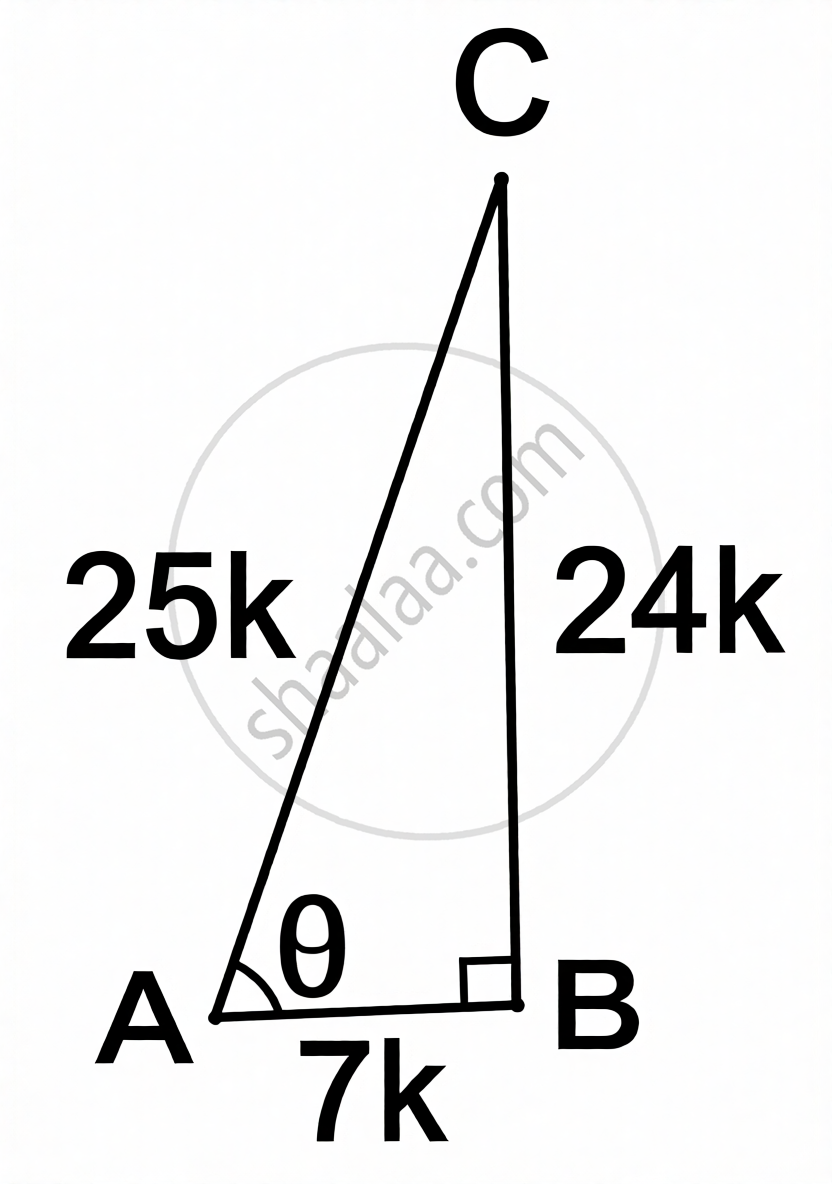
Both Assertion (A) and Reason (R) are true and Reason (R) is a correct explanation of Assertion (A).
Both Assertion (A) and Reason (R) are true but Reason (R) is not a correct explanation of Assertion (А).
Assertion (A) is true and Reason (R) is false.
Assertion (A) is false and Reason (R) is true.
Assertion (A): If \(\sin \alpha=\frac{1}{2}\) then \((3 \cos \alpha - 4 \cos^{3} \alpha) = 0\).
Reason (R): \(\cos 3 \alpha = 3 \cos \alpha - 4 \cos^{3} \alpha\).
Both Assertion (A) and Reason (R) are true and Reason (R) is a correct explanation of Assertion (A).
Both Assertion (A) and Reason (R) are true but Reason (R) is not a correct explanation of Assertion (А).
Assertion (A) is true and Reason (R) is false.
Assertion (A) is false and Reason (R) is true.
R.S. Aggarwal solutions for Mathematics [English] Class 10 20 Additional Questions Heights and Distances [Pages 1028 - 1030]
Case-Based Questions
| Totem poles are made from large trees. These poles are carved with symbols or figures and are mostly found in Western Canada and northwestern United States. Two such poles of equal heights are standing 28 m apart. From a point somewhere between them in the same line, the angles of elevation of the top of the two poles are 60° and 30° respectively. |
Based on the above information, answer the following questions.
- Draw a neat well-labelled figure based on the above information.
- Find the height of the poles.
- If the distances of the top of the poles from the point of observation are taken as p and q then find a relation between p and q.
- Find the location of the point of observation.
Radio towers are used for transmitting a range of communication services including radio and television. The tower will either act as an antenna itself or support one or more antennas on its structure. On a similar concept, a radio station tower was built in two sections A and B. The tower is supported by wires from a point O. The distance between the base of the tower and point O is 36 cm. From point O, the angle of elevation of the top of the section B is 30° and the angle of elevation of the top of section A is 45°.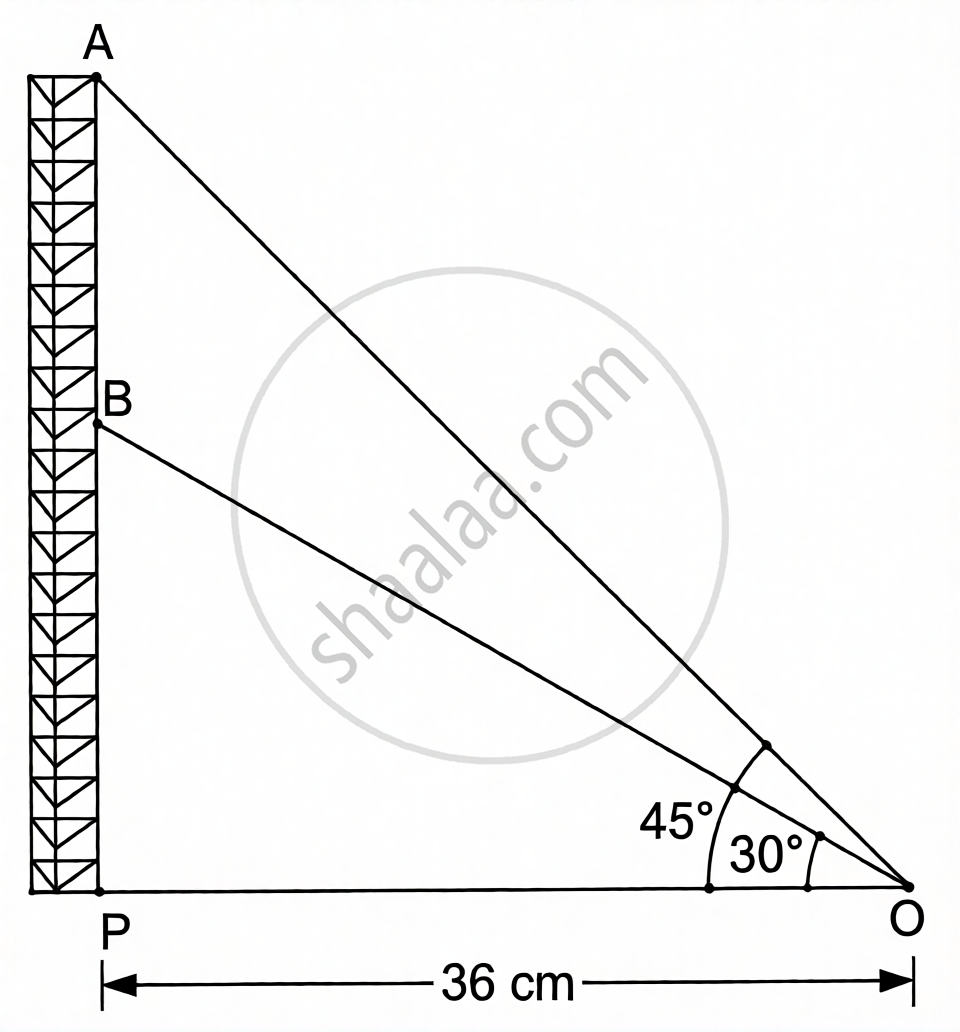 |
Based on the given information, answer the following questions.
- Find the length of the wire from the point O to the top of section B.
- Find the distance AB.
- Find the area of ΔOPB.
- Find the height of section A from the base of the tower.
| Two lamp posts are of equal heights. A boy measured the elevation of the top of each lamp post from the midpoint of the line segment joining the feet of the lamp post, as 30°. After walking 15 m towards one of them, he measured the elevation of the top of the nearest lamp post at the point where he stands as 60°. |
Based on the above information, answer the following questions.
- Taking h metres as the height of each lamp post and x metres as the distance between the feet of the two lamp posts, find a relation between x and h.
- After moving 15 m towards one lamp post, what is the relation between x and h?
- Find the height of each lamp post.
- Find the distance between the two lamp posts.
| We have all seen aeroplanes flying in the sky, but we might not have thought of how they actually reached the correct destination. Air Traffic Control (ATC) is a service provided by ground-based air traffic controllers who direct an aircraft on the ground and through a given section of controlled airspace and can provide advisory services to the aircraft in non-controlled airspace. All this air traffic is managed and regulated using various concepts based on coordinate geometry and trigonometry. At a given instance, ATC finds that the angle of elevation of an aeroplane from a point on the ground is 60°. After a flight of 30 seconds, it is observed that the angle of elevation changes to 30°. The height of the plane remains constant as \(3000 \sqrt{3} \mathrm{~m}\). |
Based on the above information, answer the following questions.
- Draw a neat and well-labelled figure to represent the above information.
- What is the distance travelled by the plane in 30 seconds?
- Keeping the height constant, during the above flight, it was observed that after \(15(\sqrt{3}-1)\) seconds, the angle of elevation changed to \(45^{\circ}\). How much is the distance travelled in that duration?
- What is the speed of the plane in km/hr?
|
One evening, Ratan was in a park. Children were playing cricket. Birds were singing on a nearby tree of height 80 m. He observed a bird on the tree at an angle of elevation of 45°. When a sixer was hit, a ball flew through the tree, frightening the bird to fly away. In 2 seconds, he observed the bird flying at the same height at an angle of elevation of 60°.
|
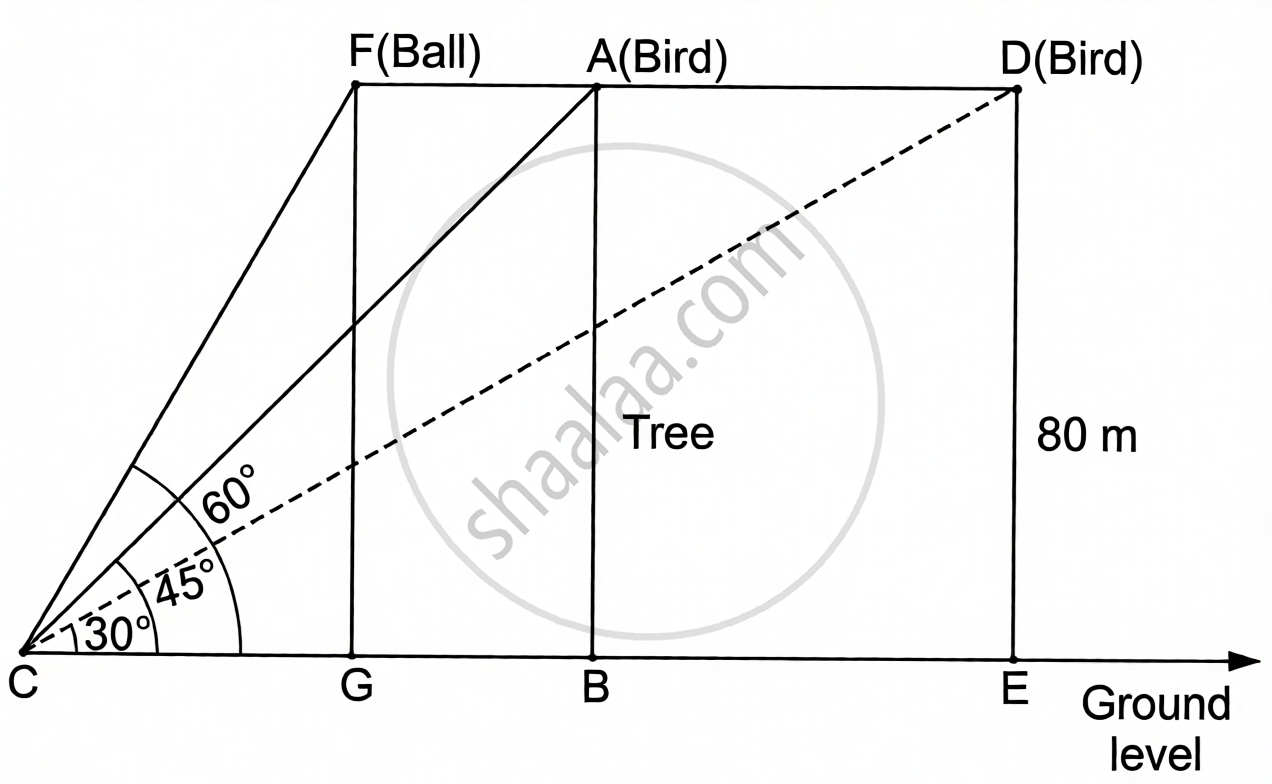
Based on the above information, answer the following questions.
- At what distance from the foot of the tree was Ratan observing the bird sitting on the tree?
- How far did the bird fly in the mentioned time?
- After hitting the tree, how far did the ball travel in the sky when Ratan saw it?
- What is the speed of the bird in metre/minute if it has flown \(20(\sqrt{3}+1) \mathrm{~m}\)?
R.S. Aggarwal solutions for Mathematics [English] Class 10 20 Additional Questions Area of Circle, Sector and Segment [Pages 1035 - 1042]
Assertion-and-Reason Type Questions Each question consists of two statements, namely, Assertion (A) and Reason (R). For selecting the correct answer, use the following code:
Assertion (A): The area of a semicircle of diameter $$d$$ is $$\frac{1}{8}\pi d^{2}$$.
Reason (R): The central angle of a semicircle is $$90^{\circ}$$.
Both Assertion (A) and Reason (R) are true and Reason (R) is a correct explanation of Assertion (A).
Both Assertion (A) and Reason (R) are true but Reason (R) is not a correct explanation of Assertion (А).
Assertion (A) is true and Reason (R) is false.
Assertion (A) is false and Reason (R) is true.
Assertion (A): If the circumferences of two circles are in the ratio $$5 : 6$$ then the ratio of their radii is $$5 : 6$$.
Reason (R): The circumference of a circle is directly proportional to the square of the radius of the circle.
Both Assertion (A) and Reason (R) are true and Reason (R) is a correct explanation of Assertion (A).
Both Assertion (A) and Reason (R) are true but Reason (R) is not a correct explanation of Assertion (А).
Assertion (A) is true and Reason (R) is false.
Assertion (A) is false and Reason (R) is true.
Assertion (A): If the radius of a semicircular protractor is $$7\ \text{cm}$$ then its perimeter is $$36\ \text{cm}$$.
Reason (R): The perimeter of a semicircular protractor of radius $$r$$ cm is $$r(\pi + 2)$$ cm.
Both Assertion (A) and Reason (R) are true and Reason (R) is a correct explanation of Assertion (A).
Both Assertion (A) and Reason (R) are true but Reason (R) is not a correct explanation of Assertion (А).
Assertion (A) is true and Reason (R) is false.
Assertion (A) is false and Reason (R) is true.
Assertion (A): If the radius of a circle is tripled then the resulting percentage increase in the area of the circle is $$900\%$$.
Reason (R): The area of a circle is directly proportional to the square of its radius.
Both Assertion (A) and Reason (R) are true and Reason (R) is a correct explanation of Assertion (A).
Both Assertion (A) and Reason (R) are true but Reason (R) is not a correct explanation of Assertion (А).
Assertion (A) is true and Reason (R) is false.
Assertion (A) is false and Reason (R) is true.
Assertion (A): If a circle and a square have the same perimeter then the area of the square is greater than the area of the circle.
Reason (R): If the radius of the circle is $$r$$ and the side of the square is $$s$$, then $$r = \frac{2s}{\pi}$$.
Both Assertion (A) and Reason (R) are true and Reason (R) is a correct explanation of Assertion (A).
Both Assertion (A) and Reason (R) are true but Reason (R) is not a correct explanation of Assertion (А).
Assertion (A) is true and Reason (R) is false.
Assertion (A) is false and Reason (R) is true.
Assertion (A): If a bicycle wheel makes $$5000$$ revolutions in moving $$11\ \text{km}$$ then the diameter of the wheel is $$70\ \text{cm}$$.
Reason (R): The distance covered by a wheel in $$1$$ revolution is equal to the circumference of the wheel.
Both Assertion (A) and Reason (R) are true and Reason (R) is a correct explanation of Assertion (A).
Both Assertion (A) and Reason (R) are true but Reason (R) is not a correct explanation of Assertion (А).
Assertion (A) is true and Reason (R) is false.
Assertion (A) is false and Reason (R) is true.
Assertion (A): The area of the square inscribed in a circle of radius $$10\ \text{cm}$$ is $$200\ \text{cm}^{2}$$.
Reason (R): Diagonal of inscribed square = diameter of circle.
Both Assertion (A) and Reason (R) are true and Reason (R) is a correct explanation of Assertion (A).
Both Assertion (A) and Reason (R) are true but Reason (R) is not a correct explanation of Assertion (А).
Assertion (A) is true and Reason (R) is false.
Assertion (A) is false and Reason (R) is true.
Assertion (A): The length of the arc of a sector of a circle with radius $$14\ \text{cm}$$ and of central angle $$60^{\circ}$$ is $$\frac{88}{3}\ \text{cm}$$.
Reason (R): The length of the arc of a circle of radius $$r$$ cm and central angle $$\theta$$ is $$\left(\frac{2\pi r\theta}{360}\right)\ \text{cm}$$.
Both Assertion (A) and Reason (R) are true and Reason (R) is a correct explanation of Assertion (A).
Both Assertion (A) and Reason (R) are true but Reason (R) is not a correct explanation of Assertion (А).
Assertion (A) is true and Reason (R) is false.
Assertion (A) is false and Reason (R) is true.
Assertion (A): OACB is a quadrant of a circle with centre O and radius $$7\ \text{cm}$$, where ACB is the arc. Then, the perimeter of the quadrant is $$25\ \text{cm}$$.
Reason (R): The perimeter of the sector of a circle of radius $$r$$ cm and central angle $$\theta$$ is $$2r\left(1 + \frac{\pi\theta}{360}\right)\ \text{cm}$$.
Both Assertion (A) and Reason (R) are true and Reason (R) is a correct explanation of Assertion (A).
Both Assertion (A) and Reason (R) are true but Reason (R) is not a correct explanation of Assertion (А).
Assertion (A) is true and Reason (R) is false.
Assertion (A) is false and Reason (R) is true.
Assertion (A): The area of the sector of a circle of radius $$14\ \text{cm}$$ and central angle $$90^{\circ}$$ is $$154\ \text{cm}^{2}$$.
Reason (R): The area of the sector of a circle of radius $$r$$ cm and central angle $$\theta$$ is $$\left(\pi r^{2}\frac{\theta}{360}\right)\ \text{cm}^{2}$$.
Both Assertion (A) and Reason (R) are true and Reason (R) is a correct explanation of Assertion (A).
Both Assertion (A) and Reason (R) are true but Reason (R) is not a correct explanation of Assertion (А).
Assertion (A) is true and Reason (R) is false.
Assertion (A) is false and Reason (R) is true.
Assertion (A): If a sector of a circle with central angle $$60^{\circ}$$ has an area $$924\ \text{cm}^{2}$$ then the radius of the circle is $$42\ \text{cm}$$.
Reason (R): The sum of the areas of a major sector of a circle and its corresponding minor sector is equal to the area of the circle.
Both Assertion (A) and Reason (R) are true and Reason (R) is a correct explanation of Assertion (A).
Both Assertion (A) and Reason (R) are true but Reason (R) is not a correct explanation of Assertion (А).
Assertion (A) is true and Reason (R) is false.
Assertion (A) is false and Reason (R) is true.
Assertion (A): The area of the sector of a circle of radius $$21\ \text{cm}$$ cut-off by an arc of length $$22\ \text{cm}$$ is $$231\ \text{cm}^{2}$$.
Reason (R): The angle subtended by the arc at the centre of the circle is $$30^{\circ}$$.
Both Assertion (A) and Reason (R) are true and Reason (R) is a correct explanation of Assertion (A).
Both Assertion (A) and Reason (R) are true but Reason (R) is not a correct explanation of Assertion (А).
Assertion (A) is true and Reason (R) is false.
Assertion (A) is false and Reason (R) is true.
Assertion (A): The hour hand of a clock is $$6\ \text{cm}$$ long. The angle swept by it between 9.20 a.m. and 9.55 a.m. is $$35^{\circ}$$.
Reason (R): To find the area swept by the hour hand of the clock in a certain time interval, we calculate the area of the sector of a circle.
Both Assertion (A) and Reason (R) are true and Reason (R) is a correct explanation of Assertion (A).
Both Assertion (A) and Reason (R) are true but Reason (R) is not a correct explanation of Assertion (А).
Assertion (A) is true and Reason (R) is false.
Assertion (A) is false and Reason (R) is true.
Assertion (A): The difference between the areas of two segments of a circle of radius $$5\ \text{cm}$$, formed by a chord subtending an angle of $$90^{\circ}$$ at the centre, is $$\left(\frac{25}{2}\pi + 25\right)\ \text{cm}^{2}$$.
Reason (R): The area of a segment of a circle is less than the area of the corresponding sector.
Both Assertion (A) and Reason (R) are true and Reason (R) is a correct explanation of Assertion (A).
Both Assertion (A) and Reason (R) are true but Reason (R) is not a correct explanation of Assertion (А).
Assertion (A) is true and Reason (R) is false.
Assertion (A) is false and Reason (R) is true.
Case-Based Questions
|
An interschool rangoli competition was organised by one of the reputed schools of Odisha. The theme of the rangoli competition was Diwali celebrations, wherein students were supposed to make mathematical designs. Students from various schools participated and made beautiful rangoli designs. One such design is shown in the given figure. Rangoli is in the shape of a square ABCD of side 40 cm. At each corner of the square, a quadrant of a circle of radius 10 cm is drawn in which diyas are kept. A circle of diameter 20 cm is also drawn inside the square.
|
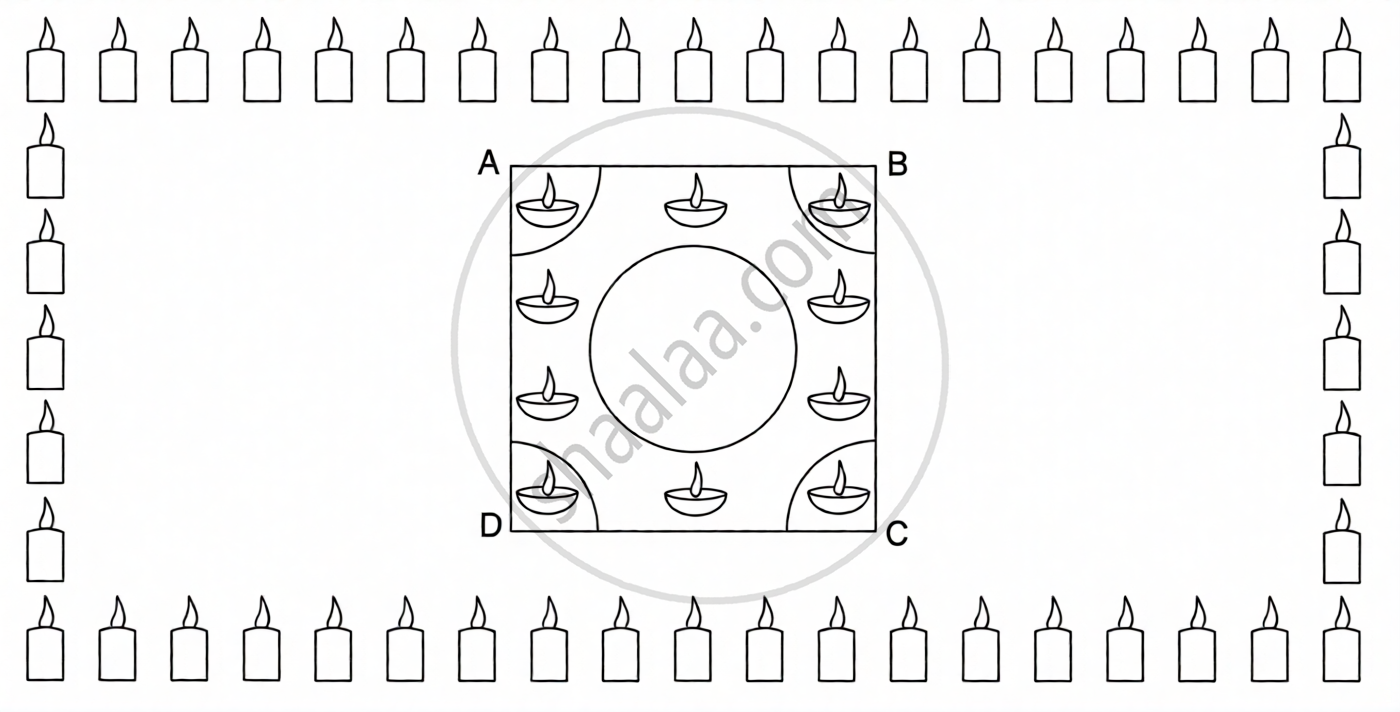
Based on the above information, answer the following questions.
- Find the area of the square ABCD.
- What is the area of the circle drawn inside the square?
- If the circle and the four quadrants are cut off from the square ABCD and removed then find the area of the remaining portion of the square ABCD.
- Find the combined area of the four quadrants and the circle removed.
|
Governing council of a local public development authority of Dehradun decided to build an adventurous playground on the top of a hill, which will have adequate space for parking. After survey, it was decided to build a rectangular playground, with a semicircular area allotted for parking at one end of the playground. The length and breadth of the rectangular playground are 14 units and 7 units, respectively. There are two quadrants of radius 2 units on one side for special seats.
|
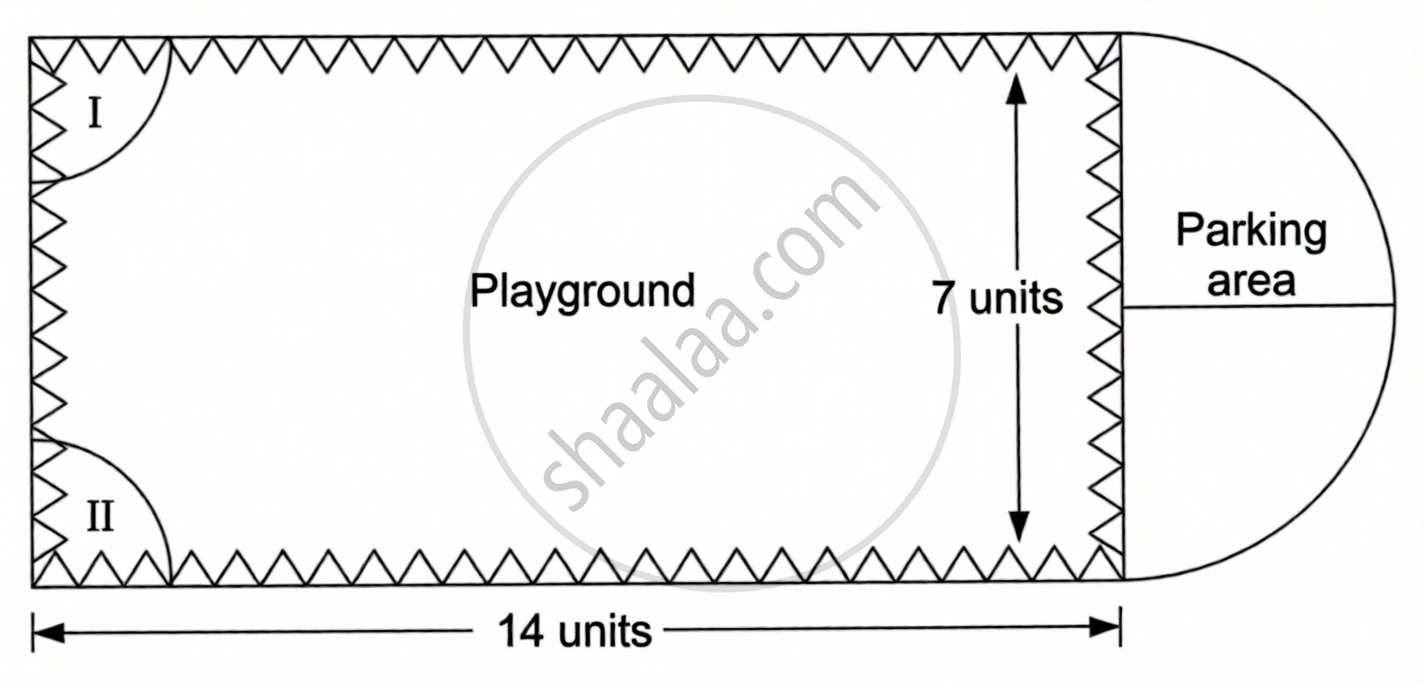
Based on the given information, answer the following questions.
- What is the total perimeter of the parking area?
- What is the total area of the parking and the two quadrants?
- What is the ratio of the area of the playground to the area of the parking area?
- Find the cost of fencing the playground and parking area at the rate of ₹ 2 per unit.
|
In an annual day function of a school, the organizers wanted to give a cash prize along with a memento to their best students. Each memento is made as shown in the given figure and its base ABCD is shown from the front side. The rate of silver plating is ₹ 20 per \(\mathrm{cm}^{2}\).
|
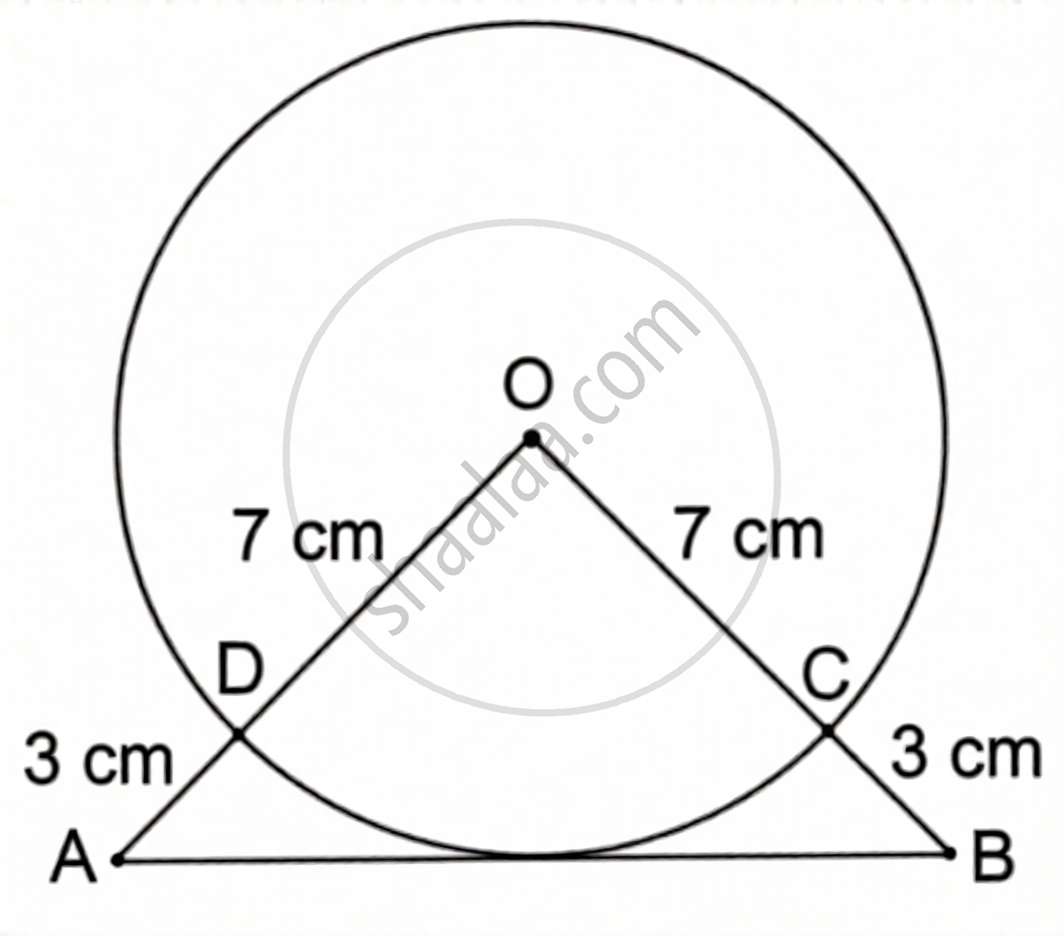
Based on the above information, answer the following questions.
- What is the area of the quadrant ODCO?
- Find the area of the \(\triangle AOB\).
- What is the total cost of silver plating the shaded part ABCD?
- What is the length of \(\operatorname{arc} CD\)?
|
The most accurate way to determine the age of a tree is to count the annual rings of wood growth. One such trunk has been shown.
To make an identification mark, the forest department has painted segment ACBA, as shown in the given figure. If the chord AB makes an angle of 90° at the centre O and the radius of the trunk is 21 cm, find the: |
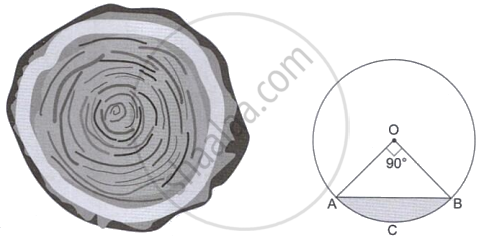
- length of the chord AB.
- area of the \(\triangle OAB\).
- area of the segment ACBA.
- perimeter of the sector OACBO.
|
Flower beds look beautiful growing in gardens. One such circular garden of radius \(r \mathrm{~m}\), has two segments with flowers. One segment which subtends an angle of 90° at the centre is full of red roses, while the other segment with central angle 60° is full of yellow coloured flowers. It is given that the combined area of the two segments of flowers is \(256 \frac{2}{3} \mathrm{~m}^{2}\).
|
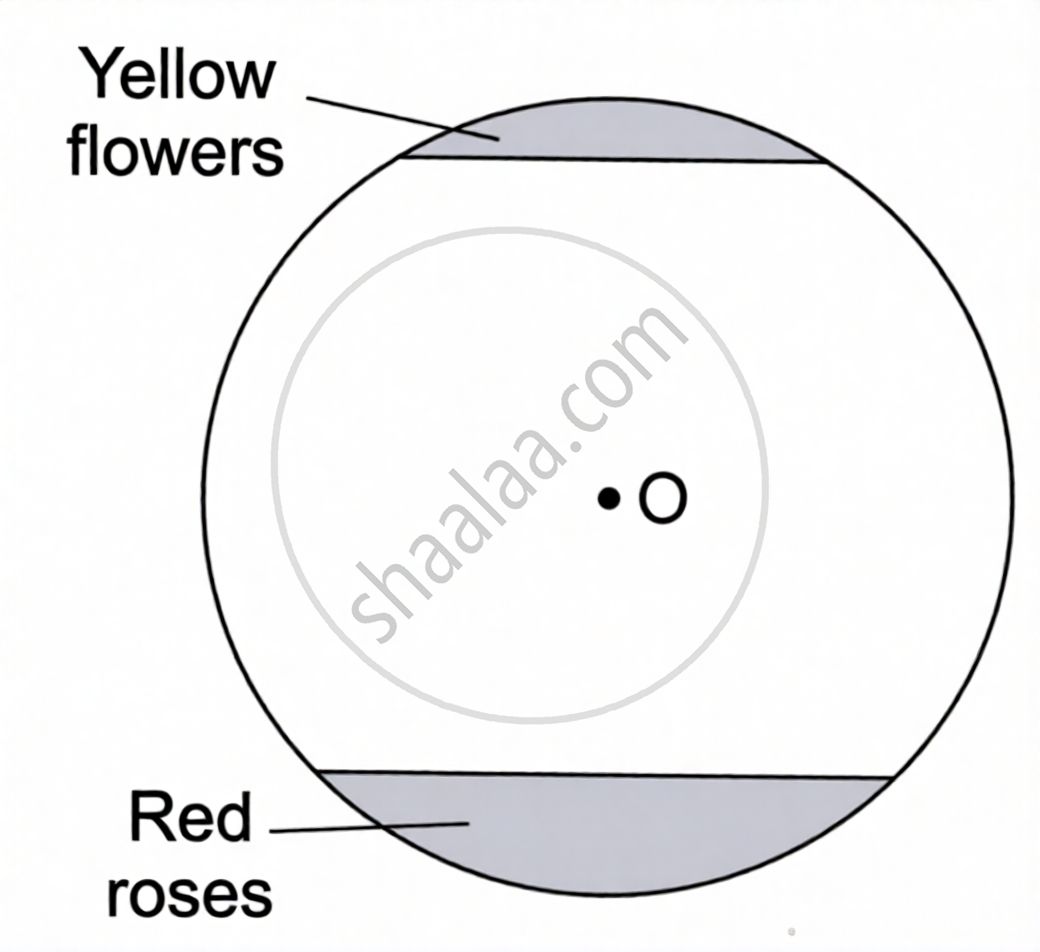
Based on the above information, answer the following questions.
- Write an equation representing the total area of the two segments in terms of r.
- Find the value of r.
- Find the area of the segment with red roses.
- Find the area of the segment with yellow flowers.
R.S. Aggarwal solutions for Mathematics [English] Class 10 20 Additional Questions Volume and Surface Areas of Solids [Pages 1046 - 1054]
Assertion-and-Reason Type Questions Each question consists of two statements, namely, Assertion (A) and Reason (R). For selecting the correct answer, use the following code:
Assertion (A): The diameter of a sphere, whose surface area is $$616\ \mathrm{cm}^{2}$$, is 7 cm.
Reason (R): The surface area of a sphere of radius $$r$$ is $$4\pi r^{2}$$.
Both Assertion (A) and Reason (R) are true and Reason (R) is a correct explanation of Assertion (A).
Both Assertion (A) and Reason (R) are true but Reason (R) is not a correct explanation of Assertion (A).
Assertion (A) is true and Reason (R) is false.
Assertion (A) is false and Reason (R) is true.
Assertion (A): The curved surface area of a cone having height 24 cm and radius 7 cm is $$550\ \mathrm{cm}^{2}$$.
Reason (R): The curved surface area of a cone is given by $$S = 2\pi rh$$, where $$r$$ and $$h$$ denote the radius of the base and height of the cone respectively.
Both Assertion (A) and Reason (R) are true and Reason (R) is a correct explanation of Assertion (A).
Both Assertion (A) and Reason (R) are true but Reason (R) is not a correct explanation of Assertion (A).
Assertion (A) is true and Reason (R) is false.
Assertion (A) is false and Reason (R) is true.
Assertion (A): The total surface area of a solid hemisphere of diameter $$d$$ is $$\frac{3}{4}\pi d^{2}$$.
Reason (R): If the diameter of a solid hemisphere is halved then its total surface area reduces to 25% of the original value.
Both Assertion (A) and Reason (R) are true and Reason (R) is a correct explanation of Assertion (A).
Both Assertion (A) and Reason (R) are true but Reason (R) is not a correct explanation of Assertion (A).
Assertion (A) is true and Reason (R) is false.
Assertion (A) is false and Reason (R) is true.
Assertion (A): If the curved surface area of a right circular cylinder of height 14 cm is $$88\ \mathrm{cm}^{2}$$ then the diameter of its circular base is 2 cm.
Reason (R): Curved surface area of a right circular cylinder = area of circular base × height.
Both Assertion (A) and Reason (R) are true and Reason (R) is a correct explanation of Assertion (A).
Both Assertion (A) and Reason (R) are true but Reason (R) is not a correct explanation of Assertion (A).
Assertion (A) is true and Reason (R) is false.
Assertion (A) is false and Reason (R) is true.
Assertion (A): The volume of a right circular cone whose area of the base is $$156\ \mathrm{cm}^{2}$$ and the vertical height is 8 cm, is $$416\ \mathrm{cm}^{3}$$.
Reason (R): If the radius and height of a cone are doubled then its volume becomes four times.
Both Assertion (A) and Reason (R) are true and Reason (R) is a correct explanation of Assertion (A).
Both Assertion (A) and Reason (R) are true but Reason (R) is not a correct explanation of Assertion (A).
Assertion (A) is true and Reason (R) is false.
Assertion (A) is false and Reason (R) is true.
Assertion (A): If the volumes of two spheres are in the ratio 125 : 64 then the ratio of their surface areas is 25 : 16.
Reason (R): If the volume and surface area of a sphere are numerically equal then the radius of the sphere is 3 units.
Both Assertion (A) and Reason (R) are true and Reason (R) is a correct explanation of Assertion (A).
Both Assertion (A) and Reason (R) are true but Reason (R) is not a correct explanation of Assertion (A).
Assertion (A) is true and Reason (R) is false.
Assertion (A) is false and Reason (R) is true.
Assertion (A): The surface area of the largest sphere that can be inscribed in a hollow cube of side $$a\ \mathrm{cm}$$ is $$\pi a^{2}\ \mathrm{cm}^{2}$$.
Reason (R): The surface area of a sphere of radius $$r$$ is $$\frac{4}{3}\pi r^{3}$$.
Both Assertion (A) and Reason (R) are true and Reason (R) is a correct explanation of Assertion (A).
Both Assertion (A) and Reason (R) are true but Reason (R) is not a correct explanation of Assertion (A).
Assertion (A) is true and Reason (R) is false.
Assertion (A) is false and Reason (R) is true.
Assertion (A): A solid is in the form of a cone of radius $$r$$ surmounted on a hemisphere of the same radius. If the height of the cone is the same as the diameter of its base then the volume of the solid is $$\frac{4}{3}\pi r^{3}$$.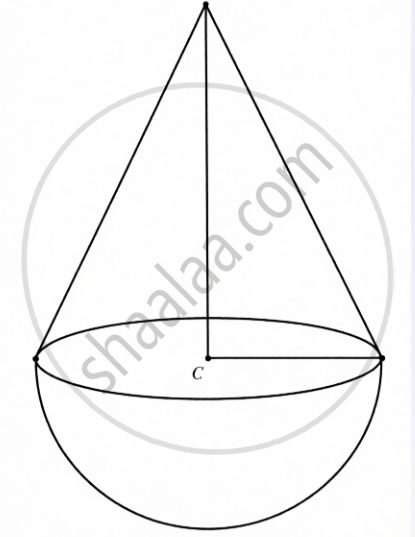
Reason (R): Total volume of the solid $$=\text{volume of the cone}+\text{volume of the hemisphere}$$
Both Assertion (A) and Reason (R) are true and Reason (R) is a correct explanation of Assertion (A).
Both Assertion (A) and Reason (R) are true but Reason (R) is not a correct explanation of Assertion (A).
Assertion (A) is true and Reason (R) is false.
Assertion (A) is false and Reason (R) is true.
Assertion (A): The surface area of the cuboid formed by joining two cubes of sides 4 cm each, end to end, is $$160\ \mathrm{cm}^{2}$$.
Reason (R): The surface area of a cuboid of dimensions $$l \times b \times h$$ is $$(lb + bh + lh)$$.
Both Assertion (A) and Reason (R) are true and Reason (R) is a correct explanation of Assertion (A).
Both Assertion (A) and Reason (R) are true but Reason (R) is not a correct explanation of Assertion (A).
Assertion (A) is true and Reason (R) is false.
Assertion (A) is false and Reason (R) is true.
Assertion (A): The volume of the largest sphere carved out of a solid cube of side 21 cm is $$4851\ \mathrm{cm}^{3}$$.
Reason (R): The radius of the largest sphere carved out of a solid cube is half the side of the cube.
Both Assertion (A) and Reason (R) are true and Reason (R) is a correct explanation of Assertion (A).
Both Assertion (A) and Reason (R) are true but Reason (R) is not a correct explanation of Assertion (A).
Assertion (A) is true and Reason (R) is false.
Assertion (A) is false and Reason (R) is true.
Assertion (A): A top is of the shape of a cone mounted over a hemisphere of the same radius. If the radius of the hemisphere is 3.5 cm and the total height of the top is 15.5 cm then the total surface area of the top is $$214.5\ \mathrm{cm}^{2}$$.
Reason (R): The total surface area of the top is the sum of the curved surface area of the hemisphere and the curved surface area of the cone.
Both Assertion (A) and Reason (R) are true and Reason (R) is a correct explanation of Assertion (A).
Both Assertion (A) and Reason (R) are true but Reason (R) is not a correct explanation of Assertion (A).
Assertion (A) is true and Reason (R) is false.
Assertion (A) is false and Reason (R) is true.
Assertion (A): A hemispherical bowl is made of steel of thickness 1 cm. If the inner radius of the bowl is 5 cm then the volume of steel used is $$\left(\frac{182}{3}\pi\right)\ \mathrm{cm}^{3}$$.
Reason (R): The volume of steel is calculated as the difference between the volumes of two hemispheres with radii 6 cm and 5 cm.
Both Assertion (A) and Reason (R) are true and Reason (R) is a correct explanation of Assertion (A).
Both Assertion (A) and Reason (R) are true but Reason (R) is not a correct explanation of Assertion (A).
Assertion (A) is true and Reason (R) is false.
Assertion (A) is false and Reason (R) is true.
Assertion (A): If a conical cup has the same radius but half the height as that of a cylindrical cup then the ratio of the volume of the conical cup to that of the cylindrical cup is 2 : 3.
Reason (R): The volume of a cone is one third of the volume of a cylinder of the same base radius and same height.
Both Assertion (A) and Reason (R) are true and Reason (R) is a correct explanation of Assertion (A).
Both Assertion (A) and Reason (R) are true but Reason (R) is not a correct explanation of Assertion (A).
Assertion (A) is true and Reason (R) is false.
Assertion (A) is false and Reason (R) is true.
Assertion (A): The total surface area (internal and external) of a hemispherical bowl having radii $$r_{1}$$ and $$r_{2}\ (r_{2} > r_{1})$$ is $$3\pi r_{1}^{2} + \pi r_{2}^{2}$$.
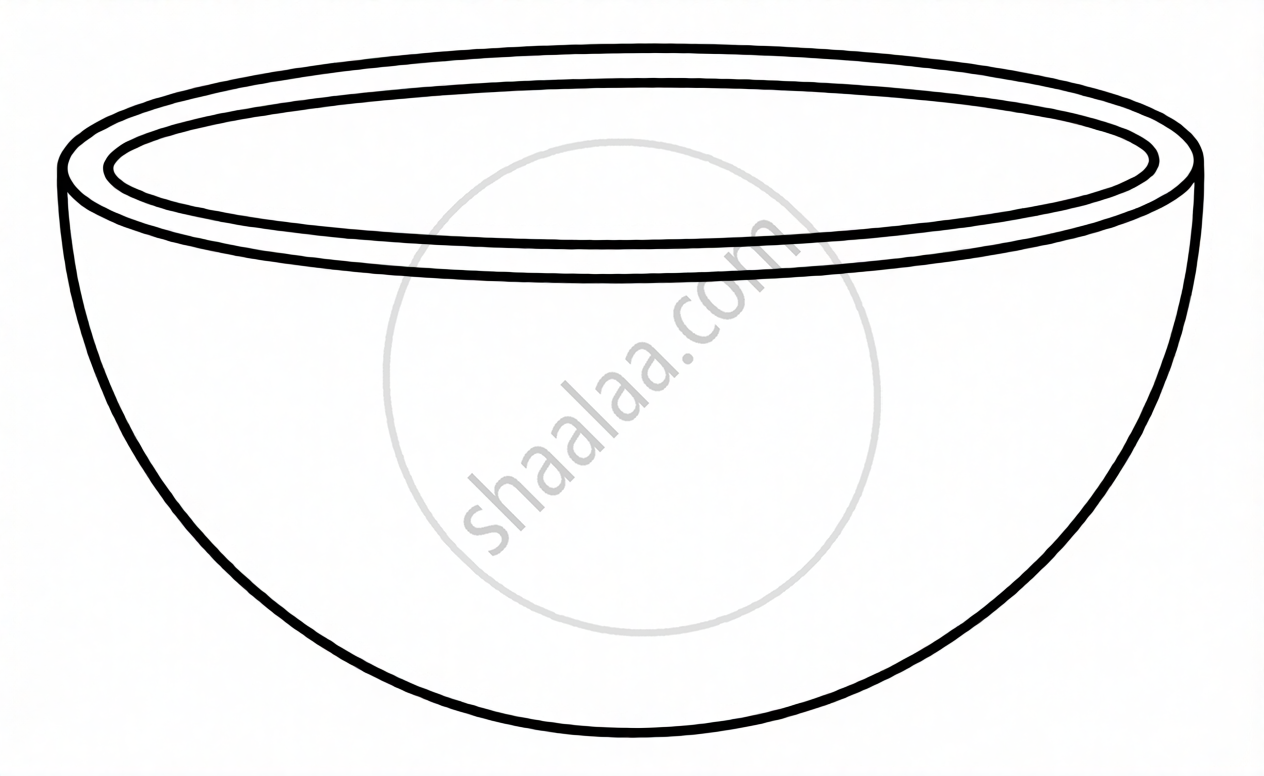
Reason (R): The total surface area of a solid hemisphere of radius $$r$$ is $$3\pi r^{2}$$.
Both Assertion (A) and Reason (R) are true and Reason (R) is a correct explanation of Assertion (A).
Both Assertion (A) and Reason (R) are true but Reason (R) is not a correct explanation of Assertion (A).
Assertion (A) is true and Reason (R) is false.
Assertion (A) is false and Reason (R) is true.
Assertion (A): 168 spherical shots of diameter 3 cm each can be made by melting a cuboidal solid of dimensions $$18\ \mathrm{cm} \times 22\ \mathrm{cm} \times 6\ \mathrm{cm}$$.
Reason (R): Total volume of the spherical shots = volume of the cuboidal solid.
Both Assertion (A) and Reason (R) are true and Reason (R) is a correct explanation of Assertion (A).
Both Assertion (A) and Reason (R) are true but Reason (R) is not a correct explanation of Assertion (A).
Assertion (A) is true and Reason (R) is false.
Assertion (A) is false and Reason (R) is true.
Case-Based Questions
|
In a coffee shop, coffee is served in two types of cups. One is cylindrical in shape with diameter 7 cm and height 14 cm and the other is hemispherical with diameter 21 cm.
|
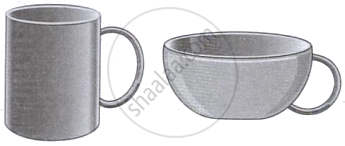
Based on the above information, answer the following questions.
- Find the area of the base of the cylindrical cup.
- What is the capacity of the hemispherical cup?
- What is the capacity of the cylindrical cup?
- Find the curved surface area of the cylindrical cup.
|
Singing bowls (hemispherical in shape) are commonly used in sound healing practices. Mallet (cylindrical in shape) is used to strike the bowl in a sequence to produce sound and vibration. In the given figure, the hemispherical bowl has outer radius 6 cm and inner radius 5 cm, and the mallet has a height of 10 cm and radius 2 cm.
|
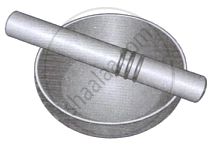
Based on the above information, answer the following questions. [Use π = 3.14]
- What is the volume of the material used for making the mallet?
- The bowl is to be polished from inside. Find the inner surface area of the bowl.
- Find the volume of metal used to make the bowl.
- Find the total surface area of the mallet.
|
A company deals in casting and moulding of metal on orders received from its clients. In one such order, the company is supposed to make 50 toys in the form of a hemisphere surmounted by a right circular cone of the same base radius as that of the hemisphere. The radius of the base of the cone is 21 cm and height is 28 cm.
|
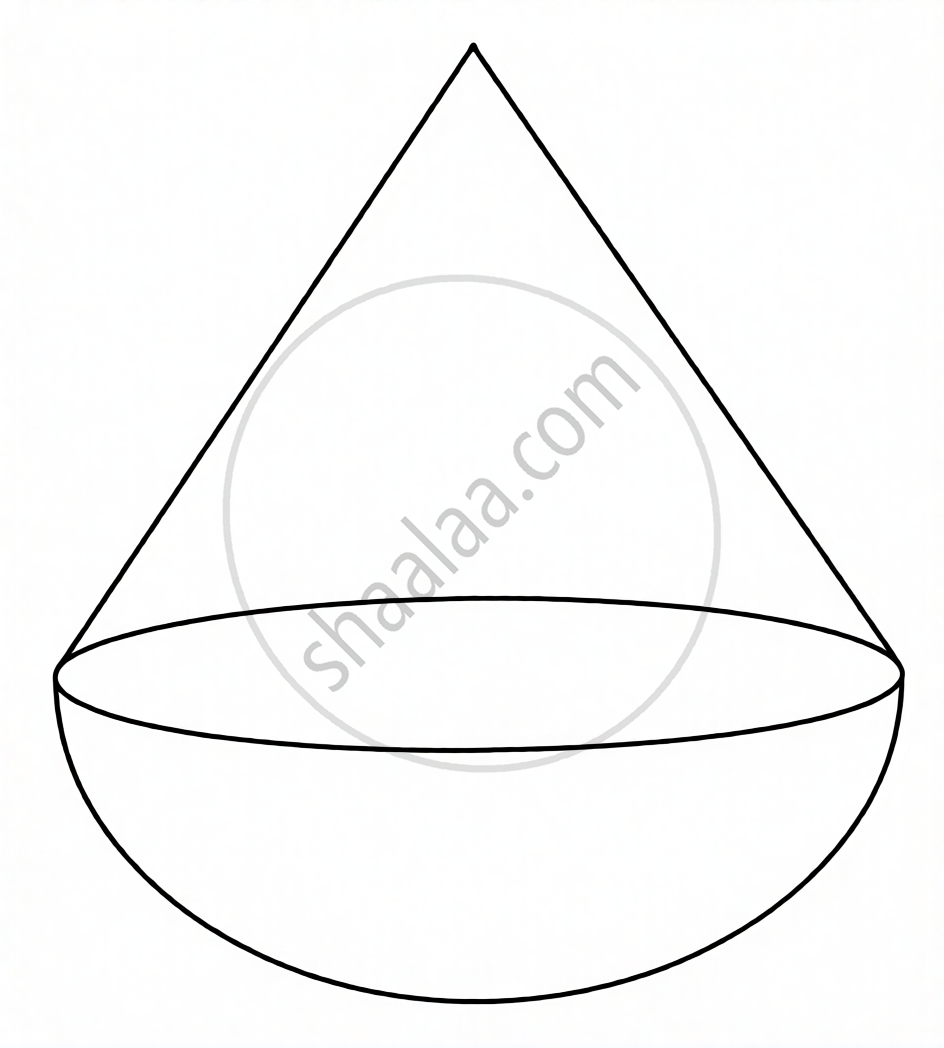
Based on the above information, answer the following questions.
- Find the volume of 50 toys.
- Find the ratio of the volume of hemisphere to the volume of cone.
- Find the cost of painting the hemispherical part of the 50 toys at the rate of ₹10 per cm2.
- If one such toy is melted and recast into a solid cylinder of diameter 28 cm then find the height of the cylinder.
| A cuboidal wooden toy is of dimensions 14 cm × 17 cm × 4 cm. On its top, there are seven cylindrical hollows for bees to fit in. Each cylindrical hollow is of height 3 cm and radius 2 cm. |
Based on the above information, answer the following questions.
- Find the volume of the wood carved out to make one cylindrical hollow.
- Find the lateral surface area of the cuboid to paint it with green colour.
- Find the volume of wood in the remaining cuboid after carving out the seven cylindrical hollows.
- Find the surface area of the top surface of the cuboid to be painted yellow.
|
Khurja is a city in the Indian state of Uttar Pradesh famous for pottery. Khurja pottery is traditional Indian pottery work which has attracted Indians as well as foreigners with a variety of tea sets, crockery, and ceramic tile works. A huge portion of the ceramics used in the country is supplied by Khurja, which is also referred to as the ‘Ceramic Town’. One of the private schools of Bulandshahar organised an educational tour for class 10 students to Khurja. The given figure shows two pottery objects of Khurja. Students found the shapes of the objects very interesting and they could easily relate them with mathematical shapes like sphere, hemisphere, cylinder, etc. The internal radius of the hemispherical bowl in I is 9 cm and the radius and height of the cylindrical jar in II is 1.5 cm and 4 cm respectively.
|
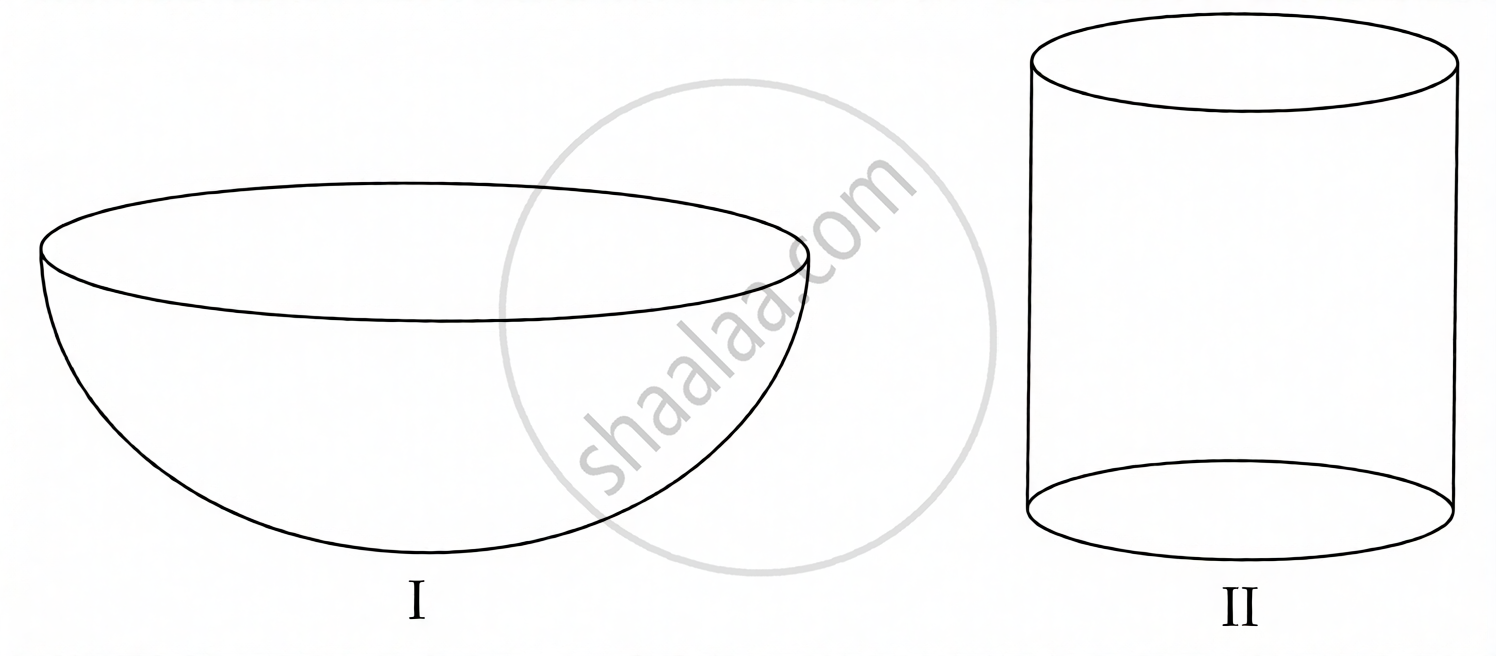
Based on the above information, answer the following questions.
- Find the capacity of the hemispherical bowl.
- Find the curved surface area of the cylindrical jar.
- If the hemispherical bowl (filled completely with water) is to be emptied into cylindrical jars then how many cylindrical jars are required?
- If in the cylindrical jar full of water, a conical funnel of same height and same diameter is immersed then how much water will flow out of the jar?
|
A golf ball is spherical with about 300–500 dimples that help increase its velocity while in play. Golf balls are traditionally white but available in colours also. In the given figure, a golf ball has diameter 4.2 cm and the surface has 315 dimples (hemispherical) of radius 2 mm.
|
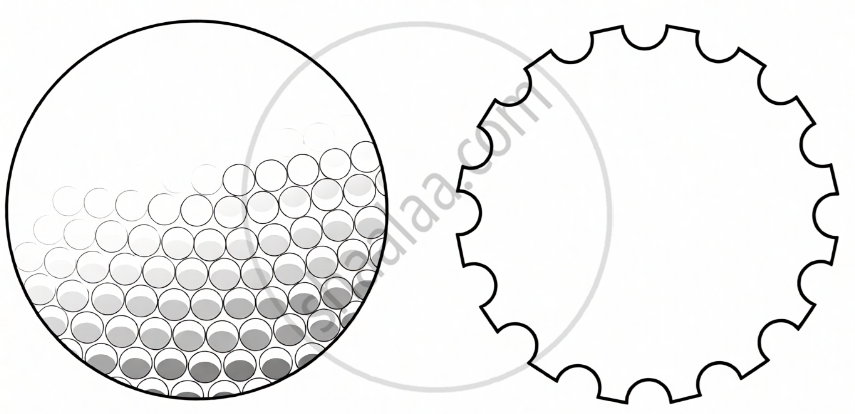
Based on the above information, answer the following questions.
- Find the surface area of one such dimple.
- Find the volume of the material dug out to make one dimple.
- Find the total surface area exposed to the surroundings.
- Find the volume of the golf ball.
R.S. Aggarwal solutions for Mathematics [English] Class 10 20 Additional Questions Mean, Median, Mode of Grouped Data, Cumulative Frequency Graph and Ogive [Pages 1058 - 1064]
Assertion-and-Reason Type Questions Each question consists of two statements, namely, Assertion (A) and Reason (R). For selecting the correct answer, use the following code:
Assertion (A): The mean of the first ten natural numbers is 5.5.
Reason (R): The sum of the first ten natural numbers is $$\frac{n(n + 1)}{2}$$.
Both Assertion (A) and Reason (R) are true and Reason (R) is a correct explanation of Assertion (A).
Both Assertion (A) and Reason (R) are true but Reason (R) is not a correct explanation of Assertion (A).
Assertion (A) is true and Reason (R) is false.
Assertion (A) is false and Reason (R) is true.
Assertion (A): If the mean of 6, 7, p, 8, q and 14 is 9 then p + q = 19.
Reason (R): $$\text{Mean} = \dfrac{\text{sum of observations}}{\text{number of observations}}.$$
Both Assertion (A) and Reason (R) are true and Reason (R) is a correct explanation of Assertion (A).
Both Assertion (A) and Reason (R) are true but Reason (R) is not a correct explanation of Assertion (A).
Assertion (A) is true and Reason (R) is false.
Assertion (A) is false and Reason (R) is true.
Assertion (A): The mode of the numbers 2, 3, 3, 4, 5, 4, 4, 5, 3, 4, 2, 6, 7 is 4.
Reason (R): Mode is a measure of central tendency that gives the value of the middle-most observation in the data.
Both Assertion (A) and Reason (R) are true and Reason (R) is a correct explanation of Assertion (A).
Both Assertion (A) and Reason (R) are true but Reason (R) is not a correct explanation of Assertion (A).
Assertion (A) is true and Reason (R) is false.
Assertion (A) is false and Reason (R) is true.
Assertion (A): If the mean and median of a distribution are 169 and 170 respectively then its mode is 172.
Reason (R): The empirical relation between mean, median and mode is mode = 3 median – 2 mean.
Both Assertion (A) and Reason (R) are true and Reason (R) is a correct explanation of Assertion (A).
Both Assertion (A) and Reason (R) are true but Reason (R) is not a correct explanation of Assertion (A).
Assertion (A) is true and Reason (R) is false.
Assertion (A) is false and Reason (R) is true.
Assertion (A): The median of the first eight prime number is 9.
Reason (R): For a data having n observations, if n is odd then the median is the $$\left(\dfrac{n + 1}{2}\right)\text{th}$$ observation.
Both Assertion (A) and Reason (R) are true and Reason (R) is a correct explanation of Assertion (A).
Both Assertion (A) and Reason (R) are true but Reason (R) is not a correct explanation of Assertion (A).
Assertion (A) is true and Reason (R) is false.
Assertion (A) is false and Reason (R) is true.
Assertion (A): If the classes of a frequency distribution are 1–9, 10–18, 19–27, ..., etc., then the class size is 9.
Reason (R): The frequency of each class interval is centred around its midpoint.
Both Assertion (A) and Reason (R) are true and Reason (R) is a correct explanation of Assertion (A).
Both Assertion (A) and Reason (R) are true but Reason (R) is not a correct explanation of Assertion (A).
Assertion (A) is true and Reason (R) is false.
Assertion (A) is false and Reason (R) is true.
Assertion (A): For the following frequency distribution,
| Marks below | Number of students |
| 10 | 1 |
| 20 | 5 |
| 30 | 13 |
| 40 | 15 |
| 50 | 16 |
the modal class is 30–40.
Reason (R): In a frequency distribution, the class having maximum frequency is called the modal class.
Both Assertion (A) and Reason (R) are true and Reason (R) is a correct explanation of Assertion (A).
Both Assertion (A) and Reason (R) are true but Reason (R) is not a correct explanation of Assertion (A).
Assertion (A) is true and Reason (R) is false.
Assertion (A) is false and Reason (R) is true.
Assertion (A): For the following frequency distribution,
| Class | Frequency |
| 20–40 | 10 |
| 40–60 | 12 |
| 60–80 | 14 |
| 80–100 | 13 |
| 100–120 | 17 |
the median class is 60–80.
Reason (R): If the sum of frequencies in a continuous distribution is n then the class interval whose cumulative frequency is just greater than $$\dfrac{n}{2}$$ is called the median class.
Both Assertion (A) and Reason (R) are true and Reason (R) is a correct explanation of Assertion (A).
Both Assertion (A) and Reason (R) are true but Reason (R) is not a correct explanation of Assertion (A).
Assertion (A) is true and Reason (R) is false.
Assertion (A) is false and Reason (R) is true.
Assertion (A): In the following frequency distribution,
| Height (in cm) | Number of students |
| 110–115 | 15 |
| 115–130 | 13 |
| 130–145 | 11 |
| 145–160 | 10 |
| 160–175 | 11 |
the sum of the lower limit of the modal class and the upper limit of the median class is 240.
Reason (R): The median class of the given frequency distribution is 130–145.
Both Assertion (A) and Reason (R) are true and Reason (R) is a correct explanation of Assertion (A).
Both Assertion (A) and Reason (R) are true but Reason (R) is not a correct explanation of Assertion (A).
Assertion (A) is true and Reason (R) is false.
Assertion (A) is false and Reason (R) is true.
Assertion (A): If the value of each observation of a statistical data consisting of n terms is increased by 3 then the mean of the data increases by 3n.
Reason (R): The sum of the differences between individual observations and their mean is zero.
Both Assertion (A) and Reason (R) are true and Reason (R) is a correct explanation of Assertion (A).
Both Assertion (A) and Reason (R) are true but Reason (R) is not a correct explanation of Assertion (A).
Assertion (A) is true and Reason (R) is false.
Assertion (A) is false and Reason (R) is true.
Assertion (A): A 'more than' ogive has а descending slope while a 'less than' ogive has an ascending slope.
Reason (R): The cumulative frequencies decrease in a 'more than' type of distribution and increase in a 'less than' type of distribution.
Both Assertion (A) and Reason (R) are true and Reason (R) is a correct explanation of Assertion (A).
Both Assertion (A) and Reason (R) are true but Reason (R) is not a correct explanation of Assertion (A).
Assertion (A) is true and Reason (R) is false.
Assertion (A) is false and Reason (R) is true.
Assertion (A): If a 'less than' type and 'more than' type cumulative frequency curves of a grouped data intersect at (9, 12) then the median of the data is 9.
Reason (R): The ordinate of the point of intersection of 'less than' type and 'more than' type cumulative frequency curves of a grouped data gives its median.
Both Assertion (A) and Reason (R) are true and Reason (R) is a correct explanation of Assertion (A).
Both Assertion (A) and Reason (R) are true but Reason (R) is not a correct explanation of Assertion (A).
Assertion (A) is true and Reason (R) is false.
Assertion (A) is false and Reason (R) is true.
Case-Based Questions
|
India Meteorological Department observes seasonal and annual rainfall every year in different subdivisions of our country. It helps them to compare and analyse the results. The table given below shows subdivision wise seasonal (monsoon) rainfall (mm) in 2018.
|
Based on the above information, answer the following questions.
- Write the modal class.
- Find the median of the given data.
- Find the mean rainfall in this season.
- If a subdivision having at least 1000 mm rainfall during monsoon season is considered as a good rainfall subdivision then how many subdivision had good rainfall?
|
At a courier company, a daily report of parcels received for dispatch is prepared every evening, which classifies the parcels on the basis of their weights. The report of a certain day is as follows:
|
Based on the above information, answer the following questions.
- How many parcels have weights in the range of 300–400 grams?
- How many parcels have weights in the range of 200–300 grams?
- In which weight range the number of parcels is the lowest?
- Find the mean weight of parcels received on that particular day.
|
Yoga is an ancient practice which is a form of meditation and exercise. By practising yoga, we not only make our body healthy but also achieve inner peace and calmness. The International Yoga Day is being celebrated on the 21st of June every year since 2015. To promote yoga, a society in Pune organised a 7-day yoga camp in their society. The number of people of different age groups who enrolled for this camp is given as follows:
|
Based on the above information, answer the following questions.
- Which age group had the highest number of participants enrolled for the camp?
- Find the modal age of people enrolled for the camp.
- Find the median age of people enrolled for the camp.
- If x more people of age group 55–65 had enrolled for the camp, the mean age would have been 57. Find the value of x.
R.S. Aggarwal solutions for Mathematics [English] Class 10 20 Additional Questions Probability [Pages 1068 - 1074]
Assertion-and-Reason Type Questions Each question consists of two statements, namely, Assertion (A) and Reason (R). For selecting the correct answer, use the following code:
Assertion (A): An event is very likely to happen if its probability is 0.99.
Reason (R): Probability of a sure event is always 1.
Both Assertion (A) and Reason (R) are true and Reason (R) is a correct explanation of Assertion (A).
Both Assertion (A) and Reason (R) are true but Reason (R) is not a correct explanation of Assertion (A).
Assertion (A) is true and Reason (R) is false.
Assertion (A) is false and Reason (R) is true.
Assertion (A): \[\frac{7}{0.01}\] cannot be the probability of occurrence of an event.
Reason (R): The probability of an impossible event is 0.
Both Assertion (A) and Reason (R) are true and Reason (R) is a correct explanation of Assertion (A).
Both Assertion (A) and Reason (R) are true but Reason (R) is not a correct explanation of Assertion (A).
Assertion (A) is true and Reason (R) is false.
Assertion (A) is false and Reason (R) is true.
Assertion (A): Two players, Tanya and Manya, play a table tennis match. The probability of Tanya winning the match is 0.79 and that of Manya winning the match is 0.21.
Reason (R): The sum of the probabilities of two complementary events is 1.
Both Assertion (A) and Reason (R) are true and Reason (R) is a correct explanation of Assertion (A).
Both Assertion (A) and Reason (R) are true but Reason (R) is not a correct explanation of Assertion (A).
Assertion (A) is true and Reason (R) is false.
Assertion (A) is false and Reason (R) is true.
Assertion (A): The probability of randomly drawing a card with an even number from a box containing cards numbered 1 to 100 is \[\frac{1}{2}\].
Reason (R): \[P\text{ (event)}=\frac{\text { number of favourable outcomes }}{\text { total number of possible outcomes }}\]
Both Assertion (A) and Reason (R) are true and Reason (R) is a correct explanation of Assertion (A).
Both Assertion (A) and Reason (R) are true but Reason (R) is not a correct explanation of Assertion (A).
Assertion (A) is true and Reason (R) is false.
Assertion (A) is false and Reason (R) is true.
Assertion (A): A bag contains 5 red, 8 black and 7 green balls. One ball is drawn at random from the bag. The probability of getting neither a black nor a red ball is \[\frac{7}{20}\].
Reason (R): The total number of balls in the bag is 20, out of which 7 are neither black nor red.
Both Assertion (A) and Reason (R) are true and Reason (R) is a correct explanation of Assertion (A).
Both Assertion (A) and Reason (R) are true but Reason (R) is not a correct explanation of Assertion (A).
Assertion (A) is true and Reason (R) is false.
Assertion (A) is false and Reason (R) is true.
Assertion (A): If three coins are tossed simultaneously then the probability of getting at most one tail is \[\frac{1}{2}\].
Reason (R): Each of the three coins can show either of the two possibilities, i.e., head or tail.
Both Assertion (A) and Reason (R) are true and Reason (R) is a correct explanation of Assertion (A).
Both Assertion (A) and Reason (R) are true but Reason (R) is not a correct explanation of Assertion (A).
Assertion (A) is true and Reason (R) is false.
Assertion (A) is false and Reason (R) is true.
Assertion (A): When two coins are tossed together, the probability of getting no tail is \[\frac{1}{4}\].
Reason (R): The probability P(E) of an event satisfies \[0\leq P(E)\leq 1\].
Both Assertion (A) and Reason (R) are true and Reason (R) is a correct explanation of Assertion (A).
Both Assertion (A) and Reason (R) are true but Reason (R) is not a correct explanation of Assertion (A).
Assertion (A) is true and Reason (R) is false.
Assertion (A) is false and Reason (R) is true.
Assertion (A): A card is drawn at random from a well-shuffled pack of 52 cards. The probability that the card drawn is not an ace is \[\frac{9}{13}\].
Reason (R): When randomly drawing out a card from a well-shuffled pack of cards, the event of drawing out an ace card and the event of drawing out a non-ace card are complementary events.
Both Assertion (A) and Reason (R) are true and Reason (R) is a correct explanation of Assertion (A).
Both Assertion (A) and Reason (R) are true but Reason (R) is not a correct explanation of Assertion (A).
Assertion (A) is true and Reason (R) is false.
Assertion (A) is false and Reason (R) is true.
Assertion (A): The probability of getting a prime number, when a die is thrown once, is \[\frac{2}{3}.\]
Reason (R): On the faces of a die, prime numbers are 2, 3 and 5.
Both Assertion (A) and Reason (R) are true and Reason (R) is a correct explanation of Assertion (A).
Both Assertion (A) and Reason (R) are true but Reason (R) is not a correct explanation of Assertion (A).
Assertion (A) is true and Reason (R) is false.
Assertion (A) is false and Reason (R) is true.
Assertion (A): The probability of getting a doublet in a single throw of a pair of dice is \[\frac{1}{6}.\]
Reason (R): For any event \[A,\ 0\leq P(A)\leq 1.\]
Both Assertion (A) and Reason (R) are true and Reason (R) is a correct explanation of Assertion (A).
Both Assertion (A) and Reason (R) are true but Reason (R) is not a correct explanation of Assertion (A).
Assertion (A) is true and Reason (R) is false.
Assertion (A) is false and Reason (R) is true.
Assertion (A): A fair die is thrown once. The probability of getting a prime number is \[\frac{1}{2}.\]
Reason (R): A natural number is prime if it has only two factors.
Both Assertion (A) and Reason (R) are true and Reason (R) is a correct explanation of Assertion (A).
Both Assertion (A) and Reason (R) are true but Reason (R) is not a correct explanation of Assertion (A).
Assertion (A) is true and Reason (R) is false.
Assertion (A) is false and Reason (R) is true.
Assertion (A): Two dice are thrown together. The probability that the difference of the numbers on their upper faces equals 3 is \[\frac{1}{6}.\]
Reason (R): The total number of possible outcomes when two dice are rolled simultaneously is 36.
Both Assertion (A) and Reason (R) are true and Reason (R) is a correct explanation of Assertion (A).
Both Assertion (A) and Reason (R) are true but Reason (R) is not a correct explanation of Assertion (A).
Assertion (A) is true and Reason (R) is false.
Assertion (A) is false and Reason (R) is true.
Assertion (A): The probability that a leap year has 53 Sundays is \[\frac{2}{7}.\]
Reason (R): The probability that a non-leap year has 53 Sundays is \[\frac{5}{7}.\]
Both Assertion (A) and Reason (R) are true and Reason (R) is a correct explanation of Assertion (A).
Both Assertion (A) and Reason (R) are true but Reason (R) is not a correct explanation of Assertion (A).
Assertion (A) is true and Reason (R) is false.
Assertion (A) is false and Reason (R) is true.
Case-Based Questions
| ‘Eight Ball’ is a game played on a pool table with 15 balls numbered 1 to 15 and a ‘cue ball’ that is solid and white. Of the 15 numbered balls, eight are solid (non-white) coloured and numbered 1 to 8 and seven are striped balls numbered 9 to 15. The 15 numbered pool balls (no cue ball) are placed in a large bowl and mixed, then one ball is drawn out at random. |
Based on the above information, answer the following questions.
- What is the probability that the drawn ball bears the number 8?
- What is the probability that the drawn ball bears an even number?
- What is the probability that the drawn ball bears a number, which is a multiple of 3?
- What is the probability that the drawn ball is solid coloured and bears an even number?
| Blood group describes the type of blood a person has. It is a classification of blood based on the presence or absence of inherited antigenic substances on the surface of red blood cells. Blood types predict whether a serious reaction will occur in a blood transfusion. In a sample of 50 people, 21 had type O blood, 22 had type A, 5 had type B and the rest had type AB blood group. |
Based on the above information, answer the following questions.
- What is the probability that a person chosen at random had type O blood group?
- What is the probability that a person chosen at random had type AB blood group?
- What is the probability that a person chosen at random had neither type A nor type B blood group?
- What is the probability that a person chosen at random had either type A or type B or type O blood group?
|
Computer-based learning (CBL) refers to any teaching methodology that makes use of computers for information transmission. At an elementary school level, computer applications can be used to display multimedia lesson plans. A survey was done on 1000 elementary and secondary schools of Assam and they were classified by the number of computers they had.
|
One school is chosen at random. Then,
- find the probability that the school chosen at random has more than 100 computers.
- find the probability that the school chosen at random has 50 or fewer computers.
- find the probability that the school chosen at random has no more than 20 computers.
- find the probability that the school chosen at random has 10 or less than 10 computers.
|
A middle school decided to run the following spinner game as a fundraiser on Christmas Carnival. Making purple: Spin each spinner once. Blue and red makes purple. So, if one spinner shows Red (R) and another Blue (B) then you ‘win’. One such outcome is written as 'RB'.
|
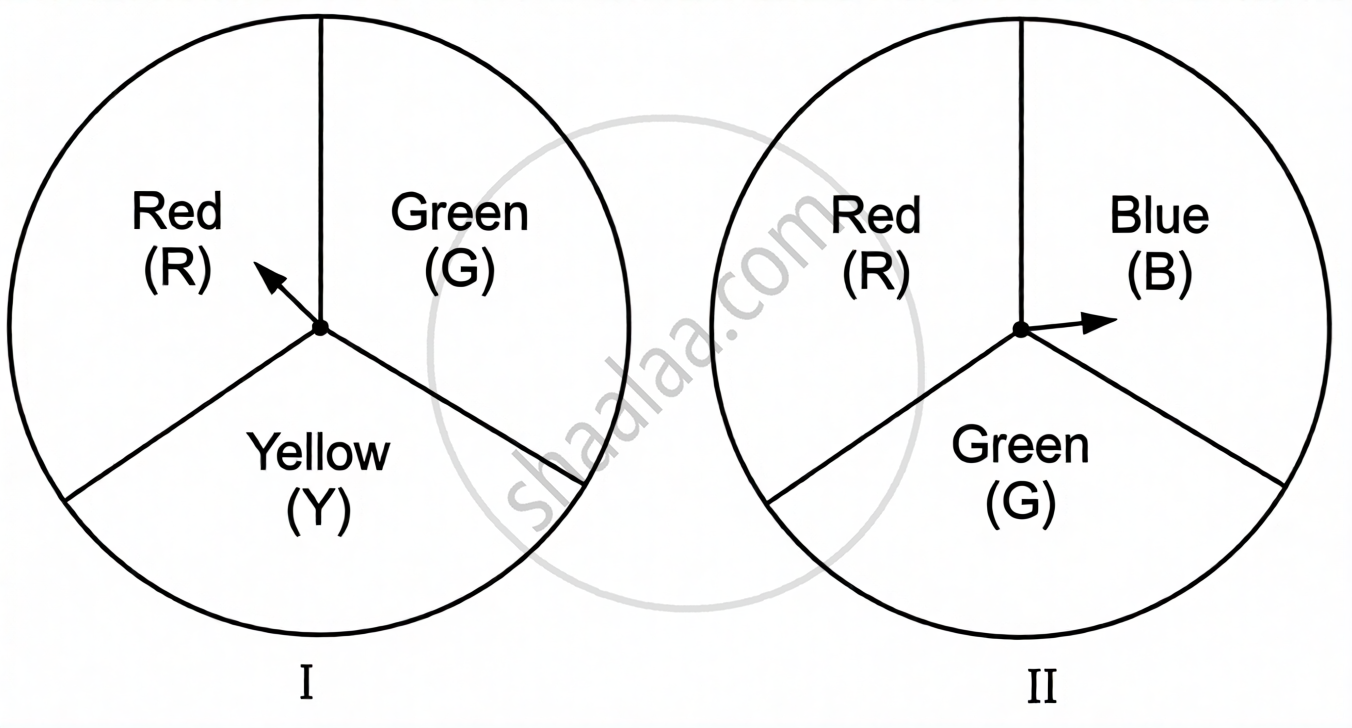
Based on the above information, answer the following questions.
- List all possible outcomes of the game.
- Find the probability of ‘making purple’.
- For each win, a participant gets ₹ 10, but if he/she loses, he/she has to pay ₹ 5 to the school. If 99 participants played, calculate how much fund the school could have collected.
- If the same amount of ₹ 5 has been decided for winning or losing the game then how much fund had been collected by the school? (Number of participants (= 99).
|
Some students were asked to list their favourite colour. The measure of each colour is shown by the central angle of the given pie chart. Study the pie chart and answer the following questions.
|
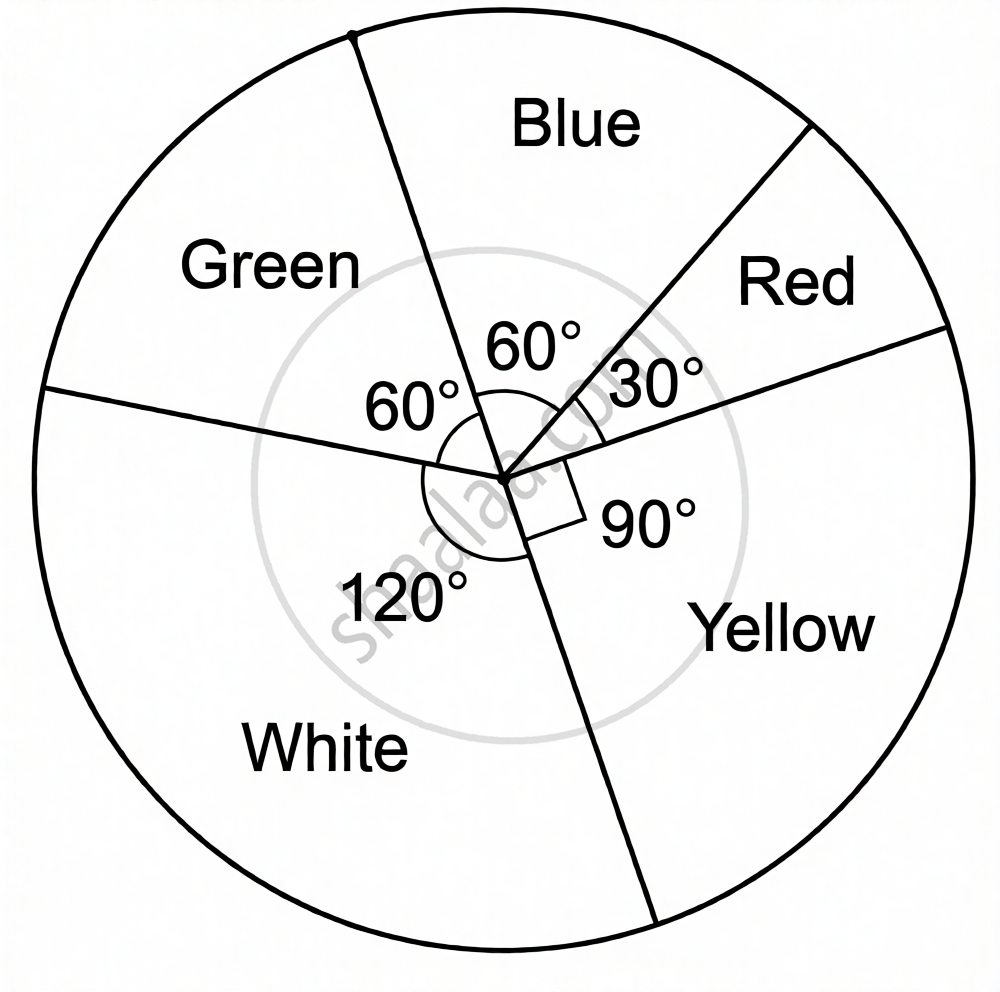
- If a student is chosen at random then find the probability of his/her favourite colour being white.
- What is the probability of his/her favourite colour being blue or green?
- What is the probability of the favourite colour being red or blue?
- If 15 students liked the colour yellow, how many students participated in the survey?
Solutions for 20: Additional Questions
R.S. Aggarwal solutions for Mathematics [English] Class 10 chapter 20 - Additional Questions
Shaalaa.com has the CBSE, Karnataka Board Mathematics Mathematics [English] Class 10 CBSE, Karnataka Board solutions in a manner that help students grasp basic concepts better and faster. The detailed, step-by-step solutions will help you understand the concepts better and clarify any confusion. R.S. Aggarwal solutions for Mathematics Mathematics [English] Class 10 CBSE, Karnataka Board 20 (Additional Questions) include all questions with answers and detailed explanations. This will clear students' doubts about questions and improve their application skills while preparing for board exams.
Further, we at Shaalaa.com provide such solutions so students can prepare for written exams. R.S. Aggarwal textbook solutions can be a core help for self-study and provide excellent self-help guidance for students.
Concepts covered in Mathematics [English] Class 10 chapter 20 Additional Questions are .
Using R.S. Aggarwal Mathematics [English] Class 10 solutions Additional Questions exercise by students is an easy way to prepare for the exams, as they involve solutions arranged chapter-wise and also page-wise. The questions involved in R.S. Aggarwal Solutions are essential questions that can be asked in the final exam. Maximum CBSE, Karnataka Board Mathematics [English] Class 10 students prefer R.S. Aggarwal Textbook Solutions to score more in exams.
Get the free view of Chapter 20, Additional Questions Mathematics [English] Class 10 additional questions for Mathematics Mathematics [English] Class 10 CBSE, Karnataka Board, and you can use Shaalaa.com to keep it handy for your exam preparation.
