Advertisements
Online Mock Tests
Chapters
1: Real Numbers
Algebra
2: Polynomials
3: Linear Equations in Two Variables
4: Quadratic Equations
5: Arithmetic Progression
Coordinate Geometry
6: Coordinate Geometry
Geometry
7: Triangles
8: Circles
9: Constructions
Trigonometry
10: Trignometric Ratios
11: T-Ratios of Some Particular Angles
12: Trigonometric Ratios of Some Complemantary Angles
13: Trigonometric identities
14: Heights and Distances
Mensuration
15: Perimeter And Area of Plane Figures
16: Area of Circle, Sector and Segment
17: Volumes and Surface Areas of Solids
Statistics and Probability
18: Mean, Median, Mode of Grouped Data, Cumulative Frequency Graph and Ogive
▶ 19: Probability
20: Additional Questions
![R.S. Aggarwal solutions for Mathematics [English] Class 10 chapter 19 - Probability - Shaalaa.com](/images/mathematics-english-class-10_6:8f062ea57bdf49abb4f6d22550b39d56.jpg "R.S. Aggarwal solutions for Mathematics [English] Class 10 chapter 19 - Probability")
Advertisements
Solutions for Chapter 19: Probability
Below listed, you can find solutions for Chapter 19 of CBSE, Karnataka Board R.S. Aggarwal for Mathematics [English] Class 10.
R.S. Aggarwal solutions for Mathematics [English] Class 10 19 Probability EXERCISE 19 [Pages 927 - 932]
Very-Short-Answer Questions
Fill in the blank:
The probability of an impossible event is ....... .
Fill in the blank:
The probability of a sure event is ........ .
Fill in the blank:
For any event E, P(E) + P(not E) = ........ .
Fill in the blank:
The probability of a possible but not a sure event lies between ......... and ........ .
Fill in the blank:
The sum of probabilities of all the outcomes of an experiment is ....... .
A coin is tossed once. What is the probability of getting a tail?
Two coins are tossed simultaneously. Find the probability of getting exactly 1 head.
Two coins are tossed simultaneously. Find the probability of getting at most 1 head.
Two coins are tossed simultaneously. Find the probability of getting at least 1 head.
A die is thrown once. Find the probability of getting an even number.
A die is thrown once. Find the probability of getting a number less than 5.
A die is thrown once. Find the probability of getting a number greater than 2.
A die is thrown once. Find the probability of getting a number between 3 and 6.
A die is thrown once. Find the probability of getting a number other than 3.
A die is thrown once. Find the probability of getting the number 5.
Short-Answer Questions
A letter of English alphabet is chosen at random. Determine the probability that the chosen letter is a consonant.
A child has a die whose 6 faces show the letters given below:
\[\boxed{\text{A}}\]\[\boxed{\text{B}}\]\[\boxed{\text{C}}\]\[\boxed{\text{A}}\]\[\boxed{\text{A}}\]\[\boxed{\text{B}}\]
The die is thrown once. What is the probability of getting (i) A and (ii) B?
12 defective pens are accidentally mixed up with 132 good ones. It is not possible to just look at a pen and tell whether it is defective or not. One pen is taken out at random from the lot. Find the probability that the pen taken out is a good one.
12 defective pens are accidentally mixed up with 132 good ones. It is not possible to just look at a pen and tell whether it is defective or not. One pen is taken out at random from the lot. Find the probability that the pen taken out is defective.
In a lottery there are 10 prizes and 25 blanks. What is the probability of getting a prize?
250 lottery tickets were sold and there are 5 prizes on these tickets. If Kunal has purchased one lottery ticket, what is the probability that he wins a prize?
If the probability of winning a game is 0.7, what is the probability of losing it?
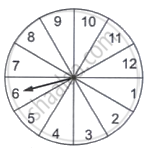
A game of chance consists of spinning an arrow which is equally likely to come to rest pointing to one of the numbers 1, 2, 3, ..., 12 as shown in the figure. What is the probability that it will point to
- 6?
- an even number?
- a prime number?
- a number which is a multiple of 5?
- a number which is a factor of 8?
17 cards numbered 1, 2, 3, 4, ...., 17 are put in a box and mixed thoroughly. A card is drawn at random from the box. Find the probability that the card drawn bears an odd number.
17 cards numbered 1, 2, 3, 4, ...., 17 are put in a box and mixed thoroughly. A card is drawn at random from the box. Find the probability that the card drawn bears a number divisible by 5.
A bag contains 4 white balls, 5 red balls, 2 black balls and 4 green balls. A ball is drawn at random from the bag. Find the probability that it is (i) black, (ii) not green, (iii) red or white, (iv) neither red nor green.
A bag contains 5 white balls, 7 red balls, 4 black balls and 2 blue balls. A ball is drawn at random from the bag. Find the probability that the drawn ball is (i) white or blue, (ii) neither white nor black.
A jar contains 24 marbles. Some of these are green and others are blue. If a marble is drawn at random from the jar, the probability that it is green is `2/3`. Find the number of blue marbles in the jar.
A jar contains 54 marbles, each of which some are blue, some are green and some are white. The probability of selecting a blue marble at random is `1/3` and the probability of selecting a green marble at random is `4/9`. How many white marbles does the jar contain?
The probability of selecting a red ball at random from the jar that contains only red, blue and orange balls is `1/4`. The probability of selecting a blue ball at random from the same jar is `1/3`. If the jar contains 10 orange balls, find the total number of balls in the jar.
A bag contains 18 balls out of which x balls are red. If one ball is drawn at random from the bag, what is the probability that it is not red?
A bag contains 18 balls out of which x balls are red. If two more red balls are put in the bag, the probability of drawing a red ball will be `9/8` times the probability of drawing a red ball in the first case. Find the value of x.
A bag contains 15 white and some black balls. If the probability of drawing a black ball from the bag is thrice that of drawing a white ball, find the number of black balls in the bag.
A box contains 90 discs which are numbered from 1 to 90. If one disc is drawn at random from the box, find the probability that it bears a two-digit number.
A box contains 90 discs which are numbered from 1 to 90. If one disc is drawn at random from the box, find the probability that it bears a number divisible by 5.
A bag contains some balls of which x are white, 2x are black and 3x are red. A ball is selected at random What is the probability that it is not red?
A bag contains some balls of which x are white, 2x are black and 3x are red. A ball is selected at random. What is the probability that it is white?
Cards marked with numbers 5 to 50 (one number on one card) are placed in a box and mixed thoroughly. One card is drawn at random from the box. Find the probability that the number on the card taken out is a prime number less than 10.
Cards marked with numbers 5 to 50 (one number on one card) are placed in a box and mixed thoroughly. One card is drawn at random from the box. Find the probability that the number on the card taken out is a number which is a perfect square.
A box contains cards numbered from 1 to 20. A card is drawn at random from the box. Find the probability that the number on the drawn card is a prime number.
A box contains cards numbered from 1 to 20. A card is drawn at random from the box. Find the probability that the number on the drawn card is a composite number.
A box contains cards numbered from 1 to 20. A card is drawn at random from the box. Find the probability that the number on the drawn card is a number divisible by 3.
A box contains cards bearing numbers 6 to 70. If one card is drawn at random from the box, find the probability that it bears a one-digit number.
A box contains cards bearing numbers 6 to 70. If one card is drawn at random from the box, find the probability that it bears a number divisible by 5.
A box contains cards bearing numbers 6 to 70. If one card is drawn at random from the box, find the probability that it bears an odd number less than 30.
A box contains cards bearing numbers 6 to 70. If one card is drawn at random from the box, find the probability that it bears a composite number between 50 and 70.
Cards marked with numbers 1, 3, 5, ..., 101 are placed in a bag and mixed thoroughly. A card is drawn at random from the bag. Find the probability that the number on the drawn card is less than 19.
Cards marked with numbers 1, 3, 5, ..., 101 are placed in a bag and mixed thoroughly. A card is drawn at random from the bag. Find the probability that the number on the drawn card is a prime number less than 20.
Cards bearing numbers 1, 3, 5, ...., 35 are kept in a bag. A card is drawn at random from the bag. Find the probability of getting a card bearing a prime number less than 15.
Cards bearing numbers 1, 3, 5, .... , 35 are kept in a bag. A card is drawn at random from the bag. Find the probability of getting a card bearing a number divisible by 3 and 5.
A box contains cards numbered 3, 5, 7, 9, .... , 35, 37. A card is drawn at random from the box. Find the probability that the number on the card is a prime number.
Cards numbered 1 to 30 are put in a bag. A card is drawn at random from the bag. Find the probability that the number on the drawn card is not divisible by 3.
Cards numbered 1 to 30 are put in a bag. A card is drawn at random from the bag. Find the probability that the number on the drawn card is a prime number greater than 7.
Cards numbered 1 to 30 are put in a bag. A card is drawn at random from the bag. Find the probability that the number on the drawn card is not a perfect square number.
A box contains 25 cards numbered from 1 to 25. A card is drawn at random from the bag. Find the probability that the number on the drawn card is divisible by 2 or 3.
A box contains 25 cards numbered from 1 to 25. A card is drawn at random from the bag. Find the probability that the number on the drawn card is a prime number.
Tickets numbered 2, 3, 4, 5, ..., 100, 101 are placed in a box and mixed thoroughly. One ticket is drawn at random from the box. Find the probability that the number on the ticket is an even number.
Tickets numbered 2, 3, 4, 5, ..., 100, 101 are placed in a box and mixed thoroughly. One ticket is drawn at random from the box. Find the probability that the number on the ticket is a number less than 16.
Tickets numbered 2, 3, 4, 5, ..., 100, 101 are placed in a box and mixed thoroughly. One ticket is drawn at random from the box. Find the probability that the number on the ticket is a number which is a perfect square.
Tickets numbered 2, 3, 4, 5, ..., 100, 101 are placed in a box and mixed thoroughly. One ticket is drawn at random from the box. Find the probability that the number on the ticket is a prime number less than 40.
In a family of 3 children, find the probability of having at least one boy.
Two different dice are thrown together. Find the probability that the numbers obtained have:
- even sum,
- even product.
Two different dice are thrown together. Find the probability that the numbers obtained have a sum less than 7.
Two different dice are thrown together. Find the probability that the numbers obtained have a product less than 16.
Two different dice are thrown together. Find the probability that the numbers obtained is a doublet of odd numbers.
Peter throws two different dice together and finds the product of the two numbers obtained. Rina throws a die and squares the number obtained. Who has the better chance to get the number 25?
A card is drawn at random form a well-shuffled deck of playing cards. Find the probability that the card drawn is neither a king nor a queen.
Find the probability of getting the sum of two numbers, less than 3 or more than 11, when a pair of distinct dice is thrown together.
The probability of selecting a rotten apple randomly from a heap of 900 apples is 0.18. What is the number of rotten apples in the heap?
What is the probability that an ordinary year has 53 Sundays?
Find the probability that a leap year selected at random will contain 53 Sundays.
A letter is chosen at random from the letters of the word 'ASSOCIATION'. Find the probability that the chosen letter is a vowel.
A letter is chosen at random from the letters of the word 'ASSOCIATION'. Find the probability that the chosen letter is a consonant.
A letter is chosen at random from the letters of the word 'ASSOCIATION'. Find the probability that the chosen letter is a an S.
A game consists of tossing a one-rupee coin three times, and noting its outcome each time. If getting the same result in all the tosses is a success, find the probability of losing the game.
The king, the jack and the 10 of spades are lost from a pack of 52 cards and a card is drawn from the remaining cards after shuffling. Find the probability of getting a red card.
The king, the jack and the 10 of spades are lost from a pack of 52 cards and a card is drawn from the remaining cards after shuffling. Find the probability of getting a black jack.
The king, the jack and the 10 of spades are lost from a pack of 52 cards and a card is drawn from the remaining cards after shuffling. Find the probability of getting a red king.
The king, the jack and the 10 of spades are lost from a pack of 52 cards and a card is drawn from the remaining cards after shuffling. Find the probability of getting a 10 of hearts.
All red face cards are removed from a pack of playing cards. The remaining cards are well shuffled and then a card is drawn at random from them. Find the probability that the drawn card is a red card.
All red face cards are removed from a pack of playing cards. The remaining cards are well shuffled and then a card is drawn at random from them. Find the probability that the drawn card is a face card.
All red face cards are removed from a pack of playing cards. The remaining cards are well shuffled and then a card is drawn at random from them. Find the probability that the drawn card is a card of clubs.
All kings, queens and aces are removed from a pack of 52 cards. The remaining cards are well-shuffled and then a card is drawn from it. Find the probability that the drawn card is a black face card.
All kings, queens and aces are removed from a pack of 52 cards. The remaining cards are well-shuffled and then a card is drawn from it. Find the probability that the drawn card is a red card.
A card is drawn at random from a well-shuffled pack of 52 cards. Find the probability that the card drawn is neither a red card nor a queen.
Five cards,the ten, jack, queen, king and ace of diamonds are well-shuffled with their faces downwards. One card is then picked up at random. What is the probability that the drawn card is the queen?
Five cards,the ten, jack, queen, king and ace of diamonds are well-shuffled with their faces downwards. One card is then picked up at random. If the queen is drawn and put aside and a second card is drawn, find the probability that the second card is
- an ace,
- a queen.
A card is drawn at random from a well-shuffled deck of playing cards. Find the probability that the card drawn is a card of spade or an ace.
A card is drawn at random from a well shuffled deck of 52 playing cards. Find the probability that the card drawn is a red king?
A card is drawn at random from a well-shuffled deck of playing cards. Find the probability that the card drawn is either a king or a queen.
A card is drawn at random from a well-shuffled deck of playing cards. Find the probability that the card drawn is neither a king nor a queen.
Find the probability that a number selected at random from the numbers 3, 4, 4, 4, 5, 5, 6, 6, 6, 7 will be their mean.
The probability that it will rain tomorrow is 0.85. What is the probability that it will not rain tomorrow?
Find the probability that a leap year selected at random will contain 53 Sundays and 53 Mondays.
R.S. Aggarwal solutions for Mathematics [English] Class 10 19 Probability MULTIPLE-CHOICE QUESTIONS (MCQ) [Pages 944 - 948]
Choose the correct answer in each of the following questions:
If P(E) denotes the probability of an event E then ______.
P(E) < 0
P(E) > 1
0 ≤ P(E) ≤ 1
–1 ≤ P(E) ≤ 1
If the probability of occurence of an event is p then the probability of non-happening of this event is ______.
(p – 1)
(1 – p)
p
`(1 - 1/P)`
What is the probability of an impossible event?
`1/2`
0
1
More than 1
What is the probability of a sure event?
0
`1/2`
1
Less than 1
Which of the following cannot be the probability of an event?
1.5
`3/5`
25%
0.3
A number is selected at random from the numbers 1 to 30. What is the probability that the selected number is a prime number?
`2/3`
`1/6`
`1/3`
`11/30`
The probability that a number selected at random from the numbers 1, 2, 3, ..., 15 is a multiple of 4, is ______.
`4/15`
`2/15`
`1/5`
`1/3`
A box contains cards numbered 6 to 50. A card is drawn at random from the box. The probability that the drawn card has a number which is a perfect square is ______.
`1/45`
`2/15`
`4/45`
`1/9`
A box contains 90 discs, numbered from 1 to 90. If one disc is drawn at random from the box, the probability that it bears a prime number less than 23, is ______.
`7/90`
`9/90`
`1/9`
`10/90`
`4/15`
`4/45`
`8/89`
\[\frac{9}{89}\]
Cards bearing numbers 2, 3, 4, ..., 11 are kept in a bag. A card is drawn at random from the bag. The probability of getting a card with a prime number is ______.
`1/2`
`2/5`
`3/10`
`5/9`
One ticket is drawn at random from a bag containing tickets numbered 1 to 40. The probability that the selected ticket has a number, which is a multiple of 7, is ______.
`1/7`
`1/8`
`1/5`
`7/40`
Which of the following cannot be the probability of an event?
`1/3`
0.3
33%
`7/6`
If the probability of winning a game is 0.4 then the probability of losing it, is ______.
0.96
`1/0.4`
0.6
none of these
If an event cannot occur, then its probability is ______.
1
`3/4`
`1/2`
0
There are 20 tickets numbered as 1, 2, 3, ..., 20 respectively. One ticket is drawn at random. What is the probability that the number on the ticket drawn is a multiple of 5?
`1/4`
`1/5`
`2/5`
`3/10`
There are 25 tickets numbered 1, 2, 3, 4, ..., 25 respectively. One ticket is draw at random. What is the probability that the number on the ticket is a multiple of 3 or 5?
`2/5`
`11/25`
`12/25`
`13/25`
Cards, each marked with one of the numbers 6, 7, 8, ..., 15, are placed in a box and mixed thoroughly. One card is drawn at random from the box. What is the probability of getting a card with a number less than 10?
`3/5`
`1/3`
`1/2`
`2/5`
A die is thrown once. The probability of getting an even number is ______.
`1/2`
`1/3`
`1/6`
`5/6`
The probability of throwing a number greater than 2 with a fair die is ______.
`2/5`
`5/6`
`1/3`
`2/3`
A die is thrown once. The probability of getting an odd number greater than 3 is ______.
`1/3`
`1/6`
`1/2`
0
A die is thrown once. The probability of getting a prime number is ______.
`2/3`
`1/3`
`1/2`
`1/6`
Two dice are thrown together. The probability of getting the same number on both dice is ______.
`1/2`
`1/3`
`1/6`
`1/12`
The probability of getting 2 heads, when two coins are tossed, is ______.
1
`3/4`
`1/2`
`1/4`
Two dice are thrown together. The probability of getting a doublet is ______.
`1/3`
`1/6`
`1/4`
`2/3`
Two coins are tossed simultaneously. What is the probability of getting at most one head?
`1/4`
`1/2`
`2/3`
`3/4`
Three coins are tossed simultaneously. What is the probability of getting exactly two heads?
`1/2`
`1/4`
`3/8`
`3/4`
In a lottery, there are 8 prizes and 16 blanks. What is the probability of getting a prize?
`1/2`
`1/3`
`2/3`
None of these
In a lottery, there are 6 prizes and 24 blanks. What is the probability of not getting a prize?
`3/4`
`3/5`
`4/5`
None of these
A box contains 3 blue, 2 white and 4 red marbles. If a marble is drawn at random from the box, what is the probability that it will not be a white marble?
`1/3`
`4/9`
`7/9`
`2/9`
A bag contains 4 red and 6 black balls. A ball is taken out of the bag at random. What is the probability of getting a black ball?
`2/5`
`3/5`
`1/10`
None of these
A bag contains 8 red, 2 black and 5 white balls. One ball is drawn at random. What is the probability that the ball drawn is not black?
`8/15`
`2/15`
`13/15`
`1/3`
A bag contains 3 white, 4 red and 5 black balls. One ball is drawn at random. What is the probability that the ball drawn is neither black nor white?
`1/4`
`1/2`
`1/3`
`3/4`
A card is drawn at random from a well-shuffled deck of 52 cards. What is the probability of getting a black king?
`1/13`
`1/26`
`2/39`
None of these
From a well-shuffled deck of 52 cards, one card is drawn at random. What is the probability of getting a queen?
`1/13`
`1/26`
`4/39`
None of these
One card is drawn at random from a well-shuffled deck of 52 cards. What is the probability of getting a face card?
`1/26`
`3/26`
`3/13`
`4/13`
Once card is drawn at random from a well-shuffled deck of 52 cards. What is the probability of getting a black face card?
`1/26`
`3/26`
`3/13`
`3/14`
One card is drawn at random from a well-shuffled deck of 52 cards. What is the probability of getting a 6?
`3/26`
`1/52`
`1/13`
None of these
Solutions for 19: Probability
R.S. Aggarwal solutions for Mathematics [English] Class 10 chapter 19 - Probability
Shaalaa.com has the CBSE, Karnataka Board Mathematics Mathematics [English] Class 10 CBSE, Karnataka Board solutions in a manner that help students grasp basic concepts better and faster. The detailed, step-by-step solutions will help you understand the concepts better and clarify any confusion. R.S. Aggarwal solutions for Mathematics Mathematics [English] Class 10 CBSE, Karnataka Board 19 (Probability) include all questions with answers and detailed explanations. This will clear students' doubts about questions and improve their application skills while preparing for board exams.
Further, we at Shaalaa.com provide such solutions so students can prepare for written exams. R.S. Aggarwal textbook solutions can be a core help for self-study and provide excellent self-help guidance for students.
Concepts covered in Mathematics [English] Class 10 chapter 19 Probability are .
Using R.S. Aggarwal Mathematics [English] Class 10 solutions Probability exercise by students is an easy way to prepare for the exams, as they involve solutions arranged chapter-wise and also page-wise. The questions involved in R.S. Aggarwal Solutions are essential questions that can be asked in the final exam. Maximum CBSE, Karnataka Board Mathematics [English] Class 10 students prefer R.S. Aggarwal Textbook Solutions to score more in exams.
Get the free view of Chapter 19, Probability Mathematics [English] Class 10 additional questions for Mathematics Mathematics [English] Class 10 CBSE, Karnataka Board, and you can use Shaalaa.com to keep it handy for your exam preparation.
