Advertisements
Advertisements
Question
|
In a pool at an aquarium, a dolphin jumps out of the water travelling at 20 cm per second. Its height above water level after t seconds is given by h = 20t – 16t2.
|
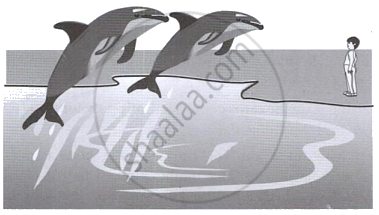
Based on the given information, answer the following questions.
- Find the zeros of the polynomial p(t) = 20t – 16t2.
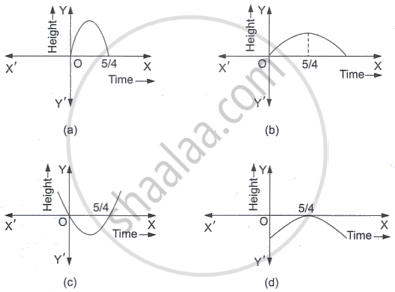
- Which of the following types of graphs represents p(t)?
- What would be the value of h at `t = 3/2`? Interpret the result.
- How much distance has the dolphin covered before hitting the water level again?
Advertisements
Solution
i. \[p(t)=20t-16t^{2}=4t(5-4t)=0\]
\[4t=0 \Rightarrow t=0\]
\[5-4t=0 \Rightarrow t=\frac{5}{4}\]
ii. A quadratic polynomial is represented by a parabola, and its zeros are where the parabola meets the t-axis.
The zeros 0 and `5/4` are consistent with graphs (a) and (c).
The coefficient of t2 is [–16], which is negative, so the parabola opens downward.
Graph (a) is the downward-facing parabola, so it is the correct choice.
iii. \[h=20\left(\frac{3}{2}\right)-16\left(\frac{3}{2}\right)^{2}\]
\[h=30-36=-6 \text{ cm}\]
Interpretation: after `3/2` seconds the dolphin is 6 cm below the water level, which means it has already re-entered the water.
iv. The dolphin returns to the water at `t = 5/4` seconds, so the time of flight is `5/4` s.
\[\text{Distance}=\text{speed}\times\text{time}\]
\[=20\times\frac{5}{4}=25 \text{ cm}\]
