Advertisements
Advertisements
Question
|
Hockey is played on a rectangular field which is 91.40 m long and 55 m broad. The shorter edges of the field are called backlines. Each of the two goals consists of two upright posts placed equidistant from the centre of the backline, joined at the top by a horizontal crossbar. The inner edges of each post must be 3.66 m apart and the lower edge of each crossbar must be 2.14 m above the ground. Each team plays with 11 players on the field during the game, including the goalie. Positions of the players on the left side is shown below.
|
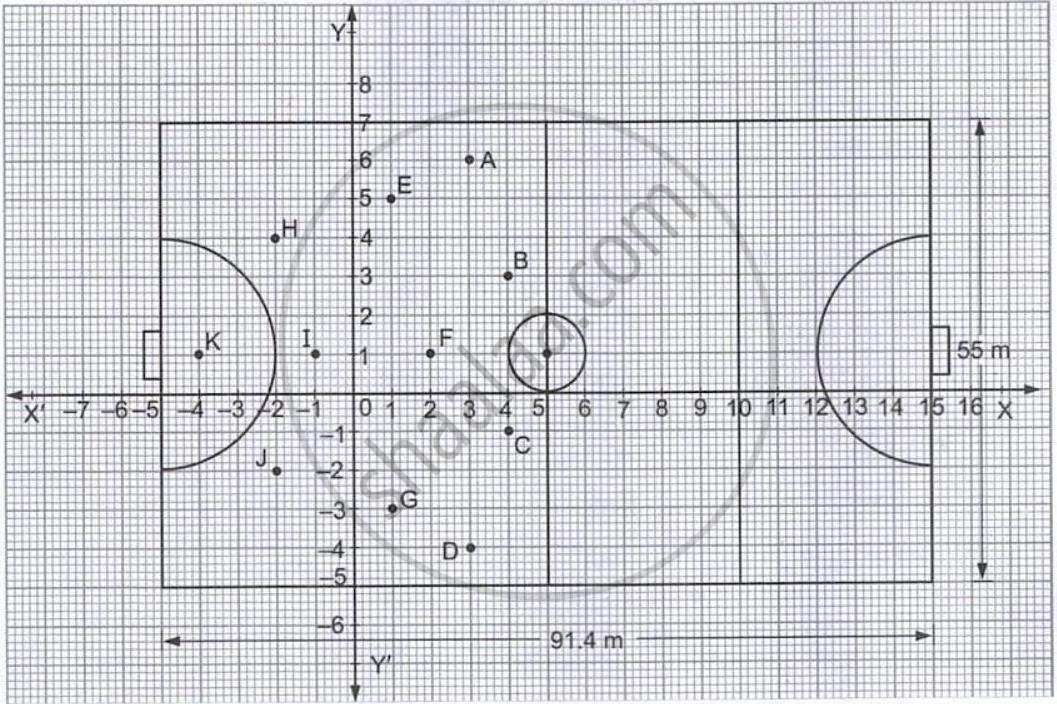
Using the picture of a hockey field given above, answer the questions that follow.
- What are the coordinates of the centroid of \(\triangle HFJ\)?
- What are the coordinates of the point on the x-axis, equidistant from F and I?
- What are the coordinates of the point on the y-axis, equidistant from B and C?
- What are the coordinates of the position of a player Q such that his distance from K is twice his distance from F, where K, Q and F are collinear?
- If a player P needs to be at equal distances from A and G such that A, P and G are in a straight line then what will be the position of P?
Advertisements
Solution
From the given Cartesian grid:
\(A(3, 6)\)
\(B(4, 3)\)
\(C(4, -1)\)
\(D(3, -4)\)
\(E(2, 4)\)
\(F(2, 1)\)
\(G(1, -3)\)
\(H(-2, 4)\)
\(I(-1, 1)\)
\(J(-2, -2)\)
\(K(-4, 1)\)
i. Centroid of \(\triangle HFJ\):
Vertices: \(H(-2, 4), F(2, 1), J(-2, -2)\)
Centroid Formula: \[G = \left(\frac{x_1 + x_2 + x_3}{3}, \frac{y_1 + y_2 + y_3}{3}\right)\]
\[G = \left(\frac{-2 + 2 + (-2)}{3}, \frac{4 + 1 + (-2)}{3}\right)\]
\[= \left(-\frac{2}{3}, \frac{3}{3}\right)\]
\[= \left(-\frac{2}{3}, 1\right)\]
ii. Point on the x-axis equidistant from \(F(2, 1)\) and \(I(-1, 1)\):
Any point on the x-axis is of the form \(M(x, 0)\).
\[MF = MI \implies MF^2 = MI^2\]
\[(x - 2)^2 + (0 - 1)^2 = (x - (-1))^2 + (0 - 1)^2\]
\[(x - 2)^2 + 1 = (x + 1)^2 + 1\]
\[x^2 - 4x + 4 = x^2 + 2x + 1\]
\[-4x + 4 = 2x + 1\]
\[6x = 3\]
\[\implies x = \frac{1}{2}\]
iii. Point on the y-axis equidistant from \(B(4, 3)\) and \(C(4, -1)\):
Any point on the y-axis is of the form \(N(0, y)\).
\[NB = NC \implies NB^2 = NC^2\]
\[(0 - 4)^2 + (y - 3)^2 = (0 - 4)^2 + (y - (-1))^2\]
\[16 + (y - 3)^2 = 16 + (y + 1)^2\]
\[y^2 - 6y + 9 = y^2 + 2y + 1\]
\[-6y + 9 = 2y + 1\]
\[8y = 8\]
\[\implies y = 1\]
iv. Coordinates of position Q:
Given:
\(K(-4, 1)\) and \(F(2, 1)\) are collinear with Q.
Distance of Q from K is twice its distance from F:
\[QK = 2QF \implies \frac{KQ}{QF} = \frac{2}{1}\]
However, from the geometric layout of the field, Q lies along the line connecting K and F.
Here, Q divides the segment KF internally such that:
\[KQ : QF = 1 : 2\]
Section Formula: \[x_Q = \frac{1(2) + 2(-4)}{1 + 2}\]
\[= \frac{2 - 8}{3} = -2\]
\[y_Q = \frac{1(1) + 2(1)}{1 + 2}\]
\[= \frac{3}{3}\]
\[= 1\]
v. Position of player P:
Since P is equidistant from \(A(3, 6)\) and \(G(1, -3)\) and all three points are collinear, P is the midpoint of AG.
Midpoint Formula: \[P = \left(\frac{x_A + x_G}{2}, \frac{y_A + y_G}{2}\right)\]
\[P = \left(\frac{3 + 1}{2}, \frac{6 + (-3)}{2}\right)\]
\[= \left(2, \frac{3}{2}\right)\]
