Advertisements
Advertisements
Question
Assertion (A): A solid is in the form of a cone of radius $$r$$ surmounted on a hemisphere of the same radius. If the height of the cone is the same as the diameter of its base then the volume of the solid is $$\frac{4}{3}\pi r^{3}$$.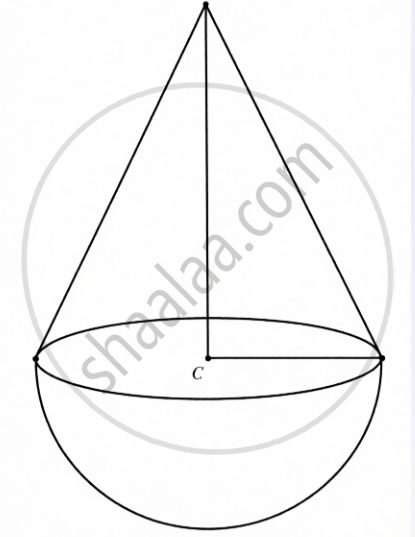
Reason (R): Total volume of the solid $$=\text{volume of the cone}+\text{volume of the hemisphere}$$
Options
Both Assertion (A) and Reason (R) are true and Reason (R) is a correct explanation of Assertion (A).
Both Assertion (A) and Reason (R) are true but Reason (R) is not a correct explanation of Assertion (A).
Assertion (A) is true and Reason (R) is false.
Assertion (A) is false and Reason (R) is true.
Advertisements
Solution
Both Assertion (A) and Reason (R) are true and Reason (R) is a correct explanation of Assertion (A).
Explanation:
Step 1 – Assertion: A is true. The cone height is $$2r$$, so: $$V = \frac{1}{3}\pi r^{2}(2r) + \frac{2}{3}\pi r^{3}$$ $$V = \frac{4}{3}\pi r^{3}$$
Step 2 – Reason: R is true. The total volume of the composite solid is the sum of the volumes of the cone and hemisphere.
Step 3 – Link: Adding those two component volumes, using the stated cone height, gives the volume in A; therefore, R correctly explains A.
