Advertisements
Online Mock Tests
Chapters
1: Real Numbers
Algebra
2: Polynomials
3: Linear Equations in Two Variables
4: Quadratic Equations
5: Arithmetic Progression
Coordinate Geometry
6: Coordinate Geometry
Geometry
7: Triangles
8: Circles
9: Constructions
Trigonometry
10: Trignometric Ratios
11: T-Ratios of Some Particular Angles
12: Trigonometric Ratios of Some Complemantary Angles
13: Trigonometric identities
14: Heights and Distances
Mensuration
15: Perimeter And Area of Plane Figures
16: Area of Circle, Sector and Segment
17: Volumes and Surface Areas of Solids
Statistics and Probability
18: Mean, Median, Mode of Grouped Data, Cumulative Frequency Graph and Ogive
19: Probability
▶ 20: Additional Questions
![R.S. Aggarwal solutions for माठेमटिक्स [इंग्रजी] इयत्ता १० chapter 20 - Additional Questions - Shaalaa.com](/images/mathematics-english-class-10_6:8f062ea57bdf49abb4f6d22550b39d56.jpg "R.S. Aggarwal solutions for माठेमटिक्स [इंग्रजी] इयत्ता १० chapter 20 - Additional Questions")
Advertisements
Solutions for Chapter 20: Additional Questions
Below listed, you can find solutions for Chapter 20 of CBSE, Karnataka Board R.S. Aggarwal for माठेमटिक्स [इंग्रजी] इयत्ता १०.
R.S. Aggarwal solutions for माठेमटिक्स [इंग्रजी] इयत्ता १० 20 Additional Questions Real Numbers [Pages 965 - 969]
Assertion-and-Reason Type Questions Each question consists of two statements, namely, Assertion (A) and Reason (R). For selecting the correct answer, use the following code:
Assertion (A): \(\sqrt{10}\) is an irrational number.
Reason (R): If m is a natural number which is not a perfect square then \(\sqrt{m}\) is irrational.
Both Assertion (A) and Reason (R) are true and Reason (R) is a correct explanation of Assertion (A).
Both Assertion (A) and Reason (R) are true but Reason (R) is not a correct explanation of Assertion (A).
Assertion (A) is true and Reason (R) is false.
Assertion (A) is false and Reason (R) is true.
Assertion (A): \[\frac{19}{500}\] is a terminating decimal.
Reason (R): The rational number \[\frac{p}{q}\] is a terminating decimal, if \[q = (2^{m} \times 5^{n})\] for some whole numbers m and n.
Both Assertion (A) and Reason (R) are true and Reason (R) is a correct explanation of Assertion (A).
Both Assertion (A) and Reason (R) are true but Reason (R) is not a correct explanation of Assertion (A).
Assertion (A) is true and Reason (R) is false.
Assertion (A) is false and Reason (R) is true.
Assertion (A): \[\frac{31}{90}\] is a nonterminating, repeating decimal.
Reason (R): The rational number \[\frac{p}{q}\] is a repeating decimal, if q has at least one factor other than 2 and 5.
Both Assertion (A) and Reason (R) are true and Reason (R) is a correct explanation of Assertion (A).
Both Assertion (A) and Reason (R) are true but Reason (R) is not a correct explanation of Assertion (A).
Assertion (A) is true and Reason (R) is false.
Assertion (A) is false and Reason (R) is true.
Assertion (A): \[\sqrt{7}\] is an irrational number.
Reason (R): If p is prime then \[\sqrt{p}\] is irrational.
Both Assertion (A) and Reason (R) are true and Reason (R) is a correct explanation of Assertion (A).
Both Assertion (A) and Reason (R) are true but Reason (R) is not a correct explanation of Assertion (A).
Assertion (A) is true and Reason (R) is false.
Assertion (A) is false and Reason (R) is true.
Assertion (A): \[\frac{22}{7}\] is a nonterminating, repeating decimal.
Reason (R): The rational number \[\frac{p}{q}\] is a terminating decimal, if \[q = (2^{m} \times 5^{n})\] for some whole numbers m and n.
Both Assertion (A) and Reason (R) are true and Reason (R) is a correct explanation of Assertion (A).
Both Assertion (A) and Reason (R) are true but Reason (R) is not a correct explanation of Assertion (A).
Assertion (A) is true and Reason (R) is false.
Assertion (A) is false and Reason (R) is true.
Assertion (A): \[\frac{1}{\sqrt{3}}\] is a rational number.
Reason (R): If p is prime then \[\frac{1}{\sqrt{p}}\] is irrational.
Both Assertion (A) and Reason (R) are true and Reason (R) is a correct explanation of Assertion (A).
Both Assertion (A) and Reason (R) are true but Reason (R) is not a correct explanation of Assertion (A).
Assertion (A) is true and Reason (R) is false.
Assertion (A) is false and Reason (R) is true.
Assertion (A): π is irrational and \[\frac{22}{7}\] is rational.
Reason (R): \[\pi \neq \frac{22}{7}\]
Both Assertion (A) and Reason (R) are true and Reason (R) is a correct explanation of Assertion (A).
Both Assertion (A) and Reason (R) are true but Reason (R) is not a correct explanation of Assertion (A).
Assertion (A) is true and Reason (R) is false.
Assertion (A) is false and Reason (R) is true.
Assertion (A): \[\sqrt{5}\] is an irrational number.
Reason (R): Let p be a prime number and a be a positive integer. Then, p divides \[a^{2} \Rightarrow\] p divides a.
Both Assertion (A) and Reason (R) are true and Reason (R) is a correct explanation of Assertion (A).
Both Assertion (A) and Reason (R) are true but Reason (R) is not a correct explanation of Assertion (A).
Assertion (A) is true and Reason (R) is false.
Assertion (A) is false and Reason (R) is true.
Assertion (A): \[0.\overline{6}\] is a terminating decimal.
Reason (R): The rational number \[\frac{p}{q}\] is a terminating decimal, if \[q = (2^{m} \times 5^{n})\] for some whole numbers m and n.
Both Assertion (A) and Reason (R) are true and Reason (R) is a correct explanation of Assertion (A).
Both Assertion (A) and Reason (R) are true but Reason (R) is not a correct explanation of Assertion (A).
Assertion (A) is true and Reason (R) is false.
Assertion (A) is false and Reason (R) is true.
Assertion (A): The HCF of two numbers is 25 and their LCM is 60.
Reason (R): The HCF of two given numbers always divides their LCM exactly.
Both Assertion (A) and Reason (R) are true and Reason (R) is a correct explanation of Assertion (A).
Both Assertion (A) and Reason (R) are true but Reason (R) is not a correct explanation of Assertion (A).
Assertion (A) is true and Reason (R) is false.
Assertion (A) is false and Reason (R) is true.
Assertion (A): The HCF of two numbers is 7 and their LCM is 70. If one of the numbers is 14 then the other number is 30.
Reason (R): For any two given positive integers a and b, we have \[\text{HCF},(a, b) \times \text{LCM},(a, b) = (a \times b).\]
Both Assertion (A) and Reason (R) are true and Reason (R) is a correct explanation of Assertion (A).
Both Assertion (A) and Reason (R) are true but Reason (R) is not a correct explanation of Assertion (A).
Assertion (A) is true and Reason (R) is false.
Assertion (A) is false and Reason (R) is true.
Assertion (A): The number \[5^{n}\] cannot end with digit 0, where n is a natural number.
Reason (R): Prime factorisation of 5 has only two prime factors 1 and 5.
Both Assertion (A) and Reason (R) are true and Reason (R) is a correct explanation of Assertion (A).
Both Assertion (A) and Reason (R) are true but Reason (R) is not a correct explanation of Assertion (A).
Assertion (A) is true and Reason (R) is false.
Assertion (A) is false and Reason (R) is true.
Case-Based Questions
| February 14 is celebrated as the International Book Giving Day and many countries in the world celebrate this day. Some people in India also started celebrating this day and donated the following number of books of various subjects to a public library: History = 96, Science = 240, Mathematics = 336. These books have to be arranged in minimum number of stacks such that each stack contains books of only one subject and the number of books on each stack is the same. |
Based on the above information, answer the following questions.
- How many books are arranged in each stack?
- How many stacks are used to arrange all the mathematics books?
- Determine the total number of stacks that will be used for arranging all the books.
- If the thickness of each book of history, science and mathematics is 1.8 cm, 2.2 cm and 2.5 cm respectively then find the height of each stack of history, science and mathematics books
|
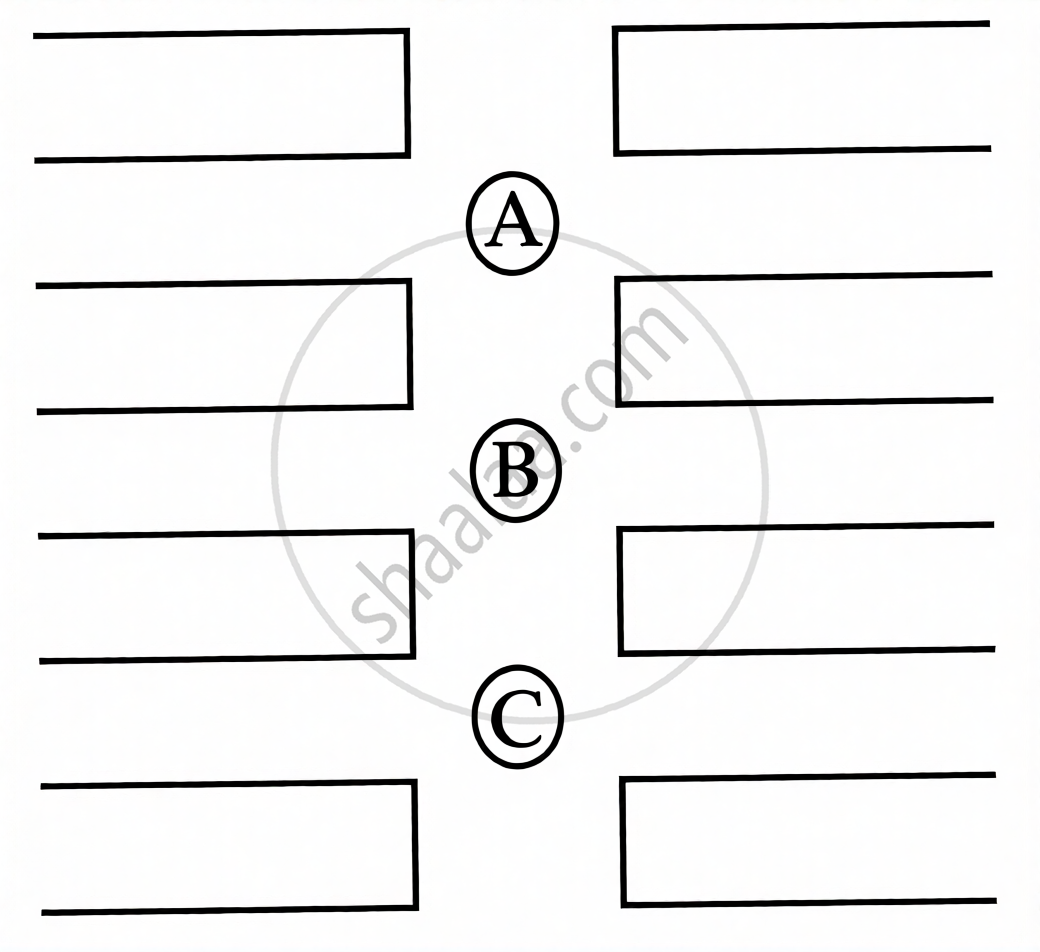
In a busy city, three roads run parallel to each other. These roads are intersected by a road, running perpendicular to each one of them. At each intersection, traffic signals have been installed. These signals labelled A, B and C change after every 108 seconds, 72 seconds and 48 seconds respectively.
These signals are switched on simultaneously at 8.00 a.m. |
Based on the above information, answer the following questions.
- At what time after 8.00 a.m. will all the signals change simultaneously?
- At what time after 8.00 a.m. will the signals A and B change simultaneously?
- At what time after 8.00 a.m. will the signals B and C change simultaneously?
- At what time after 8.00 a.m. will the signals A and C change simultaneously?
R.S. Aggarwal solutions for माठेमटिक्स [इंग्रजी] इयत्ता १० 20 Additional Questions Polynomials [Pages 971 - 975]
Assertion-and-Reason Type Questions Each question consists of two statements, namely, Assertion (A) and Reason (R). For selecting the correct answer, use the following code:
Assertion (A): A monic quadratic polynomial having 4 and –2 as its zeros is $$\left(x^{2}-2x-8\right)$$.
Reason (R): The monic quadratic polynomial having $$\alpha$$ and $$\beta$$ as its zeros, is given by $$x^{2}-(\alpha+\beta)x+\alpha\beta$$.
Both Assertion (A) and Reason (R) are true and Reason (R) is a correct explanation of Assertion (A).
Both Assertion (A) and Reason (R) are true but Reason (R) is not a correct explanation of Assertion (A).
Assertion (A) is true and Reason (R) is false.
Assertion (A) is false and Reason (R) is true.
Assertion (A): The quadratic polynomial whose zeros are $$(3+\sqrt{2})$$ and $$(3-\sqrt{2})$$ is given by $$p(x)=(x^{2}-6x+7)$$.
Reason (R): If $$\alpha$$ is a zero of the quadratic polynomial $$p(x)$$ then $$(x-\alpha)$$ is a factor of $$p(x)$$.
Both Assertion (A) and Reason (R) are true and Reason (R) is a correct explanation of Assertion (A).
Both Assertion (A) and Reason (R) are true but Reason (R) is not a correct explanation of Assertion (A).
Assertion (A) is true and Reason (R) is false.
Assertion (A) is false and Reason (R) is true.
Assertion (A): The polynomial $$p(x)=(x^{3}+x)$$ has one real zero.
Reason (R): A polynomial of nth degree has at most n zeros.
Both Assertion (A) and Reason (R) are true and Reason (R) is a correct explanation of Assertion (A).
Both Assertion (A) and Reason (R) are true but Reason (R) is not a correct explanation of Assertion (A).
Assertion (A) is true and Reason (R) is false.
Assertion (A) is false and Reason (R) is true.
Assertion (A): If $$\alpha$$ and $$\beta$$ be the zeros of polynomial $$(x^{2}-6x+k)$$ such that $$(\alpha-\beta)=2$$ then $$k=8$$.
Reason (R): If $$\alpha$$ is a zero of the polynomial $$p(x)$$ then $$p(-\alpha)=0$$.
Both Assertion (A) and Reason (R) are true and Reason (R) is a correct explanation of Assertion (A).
Both Assertion (A) and Reason (R) are true but Reason (R) is not a correct explanation of Assertion (A).
Assertion (A) is true and Reason (R) is false.
Assertion (A) is false and Reason (R) is true.
Assertion (A): If the zeros of the quadratic polynomial $$ax^{2}+bx+c$$ are both negative then a, b, c will have the same sign.
Reason (R): The zeros of a quadratic polynomial are either both positive or both negative.
Both Assertion (A) and Reason (R) are true and Reason (R) is a correct explanation of Assertion (A).
Both Assertion (A) and Reason (R) are true but Reason (R) is not a correct explanation of Assertion (A).
Assertion (A) is true and Reason (R) is false.
Assertion (A) is false and Reason (R) is true.
Assertion (A): If one zero of the polynomial $$p(x)=(k^{2}+4)x^{2}+9x+4k$$ is the reciprocal of the other zero then $$k=2$$.
Reason (R): If $$(x-\alpha)$$ is a factor of the polynomial $$p(x)$$ then $$\alpha$$ is a zero of $$p(x)$$.
Both Assertion (A) and Reason (R) are true and Reason (R) is a correct explanation of Assertion (A).
Both Assertion (A) and Reason (R) are true but Reason (R) is not a correct explanation of Assertion (A).
Assertion (A) is true and Reason (R) is false.
Assertion (A) is false and Reason (R) is true.
Assertion (A): If the sum of the zeros of the quadratic polynomial $$p(x)=kx^{2}+2x+3k$$, is equal to the product of its zeros then $$k=\frac{-2}{3}$$.
Reason (R): If $$\alpha$$ and $$\beta$$ be the zeros of a quadratic polynomial $$p(x)=ax^{2}+bx+c$$ then $$(\alpha+\beta)=\frac{-b}{a}$$ and $$\alpha\beta=\frac{c}{a}$$.
Both Assertion (A) and Reason (R) are true and Reason (R) is a correct explanation of Assertion (A).
Both Assertion (A) and Reason (R) are true but Reason (R) is not a correct explanation of Assertion (A).
Assertion (A) is true and Reason (R) is false.
Assertion (A) is false and Reason (R) is true.
Assertion (A): If on dividing the polynomial $$p(x)=x^{2}-3ax+3a-7$$ by $$(x+1)$$, we get 6 as remainder then $$a=4$$.
Reason (R): When a polynomial $$p(x)$$ is divided by $$(x-\alpha)$$ then the remainder is $$p(\alpha)$$.
Both Assertion (A) and Reason (R) are true and Reason (R) is a correct explanation of Assertion (A).
Both Assertion (A) and Reason (R) are true but Reason (R) is not a correct explanation of Assertion (A).
Assertion (A) is true and Reason (R) is false.
Assertion (A) is false and Reason (R) is true.
Assertion (A): A monic cubic polynomial having 3, 2, –1 as its zeros is $$p(x)=x^{3}+4x^{2}-x+6$$.
Reason (R): The monic cubic polynomial having $$\alpha,\beta,\gamma$$ as its zeros is given by $$x^{3}-(\alpha+\beta+\gamma)x^{2}+(\alpha\beta+\beta\gamma+\gamma\alpha)x-(\alpha\beta\gamma)$$.
Both Assertion (A) and Reason (R) are true and Reason (R) is a correct explanation of Assertion (A).
Both Assertion (A) and Reason (R) are true but Reason (R) is not a correct explanation of Assertion (A).
Assertion (A) is true and Reason (R) is false.
Assertion (A) is false and Reason (R) is true.
Case-Based Questions
|
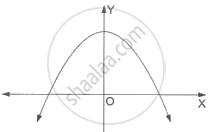
Rainbow is an arch of colours that is visible in the sky after rain or when water droplets are present in the atmosphere. The colours of the rainbow are generally red, orange, yellow, green, blue, indigo, and violet. Each colour of the rainbow makes a parabola. We know that any quadratic polynomials p(x) = ax2 + bx + c (a ≠ 0) represents a parabola on the graph paper. |
Based on the above information, answer the following questions.
- The graph of a rainbow y = f(x) is shown in the figure given below. Write the number of zeros of the curve.
- If the graph of a rainbow does not intersect the x-axis but intersects y-axis at one point, then how many zeros will it have?
- The polynomial x2 – 2x – (7a + 3) represents a rainbow. If –4 is a zero of it, find the value of a.
- If α and β are the zeros of the quadratic polynomialp (x) = x2 – rx – s then find the value of α2 + β2.
|
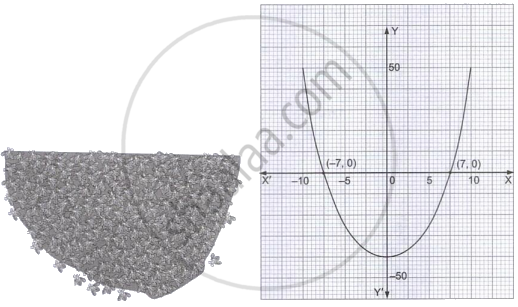
While playing in a garden, Tanya saw a honeycomb and asked her mother what it was. Her mother replied that it is a honeycomb made by honey bees to store honey. Also, she told her that the shape of the honeycomb formed is a mathematical structure. The mathematical representation of the honeycomb is shown in the graph.
|
Based on the above information, answer the following questions.
- How many zeros are there for the polynomial represented by the given graph?
- Write the zeros of the polynomial.
- If the zeros of a polynomial x2 + (p + 1)x + q are 2 and –3 then determine the values of p and g.
- If the square of the difference between the zeros of the polynomial x2 + ax + 45 is 144 then find the value of a.
|
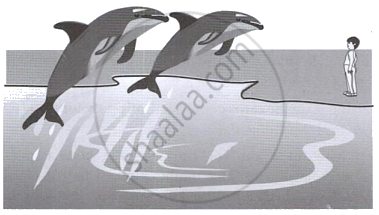
In a pool at an aquarium, a dolphin jumps out of the water travelling at 20 cm per second. Its height above water level after t seconds is given by h = 20t – 16t2.
|
Based on the given information, answer the following questions.
- Find the zeros of the polynomial p(t) = 20t – 16t2.
- Which of the following types of graphs represents p(t)?
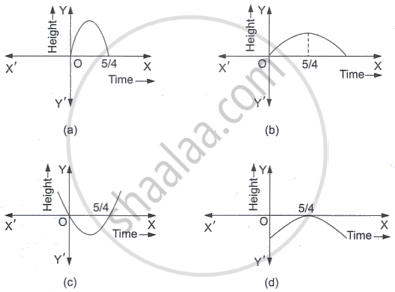
- What would be the value of h at `t = 3/2`? Interpret the result.
- How much distance has the dolphin covered before hitting the water level again?
R.S. Aggarwal solutions for माठेमटिक्स [इंग्रजी] इयत्ता १० 20 Additional Questions Linear Equations in Two Variables [Pages 978 - 984]
Assertion-and-Reason Type Questions Each question consists of two statements, namely, Assertion (A) and Reason (R). For selecting the correct answer, use the following code:
Assertion (A): The system of equations \[2x+3y-6=0\] and \[4x+6y-12=0\] has infinitely many solutions.
Reason (R): The system of equations \[a_{1}x+b_{1}y+c_{1}=0,\ a_{2}x+b_{2}y+c_{2}=0\] has infinitely many solutions, if \[\frac{a_{1}}{a_{2}}=\frac{b_{1}}{b_{2}}=\frac{c_{1}}{c_{2}}.\]
Both Assertion (A) and Reason (R) are true and Reason (R) is a correct explanation of Assertion (A).
Both Assertion (A) and Reason (R) are true but Reason (R) is not a correct explanation of Assertion (A).
Assertion (A) is true and Reason (R) is false.
Assertion (A) is false and Reason (R) is true.
Assertion (A): The system of equations \[2x-3y-5=0\] and \[4x-6y+3=0\] has no solutions.
Reason (R): The system of equations \[a_{1}x+b_{1}y+c_{1}=0,\ a_{2}x+b_{2}y+c_{2}=0\] has no solutions, if \[\frac{a_{1}}{a_{2}}=\frac{b_{1}}{b_{2}}\ne\frac{c_{1}}{c_{2}}.\]
Both Assertion (A) and Reason (R) are true and Reason (R) is a correct explanation of Assertion (A).
Both Assertion (A) and Reason (R) are true but Reason (R) is not a correct explanation of Assertion (A).
Assertion (A) is true and Reason (R) is false.
Assertion (A) is false and Reason (R) is true.
Assertion (A): The system of equations \[x+2y+2=0\] and \[3x+2y-2=0\] has a unique solution.
Reason (R): The system of equations \[a_{1}x+b_{1}y+c_{1}=0,\ a_{2}x+b_{2}y+c_{2}=0\] has a unique solution, if \[\frac{a_{1}}{a_{2}}=\frac{b_{1}}{b_{2}}\ne\frac{c_{1}}{c_{2}}.\]
Both Assertion (A) and Reason (R) are true and Reason (R) is a correct explanation of Assertion (A).
Both Assertion (A) and Reason (R) are true but Reason (R) is not a correct explanation of Assertion (A).
Assertion (A) is true and Reason (R) is false.
Assertion (A) is false and Reason (R) is true.
Assertion (A): The system of equations \[3x-6y=0\] and \[x-2y-6=0\] has infinitely many solutions.
Reason (R): The system of equations \[a_{1}x+b_{1}y+c_{1}=0,\ a_{2}x+b_{2}y+c_{2}=0\] has infinitely many solutions, if \[\frac{a_{1}}{a_{2}}=\frac{b_{1}}{b_{2}}=\frac{c_{1}}{c_{2}}.\]
Both Assertion (A) and Reason (R) are true and Reason (R) is a correct explanation of Assertion (A).
Both Assertion (A) and Reason (R) are true but Reason (R) is not a correct explanation of Assertion (A).
Assertion (A) is true and Reason (R) is false.
Assertion (A) is false and Reason (R) is true.
Assertion (A): The system of equations \[2x-5y+4=0\], \[2x+y-8=0\] has a unique solution.
Reason (R): The system of equations \[a_{1}x+b_{1}y+c_{1}=0,\ a_{2}x+b_{2}y+c_{2}=0\] is inconsistent, if \[\frac{a_{1}}{a_{2}}=\frac{b_{1}}{b_{2}}\ne\frac{c_{1}}{c_{2}}.\]
Both Assertion (A) and Reason (R) are true and Reason (R) is a correct explanation of Assertion (A).
Both Assertion (A) and Reason (R) are true but Reason (R) is not a correct explanation of Assertion (A).
Assertion (A) is true and Reason (R) is false.
Assertion (A) is false and Reason (R) is true.
Assertion (A): The homogeneous system of equations \[2x+3y=0\], \[4x+6y=0\] has an infinite number of solution.
Reason (R): The homogeneous system of equations \[a_{1}x+b_{1}y=0,\ a_{2}x+b_{2}y=0\] has an infinitely many solutions, if \[\frac{a_{1}}{a_{2}}=\frac{b_{1}}{b_{2}}.\]
Both Assertion (A) and Reason (R) are true and Reason (R) is a correct explanation of Assertion (A).
Both Assertion (A) and Reason (R) are true but Reason (R) is not a correct explanation of Assertion (A).
Assertion (A) is true and Reason (R) is false.
Assertion (A) is false and Reason (R) is true.
Assertion (A): The homogeneous system of equations \[3x-4y=0\], \[2x-3y=0\] has a unique solution x = 0 and y = 0.
Reason (R): The homogeneous system of equations \[a_{1}x+b_{1}y=0,\ a_{2}x+b_{2}y=0\] has a unique solution x = 0 and y = 0 when \[\frac{a_{1}}{a_{2}}\ne\frac{b_{1}}{b_{2}}.\]
Both Assertion (A) and Reason (R) are true and Reason (R) is a correct explanation of Assertion (A).
Both Assertion (A) and Reason (R) are true but Reason (R) is not a correct explanation of Assertion (A).
Assertion (A) is true and Reason (R) is false.
Assertion (A) is false and Reason (R) is true.
Assertion (A): The system of linear equations \[3x+5y-4=0\], \[15x+25y-25=0\] is inconsistent.
Reason (R): The pair of linear equations \[a_{1}x+b_{1}y+c_{1}=0,\ a_{2}x+b_{2}y+c_{2}=0\] is inconsistent, if \[\frac{a_{1}}{a_{2}}=\frac{b_{1}}{b_{2}}\ne\frac{c_{1}}{c_{2}}.\]
Both Assertion (A) and Reason (R) are true and Reason (R) is a correct explanation of Assertion (A).
Both Assertion (A) and Reason (R) are true but Reason (R) is not a correct explanation of Assertion (A).
Assertion (A) is true and Reason (R) is false.
Assertion (A) is false and Reason (R) is true.
Assertion (A): The system of linear equations \[5x-9y+6=0\], \[10x-18y+12=0\] is inconsistent.
Reason (R): The pair of linear equations \[a_{1}x+b_{1}y+c_{1}=0,\ a_{2}x+b_{2}y+c_{2}=0\] is inconsistent, if \[\frac{a_{1}}{a_{2}}=\frac{b_{1}}{b_{2}}\ne\frac{c_{1}}{c_{2}}.\]
Both Assertion (A) and Reason (R) are true and Reason (R) is a correct explanation of Assertion (A).
Both Assertion (A) and Reason (R) are true but Reason (R) is not a correct explanation of Assertion (A).
Assertion (A) is true and Reason (R) is false.
Assertion (A) is false and Reason (R) is true.
Assertion (A): The system of linear equations \[2x-3y+1=0\], \[4x-6y+3=0\] is inconsistent.
Reason (R): The system of linear equations \[a_{1}x+b_{1}y+c_{1}=0,\ a_{2}x+b_{2}y+c_{2}=0\] has a unique solution, if \[\frac{a_{1}}{a_{2}}\ne\frac{b_{1}}{b_{2}}.\]
Both Assertion (A) and Reason (R) are true and Reason (R) is a correct explanation of Assertion (A).
Both Assertion (A) and Reason (R) are true but Reason (R) is not a correct explanation of Assertion (A).
Assertion (A) is true and Reason (R) is false.
Assertion (A) is false and Reason (R) is true.
Assertion (A): The system of linear equations \[x-2y+6=0\], \[2x-4y+9=0\] has a unique solution.
Reason (R): The system of linear equations \[a_{1}x+b_{1}y+c_{1}=0,\ a_{2}x+b_{2}y+c_{2}=0\] has a unique solution, if \[\frac{a_{1}}{a_{2}}\ne\frac{b_{1}}{b_{2}}.\]
Both Assertion (A) and Reason (R) are true and Reason (R) is a correct explanation of Assertion (A).
Both Assertion (A) and Reason (R) are true but Reason (R) is not a correct explanation of Assertion (A).
Assertion (A) is true and Reason (R) is false.
Assertion (A) is false and Reason (R) is true.
Assertion (A): The system of linear equations \[x+y-9=0\], \[x-y+3=0\] has a unique solution.
Reason (R): The system of linear equations \[a_{1}x+b_{1}y+c_{1}=0,\ a_{2}x+b_{2}y+c_{2}=0\] has a unique solution, if \[\frac{a_{1}}{a_{2}}=\frac{b_{1}}{b_{2}}.\]
Both Assertion (A) and Reason (R) are true and Reason (R) is a correct explanation of Assertion (A).
Both Assertion (A) and Reason (R) are true but Reason (R) is not a correct explanation of Assertion (A).
Assertion (A) is true and Reason (R) is false.
Assertion (A) is false and Reason (R) is true.
Case-Based Questions
| Arun, a production manager in Mumbai, hires a taxi everyday to go to his office. The taxi charges in Mumbai consist of a fixed charge together with the charges for the distance covered. His office is at a distance of 10 km from his home. For a distance of 10 km to his office, Arun paid ₹105. While coming back home, he took another route. He covered a distance of 15 km and paid ₹155. |
Based on the above information, answer the following questions.
(i) What are the fixed charges?
(ii) What are the charges per kilometre?
(iii) If fixed charge are ₹20 and charges per kilometre are ₹10 then how much would Arun have to pay for travelling a distance of 10 km?
(iv) Find the total amount paid by Arun for travelling 10 km from home to office and 25 km from office to home. [Fixed charges and charges per kilometre are as in (i) and (ii).]
| Two schools 'X' and 'Y' decided to award prizes to their students for two games—₹p per student for hockey and ₹q per student for cricket. School X decided to award a total of ₹ 9500 for the two games to 5 and 4 students respectively; while school Y decided to award ₹ 7370 for the two games to 4 and 3 students respectively. |
Based on the above information, answer the following questions.
- Represent the above information algebraically (in terms of p and q).
- What is the prize amount for hockey?
- Prize amount for which game is higher and by how much?
- What will be the total prize amount if there are 2 students each from the two games?
Read the following passage:
|
A coaching institute of Mathematics conducts classes in two batches I and II and fees for rich and poor children are different. In batch I, there are 20 poor and 5 rich children, whereas in batch II, there are 5 poor and 25 rich children. The total monthly collection of fees from batch I is ₹9,000 and from batch II is ₹26,000. Assume that each poor child pays ₹x per month and each rich child pays ₹y per month.
|
Based on the above information, answer the following questions:
- Represent the information given above in terms of x and y.
- Find the monthly fee paid by a poor child.
OR
Find the difference in the monthly fee paid by a poor child and a rich child. - If there are 10 poor and 20 rich children in batch II, what is the total monthly collection of fees from batch II?
R.S. Aggarwal solutions for माठेमटिक्स [इंग्रजी] इयत्ता १० 20 Additional Questions Quadratic Equations [Pages 985 - 990]
Assertion-and-Reason Type Questions Each question consists of two statements, namely, Assertion (A) and Reason (R). For selecting the correct answer, use the following code:
Assertion (A): The quadratic equation $$x^{2}+3x+4=0$$ has both real roots.
Reason (R): The equation $$ax^{2}+bx+c=0,\ a\neq 0$$ has both real roots, if $$(b^{2}-4ac)\geq 0$$.
Both Assertion (A) and Reason (R) are true and Reason (R) is a correct explanation of Assertion (A).
Both Assertion (A) and Reason (R) are true but Reason (R) is not a correct explanation of Assertion (A).
Assertion (A) is true and Reason (R) is false.
Assertion (A) is false and Reason (R) is true.
Assertion (A): The polynomial $$p(x)=x^{2}+3x+3$$ has two real zeros.
Reason (R): A quadratic polynomial can have at most two real zeros.
Both Assertion (A) and Reason (R) are true and Reason (R) is a correct explanation of Assertion (A).
Both Assertion (A) and Reason (R) are true but Reason (R) is not a correct explanation of Assertion (A).
Assertion (A) is true and Reason (R) is false.
Assertion (A) is false and Reason (R) is true.
Assertion (A): The polynomial $$x^{2}+4x$$ has two real zeros.
Reason (R): The zeros of the polynomial $$x^{2}+ax\ (a\neq 0)$$ are 0 and $$a$$.
Both Assertion (A) and Reason (R) are true and Reason (R) is a correct explanation of Assertion (A).
Both Assertion (A) and Reason (R) are true but Reason (R) is not a correct explanation of Assertion (A).
Assertion (A) is true and Reason (R) is false.
Assertion (A) is false and Reason (R) is true.
Assertion (A): If $$(5 + \sqrt{7})$$ is a root of a quadratic equation with rational coefficients then the other root is $$(5 - \sqrt{7})$$.
Reason (R): The surd roots of a quadratic equation with rational coefficients occur in conjugate pairs.
Both Assertion (A) and Reason (R) are true and Reason (R) is a correct explanation of Assertion (A).
Both Assertion (A) and Reason (R) are true but Reason (R) is not a correct explanation of Assertion (A).
Assertion (A) is true and Reason (R) is false.
Assertion (A) is false and Reason (R) is true.
Assertion (A): If one root of the quadratic equation $$4x^{2}-10x+(k-4)=0$$ is the reciprocal of the other then the value of $$k$$ is 8.
Reason (R): The roots of the quadratic equation $$x^{2}-x+1=0$$ are real.
Both Assertion (A) and Reason (R) are true and Reason (R) is a correct explanation of Assertion (A).
Both Assertion (A) and Reason (R) are true but Reason (R) is not a correct explanation of Assertion (A).
Assertion (A) is true and Reason (R) is false.
Assertion (A) is false and Reason (R) is true.
Assertion (A): If the equation $$x^{2}-kx+1=0$$ has no real roots then $$-2<k<2$$.
Reason (R): The equation $$ax^{2}+bx+c=0$$ has real roots, if $$(b^{2}-4ac)\geq 0$$.
Both Assertion (A) and Reason (R) are true and Reason (R) is a correct explanation of Assertion (A).
Both Assertion (A) and Reason (R) are true but Reason (R) is not a correct explanation of Assertion (A).
Assertion (A) is true and Reason (R) is false.
Assertion (A) is false and Reason (R) is true.
Assertion (A): The quadratic equation $$\sqrt{3}x^{2}+11x+6\sqrt{3}=0$$ has both real roots.
Reason (R): The quadratic equation $$ax^{2}+bx+c=0$$ has both imaginary roots, if $$(b^{2}-4ac)<0$$.
Both Assertion (A) and Reason (R) are true and Reason (R) is a correct explanation of Assertion (A).
Both Assertion (A) and Reason (R) are true but Reason (R) is not a correct explanation of Assertion (A).
Assertion (A) is true and Reason (R) is false.
Assertion (A) is false and Reason (R) is true.
Assertion (A): If –5 is a root of $$2x^{2}+2px-15=0$$ and the equation $$p(x^{2}+x)+k=0$$ has equal roots then $$k=\frac{7}{8}$$.
Reason (R): The equation $$ax^{2}+bx+c=0,\ a\neq 0$$ has equal roots, if $$(b^{2}-4ac)=0$$.
Both Assertion (A) and Reason (R) are true and Reason (R) is a correct explanation of Assertion (A).
Both Assertion (A) and Reason (R) are true but Reason (R) is not a correct explanation of Assertion (A).
Assertion (A) is true and Reason (R) is false.
Assertion (A) is false and Reason (R) is true.
Assertion (A): If the quadratic equation $$px^{2}-4x+4=0$$ has real roots them $$p\leq 1$$.
Reason (R): The quadratic equation $$ax^{2}+bx+c=0$$ has both real roots, if $$(b^{2}-4ac)<0$$.
Both Assertion (A) and Reason (R) are true and Reason (R) is a correct explanation of Assertion (A).
Both Assertion (A) and Reason (R) are true but Reason (R) is not a correct explanation of Assertion (A).
Assertion (A) is true and Reason (R) is false.
Assertion (A) is false and Reason (R) is true.
Assertion (A): The quadratic equation $$x^{2}+5kx+16=0$$ has no real roots, if $$\frac{-8}{5}<k<\frac{8}{5}$$.
Reason (R): The equation $$ax^{2}+bx+c=0,\ a\neq 0$$ has no real root, if $$(b^{2}-4ac)<0$$.
Both Assertion (A) and Reason (R) are true and Reason (R) is a correct explanation of Assertion (A).
Both Assertion (A) and Reason (R) are true but Reason (R) is not a correct explanation of Assertion (A).
Assertion (A) is true and Reason (R) is false.
Assertion (A) is false and Reason (R) is true.
Assertion (A): The quadratic equation $$x^{2}-x-6=0$$ has –2 and 3 as its roots.
Reason (R): If $$ax^{2}+bx+c=0$$ then $$x=\frac{-b\pm\sqrt{b^{2}-4ac}}{2a}.$$
Both Assertion (A) and Reason (R) are true and Reason (R) is a correct explanation of Assertion (A).
Both Assertion (A) and Reason (R) are true but Reason (R) is not a correct explanation of Assertion (A).
Assertion (A) is true and Reason (R) is false.
Assertion (A) is false and Reason (R) is true.
Assertion (A): The quadratic equation $$x^{2}-4x+3=0$$ has both real roots.
Reason (R): The equation $$ax^{2}+bx+c=0,\ a\neq 0$$ has both real roots, if $$(b^{2}-4ac)\geq 0$$.
Both Assertion (A) and Reason (R) are true and Reason (R) is a correct explanation of Assertion (A).
Both Assertion (A) and Reason (R) are true but Reason (R) is not a correct explanation of Assertion (A).
Assertion (A) is true and Reason (R) is false.
Assertion (A) is false and Reason (R) is true.
Assertion (A): The quadratic equation $$3x^{2}-5x+4=0$$ has no real root.
Reason (R): The equation $$ax^{2}+bx+c=0,\ a\neq 0$$ has no real root, if $$(b^{2}-4ac)<0$$.
Both Assertion (A) and Reason (R) are true and Reason (R) is a correct explanation of Assertion (A).
Both Assertion (A) and Reason (R) are true but Reason (R) is not a correct explanation of Assertion (A).
Assertion (A) is true and Reason (R) is false.
Assertion (A) is false and Reason (R) is true.
Case-Based Questions
| In an auditorium, seats are arranged in rows and columns. The number of rows are equal to the number of seats in each row in the beginning. When the number of rows is doubled and the number of seats in each row is reduced by 10, the total number of seats increases by 300. |
Based on the given information, answer the following questions.
- Taking x as the number of rows in the beginning, represent the above situation by a quadratic equation.
- How many rows are there in the original arrangement?
- How many seats are there in the auditorium in the beginning?
- How many seats are there in the auditorium after rearrangement?
|
While designing the school year book, a teacher told the student that the length and width of a particular photo is increased by x units each to double its area. The original photo is 18 cm long and 12 cm wide.
|
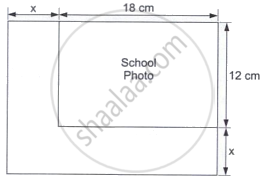
Based on the above information, answer the following questions.
- Write an algebraic equation depicting the above information.
- Write the corresponding quadratic equation in standard form.
- What should be the new dimensions of the enlarged photo?
- Can any rational value of x make the new area equal to 220 cm2?
|
Social work aims at fulfilment of human needs. Social workers aim to open the doors of access and opportunity for those who are in greatest need. Free education is a great social work. By doing so, we can remove illiteracy from our society. Raman, being a social worker, wants to donate his land to the Village Panchayat for opening a school. Raman's land is in the form of a rectangle of dimensions 500 m × 400 m. The Village Panchayat decides to leave area on all four sides of the land for grass and flowers. A path of uniform width x m is kept for grass and flowers on all four sides, with an area of 118400 m2.
|
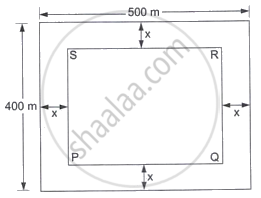
Based on the given information, answer the following questions.
- Write a quadratic equation in x to represent the above information.
- Find the value of x.
- Find the perimeter of rectangle PQRS.
- For what value of x will the area of the path of uniform width be 93600 m2?
R.S. Aggarwal solutions for माठेमटिक्स [इंग्रजी] इयत्ता १० 20 Additional Questions Arithmetic Progression [Pages 993 - 998]
Assertion-and-Reason Type Questions Each question consists of two statements, namely, Assertion (A) and Reason (R). For selecting the correct answer, use the following code:
Assertion (A): The numbers $$a, b, c$$ are in AP if and only if $$2b = (a + c).$$
Reason (R): The sum of the first $$n$$ odd natural numbers is $$n^{2}.$$
Both Assertion (A) and Reason (R) are true and Reason (R) is a correct explanation of Assertion (A).
Both Assertion (A) and Reason (R) are true but Reason (R) is not a correct explanation of Assertion (A).
Assertion (A) is true and Reason (R) is false.
Assertion (A) is false and Reason (R) is true.
Assertion (A): The sum of first n natural numbers is given by $$S_{n} = \frac{1}{2}n(n + 1).$$
Reason (R): In an AP with first term a and common difference d, the sum of n terms is given by $$S_{n} = \frac{n}{2} \times [2a + (n - 1)d].$$
Both Assertion (A) and Reason (R) are true and Reason (R) is a correct explanation of Assertion (A).
Both Assertion (A) and Reason (R) are true but Reason (R) is not a correct explanation of Assertion (A).
Assertion (A) is true and Reason (R) is false.
Assertion (A) is false and Reason (R) is true.
Assertion (A): The sum of first n even natural numbers is n(n + 1).
Reason (R): The sum of n terms of an AP with first term a and last term $$l$$ is $$S_{n} = \frac{n}{2},(a + l).$$
Both Assertion (A) and Reason (R) are true and Reason (R) is a correct explanation of Assertion (A).
Both Assertion (A) and Reason (R) are true but Reason (R) is not a correct explanation of Assertion (A).
Assertion (A) is true and Reason (R) is false.
Assertion (A) is false and Reason (R) is true.
Assertion (A): The 9th term of the AP 37, 33, 29, 25, ... is –5.
Reason (R): The nth term of the AP with first term a and common difference d is given by $$T_{n} = a + (n - 1)d.$$
Both Assertion (A) and Reason (R) are true and Reason (R) is a correct explanation of Assertion (A).
Both Assertion (A) and Reason (R) are true but Reason (R) is not a correct explanation of Assertion (A).
Assertion (A) is true and Reason (R) is false.
Assertion (A) is false and Reason (R) is true.
Assertion (A): The 10th term from the end of the AP 16, 11, 6, 1, ..., –79 is –34.
Reason (R): The nth term from the end of an AP with last term $$l$$ and common difference d is $${\{l - (n - 1)d}\}.$$
Both Assertion (A) and Reason (R) are true and Reason (R) is a correct explanation of Assertion (A).
Both Assertion (A) and Reason (R) are true but Reason (R) is not a correct explanation of Assertion (A).
Assertion (A) is true and Reason (R) is false.
Assertion (A) is false and Reason (R) is true.
Assertion (A): 47 + 45 + 43 + ... + 11 is an AP having 19 terms.
Reason (R): In an AP with first term a and common difference d, the nth term is given by $$T_{n} = a + (n - 1)d.$$
Both Assertion (A) and Reason (R) are true and Reason (R) is a correct explanation of Assertion (A).
Both Assertion (A) and Reason (R) are true but Reason (R) is not a correct explanation of Assertion (A).
Assertion (A) is true and Reason (R) is false.
Assertion (A) is false and Reason (R) is true.
Assertion (A): In an AP, the first term is 6, the last term is 78 and the sum of the given terms is 630. Then, there are 16 terms in the given AP.
Reason (R): If a is the first term, $$l$$ is the last term and n is the number of terms in an AP then $$S_{n} = \frac{n}{2} (a + l).$$
Both Assertion (A) and Reason (R) are true and Reason (R) is a correct explanation of Assertion (A).
Both Assertion (A) and Reason (R) are true but Reason (R) is not a correct explanation of Assertion (A).
Assertion (A) is true and Reason (R) is false.
Assertion (A) is false and Reason (R) is true.
Assertion (A): The next term of the AP $$\sqrt{3},\ \sqrt{12},\ \sqrt{27},\ \ldots$$ is $$\sqrt{48}.$$
Reason (R): In an AP, we have $$T_{n + 1} = (T_{n} + d).$$
Both Assertion (A) and Reason (R) are true and Reason (R) is a correct explanation of Assertion (A).
Both Assertion (A) and Reason (R) are true but Reason (R) is not a correct explanation of Assertion (A).
Assertion (A) is true and Reason (R) is false.
Assertion (A) is false and Reason (R) is true.
Assertion (A): In an AP, it is given that $$T_{9} = 39$$ and $$T_{15} = 63.$$ Then, its first term is 7 and the common difference is 4.
Reason (R): In an AP with first term a and common difference d, the nth term is given by $$T_{n} = a + (n - 1)d.$$
Both Assertion (A) and Reason (R) are true and Reason (R) is a correct explanation of Assertion (A).
Both Assertion (A) and Reason (R) are true but Reason (R) is not a correct explanation of Assertion (A).
Assertion (A) is true and Reason (R) is false.
Assertion (A) is false and Reason (R) is true.
Assertion (A): The sum of 14 terms of the AP 7 + 10 + 13 + ... is 375.
Reason (R): The sum of n terms of an AP with first term a and common difference d is given by $$S_{n} = \frac{n}{2} \cdot {\{2a + (n - 1)d}\}.$$
Both Assertion (A) and Reason (R) are true and Reason (R) is a correct explanation of Assertion (A).
Both Assertion (A) and Reason (R) are true but Reason (R) is not a correct explanation of Assertion (A).
Assertion (A) is true and Reason (R) is false.
Assertion (A) is false and Reason (R) is true.
Case-Based Questions
|
Sanjana being a plant lover decides to convert her balcony into a beautiful garden full of plants. She bought few plants with pots for her balcony. She placed the pots in such a way that the number of pots in the first row is 2, second row is 5, third row is 8, and so on. |
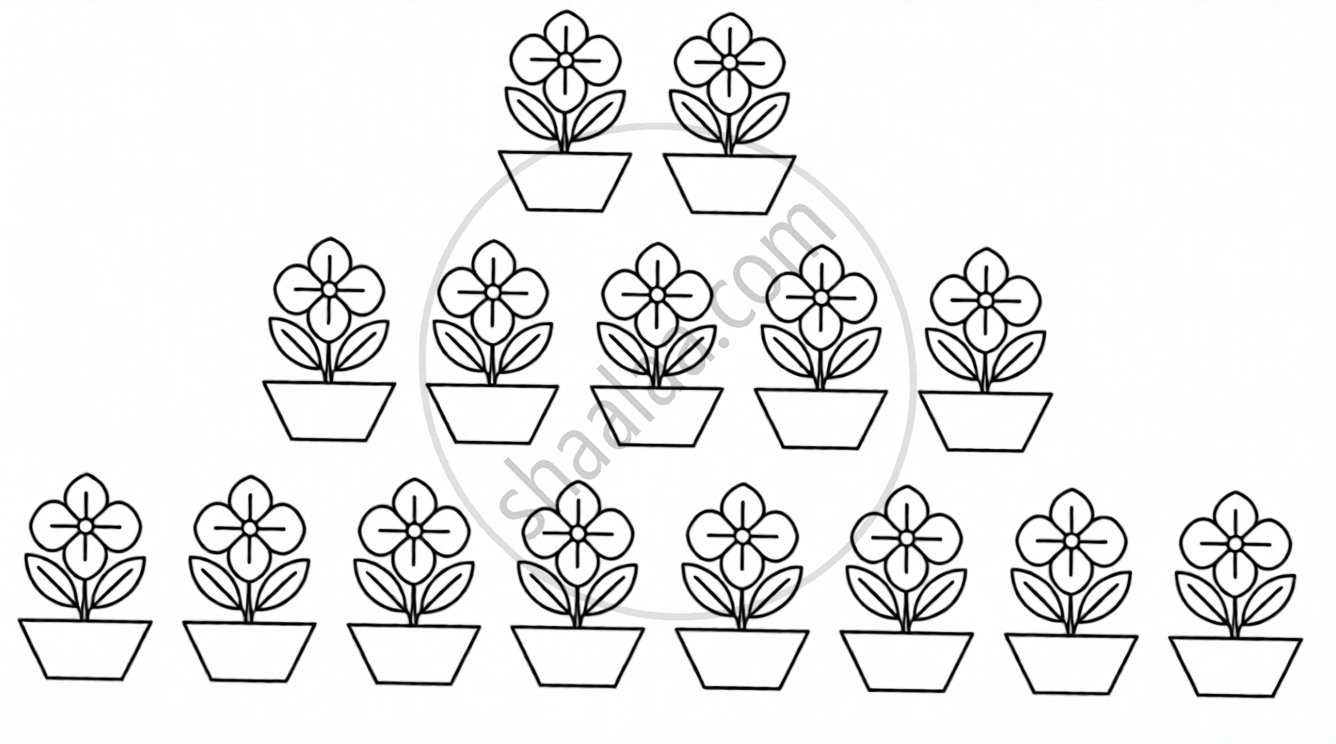
Based on the given information, answer the following questions.
- Find the number of pots placed in the 10th row.
- Find the difference in the number of pots placed in the 5th row and the 2nd row.
- If Sanjana wants to place 100 pots in total then find the total number of rows formed in the arrangement.
- If Sanjana has sufficient space for 12 rows then how many total number of pots are placed by her with the same arrangement?
| India is a competitive manufacturing location due to low manpower costs and strong technical and engineering capabilities, which contribute to higher-quality production runs. The production of TV sets in a factory increases uniformly by a fixed number every year. It produced 16000 sets in the 6th year and 22600 sets in the 9th year. |
Based on the above information, answer the following questions.
- In which year will the factory produce 29200 sets?
- Find the production during the 8th year.
- Find the production during the first 3 years.
- Find the difference in production during the 7th year and the 4th year.
| A school auditorium has to be constructed to accommodate at least 1500 people. The chairs are to be placed in a concentric circular arrangement in such a way that each succeeding circular row has 10 seats more than the previous one. |
Based on the above information, answer the following questions.
- If the first circular row has 30 seats then how many seats will there be in the 10th row?
- For 1500 seats, how many rows must the auditorium have?
- If 1500 seats are to be arranged in the auditorium, how many seats are still left to be put after the 10th row?
- If there were 17 rows in the auditorium, how many seats would be in the middle row?
| Ravindra took a loan of ₹3,45,000 from a bank to buy a car and decided to pay back by ₹2,000 at the end of the first month and then increased the instalment amount by ₹200 each month. |
Based on the given information, answer the following questions.
- Find the amount paid by him in the 10th instalment.
- Find the total amount paid by him in the first 10 instalments.
- In how many instalments would he clear his total loan?
- What amount will he be able to clear in his first 45 instalments?
|
A fashion designer is designing a fabric pattern. In each row, there are some shaded squares and unshaded triangles.
|
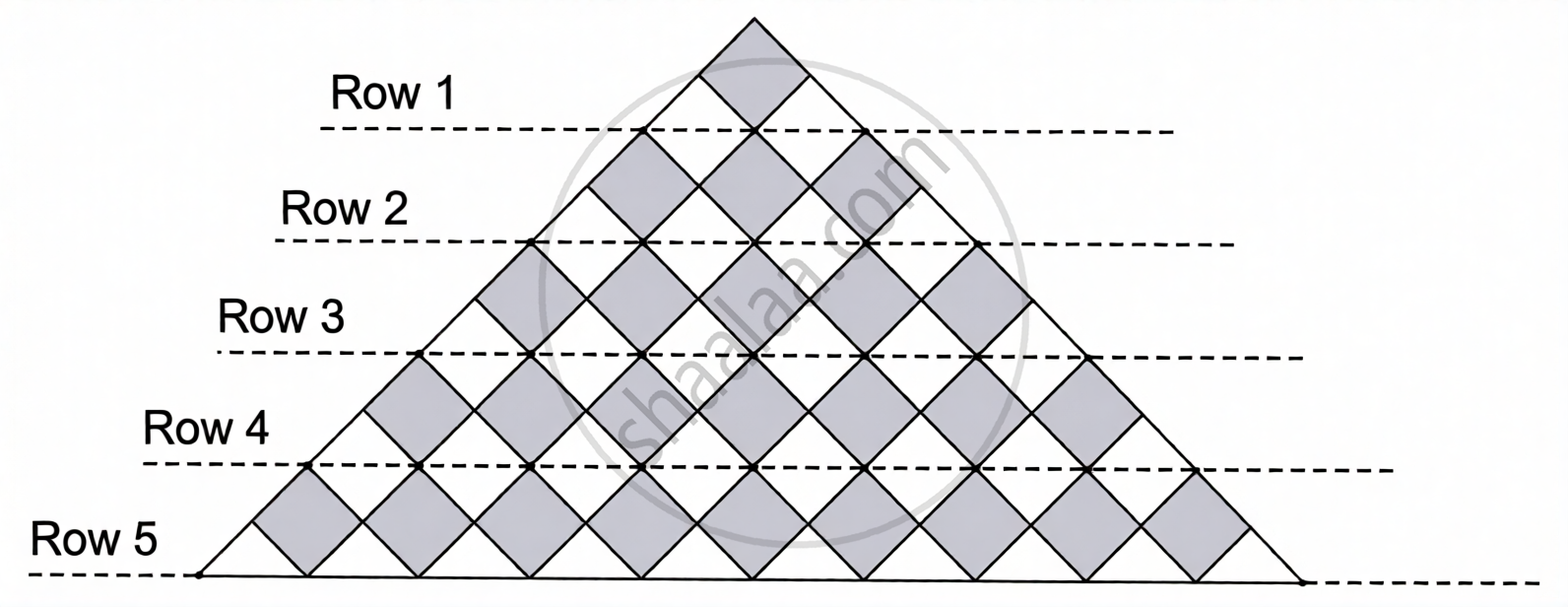
Based on the given figure, answer the following questions.
- Identify the AP for the number of squares in each row.
- Identify the AP for the number of triangles in each row.
- If each shaded square is of side 2 cm then find the shaded area when 15 rows have been designed.
- Write a formula for finding the total number of triangles in n number of rows. Hence, find \(S_{10}\).
Solutions for 20: Additional Questions
R.S. Aggarwal solutions for माठेमटिक्स [इंग्रजी] इयत्ता १० chapter 20 - Additional Questions
Shaalaa.com has the CBSE, Karnataka Board Mathematics माठेमटिक्स [इंग्रजी] इयत्ता १० CBSE, Karnataka Board solutions in a manner that help students grasp basic concepts better and faster. The detailed, step-by-step solutions will help you understand the concepts better and clarify any confusion. R.S. Aggarwal solutions for Mathematics माठेमटिक्स [इंग्रजी] इयत्ता १० CBSE, Karnataka Board 20 (Additional Questions) include all questions with answers and detailed explanations. This will clear students' doubts about questions and improve their application skills while preparing for board exams.
Further, we at Shaalaa.com provide such solutions so students can prepare for written exams. R.S. Aggarwal textbook solutions can be a core help for self-study and provide excellent self-help guidance for students.
Concepts covered in माठेमटिक्स [इंग्रजी] इयत्ता १० chapter 20 Additional Questions are .
Using R.S. Aggarwal माठेमटिक्स [इंग्रजी] इयत्ता १० solutions Additional Questions exercise by students is an easy way to prepare for the exams, as they involve solutions arranged chapter-wise and also page-wise. The questions involved in R.S. Aggarwal Solutions are essential questions that can be asked in the final exam. Maximum CBSE, Karnataka Board माठेमटिक्स [इंग्रजी] इयत्ता १० students prefer R.S. Aggarwal Textbook Solutions to score more in exams.
Get the free view of Chapter 20, Additional Questions माठेमटिक्स [इंग्रजी] इयत्ता १० additional questions for Mathematics माठेमटिक्स [इंग्रजी] इयत्ता १० CBSE, Karnataka Board, and you can use Shaalaa.com to keep it handy for your exam preparation.
