Advertisements
Advertisements
प्रश्न
|
Sanjana being a plant lover decides to convert her balcony into a beautiful garden full of plants. She bought few plants with pots for her balcony. She placed the pots in such a way that the number of pots in the first row is 2, second row is 5, third row is 8, and so on. |
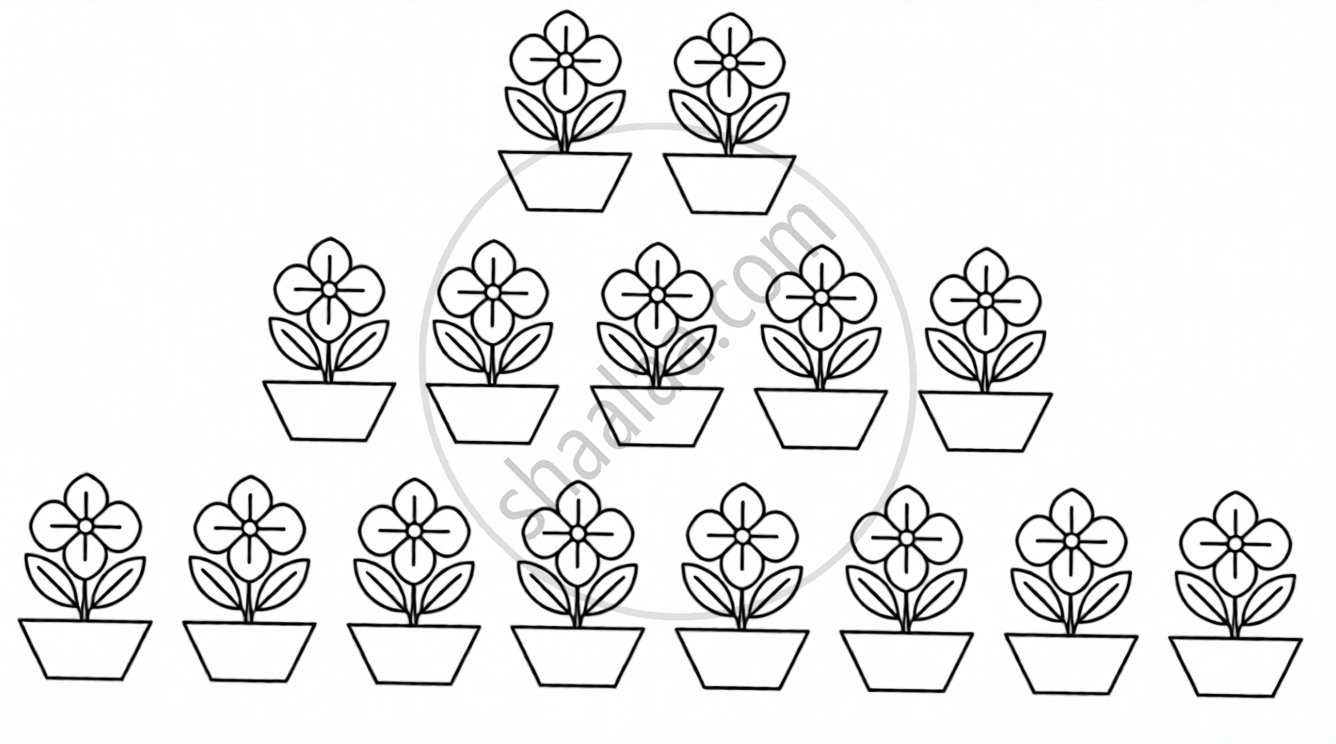
Based on the given information, answer the following questions.
- Find the number of pots placed in the 10th row.
- Find the difference in the number of pots placed in the 5th row and the 2nd row.
- If Sanjana wants to place 100 pots in total then find the total number of rows formed in the arrangement.
- If Sanjana has sufficient space for 12 rows then how many total number of pots are placed by her with the same arrangement?
Advertisements
उत्तर
From the given situation, the number of pots arranged in successive rows are: \[2, 5, 8, \ldots\]
This sequence forms an Arithmetic Progression (AP) where:
First term, \[a = 2\]
Common difference, \[d = 5 - 2 = 3\]
i. Number of pots placed in the 10th row:
Formula: \[T_n = a + (n - 1)d\]
Substitution: \[T_{10} = 2 + (10 - 1) \times 3\]
Calculation: \[T_{10} = 2 + 9 \times 3\] \[T_{10} = 2 + 27 = 29\]
29 pots are placed in the 10th row.
ii. Difference in the number of pots placed in the 5th row and the 2nd row:
Calculation: \[T_5 - T_2 = [a + (5 - 1)d] - [a + (2 - 1)d]\]
\[T_5 - T_2 = (a + 4d) - (a + d) = 3d\]
\[T_5 - T_2 = 3 \times 3 = 9\]
The difference is 9 pots.
iii. Total number of rows formed if Sanjana places 100 pots:
Given: Total sum \[S_n = 100\]
Formula: \[S_n = \frac{n}{2}[2a + (n - 1)d]\]
Substitution and Calculation: \[100 = \frac{n}{2}[2(2) + (n - 1)3]\]
\[200 = n[4 + 3n - 3]\]
\[200 = n(3n + 1)\]
\[3n^2 + n - 200 = 0\]
Factoring by splitting the middle term: \[3n^2 + 25n - 24n - 200 = 0\]
\[n(3n + 25) - 8(3n + 25) = 0\]
\[(3n + 25)(n - 8) = 0\]
\[n = -\frac{25}{3} \quad \text{or} \quad n = 8\]
Since the number of rows (n) must be a positive integer, we discard \(n = -\frac{25}{3}\).
Total number of rows formed is 8.
iv. Total number of pots placed in 12 rows:
Given: \[n = 12\]
Formula: \[S_n = \frac{n}{2}[2a + (n - 1)d]\]
Substitution and Calculation: \[S_{12} = \frac{12}{2}[2(2) + (12 - 1)3]\]
\[S_{12} = 6 \times [4 + 11 \times 3]\]
\[S_{12} = 6 \times (4 + 33)\]
\[S_{12} = 6 \times 37 = 222\]
The total number of pots placed is 222 pots.
