Advertisements
Advertisements
Question
|
A fashion designer is designing a fabric pattern. In each row, there are some shaded squares and unshaded triangles.
|
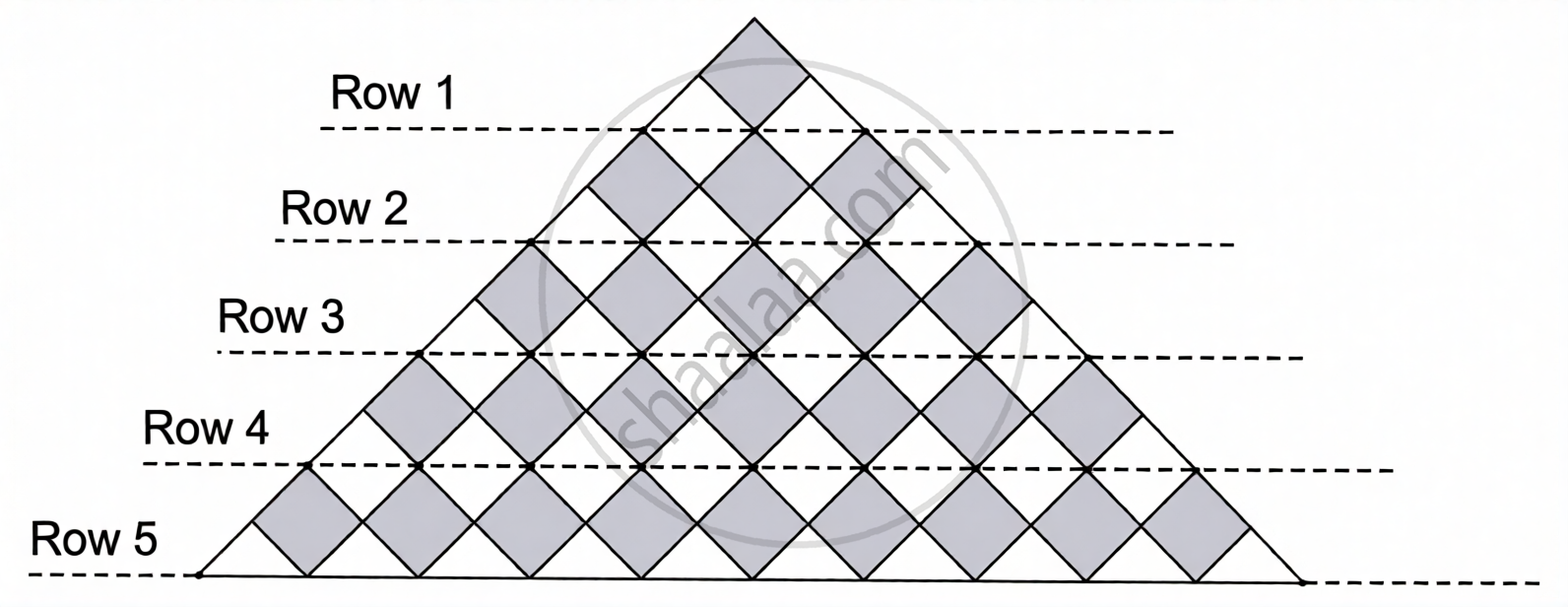
Based on the given figure, answer the following questions.
- Identify the AP for the number of squares in each row.
- Identify the AP for the number of triangles in each row.
- If each shaded square is of side 2 cm then find the shaded area when 15 rows have been designed.
- Write a formula for finding the total number of triangles in n number of rows. Hence, find \(S_{10}\).
Advertisements
Solution
From the given fabric pattern, we observe each row from top to bottom:
Row 1: 1 square, 2 triangles
Row 2: 3 squares, 6 triangles
Row 3: 5 squares, 10 triangles
Row 4: 7 squares, 14 triangles
i. AP for the number of squares in each row:
The sequence representing squares in each row is: \[1, 3, 5, 7, \ldots\]
Here, first term \[a = 1\], common difference \[d = 3 - 1 = 2\].
\[1, 3, 5, 7, \ldots\]
ii. AP for the number of triangles in each row:
The sequence representing triangles in each row is: \[2, 6, 10, 14, \ldots\]
Here, first term [a = 2], common difference \[d = 6 - 2 = 4\].
\[2, 6, 10, 14, \ldots\]
iii. Shaded area when 15 rows have been designed:
Total number of squares in 15 rows: \[S_n = \frac{n}{2}[2a + (n - 1)d]\]
For squares: \[a = 1, d = 2, n = 15\]
\[S_{15} = \frac{15}{2}[2(1) + (15 - 1)2]\]
\[= \frac{15}{2}[2 + 28]\]
\[= \frac{15}{2} \times 30\]
\[= 225\]
Alternatively, sum of first n odd positive integers is \[n^2 = 15^2 = 225\].
Area of one square: \[\text{Area} = \text{side}^2 = 2\text{ cm} \times 2\text{ cm} = 4\text{ cm}^2\]
Total shaded area: \[\text{Total Area} = 225 \times 4\text{ cm}^2 = 900\text{ cm}^2\]
The total shaded area is \[900\text{ cm}^2\].
iv. Formula for total triangles in n rows and \(S_{10}\):
For triangles: \[a = 2, d = 4\]
\[S_n = \frac{n}{2}[2(2) + (n - 1)4]\]
\[S_n = \frac{n}{2}[4 + 4n - 4]\]
\[= \frac{n}{2}[4n]\]
\[= 2n^2\]
Finding \(S_{10}\): \[S_{10} = 2(10)^2\]
\[= 2 \times 100\]
\[= 200\]
Note: If taking single-row triangular units as \[1, 3, 5, \ldots\], sum is \[n^2 = 100\]; for the AP \[2, 6, 10, \ldots\],
\[S_{10} = 200\]
Formula is \[S_n = 2n^2\] or \[n^2\] for pairs, giving \[S_{10} = 100\].
