Advertisements
Advertisements
Question
| We have all seen aeroplanes flying in the sky, but we might not have thought of how they actually reached the correct destination. Air Traffic Control (ATC) is a service provided by ground-based air traffic controllers who direct an aircraft on the ground and through a given section of controlled airspace and can provide advisory services to the aircraft in non-controlled airspace. All this air traffic is managed and regulated using various concepts based on coordinate geometry and trigonometry. At a given instance, ATC finds that the angle of elevation of an aeroplane from a point on the ground is 60°. After a flight of 30 seconds, it is observed that the angle of elevation changes to 30°. The height of the plane remains constant as \(3000 \sqrt{3} \mathrm{~m}\). |
Based on the above information, answer the following questions.
- Draw a neat and well-labelled figure to represent the above information.
- What is the distance travelled by the plane in 30 seconds?
- Keeping the height constant, during the above flight, it was observed that after \(15(\sqrt{3}-1)\) seconds, the angle of elevation changed to \(45^{\circ}\). How much is the distance travelled in that duration?
- What is the speed of the plane in km/hr?
Advertisements
Solution
i. Figure:
Let A be the point of observation on the ground. Let AX be the horizontal line through A. Let P and Q be the two positions of the plane at angles of elevation \(60^\circ\) and \(30^\circ\) respectively. Let \(PB \perp AX\) and \(QC \perp AX\). Then \(PB = QC = 3000\sqrt{3}\) m.
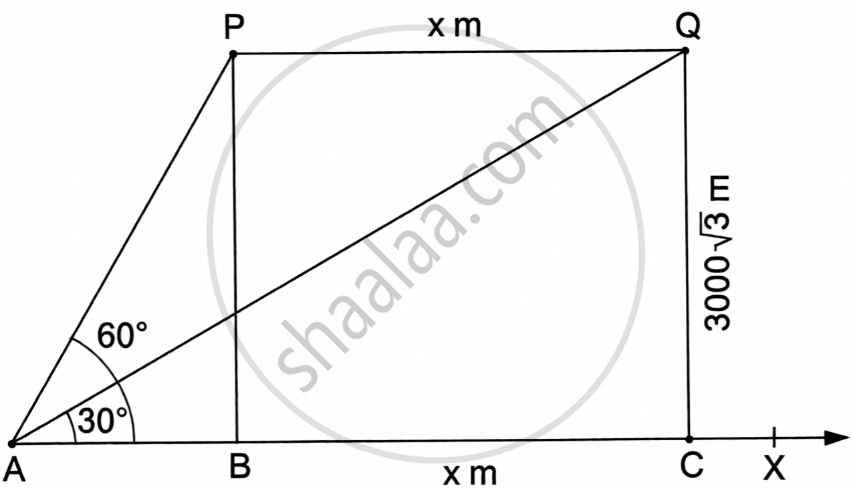
ii. Distance travelled in 30 seconds
In right \(\triangle ABP\): \[\cot 60^\circ = \frac{AB}{PB}\]
\[\Rightarrow \frac{1}{\sqrt{3}} = \frac{AB}{3000\sqrt{3}}\]
\[\Rightarrow AB = 3000 \text{ m}\]
In right \(\triangle ACQ\): \[\cot 30^\circ = \frac{AC}{QC}\]
\[\Rightarrow \sqrt{3} = \frac{AC}{3000\sqrt{3}}\]
\[\Rightarrow AC = 9000 \text{ m}\]
Therefore, \[PQ = BC = AC - AB\]
\[= 9000 - 3000\]
\[= 6000 \text{ m}\]
iii. Distance travelled in \(15(\sqrt{3}-1)\) seconds when angle is 45°
Let D be the point on the ground beneath the plane when the angle of elevation is \(45^\circ\). Let the plane be at R such that \(DR \perp AX\) and \(DR = 3000\sqrt{3}\) m.
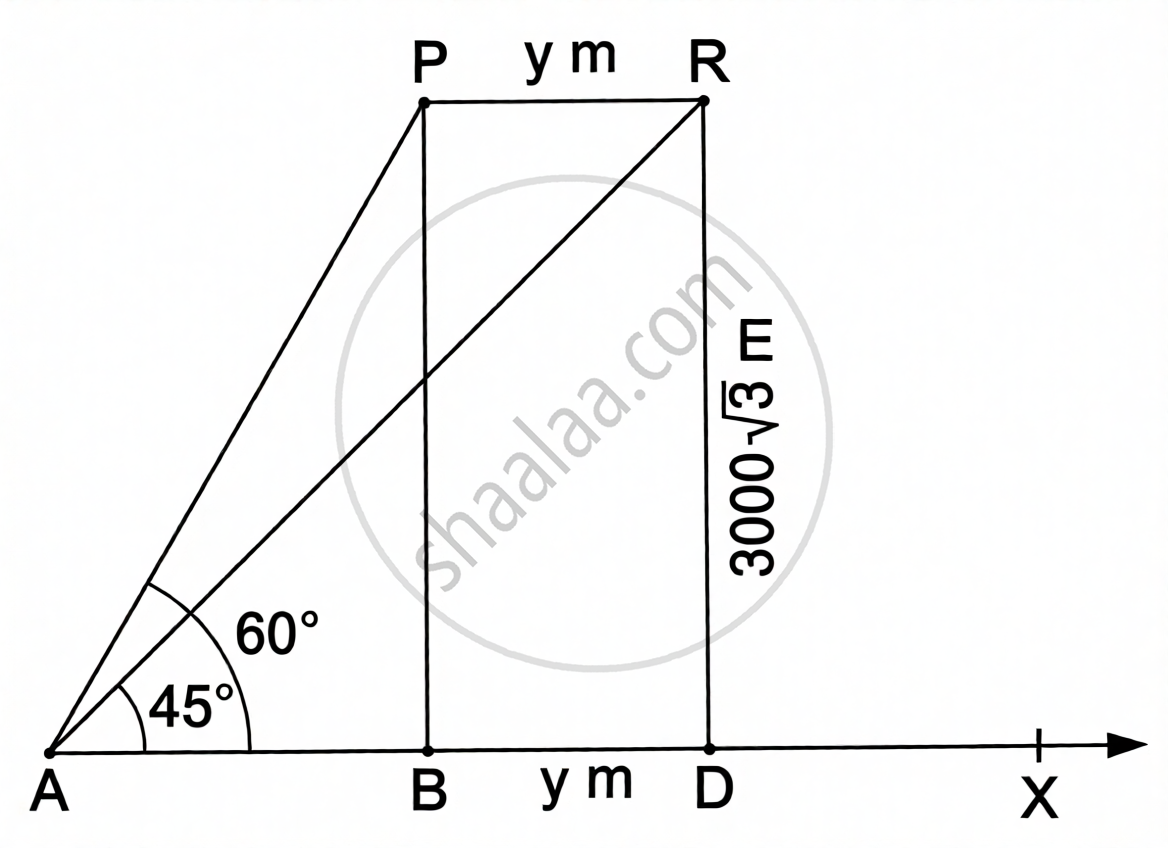
In right \(\triangle ADR\): \[\cot 45^\circ = \frac{AD}{DR}\]
\[\Rightarrow 1 = \frac{AD}{3000\sqrt{3}}\]
\[\Rightarrow AD = 3000\sqrt{3} \text{ m}\]
Distance travelled PR = \[BD = AD - AB\]
\[= 3000\sqrt{3} - 3000\]
\[= 3000(\sqrt{3} - 1)\] m.
iv. Speed of the plane
From (ii), distance 6000 m is covered in 30 s.
\[\text{Speed} = \frac{6000 \text{ m}}{30 \text{ s}} = 200 \text{ m/s}\].
Convert to km/hr: \[200 \times \frac{18}{5} = 720 \text{ km/hr}\].
