Advertisements
Advertisements
State the factors on which the strength of electric current flowing in a given conductor depends.
Concept: undefined >> undefined
An electric circuit consisting of a 0.5 m long nichrome wire XY, an ammeter, a voltmeter, four cells of 1.5 V each and a plug key was set up.
(i) Draw a diagram of this electric circuit to study the relation between the potential difference maintained between the points 'X' and 'Y' and the electric current flowing through XY.
Concept: undefined >> undefined
Advertisements
An electric circuit consisting of a 0.5 m long nichrome wire XY, an ammeter, a voltmeter, four cells of 1.5 V each and a plug key was set up.
Following graph was plotted between V and I values:
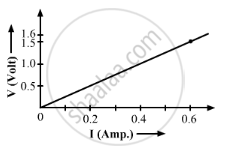
What would be the values of `V/I` rations when the potential difference is 0.8 V, 1.2 V and 1.6 V respectively?
What conclusion do you draw from these values?
What is the resistance of the wire?
Concept: undefined >> undefined
The p.d. across a 3 Ω resistor is 6 V. The current flowing in the resistor will be:
(a) `1/2A`
(b) 1 A
(c) 2 A
(d) 6 A
Concept: undefined >> undefined
A car headlight bulb working on a 12 V car battery draws a current of 0.5 A. The resistance of the light bulb is:
Concept: undefined >> undefined
A battery of 9 V is connected in series with resistors of 0.2 Ω, 0.3 Ω, 0.4 Ω, 0.5 Ω and 12 Ω. How much current would flow through the 12 Ω resistor?
Concept: undefined >> undefined
An electric bulb of resistance 20 Ω and a resistance wire of 4 Ω are connected in series with a 6 V battery.
Draw the circuit diagram, and calculate:
(a) total resistance of the circuit.
(b) current through the circuit.
(c) potential difference across the electric bulb.
(d) potential difference across the resistance wire.
Concept: undefined >> undefined
Three resistors are connected as shown in the diagram.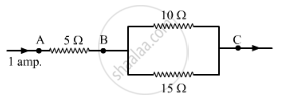
Through the resistor 5 ohm, a current of 1 ampere is flowing.
(i) What is the current through the other two resistors?
(ii) What is the p.d. across AB and across AC?
(iii) What is the total resistance
Concept: undefined >> undefined
The circuit diagram given below shows the combination of three resistors R1, R2 and R3:
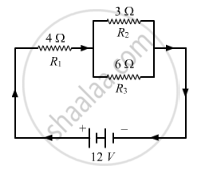
Find :
(i) total resistance of the circuit.
(ii) total current flowing in the circuit.
(iii) the potential difference across R1.
Concept: undefined >> undefined
In the circuit diagram given below five resistances of 10 Ω, 40 Ω, 30 Ω, 20 Ω, and 60 Ω are connected as shown to a 12 V battery.
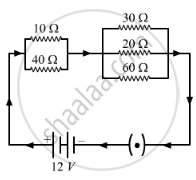
Calculate:
(a) total resistance in the circuit.
(b) total current flowing in the circuit.
Concept: undefined >> undefined
In the circuit diagram given below, three resistors R1, R2, and R3 of 5 Ω, 10 Ω and 30 Ω, respectively are connected as shown
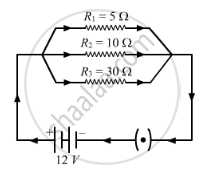
Calculate:
- current through each resistor.
- total current in the circuit.
- total resistance in the circuit.
Concept: undefined >> undefined
A p.d. of 6 V is applied to two resistors of 3 Ω and 6 Ω connected in parallel. Calculate:
(a) the combined resistance
(b) the current flowing in the main circuit
(c) the current flowing in the 3 Ω resistor.
Concept: undefined >> undefined
In the circuit shown below, the voltmeter reads 10 V.
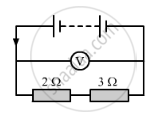
(a) What is the combined resistance?
(b) What current flows?
(c) What is the p.d. across 2 Ω resistor?
(d) What is the p.d. across 3 Ω resistor?
Concept: undefined >> undefined
A 5 V battery is connected to two 20 Ω resistors which are joined together in series.
(a) Draw a circuit diagram to represent this. Add an arrow to indicate the direction of conventional current flow in the circuit.
(b) What is the effective resistance of the two resistors?
(c) Calculate the current that flows from the battery?
(d) What is the p.d. across each resistor?
Concept: undefined >> undefined
The figure given below shows an electric circuit in which current flows from a 6 V battery through two resistors.
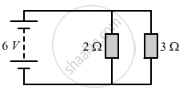
- Are the resistors connected in series with each other or in parallel?
- For each resistors, state the p.d. across it.
- The current flowing from the battery is shared between the two resistors. Which resistor will have bigger share of the current?
- Calculate the effective resistance of the two resistors.
- Calculate the current that flows from the battery.
Concept: undefined >> undefined
(a) With the help of a circuit diagram, obtain the relation for the equivalent resistance of two resistances connected in parallel.
(b) In the circuit diagram shown below, find:
(i) Total resistance.
(ii) Current shown by the ammeter A
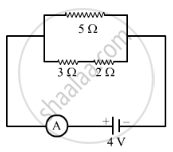
Concept: undefined >> undefined
A battery and three lamps are connected as shown:
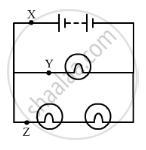
Which of the following statements about the currents at X, Y and Z is correct?
(a) The current at Z is greater than that at Y.
(b) The current at Y is greater than that at Z.
(c) The current at X equals the current at Y.
(d) The current at X equals the current at Z.
Concept: undefined >> undefined
V1, V2 and V3 are the p.ds. across the 1Ω, 2Ω and 3Ω resistors in the following diagram, and the current is 5 A.
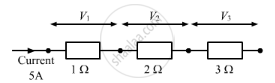
Which one of the columns (a) to (d) shows the correct values of V1, V2 and V3measured in volts?
`V_1` `V_2` `V_3`
(a) 1.0 2.0 3.0
(b) 5.0 10.0 15.0
(c) 5.0 2.5 1.6
(d) 4.0 4.0 2.0
Concept: undefined >> undefined
You can given one hundred 1 Ω resistors. What is the smallest and largest resistance you can make in a circuit using these?
Concept: undefined >> undefined
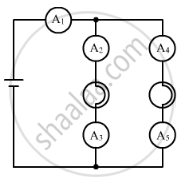
If the lamps are both the same in the figure given below and if A1 reads 0.50 A, what do A2, A3, A4 and A5 read?
Concept: undefined >> undefined
