Definitions [13]
Organic compounds containing one or more hydroxyl (–OH) groups attached to a saturated carbon atom are called alcohols.
Organic compounds containing –OH group directly attached to an aromatic ring are called phenols.
Compounds formed by replacing the hydrogen of hydroxyl group of alcohol or phenol by an alkyl or aryl group are called ethers.
Alcohols containing one hydroxyl group are called monohydric alcohols.
Alcohols containing two hydroxyl groups are called dihydric alcohols.
Alcohols containing three hydroxyl groups are called trihydric alcohols.
An alcohol in which the –OH group is attached to a primary carbon atom is called primary alcohol.
An alcohol in which the –OH group is attached to a secondary carbon atom is called secondary alcohol.
An alcohol in which the –OH group is attached to a tertiary carbon atom is called tertiary alcohol.
The reaction in which phenol reacts with carbon dioxide in presence of sodium hydroxide is called Kolbe’s reaction.
The reaction in which phenol reacts with chloroform and sodium hydroxide to introduce –CHO group at ortho position is called Reimer–Tiemann reaction.
The preparation of ethers by reacting alkyl halide with sodium alkoxide is called Williamson synthesis.
The reaction in which alcohol reacts with carboxylic acid to form ester is called esterification reaction.
Key Points
- Alcohols: Compounds with one or more –OH groups attached directly to a carbon chain. General formula: C₂H₂ₙ₊₁OH.
- Phenols: Compounds where –OH group is directly bonded to an aromatic (benzene) ring.
- Ethers: Compounds with general formula R–O–R'. If R = R', it is a symmetrical ether; if R ≠ R', it is an unsymmetrical ether.
Types of Alcohols
| Type | Meaning | Position of —OH |
|---|---|---|
| Allylic Alcohol | —OH attached to sp³-hybridised carbon next to C=C double bond | Carbon next to C=C |
| Benzylic Alcohol | —OH attached to sp³-hybridised carbon next to aromatic ring | Benzylic carbon |
| Vinylic Alcohol | —OH attached directly to a vinylic carbon (CH₂=CH—) or aryl carbon | On C=C bond |
Classification of Alcohols
Based on number of —OH groups
| Type | —OH Groups | Example |
|---|---|---|
| Monohydric | 1 | Ethanol (CH₃CH₂OH) |
| Dihydric | 2 | Ethylene glycol (CH₂OH–CH₂OH) |
| Trihydric | 3 | Glycerol |
| Polyhydric | More than 3 | Glucose |
Based on hybridisation of carbon bearing —OH (Monohydric only):
| Type | Description | Example |
|---|---|---|
| Primary (1°) | —OH on primary carbon | R–CH₂–OH |
| Secondary (2°) | —OH on secondary carbon | R–CH(OH)–R |
| Tertiary (3°) | —OH on tertiary carbon | R–C(OH)(R)–R |
| Allylic | —OH on sp³ carbon next to C=C | CH₂=CH–CH₂OH |
| Vinylic | —OH directly on sp² carbon of C=C | CH₂=CH–OH |
| Benzylic | —OH on sp³ carbon next to aromatic ring | C₆H₅–CH₂–OH |
Classification of Phenols
| Type | —OH Groups | Example |
|---|---|---|
| Monohydric | 1 | Phenol |
| Dihydric | 2 | Catechol (Benzene-1,2-diol) |
| Trihydric | 3 | Phloroglucinol (Benzene-1,3,5-triol) |
Classification of Ethers
| Type | Description | Example |
|---|---|---|
| Simple / Symmetrical | Same alkyl/aryl groups on both sides of O | CH₃–O–CH₃ (Dimethyl ether), C₆H₅–O–C₆H₅ (Diphenyl ether) |
| Mixed / Unsymmetrical | Different alkyl/aryl groups on both sides of O | CH₃–O–C₂H₅ (Ethyl methyl ether), C₂H₅–O–C₆H₅ (Ethyl phenyl ether) |
- Alcohol names are derived from alkanes by replacing ‘e’ with ‘ol’ (e.g., methane → methanol).
- In alcohols, the longest chain containing –OH is selected and numbered to give the lowest locant to the –OH group.
- Phenol is the simplest aromatic alcohol; substituted phenols use ortho (1,2), meta (1,3), and para (1,4) positions.
- Ethers are named as alkoxyalkanes in IUPAC; the smaller group becomes the alkoxy prefix.
- Common names: Alcohol → alkyl + alcohol, Ether → alkyl groups + ether
- Alcohols: O atom is sp³ hybridised; two bond pairs + two lone pairs; bent structure.
- Phenols: –OH directly on benzene ring; lone pair on O delocalised into ring → more acidic than alcohols.
- Ethers: O is sp³ hybridised. Two O–C sigma bonds + two lone pairs. Structure similar to water molecule. Bent/angular shape.
- Intermolecular Forces — Alcohols and phenols are polar; –OH groups form strong hydrogen bonding.
- Boiling Point — Increases with molecular mass; decreases with branching (n-butyl > isobutyl > sec-butyl > tert-butyl).
- Solubility — Phenols and lower alcohols (≤3 C) are water-soluble via H-bonding with water.
- Phenol is less soluble than alcohols due to the large hydrophobic benzene ring.
- Lower alcohols are colourless liquids, higher ones become waxy solids.
- Phenols are crystalline solids with a characteristic odour and higher boiling points.
- Kolbe's & Reimer–Tiemann — Phenoxide + CO₂/H⁺ → salicylic acid; + CHCl₃/NaOH → salicylaldehyde (electrophile: CCl₂).
- Oxidation/Reduction of Phenol — Na₂Cr₂O₇/H₂SO₄ → p-benzoquinone; 3H₂/Ni/433 K → cyclohexanol; Zn → benzene.
Methanol (Wood Spirit):
-
Produced by catalytic hydrogenation of CO:
\[\ce{CO + 2H2 ->[ZnO/Cr2O3, 200-300atm, 573-673K] CH3OH}\]
-
Highly poisonous; used as a solvent in paints and varnishes.
Ethanol:
-
Produced by fermentation of sugar:
\[\ce{C12H22O11 + H2O ->[Invertase] \underset{Glucose}{C6H12O6} + \underset{Fructose}{C6H12O6}}\]
-
Used as a solvent and in the preparation of carbon compounds.
Differentiation between Methanol & Ethanol:
-
Iodoform test: Ethanol gives yellow ppt (CHI₃); methanol gives no reaction.
-
With salicylic acid + H₂SO₄: Methanol forms methyl salicylate (characteristic odour); ethanol gives no specific odour.
-
Williamson Synthesis (most important): R–O–Na + X–R' → R–O–R' + NaX. Primary alkyl halide is preferred (SN2 mechanism; 2° or 3° alkyl halide gives elimination).
-
Acid-catalysed dehydration of alcohols:
\[\ce{2R - OH ->[H2SO4, 413K] R - O - R + H2O}\]
(works best for symmetrical ethers)
-
From alcohols by catalytic dehydration:
\[\ce{2C2H5OH ->[Al2O3, 513-523K] C2H5 - O - C2H5 + H2O}\]
-
Alkoxy mercuration-demercuration: \[\begin{array}{cc}
\phantom{}\ce{CH3 - CH = CH2 + C2H5OH + Hg(OCOCF3)2 -> CH3 - CH - CH2 - HgOCOCF3 ->[NaBH4/OH^{-}] CH3 - CH - CH3}\\
\phantom{................................................................................}|\phantom{.....................................................................}|\phantom{.}\\
\phantom{............................................................................................}\ce{OC2H5}\phantom{...........................................................}\ce{O-C2H5}\phantom{.}
\end{array}\]
- Colourless liquids (except dimethyl ether and diethyl ether, which are gases).
- Polar due to bent structure (like a water molecule).
- Low boiling point due to the absence of H-bonding between ether molecules.
- Slightly soluble in water due to H-bonding with water; more soluble in organic solvents.
- Structure: O is sp³ hybridised; two sp³ orbitals form O–C sigma bonds; two sp³ orbitals have lone pairs.
- Methods of preparation of ethers: Acid-catalysed dehydration of alcohols (conc. H₂SO₄, 443 K); catalytic dehydration (Al₂O₃, 250°C); Williamson synthesis (alkyl halide + sodium alkoxide, Sₙ2); reaction of alkyl halides with dry Ag₂O.
- Preparation of Diethyl Ether (Simple Ether): From ethanol using conc. H₂SO₄ / H₃PO₄ at 413 K; or by Williamson's synthesis from C₂H₅ONa + BrCH₂CH₃ under heat.
- Reactions of Diethyl Ether: O₂ (long contact) → peroxide; dil. H₂SO₄ → 2 C₂H₅OH; PCl₅ → C₂H₅OH + C₂H₅Cl; hot HI → C₂H₅I + C₂H₅OH; excess HI → 2 C₂H₅I.
- Preparation of Anisole (Mixed Ether): CH₃Br + sodium phenoxide (C₆H₅ONa) → Methyl phenyl ether (Anisole) on heating.
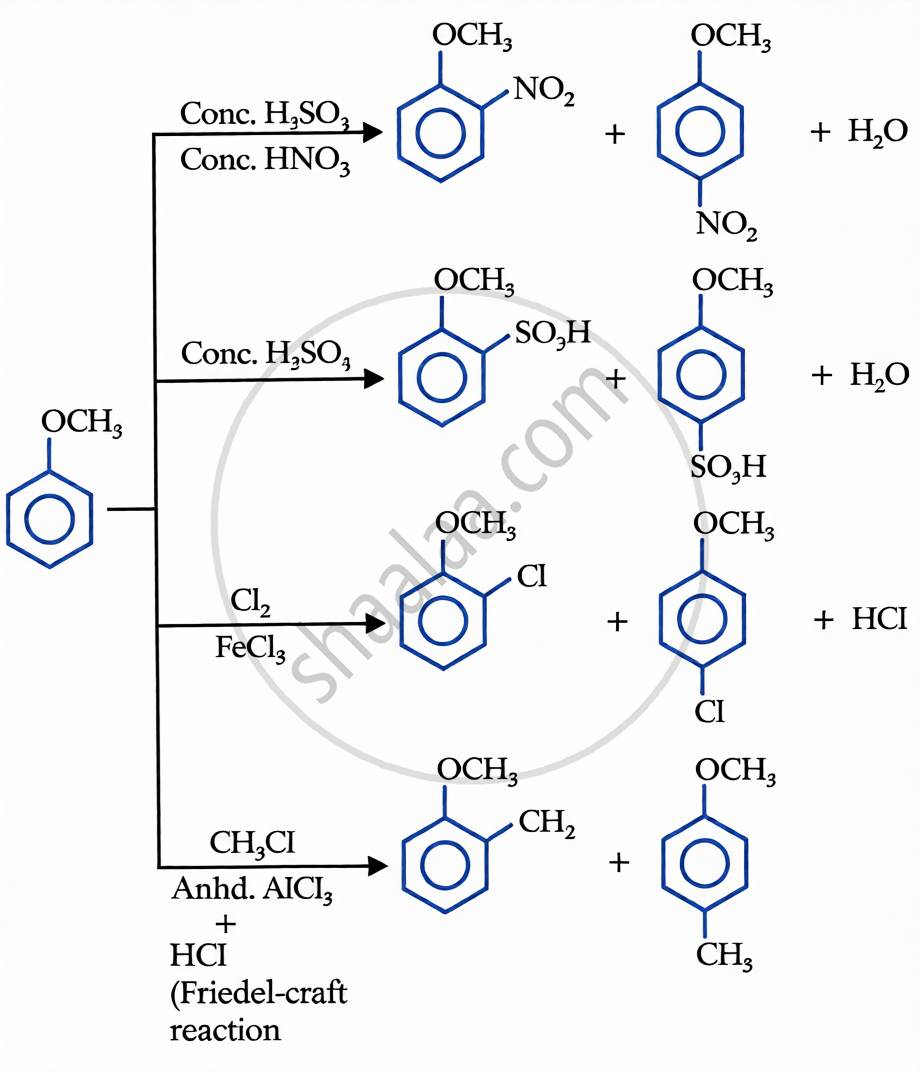
- Reactions of Anisole: HI (398 K) → phenol + CH₃I; Br₂/CH₃COOH → p-bromoanisole (major) + o-bromoanisole (minor); conc. HNO₃ + conc. H₂SO₄ → 4-nitroanisole (major) + 2-nitroanisole (minor); CH₃Cl/AlCl₃ → 4-methoxytoluene (major) + 2-methoxytoluene (minor); CH₃COCl/AlCl₃ → 4-methoxyacetophenone (major) + 2-methoxyacetophenone (minor).
- Ethers are generally very unreactive (no H-bonding between ether molecules).
- When excess HX is added → C–O bond cleaves → alkyl halides.
- Reactivity of HX: HI > HBr > HCl
- If 1° or 2° alkyl groups: Smaller alkyl group forms alkyl iodide. (e.g., C₂H₅–O–CH₃ + HI → C₂H₅OH + CH₃I)
- If one alkyl group is 3°: Forms tertiary alkyl halide (SN1 pathway).
Reaction with conc. HI:
- With excess HI: Both groups convert to iodo compounds
- e.g., \[\ce{C2H5OC2H5 + HI ->[Cold] C2H5I + C2H5OH}\]
Substitution Reactions in Aromatic Ether: The alkoxу group in ether activates the aromatic ring at ortho and para positions for electrophilic substitution. Common electrophilic substitution reactions are halogenation, Friedel-Crafts reaction, etc.
Statement:
Ethers are prepared by reacting alkyl halide with sodium alkoxide.
Mechanism:
SN2 reaction.
Best for:
Primary alkyl halides.
Limitation:
Tertiary halides undergo elimination.
Step 1: Protonation of alcohol
Step 2: Formation of carbocation (slow step)
Step 3: Elimination of proton to form alkene
Order:
Tertiary > Secondary > Primary
Due to stability of carbocation.
Statement:
Phenols are more acidic than alcohols due to resonance stabilisation of phenoxide ion.
Reason:
-
Negative charge delocalised in phenoxide ion
-
sp² hybridised carbon increases O–H polarity
Electron withdrawing groups (–NO₂) increase acidity.
Electron donating groups decrease acidity.
Statement:
Alcohols are weak acids due to polar O–H bond and can donate a proton.
Order of acidity:
Primary > Secondary > Tertiary
Reason:
Electron donating alkyl groups decrease polarity of O–H bond.
Alcohols are weaker acids than water.
Statement:
Alcohols and phenols form hydrogen bonds due to presence of –OH group.
Effect:
-
Higher boiling points
-
Greater solubility in water
Step 1: Nucleophilic addition to carbonyl carbon.
Step 2: Hydrolysis of adduct.
Products:
-
With formaldehyde → Primary alcohol
-
With aldehyde → Secondary alcohol
-
With ketone → Tertiary alcohol
Statement:
In hydroboration–oxidation, boron attaches to less substituted carbon and finally OH group appears at less substituted carbon.
Result:
Anti-Markovnikov product.
Characteristic:
Occurs without carbocation rearrangement.
Statement:
In addition of HX or water to an unsymmetrical alkene, hydrogen attaches to the carbon atom having greater number of hydrogen atoms.
Example:
Propene + H₂O → Propan-2-ol (major)
Reason:
Formation of more stable carbocation.
Statement:
Ethers undergo cleavage of C–O bond in presence of concentrated HI or HBr to form alkyl halides.
Mechanism:
Step 1: Protonation of ether oxygen
Step 2: Nucleophilic attack by halide ion
-
Primary ether → SN2 mechanism
-
Tertiary ether → SN1 mechanism
Order of reactivity of HX:
HI > HBr > HCl
Important Questions [59]
- Give Reasons Fluoride Ion Has Higher Hydration Enthalpy than Chloride Ion.
- Write the Iupac Name of the Following Compound: 2-methoxy-2-methylpropane.
- Identify A and B in the following: Br ->[Mg][Dry ether] A ->[H2O] B
- How Do You Convert The Ethanal to Propanone
- Write the Iupac Name of the Following :
- Write the IUPAC name of the given compound
- Write the Structures of the Products When Butan-2-ol Reacts With Socl2
- Write the Structures of the Products When Butan-2-ol Reacts With Cro3
- Write Iupac Name of the Following Compound (Ch3)2 N − Ch2ch3 -dimethylethanamine.
- Why is the C-O bond length in phenols less than that in methanol?
- How Do You Convert the Following : Propan-2-ol to 2-methylpropan-2-ol
- How Will You Convert: Propene to Propan-2-ol?
- Write the structures of the main products when acetone (CH3 − CO − CH3) reacts with the following reagents : CH3MgBr and then H3O+
- How Will You Convert: Phenol to 2, 4, 6 − Trinitrophenol?
- Name the reagents used in the following reactions
- What is meant by hydroboration-oxidation reaction? Illustrate it with an example.
- Write Structures of Main Compounds a and B in Each of the Following Reactions:\ C H 3 C H 2 C N C H 3 M G B R H / 3 O + −−−−−−−−−−−→ a L I a I H 4 −−−−→ B
- Write the Structures of A, B and C in the Following Reactions : C H 3 C I → K C N a → L I a I H B → H N O 2 273 K C
- Write the main product(s) in each of the following reactions CH3-CH=CH2
- Name the Reagents Used in the Following Reactions
- Name the Reagents Used in the Following Reactions
- Write the Structures of Main Products When Benzene Diazonium Chloride (C6 H5 N+2ci−) Reacts with the : Hbf4/∆
- How do you convert the following: Aniline to phenol
- Write the Structures of Main Products When Benzene Diazonium Chloride (C6 H5 N+2ci−) Reacts with the :Cu/Hbr
- What happens when Phenol is oxidised with Na2Cr2O7/H+?
- Why Phenol Undergoes Electrophilic Substitution More Easily than Benzene?
- Write the Equation Involved in the Acetylation of Salicylic Acid.
- Account for the Following: O-nitrophenol is More Steam Volatile than P-nitrophenol.
- Which one of the following has the lowest pKa value?
- For the pair phenol and cyclohexanol, answer the following: Why is phenol more acidic than cyclohexanol?
- Arrange the following in the increasing order of their property indicated: 4-Nitrobenzoic acid, benzoic acid, 3,4-Dinitrobenzoic acid, 4-Methoxy benzoic acid (Acid strength)
- Write the Mechanism of the Following Reaction
- Give reasons for the following: o-nitrophenol is more acidic than o-methoxyphenol.
- Write the Final Product(S) in Each of the Following Reactions
- What happens when (CH3)3 C – OH is heated with Cu/573 K? Write the chemical equation in support of your answer.
- Write the Mechanism of the Following Reaction
- Which of the following alcohols will not undergo oxidation?
- Write the mechanism of the following reaction
- Write the Mechanism (Using Curved Arrow Notation) of the Following Reaction :
- How do you convert the following: Ethanol to Propan-2-ol
- Give Simple Chemical Test to Distinguish Between Ethanol and Phenol.
- Write the Mechanism of the Following Reaction : \\Cec2h5oh->H2so4443kch2=Ch2 + H2o}\
- Which of the following reactions are feasible?
- Write the mechanism of the following reaction: 2CHA3CHA2OH→413KHA+CHA3−CHA2−O−CHA2−CHA3+HA2O
- Write the Structure of 3-bromo-2-methylprop-1-ene
- Write the Equations Involved in the Following Reactions : Williamson Synthesis
- How Do You Convert the Following : Phenol to Anisole
- Explain the mechanism of the following reaction
- Account for the Following : T-butyl Chloride on Heating with Sodium Methoxide Gives 2-methylpropene Instead of T-butyl Methyl Ether.
- Give Simple Chemical Tests to Distinguish Between the Following Pairs of Compounds : Propanol and 2-methylpropan-2-ol
- Write the Product(S) in the Following Reactions - 2
- Write the Formula of Reagents Used in the Following Reactions : Bromination of Phenol to 2,4,6-tribromophenol
- Write the Structures of the Main Products in the Following Reactions : 3
- Write the Main Product(S) in Each of the Following Reactions
- Write the Product(S) in the Following Reaction - 3
- Write the Formula of Reagents Used in the Following Reactions : Hydroboration of Propene and Then Oxidation to Propanol.
- What happens when Anisole is treated with CH3Cl/anhydrous AlCl3?
- Write the equation for the following: Reaction of chlorobenzene with CH3Cl/anhyd. AlCl3.
- Why Phenol Undergoes Electrophilic Substitution More Easily than Benzene?
Concepts [17]
- Concept of Alcohols, Phenols and Ethers
- Classification of Alcohols, Phenols and Ethers
- Nomenclature of Alcohols, Phenols and Ethers
- Structures of Functional Groups of Alcohols, Phenols and Ethers
- Methods of Preparation of Alcohols
- Methods of Preparation of Phenols
- Physical Properties of Alcohols and Phenols
- Chemical Reactions of Alcohols and Phenols
- Reactions Involving Cleavage of O-H Bond
- Reactions Involving Cleavage of Carbon–Oxygen (C–O) Bond in Alcohols
- Reactions of Phenols
- Commercially Importance Alcohols
- Preparation of Ethers
- Physical Properties of Ethers
- Chemical Reaction of Ethers - Cleavege of C-O Bonds
- Chemical Reaction of Ethers - Electrophilic Substitution
- Overview of Alcohols, Phenols and Ethers
