Advertisements
Advertisements
Question
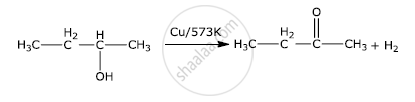
Write the final product(s) in each of the following reactions:

Advertisements
Solution
APPEARS IN
RELATED QUESTIONS
Ortho and para nitrophenols are more acidic than phenol. Draw the resonance structures of the corresponding phenoxide ions.
Name the reagent used in the following reaction:
Oxidation of a primary alcohol to carboxylic acid.
Lucas test is used for the detection of _____________.
Identify the secondary alcohols from the following set:
- \[\ce{CH3CH2CH(OH)CH3}\]
- \[\ce{(C2H5)3COH}\]

The process of converting alkyl halides into alcohols involves ______.
What is Lucas reagent?
Write the mechanism of acid dehydration of ethanol to yield ethene.
Write the mechanism of acid dehydration of ethanol to yield ethene.
Write the mechanism of acid dehydration of ethanol to yield ethene.
Write the mechanism of acid-catalysed dehydration of ethanol to yield ethene
