Advertisements
Advertisements
प्रश्न
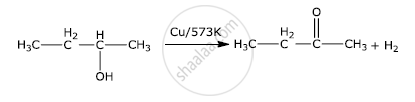
Write the final product(s) in each of the following reactions:

Advertisements
उत्तर
APPEARS IN
संबंधित प्रश्न
Write the mechanism of the following reaction :

Primary and secondary alcohols on the action of reduced copper give:
The compound which gives the most stable carbonium ion on dehydration is:
During dehydration of alcohols to alkenes by heating with cone. H2SO4 the initial step is ____________.
Explain why is OH group in phenols more strongly held as compared to OH group in alcohols.
Assertion: Bond angle in ethers is slightly less than the tetrahedral angle.
Reason: There is a repulsion between the two bulky (–R) groups.
Write the mechanism of acid-catalysed dehydration of ethanol to yield ethene.
Write the mechanism of acid dehydration of ethanol to yield ethene.
Write the mechanism of acid dehydration of ethanol to yield ethene.
Write the mechanism of acid-catalysed dehydration of ethanol to yield ethene.
