Advertisements
Advertisements
प्रश्न
\[\ce{CH3CH2OH}\] can be converted into \[\ce{CH3CHO}\] by ______.
पर्याय
catalytic hydrogenation
treatment with \[\ce{LiAlH4}\]
treatment with pyridinium chlorochromate
treatment with \[\ce{KMnO4}\]
Advertisements
उत्तर
\[\ce{CH3CH2OH}\] can be converted into \[\ce{CH3CHO}\] by treatment with pyridinium chlorochromate.
Explanation:
Alcohols are oxidized to aldehydes and finally to acids.
\[\ce{CH3CH2OH ->[{[O]}] CH3CHO ->[{[O]}] CH3COOH}\]
Oxidations can be stooped at aldehyde stage by using pyridinium chlorochromate
\[\ce{(CrO3C5H5N.HCl)}\].
\[\ce{CH3CH2OH ->[PCC] CH3CHO}\]
APPEARS IN
संबंधित प्रश्न
Give reasons for the following:
o-nitrophenol is more acidic than o-methoxyphenol.
Write the mechanism of the following reaction :

Write the mechanism of the following reaction :

Ortho and para nitrophenols are more acidic than phenol. Draw the resonance structures of the corresponding phenoxide ions.
Give the equation of the following reaction:
Treating phenol with chloroform in the presence of aqueous NaOH.
Write the mechanism of acid-catalysed dehydration of ethanol to yield ethene.
Name the reagent used in the following reaction:
Oxidation of a primary alcohol to carboxylic acid.
When 3-methylbutan-2-ol is treated with HBr, the following reaction takes place:
\[\begin{array}{cc}
\phantom{...................................}\ce{Br}\\
\phantom{..................................}|\\
\ce{CH3 - CH - CH - CH3 ->[HBr] CH3 - C - CH2 - CH3}\\
|\phantom{.........}|\phantom{...................................}|\phantom{...........}\\
\ce{CH3}\phantom{...}\ce{OH}\phantom{...............................}\ce{CH3}\phantom{.......}\\
\end{array}\]
Give a mechanism for this reaction.
(Hint: The secondary carbocation formed in step II rearranges to a more
stable tertiary carbocation by a hydride ion shift from 3rd carbon atom.)
Write the mechanism (using curved arrow notation) of the following reaction :

In the reduction \[\ce{R - CHO + H2 -> RCH2OH}\] the catalyst used is:
Dehydration of 2-butanol yields:
Which of the following is not true in case of reaction with heated copper at 300°C?
Identify the secondary alcohols from the following set:
- \[\ce{CH3CH2CH(OH)CH3}\]
- \[\ce{(C2H5)3COH}\]
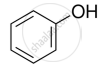

The process of converting alkyl halides into alcohols involves ______.
Alcohols react with active metals e.g. Na, K etc. to give corresponding alkoxides. Write down the decreasing order of reactivity of sodium metal towards primary, secondary and tertiary alcohols.
Why is the C – O – H bond angle in alcohols slightly less than the tetrahedral angle whereas the C – O – C bond angle in ether is slightly greater?
Write the mechanism of acid dehydration of ethanol to yield ethene.
