Advertisements
Advertisements
प्रश्न
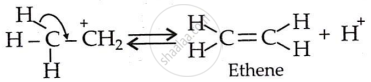
Write the mechanism of acid-catalysed dehydration of ethanol to yield ethene.
Advertisements
उत्तर
In the presence of conc. acids such as H3PO4 and H2SO4 alcohols undergo dehydration to yield alkenes.
\[\ce{\underset{Ethanol}{H3C - CH2 - OH} ->[conc{.} H+/\Delta] \underset{Ethene}{CH2 = CH2} + H2O}\]
The mechanism for this reaction is:
Step 1: Protonation of ethanol:

Step 1: Formation of carbocation:

Step 3: Formation of ethene and regeneration of proton:
APPEARS IN
संबंधित प्रश्न
Write the mechanism of the following reaction :

Give the equation of the following reaction:
Dilute HNO3 with phenol.
Give the equation of the following reaction:
Treating phenol with chloroform in the presence of aqueous NaOH.
By which of the following methods alcohol can be prepared in excellent yield?
Which of the following are used to convert RCHO into RCH2OH?
(i) H2/Pd
(ii) LiAlH4
(iii) NaBH4
(iv) Reaction with RMgX followed by hydrolysis
Which of the following is not true in case of reaction with heated copper at 300°C?
Primary and secondary alcohols on the action of reduced copper give:
The compound which gives the most stable carbonium ion on dehydration is:
During dehydration of alcohols to alkenes by heating with cone. H2SO4 the initial step is ____________.
\[\ce{CH3CH2OH}\] can be converted into \[\ce{CH3CHO}\] by ______.
Name the factors responsible for the solubility of alcohols in water.
Explain why is OH group in phenols more strongly held as compared to OH group in alcohols.
The correct geometry around oxygen in CH3OCH3 is
Write the mechanism of acid-catalysed dehydration of ethanol to yield ethene.
Write the mechanism of acid dehydration of ethanol to yield ethene.
Write the mechanism of acid dehydration of ethanol to yield ethene.
Write the mechanism of acid dehydration of ethanol to yield ethene.
Write the mechanism of acid dehydration of ethanol to yield ethene.
Write the mechanism of acid-catalysed dehydration of ethanol to yield ethene.
