हिंदी
कर्नाटक बोर्ड पी.यू.सी.पीयूसी विज्ञान 2nd PUC Class 12

Write the mechanism of acid-catalysed dehydration of ethanol to yield ethene. - Chemistry

Advertisements
Advertisements

प्रश्न

Write the mechanism of acid-catalysed dehydration of ethanol to yield ethene.

रासायनिक समीकरण/संरचनाएँ
दीर्घउत्तर
Advertisements

उत्तर

The mechanism of acid dehydration of ethanol to yield ethene involves the following three steps:

Step 1: Protonation of ethanol to form ethyl oxonium ion:

\[\begin{array}{cc}
\phantom{}\ce{H}\phantom{...}\ce{H}\phantom{.........................}\ce{H}\phantom{...}\ce{H}\phantom{...}\ce{H}\phantom{..}\\
|\phantom{....}|\phantom{..........................}|\phantom{....}|\phantom{....}|\phantom{..}\\
\ce{H - C - C - \overset{\bullet\bullet}{\underset{\bullet\bullet}{O}} - H + H^+ ⇌[Fast] H - C - C - \underset{\bullet\bullet\phantom{...}}{O^+} - H}\\
\phantom{....}|\phantom{....}|\phantom{..........................}|\phantom{....}|\phantom{..........}\\
\ce{\underset{Ethanol}{H\phantom{...}H}}\phantom{.....................}\ce{\underset{(Ethyl oxonium ion)}{\underset{Protonated alcohol}{H\phantom{...}H}}}\phantom{..}
\end{array}\]

Step 2: Formation of carbocation (rate determining step): It is the slowest step and hence the rate-determining step of the reaction.

\[\begin{array}{cc}
\ce{H}\phantom{...}\ce{H}\phantom{...}\ce{H}\phantom{...............}\ce{H}\phantom{....}\ce{H}\phantom{....}\\
|\phantom{....}|\phantom{....}|\phantom{................}|\phantom{.....}|\phantom{....}\\
\ce{H - C - C - \underset{\bullet\bullet\phantom{...}}{O^+} - H <=>[Slow] H - C - C^+ + H2O}\\
|\phantom{....}|\phantom{.....................}|\phantom{....}|\phantom{....}\\
\ce{H}\phantom{...}\ce{H}\phantom{....................}\ce{H}\phantom{...}\ce{H}\phantom{....}
\end{array}\]

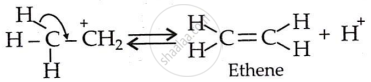
Step 3: Elimination of a proton to form ethene:

\[\begin{array}{cc}
\phantom{..}\ce{H}\phantom{...}\ce{H}\phantom{....}\ce{H}\phantom{........}\ce{H}\phantom{.}\\
|\phantom{....}|\phantom{......}\backslash\phantom{......}/\\
\ce{H - C - C^+ <=> C = C + H^+}\\
|\phantom{....}|\phantom{......}/\phantom{......}\backslash\\
\phantom{..}\ce{H}\phantom{...}\ce{H}\phantom{....}\ce{\underset{Ethene}{H\phantom{........}H}}\phantom{.}
\end{array}\]

The acid consumed in step 1 is released in Step 3. After the formation of ethene, it is removed to shift the equilibrium in a forward direction.

shaalaa.com
  क्या इस प्रश्न या उत्तर में कोई त्रुटि है?
अध्याय 7: Alcohols, Phenols and Ethers - Exercises [पृष्ठ २२३]

APPEARS IN

एनसीईआरटी Chemistry Part 1 and 2 [English] Class 12
अध्याय 7 Alcohols, Phenols and Ethers
Exercises | Q 7.19 | पृष्ठ २२३

संबंधित प्रश्न

Write the final product(s) in each of the following reactions:


Write the mechanism of the following reaction :


Ortho and para nitrophenols are more acidic than phenol. Draw the resonance structures of the corresponding phenoxide ions.


Give the equation of the following reaction:

Oxidation of propan-1-ol with alkaline KMnO4 solution.


Name the reagent used in the following reaction:

Oxidation of a primary alcohol to carboxylic acid.


When 3-methylbutan-2-ol is treated with HBr, the following reaction takes place:

\[\begin{array}{cc}
\phantom{.......................}\ce{Br}\\
\phantom{......................}|\\
\ce{CH3 - CH - CH - CH3 ->[HBr] CH3 - C - CH2 - CH3}\\
\phantom{.}|\phantom{......}|\phantom{......................}|\phantom{........}\\
\phantom{}\ce{CH3}\phantom{...}\ce{OH}\phantom{...................}\ce{CH3}\phantom{.....}
\end{array}\]

Give a mechanism for this reaction.

(Hint: The secondary carbocation formed in step II rearranges to a more

stable tertiary carbocation by a hydride ion shift from 3rd carbon atom.)


Write the mechanism (using curved arrow notation) of the following reaction :


Lucas test is used for the detection of _____________.


The compound which reacts fastest with Lucas reagent at room temperature is:


In the reduction \[\ce{R - CHO + H2 -> RCH2OH}\] the catalyst used is:


Cyclohexene is best prepared from cyclohexanol by which of the following:


During dehydration of alcohols to alkenes by heating with cone. H2SO4 the initial step is ____________.


Mark the correct increasing order of reactivity of the following compounds with HBr/HCl.

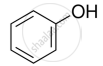
(a)
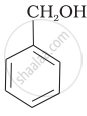
(b)
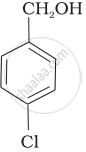
(c)

Name the factors responsible for the solubility of alcohols in water.


Suggest a reagent for the following conversion.


Explain why is OH group in phenols more strongly held as compared to OH group in alcohols.


In Kolbe’s reaction, instead of phenol, phenoxide ion is treated with carbon dioxide. Why?


The correct geometry around oxygen in CH3OCH3 is 


Write the mechanism of acid dehydration of ethanol to yield ethene.


Share
Notifications

Englishहिंदीमराठी


      Forgot password?
Use app×