Advertisements
Advertisements
प्रश्न
Give reasons for the following:
o-nitrophenol is more acidic than o-methoxyphenol.
Explain why is ortho nitrophenol more acidic than ortho methoxyphenol?
Advertisements
उत्तर १
Due to the strong –R and –I effect of the NO2 group, the electron density on the O–H bond decreases; hence, the proton is released easily.

After losing the proton, the remaining o-nitrophenoxide ion becomes stable by resonance.

Ortho-nitrophenoxide ion resonance is stable; hence, o-nitrophenol is a strong acid. On the other hand, due to the +R effect of the OCH3 group, the electron density on the O–H bond increases; hence, the removal of the proton becomes difficult.
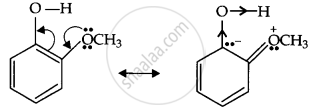
Now, the o-methoxyphenoxide ion, which remains after the loss of the proton, gets destabilised due to resonance.
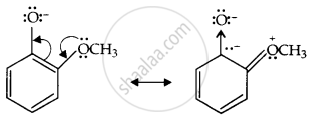
The two negative charges repel each other and destabilise the o-methoxyphenoxide ion, so o-nitrophenol is more acidic than o-methoxyphenol.
उत्तर २
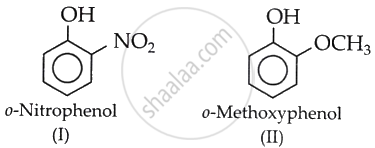
The acidity of phenol is due to the dissociation of a hydrogen ion (H+) from the hydroxyl (O–H) group. This loss increases if the O–H bond polarity intensifies and H carries a significant δ+ charge.
The presence of the strongly electron-withdrawing NO2 group at the ortho position in (I) increases the polarity of the O–H bond.
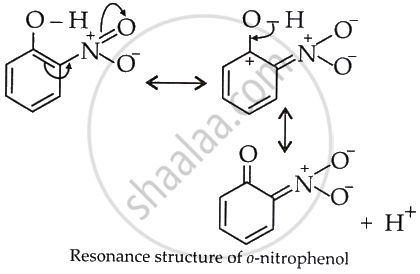
This helps in the release of H+ and increases acidity.
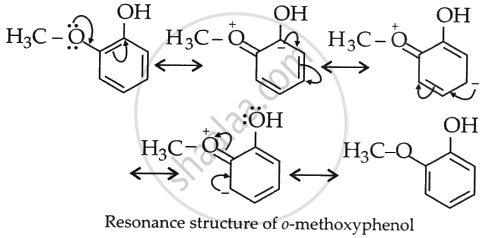
The reaction (II) is less acidic because –OCH3 is an electron-releasing group and increases the electron density on O of OH, and H+ release is suppressed. This can be understood from the resonance structures of II, which are:
संबंधित प्रश्न
Write the mechanism of the following reaction :

Write the mechanism of the following reaction :

Ortho and para nitrophenols are more acidic than phenol. Draw the resonance structures of the corresponding phenoxide ions.
Show how will you synthesize pentan-1-ol using a suitable alkyl halide.
Give the equation of the following reaction:
Treating phenol with chloroform in the presence of aqueous NaOH.
Write the mechanism of acid-catalysed dehydration of ethanol to yield ethene.
Name the reagent used in the following reaction:
Oxidation of a primary alcohol to carboxylic acid.
Name the reagent used in the following reaction:
Benzyl alcohol to benzoic acid.
By which of the following methods alcohol can be prepared in excellent yield?
Dehydration of 2-butanol yields:
Which of the following is not true in case of reaction with heated copper at 300°C?
Primary and secondary alcohols on the action of reduced copper give:
\[\ce{CH3CH2OH}\] can be converted into \[\ce{CH3CHO}\] by ______.
Mark the correct increasing order of reactivity of the following compounds with HBr/HCl.
| (a) | 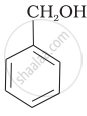 |
| (b) |  |
| (c) | 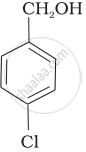 |
Alcohols react with active metals e.g. Na, K etc. to give corresponding alkoxides. Write down the decreasing order of reactivity of sodium metal towards primary, secondary and tertiary alcohols.
Assertion: Bond angle in ethers is slightly less than the tetrahedral angle.
Reason: There is a repulsion between the two bulky (–R) groups.
Which of the following alcohols will not undergo oxidation?
Which of the following observation is shown by 2-phenyl ethanol with Lucas Reagent?
Write the mechanism of acid dehydration of ethanol to yield ethene.
